First, the triage line: if your business does not show up even when someone searches your exact business name, you have a different problem than this article solves. Read our not showing on Google Maps guide first, it covers verification, suspension, and the full decision tree for not appearing at all.
This article is for the other case, the frustrating one. You are verified. You show up for your name. But for "emergency plumber [city]" or "ac repair near me", the money searches, you sit at position 8 to 20 while the same two or three shops take every call. You are listed but buried, and the causes are specific, checkable, and mostly fixable. Google's own ranking explanation names the three forces at work, relevance, distance, and prominence, and every cause below is one of those three failing you.
On This Page
1. Wrong Primary Category
The most common cause and the fastest fix. Your primary category is the single strongest relevance signal on your profile, and it mislabels more trade businesses than anything else. A shop doing mostly water-heater work listed as a generic Plumber is telling Google the wrong story about what it does, and Google believes the label over your website.
- Open your profile and read your primary category out loud. Does it describe your main revenue line?
- Compare with the shops above you. If they all share a more specific category, that is your answer.
- Fix it once, then wait. Category changes can take weeks to fully settle. Do not cycle through options hunting for magic.
Secondary categories matter too: a drain-cleaning specialist needs Drainage Service present, not just implied. The profile optimization checklist walks the full rebuild, and our contractor category guide lists the labels worth considering.
2. Review Count And Velocity Deficit
If your category is right and you are still buried, look at reviews next. This is prominence, and it is where most buried shops lose: the top three have 200 reviews arriving weekly while you have 40 and the last one landed in March. Total count impresses customers; velocity impresses the algorithm. A steady stream of fresh reviews signals a business that is active and trusted right now.
- Count velocity, not just total. Sort your reviews and the top three's by newest; compare how many arrived in the last 90 days.
- Close the velocity gap first. A text-to-review follow-up after every job is the fastest prominence lever you have.
- Then close the specificity gap. Reviews mentioning the actual service and town reinforce relevance in ways generic five-star praise never will.
Do not buy reviews and do not gate unhappy customers. Both violate policy and both get profiles suspended, which turns "buried" into "gone". The legitimate system, scripts and all, is our review guide.
The listed-but-buried zone: visible for your name, invisible for the searches that bring jobs. Almost every case traces back to one of the seven causes below.
3. Proximity Limits You Can't Fix (And What You CAN Do About Them)
Sometimes the answer is geography, and honesty matters here. Distance is one of the three ranking factors, and for urgent searches Google will always prefer the shop closer to the searcher. If you are ten miles from the neighborhood you are chasing and the top three are all inside it, you will rarely beat them there. That is not failure, it is physics.
What you can do: win where you can win. Make your service-area settings honest and complete, build town pages for the areas you genuinely serve well, and earn reviews that mention those towns by name. A shop on the edge of town with 300 specific reviews and deep local content regularly outranks a closer shop that has gone stale. You cannot move your building, but you can out-serve it. Measure your rankings by location, not just once from your office, because the map pack looks different from every street corner.
4. NAP Inconsistency
Your name, address, and phone number must be identical everywhere Google looks. One listing with "St." and another with "Street", an old landline on Yelp, a suite number missing on Facebook, each mismatch chips away at Google's confidence that you are one real, coherent business. It also makes AI assistants unable to resolve you as an entity, which buries you in AI answers too.
- Lock one exact NAP format and write it down. Down to "Suite" versus "Ste."
- Search your name and phone number and open every listing that appears. Fix mismatches before building anything new.
- Hunt duplicates. Two listings for the same business split your reviews and confuse rankings.
Our NAP guide explains the why; the work above is the doing. If you find a rival with messier listings sitting above you anyway, their other signals are simply stronger, which tells you where your real gap is.
5. Thin Service Pages
Your profile gets you considered; your website gets you believed. The buried shop almost always has the same website problem: a homepage, a thin "services" page with a bullet list, and nothing else. The shops above you have one genuine page per core service, each with real photos, real FAQs, and real detail about how they do that specific job.
One strong service page beats five thin ones, and depth beats count everywhere. Build the page for your highest-margin service first, with the content a homeowner would actually want to read before calling: pricing signals, process, timeline, and proof. Then give it time; content-driven ranking movement typically needs 60 to 90 days to show. Google's SEO Starter Guide covers the indexing fundamentals if you want to confirm your pages are being found at all.
6. A Dead Profile
When was your last photo upload? Your last post? A profile that has not changed in a year reads as a business that may not be operating, and Google treats it accordingly. This is the easiest gap of all to close and the one busy owners neglect most.
- Upload job photos weekly. Trucks, techs, before-and-afters. Recency signals an active business.
- Publish 2 to 4 posts a month: seasonal reminders, current offers, real jobs.
- Keep hours current including holidays. Stale hours are a trust signal in reverse.
- Answer new Q&A. Unanswered questions on your profile are missed sales sitting in public.
7. The Competitor Delta
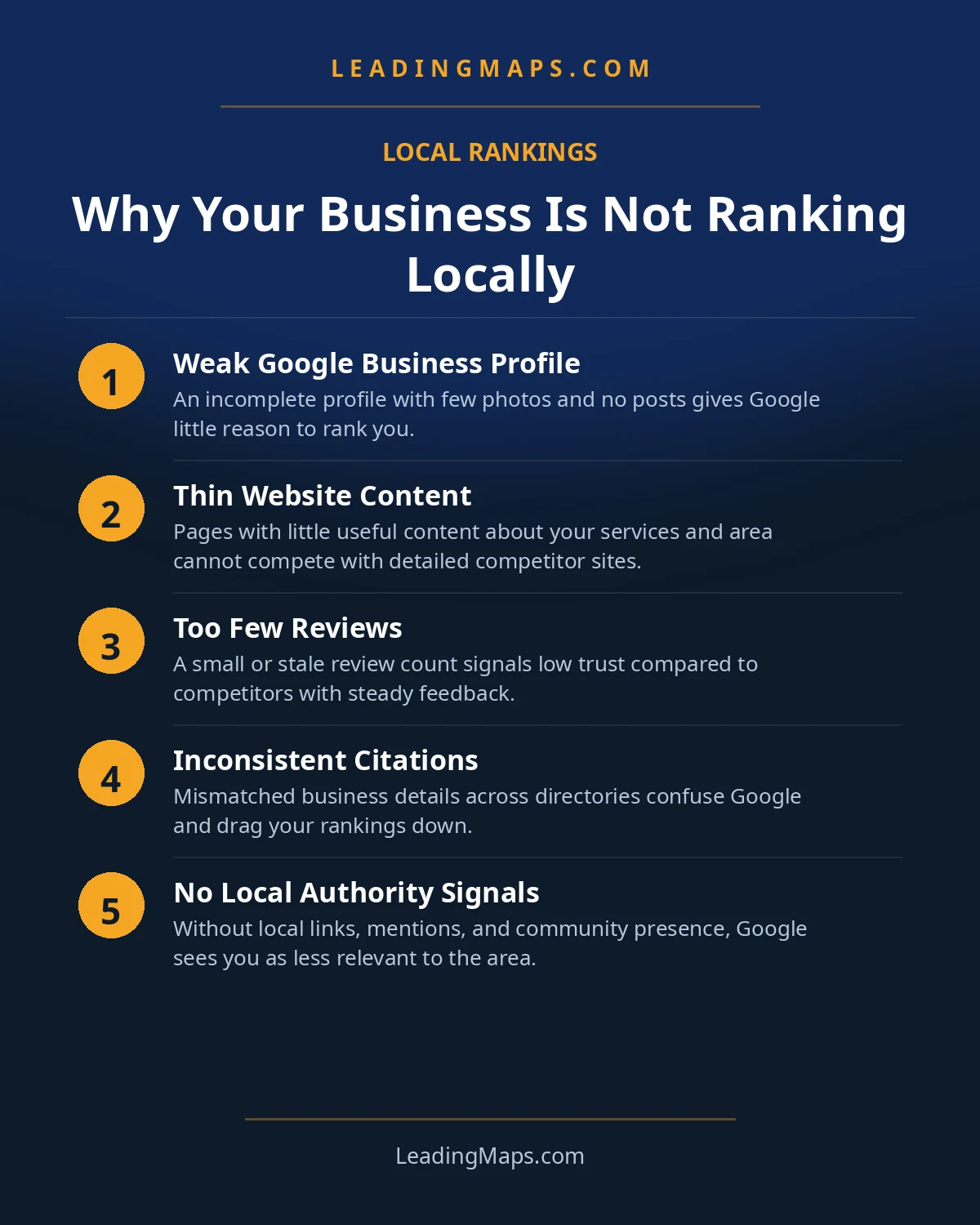
If you have checked all six and still cannot see it, stop guessing and measure. Run the full teardown: pick the three shops above you and score them against yourself on categories, reviews, photos, pages, citations, and local links. The pattern across all three is the diagnosis. Our competitor analysis guide gives you the afternoon method, and the seven ranking factors explain the mechanics behind every gap you find. One rival beating you on one thing is noise. All three beating you on the same thing is the answer.
The AI Visibility Check
One more diagnostic, and it is the one your competitors are not running. In 2026, being buried on Google is only half the problem if you are also invisible to AI assistants. Ask ChatGPT and Gemini for a contractor recommendation for your top three money queries, phrased the way a homeowner would ask. Note who gets named and who gets cited in Google's AI Overviews for the same queries.
If a rival you trail on Google is getting recommended by AI while you are not, trace it back to the seven causes above. The AI gap is almost always a data gap: thinner service lists, vaguer review text, missing schema, inconsistent NAP. The same fixes that unbury you on Google make you recommendable to AI, because both systems are reading the same structured business data.
Ranking Questions, Answered.
Being verified only proves you are a real business; ranking is decided by relevance, distance, and prominence. Page two almost always means one of three things: your primary category misses your main service, competitors have more and fresher reviews, or you are simply farther from most searchers than the shops above you. Check them in that order.
Give real changes 60 to 90 days. Categories, review campaigns, and citation cleanups need time to settle into Google's understanding of your business. If you have genuinely executed, added services, earned reviews, published pages, and nothing moved after three months, that is when troubleshooting earns its keep. Before that, you are usually just impatient.
It can keep you out of certain neighborhoods, not out of the market. Google will always prefer a closer option for an urgent query. But strong reviews, precise categories, and deeper service content regularly outrank nearer businesses that have gone stale. You cannot move your shop, but you can out-serve it. Target the towns you can realistically win.
Both, in this order: velocity first, then specificity. A steady stream of new reviews signals an active, trusted business, and it is the gap most buried shops can close fastest. Then coach customers toward detail: reviews that mention the actual service and town reinforce relevance in a way generic five-star praise never will.
Yes, if it genuinely mislabels your main revenue. A water-heater specialist listed as a general plumber tells Google the wrong story, and fixing it is the fastest relevance win there is. But do not cycle through categories hunting for magic: pick the one that describes what you actually do most, add honest secondaries, and give it 60 days.
Buried At #8? Let's Find What's Holding You Down.
Profile, Maps rankings, citations, reviews, competitors, plus whether AI assistants recommend you. A prioritized action plan, free, no pitch.
- AI visibility check, real homeowner prompts across ChatGPT, Perplexity, and AI Overviews, who gets named.
- Proposal scorecard, what your current or prospective agency should be doing, item by item.
- Competitor gap analysis, what the top 3 in your market are doing that you're not.
Get My Free SEO Audit
Delivered within 48 hours. Yours to keep.