Somebody is taking the calls you should be getting. Not a national chain, not a directory: a local shop, maybe ten miles away, sitting in the top three while you sit at number six. The difference between you and them is not a mystery and it is not luck. It is a list of specific advantages, and you can read that list off their public listings in an afternoon.
This is the owner-friendly version of a local SEO competitor analysis. No agency software, no 40-tab spreadsheet, just you, your three real rivals, and six things to compare. At the end there is a section almost nobody runs: the AI check, who ChatGPT and Google AI Overviews recommend for your money queries, and why.
On This Page
Pick Your Three Real Rivals
Before you analyze anyone, make sure you are analyzing the right businesses. Your SEO competitors are not necessarily the shops you lose bids to. They are the three businesses that consistently sit above you in the map pack when a customer searches your money keywords.
- Open an incognito window and search your top services the way a customer would: "emergency plumber [city]", "ac repair near me".
- Write down the top three map-pack names for each of your three to five money keywords.
- Keep the repeat offenders. The businesses that appear above you on most of your keywords are your three.
- Drop anyone you could not realistically serve. A shop forty miles away is not stealing your calls.
Check a couple of different neighborhoods if you can, because map-pack results shift with the searcher's location. The rivals who keep showing up across locations are the ones with genuinely stronger profiles, not just closer addresses.
The Six-Point Teardown
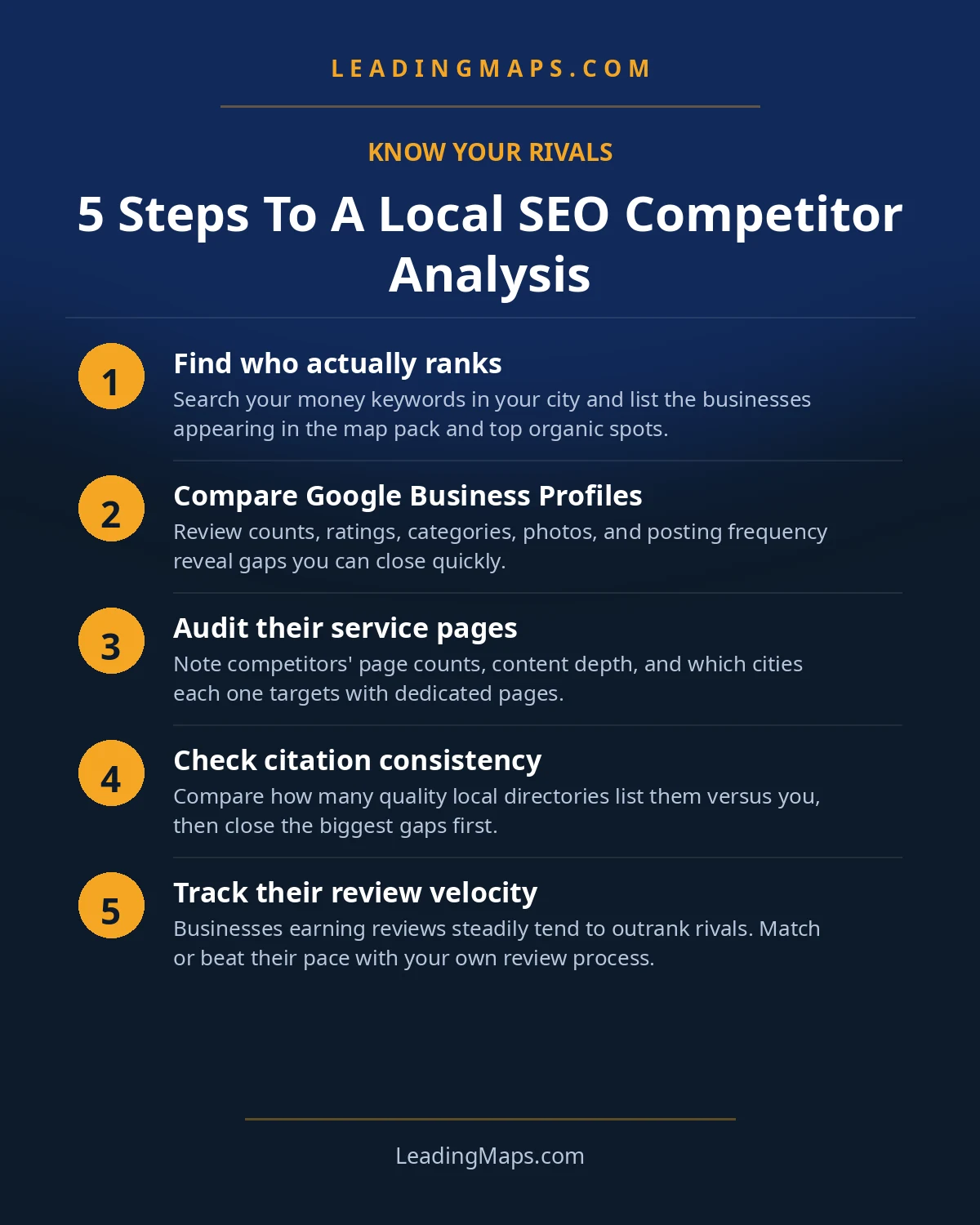
Open each rival's Google Business Profile, their website, and their reviews, side by side with your own. Compare these six things, in this order, because they are ordered roughly by impact for trade businesses. Google's own explanation of local ranking names the three forces at work, relevance, distance, and prominence, and this teardown maps directly to them.
1. Primary Category
Click through to each rival's profile and look at what they call themselves. The primary category is the single strongest relevance signal on the profile. You will often find the uncomfortable truth here: the shop beating you for "drain cleaning" has Drainage Service as its primary category while you sit under generic Plumber. That is not a marketing gap, it is a five-second settings fix you have been losing calls over. Our contractor category guide lists the options worth considering.
2. Review Count And Velocity
Sort their reviews by newest and count how many arrived in the last 30, 60, and 90 days, then do the same for yourself. Total count is prominence; velocity is momentum. A rival with 180 reviews but one a month is beatable. A rival with 120 reviews and eight a month is a machine, and it is the velocity you have to match before anything else matters. This is also the gap that closes fastest: a simple text-your-customer follow-up is all it takes to start, and our review system guide gives you the scripts.
3. Photos And Posts Activity
Look at their photo count and, more importantly, recency. A profile with photos from last week signals an active, operating business. Then check their posts tab: are they publishing offers, job photos, seasonal reminders? Dead profiles rank below live ones when everything else is close. If your rival's last photo is from 2023 and yours are fresh, congratulations, you just found a free win.
4. Service Pages And Content Depth
Open their website. Do they have one page per core service, or one thin "services" page with a bullet list? Do their pages have real photos, real FAQs, real detail? For trades, the most common finding is that the top-ranked shop has five to ten genuine service pages while everyone below has a homepage and a prayer. Content depth is relevance you can read with your eyes.
5. Citations And NAP Consistency
Search each rival's exact business name and phone number. Consistent, complete listings across the core platforms is table stakes, and the top three usually have it nailed. If you find a rival with messy, duplicated, or inconsistent listings sitting above you, that tells you something useful: their other signals are so strong they win anyway, which means your opportunity lies elsewhere. If their citations are clean and yours are not, you know exactly what to fix. Our citation site list shows where it matters.
6. Local Backlinks And Proof
The hardest advantage to read, and the slowest to build. Look for local proof: chamber memberships, supplier badges, community sponsorships, local news mentions, trade association listings. These are the prominence signals that separate number one from number four in competitive metros. You cannot copy them in an afternoon, but you can start: one chamber membership and one sponsorship this quarter is a real beginning.
Six comparisons, one afternoon, and a scorecard that tells you exactly why they rank and you don't. Most owners find the pattern is just two or three gaps, not everything.
Score It And Read The Pattern
Put it in a simple table, a spreadsheet or even a notebook page. Four columns: you and the three rivals. Six rows: the six teardown points. Score each cell 1 to 3. Then read the rows, not the columns.
What you are looking for is the pattern across all three rivals, because that pattern is Google's verdict on your market. If all three beat you on review velocity, that is not a coincidence, it is the price of admission in your trade and your town. If two of three have dedicated service pages and you have none, content depth is the lever. One rival beating you on one thing is noise; all three beating you on the same thing is the diagnosis.
Also note where you already win. A fresh profile with recent photos beating a stale number-two on activity is a gap working in your favor, and it tells you what to protect. The seven map-pack ranking factors give you the deeper why behind each row of your scorecard.
Turn Gaps Into A Prioritized Fix List
A scorecard without priorities is just homework. Order your fixes by impact versus effort, trade-owner style:
- Fix this week (free, minutes): primary category corrections, service-area settings, hours, and any secondary categories you genuinely qualify for.
- Fix this month (free, hours): launch the review follow-up system, upload fresh job photos weekly, publish your first two profile posts.
- Fix this quarter (real work): build one strong page per money service, clean up citations, and join one local organization worth linking from.
- Ongoing (compounds forever): review velocity and photo freshness. This is the race that never ends, which is why starting it now is the highest-ROI move.
One rule: do not try to fix everything at once. Close the two biggest gaps first, wait 60 to 90 days, then re-run the scorecard. Local SEO rewards the shop that fixes the right two things over the shop that half-fixes ten.
The AI Check Nobody Runs
Here is the section no competitor-analysis guide covers, and in 2026 it is half the battlefield. When a homeowner asks ChatGPT or Gemini "who is the best plumber in [your city]", someone gets named, and increasingly it is not the shop at the top of the map pack. It is the shop whose structured data, review text, and content answer the question most completely.
- Ask ChatGPT and Gemini for a contractor recommendation for your top three money services, phrased exactly the way a homeowner would ask.
- Write down who gets named. If a rival you trail on Google is getting recommended by AI instead, note it.
- Compare their review text and services list to yours. AI recommendations draw heavily on specific review wording and complete service data.
- Check Google's AI Overviews for your money queries and note which businesses get cited as sources.
- Trace it back to the six points. The AI gap is almost always a data gap: thinner services, vaguer reviews, missing schema.
The businesses AI recommends are the ones whose structured business data resolves cleanly. That means the same work you are already doing, complete service lists, specific review text, consistent NAP, LocalBusiness schema, pays twice: once in the map pack, once in the answer. Our AI-search overview explains the mechanics, and BrightLocal's own competitor analysis guide is the authority piece if you want the full agency-grade spreadsheet method this afternoon exercise is built on.
How Often To Repeat The Analysis
Once a quarter, and any time your rankings move sharply. Markets shift: a rival hires an agency, launches a review campaign, or lets their profile die, and the scorecard you built today is stale in months. The quarterly re-run takes a fraction of the time because you already have the template. Set a calendar reminder, spend the afternoon, and adjust the fix list. That rhythm, analyze, fix, wait, re-analyze, is the entire game.
Competitor Analysis Questions, Answered.
Search your money keywords the way a customer would, in an incognito window or from different parts of town. Your real competitors are the three businesses that consistently sit above you in the map pack for your top services, not the companies you compete with on the street. Ignore anyone too far away to steal your calls.
Six things tell you nearly everything: their primary category, review count and velocity, photo and post activity, service and location pages, citation consistency, and local backlinks. Score each one side by side against your own business. The pattern that emerges, usually two or three gaps, is your entire action plan.
Open their Google profile and sort reviews by newest, then count how many arrived in the last 30, 60, and 90 days. Do the same for your own profile. Velocity, how often reviews arrive, matters as much as total count for map-pack prominence, and it is the easiest gap for a busy shop to close with a simple follow-up text.
Often, yes, within limits. Distance is one of Google's three ranking factors, so you will rarely beat a competent shop right in the neighborhood you are chasing. But proximity is only one factor: businesses with stronger reviews, better category fit, and deeper service content regularly outrank closer competitors that have let their profiles go stale.
Ask ChatGPT or Gemini for a contractor recommendation for your top three services in your city, exactly the way a homeowner would. Note which businesses get named, then compare their profiles to yours: review themes, service lists, and schema. The businesses AI recommends are the ones whose structured data and review text answer the question best.
Want The Teardown Done By Professionals?
Profile, Maps rankings, citations, reviews, competitors, plus whether AI assistants recommend you. A prioritized action plan, free, no pitch.
- AI visibility check, real homeowner prompts across ChatGPT, Perplexity, and AI Overviews, who gets named.
- Proposal scorecard, what your current or prospective agency should be doing, item by item.
- Competitor gap analysis, what the top 3 in your market are doing that you're not.
Get My Free SEO Audit
Delivered within 48 hours. Yours to keep.