On This Page
- How the map pack actually works
- Factor 1: category selection, the fastest lever you own
- Factor 2: reviews, and the words inside them
- Factor 3: service-area business tactics
- Factor 4: profile completeness, services, and photos
- Factor 5: proximity and seasonal demand curves
- Factor 6: NAP consistency and citations
- Factor 7: your website and structured data
- FAQ
Every "map pack ranking factors" guide on the internet reads like it was written for coffee shops and dentists. This one is written for you: plumbers, roofers, HVAC techs, electricians, and the owners who need the phone to ring.
Here is every factor that actually moves the needle for contractors, organized by leverage. And because your next customer might ask ChatGPT instead of Google, every factor gets a second score: what it does in the map pack and what it does in ChatGPT, Gemini, Perplexity, and Google AI Overviews.
That second score matters more every month. The 2026 edition of Whitespark's Local Search Ranking Factors survey, in which 47 local search experts score 187 factors, added AI Search visibility as a brand-new scoring column this year. The signals that rank you in Google are increasingly the same evidence AI assistants cite. One foundation, two surfaces.
How The Map Pack Actually Works (Google's Own Words)
Google's official guidance says local results rest on three pillars: relevance, how well your profile matches the search; distance, how close you are to the searcher; and prominence, how well-known your business is, based on reviews, links, and how complete your information is.
Every factor below feeds one of those three pillars. Relevance is mostly yours to control, categories, services, reviews that name the work. Distance is mostly fixed, you cannot move your shop, but you can widen your effective reach. Prominence is earned over time, reviews, photos, citations, and real engagement. Keep that frame in mind, it is how you prioritize when everything cannot be done at once.
Factor 1: Category Selection, The Fastest Lever You Own
Your primary category is the single most consequential field on your profile for contractors. It tells Google what you are in one word, and it is the first filter the map pack applies.
Pick The Category Customers Search For, Not The One On Your License
Plumber for plumbers. HVAC Contractor for HVAC. Roofing Contractor for roofers. Electrician for electricians. It sounds obvious, and yet we constantly see "General Contractor" as the primary category on companies that do 90% plumbing, which is like entering a race in the wrong division. A category change is one of the fastest-impact edits you can make, and it is free.
Secondaries For Real Services Only
Add secondary categories only for services you genuinely perform and want calls for: Drainage Service, Air Conditioning Repair Service, Water Heater Repair Service. Each one is a separate relevance hook for a different search. Skip categories you do not serve, irrelevant categories dilute the signal instead of widening it. Our GBP optimization guide walks the full profile setup.
Category data is exactly the kind of structured fact AI assistants trust. Here is a wrinkle worth knowing, from the 2026 Whitespark survey: a factor like extra GBP categories can score near zero for ChatGPT visibility while scoring meaningfully for Google AI Mode and Gemini, because Google's assistants read Google's data directly. Your categories feed Google first, and everyone else secondhand.
Factor 2: Reviews, And The Words Inside Them
Review signals, quantity, average rating, velocity, and whether you respond, are gaining weight in the 2026 data. For contractors, three review factors matter more than the rest:
Velocity Beats Totals
Ten new reviews a month beats a stale pile of 300. Steady recent reviews tell Google you are active and trustworthy right now, and they tell AI assistants the same thing, recency is heavily weighted when an assistant decides who to recommend.
The Keywords Inside Review Text
A review that says "great service" helps. A review that says "they replaced our water heater the same day in Plano" is a relevance signal and a quotation waiting to happen. Reviews naming the actual service and the area feed Google's relevance pillar and get quoted by AI assistants answering "who is the best plumber near me." You cannot write them, but you can earn them: teach techs to nudge customers to mention what was fixed. Our review field guide covers the whole system.
Respond To Every Single One
Google's own guidance says replying to reviews shows you value feedback and helps you stand out. Response rate is a ranking signal, and your replies are text you control, a reply like "Glad Tom got your AC running same-day here in Mesa" adds service and city language even when the customer's review was brief. And those reply words are indexed content AI systems can quote.
Factor 3: Service-Area Business Tactics
Most contractors are service-area businesses, you go to the customer, and how you configure that on your profile is a ranking factor hiding in plain sight:
- Hide the address if customers never visit. Showing a home address nobody should drive to helps no one and can create guideline problems.
- Keep service areas honest, roughly within a two-hour drive. Oversized service areas are a negative signal, a service area the size of Texas tells Google you are not really local anywhere.
- Claim only towns you actually serve. Ranking grids show most contractors rank strongly near their base and fade with distance, so do not claim towns you will not drive to.
AI assistants cannot send a customer to your shop, they recommend based on who serves the area. Clear, honest service-area data plus service pages for your real coverage towns is what lets an assistant say your name when a homeowner asks. Fuzzy service areas are why good contractors get skipped in AI answers.
Factor 4: Profile Completeness, Services, And Photos
An incomplete profile is a relevance vacuum. The fields that matter most for contractors:
- Every service listed, with plain-language descriptions. Use Google's predefined services where they exist and custom services where they do not. "Tankless water heater installation" beats a blank field every time.
- Business hours, including emergency hours. The 2026 survey surfaced a striking new factor: whether you are open at the time of search can swing your visibility dramatically. If you run emergency service, your hours should say so.
- Real photos of real work. Jobsites, trucks, techs, before-and-afters. Quality and freshness matter, and contractors have an endless supply if someone remembers to shoot them.
- Attributes that remove friction. Licensed, veteran-led, women-led, guarantees offered, whatever is true about your business and removes doubt for the caller.
Every completed field is an extractable fact. When an assistant answers "which plumbers offer same-day service in Frisco," it pulls from attributes, hours, services, and review text, not from your homepage headline. A complete profile is machine-readable proof of what you do, and it is why our GBP optimization rebuilds all 23 fields instead of the usual five.
Factor 5: Proximity And Seasonal Demand Curves
Distance is the one factor you cannot change. Google will always favor the plumber closest to the searcher, all else equal. Two things to do about it:
Know Your Real Ranking Geography
Most contractors rank in a rough radius around their base and fade with distance. The fix is not moving the shop, it is winning the towns you can win: dedicated service-area content on the website, reviews from customers in those towns, and citations that mention them. Our Google Maps optimization system maps this radius for every client before a dollar goes anywhere else.
Ride The Seasonal Curves
Demand in the trades is not flat, and neither should your profile be. HVAC searches explode in May and June. Roofers live on storm season. Plumbers get freeze-event spikes. In the weeks before your peak, push review velocity, post about seasonal services, and make sure hours reflect extended availability. Prominence compounds during demand spikes, a profile gaining reviews fastest when everyone is searching wins twice. Our HVAC program times the whole campaign to these curves.
Assistants weight recency. A profile whose newest reviews are from this season's work reads as the active, reliable choice when a homeowner asks in the moment. Seasonality is not just a Google tactic, it is how you stay the answer AI gives all year.
Factor 6: NAP Consistency And Citations
Citations are the foundation, not the growth lever. Consistent name, address or service area, and phone data across your profile, your website, and the major directories lets Google trust that you are one real business. Sloppy data does not just cost you a few points, it caps how high your stronger signals can lift you.
For contractors, the usual messes: call-tracking numbers that differ from the profile number, old addresses from a previous shop, legacy listings from a DBA name or a merged company, and trade directories like Angi, HomeAdvisor, Thumbtack, BBB, and Nextdoor that were claimed years ago and never updated. Our citation building service exists because this cleanup is tedious, unglamorous, and absolutely necessary.
AI assistants cross-reference business facts across the web. Conflicting details erode exactly the confidence a model needs before it recommends you. One inconsistent phone number can be the difference between being named and being skipped entirely, and there is no local-pack fallback when the assistant just names your competitor.
Factor 7: Your Website And Structured Data, Your AI Proof
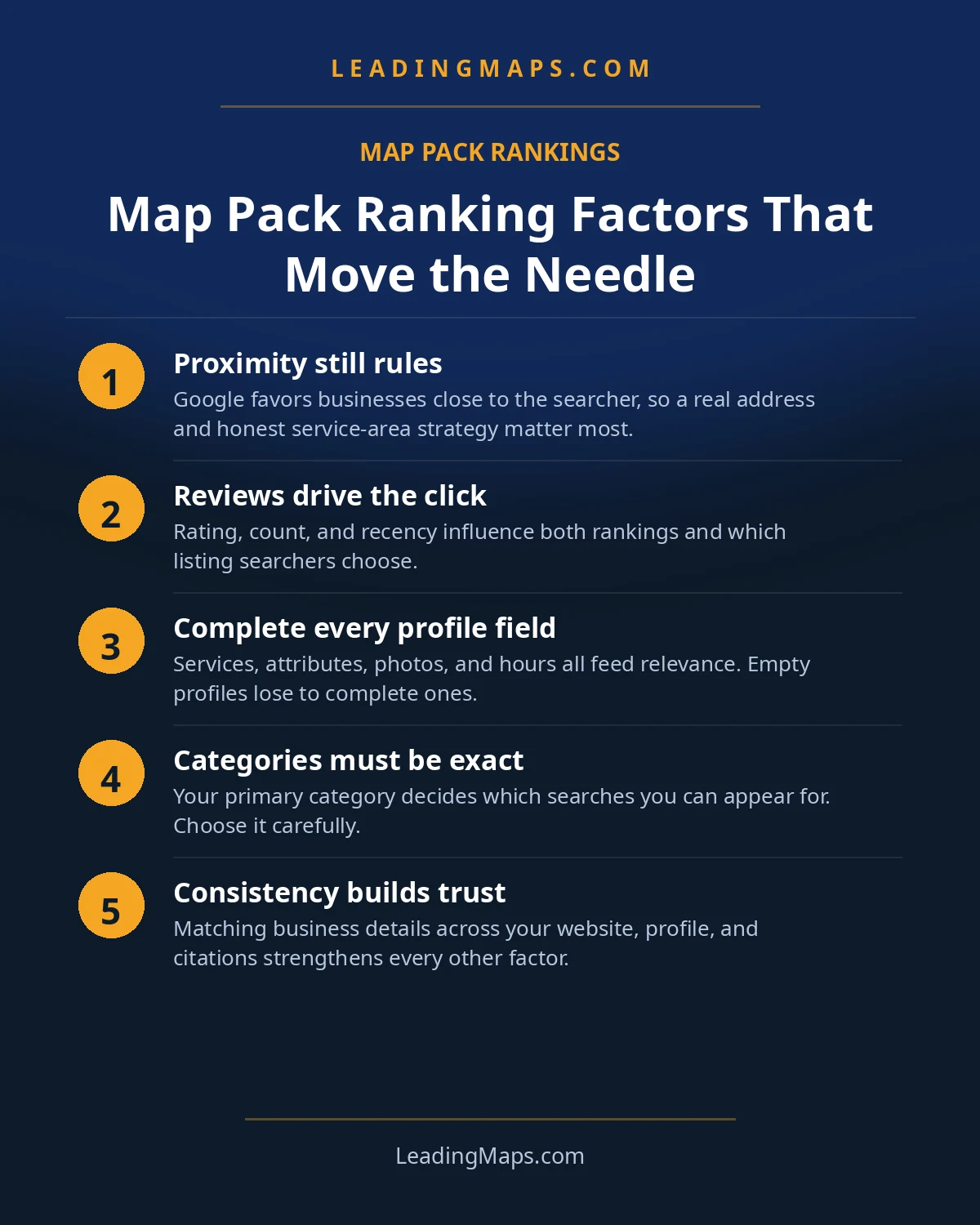
Your website does two jobs: it ranks in local organic, and it proves to AI systems that your profile's claims are true. The highest-leverage website factors for contractors:
- One strong page per core service, written for humans, describing the work, the service area, and the outcome. No thin location pages with the city name swapped in.
- LocalBusiness structured data on every page, mirroring your profile: name, hours, services, areas served. Google publishes the full LocalBusiness specification, and it is the machine-readable version of your business.
- FAQ schema answering the questions homeowners actually ask: price ranges, timelines, licensing, guarantees.
- Reviews displayed on the site, giving crawlers the same trust evidence in a second location.
This is where AI search is won. Assistants retrieve and quote from the open web, and structured, entity-rich pages are what they can confidently cite. Google's AI surfaces lean on your profile data; ChatGPT and Perplexity lean on your site. Cover both, which is exactly what our AEO and GEO work builds.
What This Looks Like In Practice
Skip the recycled generic stats. Here is the pattern we see across our contractor campaigns, the same pattern we hold ourselves to:
Average time to a top-3 map-pack position across our contractor campaigns, with about 40% call growth by month 3 and 3 to 5 times the profile views. No invented case studies, just the benchmark behind our 90-day guarantee, on month-to-month terms.
The common thread in the campaigns that get there fastest: the right primary category from day one, a review engine running by week two, and a complete profile before a dollar goes anywhere else. The campaigns that stall are almost always missing one of those three. If you want to know which factor is holding you back the most, that is exactly what the free audit finds.