Somewhere in your service area, a homeowner just typed this into ChatGPT: "Who should I call for a water heater replacement in [your city]?" The assistant answered with three company names. If yours wasn't one of them, you didn't just miss a lead, you missed a lead you never knew existed, and your competitor is already booked for tomorrow morning.
This is happening thousands of times a day across the trades. Nobody is announcing it. There is no search console report for it. But AI assistants have quietly become the new front page for "best plumber near me", and almost nobody in home services is optimized for it yet.
This guide is the one written for contractors instead of marketers. No jargon, no theory borrowed from SaaS blogs. Just how ChatGPT decides, what actually moves the needle for a trade business, a test you can run tonight for free, and an honest list of the things you should not spend money on.
On This Page
How ChatGPT Actually Decides What To Recommend
There are two versions of ChatGPT's brain, and knowing which one answers your customer's question changes everything.
The first is training data, the vast library of text the model learned from. This is where it gets its understanding of what a plumber does, what a water heater costs, and how a sewer line replacement works. But training data has a cutoff. It does not know which plumber in Fort Worth is booking jobs this week, and it was never designed to memorize every local business in America.
The second is live web search. When your question is local, "best plumber near me," "emergency HVAC in Austin tonight", the assistant goes and reads the current web: business listings, review pages, directories, and company websites. It pulls from what it finds right now, then writes an answer that names names and links sources.
Here is the part most guides skip: your customer's question never reaches the search engine in its original form. Before searching, the assistant rewrites the query into several sharper ones behind the scenes, "top-rated plumber [city] reviews," "plumber [city] water heater replacement," "emergency plumber [city] open now." Each rewrite runs as its own search, and the results get blended into one recommendation. That means being findable for one phrasing is not enough; you have to be findable across the family of rewrites.
Finally, the assistant cites its sources. Watch any ChatGPT answer about a local business and you will see the little numbered citations. Those are not decoration, they are the receipts for the recommendation. If a business has no quotable sources (no detailed reviews, no substantive service pages, no consistent listings), the model literally has nothing to cite, and it will not invent a recommendation. It names the businesses it can back up.
The Signals That Matter For Trades
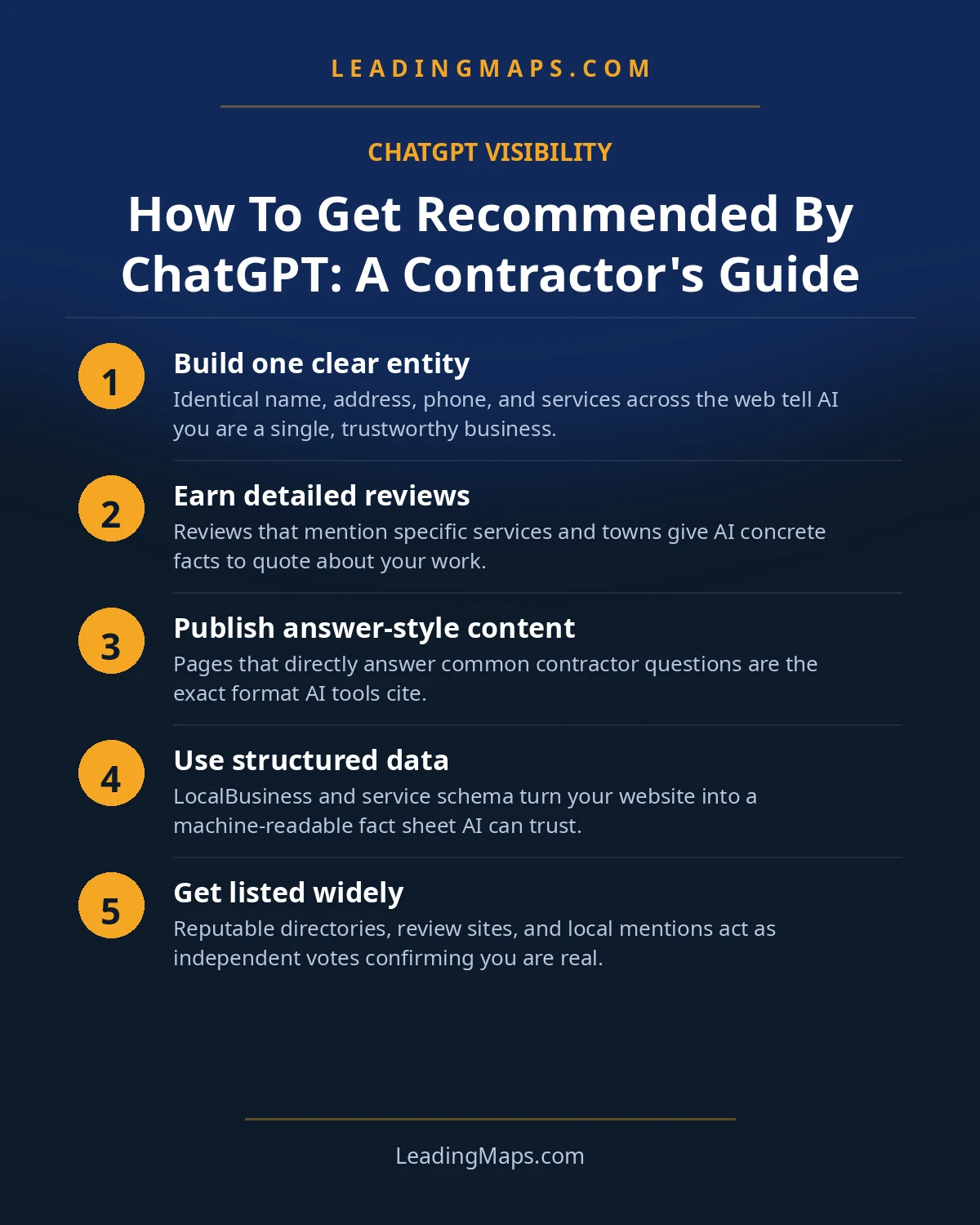
Strip away the hype and there are five things an AI assistant can actually read about your business. Everything else is noise.
1. Entity Consistency: Are You One Business Or Five?
LLMs resolve businesses as entities, a single resolved identity with a name, address, phone, hours, and service list attached. Every time your name is spelled differently across directories ("Apex Plumbing" vs "Apex Plumbing Co." vs "Apex Plumbing & Heating"), or your phone number is old on three citation sites, you look like fragments, not a business. A fragmented entity does not get recommended because the model cannot confidently resolve it.
The fix is boring and powerful: identical NAP (name, address, phone) everywhere, your website, your Business Profile, and every citation. This is the same citation work that drives Google Maps rankings, which is good news: the foundation is shared.
2. Business Profile Depth: The Structured Facts The Model Pulls
Your Google Business Profile is the richest structured data source about your company that exists, services, hours, service area, categories, photos, Q&A. When an assistant needs your hours or your service list, this is where it looks. A thin profile with three photos and no services filled out gives the model nothing to quote. A deep one, every service listed, service areas defined, recent photos, answered Q&A, is a machine-readable brochure about your business. Our Business Profile optimization process is built around exactly this depth.
3. Review Content: The Quotable Record Of What You Do
This is the signal most contractors undervalue. Review text is one of the few places on the internet where real humans describe your work in specific terms, and AI models read it closely. "Replaced our water heater the same afternoon, fair price, cleaned up after" is a citable fact about your business. "Great service!!" is nothing.
Two things matter beyond the star rating: recency (a steady stream of new reviews beats a pile from 2022) and specificity (job types, timeliness, neighborhoods). You cannot script reviews, but you can ask better: "If you mention what we fixed, it helps other homeowners find us." Customers oblige more often than you would think.
4. Citations And Authoritative Mentions
Every consistent listing, Angi, Yelp, BBB, trade directories, manufacturer dealer locators, is another independent source confirming you exist and do what you say. The model treats this like corroboration. One listing is a claim; forty consistent listings are a consensus. Quantity matters less than consistency and the presence of trade-specific sources your competitors have not bothered with.
5. Quotable Service Pages
When the assistant needs to explain what a sewer line replacement involves or what a water heater install costs, it looks for a page worth quoting. Most contractor websites have service pages that say "we do water heaters, call us", unquotable. The pages that get cited answer real questions with real structure: what the job involves, what affects the price, how long it takes, what the warranty covers. Write the page the assistant wishes existed, and it will quote you. This is where a trade-focused approach beats generic SEO, see how it works for plumbers or for HVAC companies.
The Test Protocol: Run This Yourself Tonight
You do not need an enterprise AI-visibility dashboard to know where you stand. Run this 20-minute protocol, it is the same test we run for clients every month, minus the spreadsheet.
Setup: use a fresh browser session or logged-out window so your own search history does not skew results. Set your location to your service area (most assistants let you specify a city in the prompt). Run each prompt 3 to 5 times, answers vary between runs, and you want the pattern, not one lucky draw.
The prompts to run (swap in your trade and city):
- "Who is the best plumber in [your city]?", the generic recommendation query. This is the one your customers ask.
- "I need an emergency plumber in [your city] tonight. Who should I call?", the urgent query. Notice whether the assistant prioritizes 24/7 availability signals.
- "Recommend a company for water heater replacement in [your city].", the high-ticket query. This is where review specificity and service-page depth show up.
- "What should I look for when hiring an HVAC company in [your city]?", the advice query. Check whether any local company gets cited as an example.
What to record for each run: who gets named (and in what order), which sources get cited, what the assistant says about each business, and, most importantly, whether you appear at all. Do the same across ChatGPT, Gemini, and Perplexity; they do not agree with each other, and the differences tell you which signals each one weights.
Repeat monthly. The trend line is the metric: appearing in 1 of 5 runs, then 3 of 5, then consistently, is what progress looks like. Anyone selling you a single "AI visibility score" is selling a snapshot of a moving target.
What improvement looks like in practice: a contractor invisible in AI answers goes from being named in none of five test runs to three of five within a quarter of fixing entity consistency, profile depth, and review momentum. No magic, just signals the model can read.
Company A Vs Company B: Two Plumbers, One Gets Named
Same suburb. Same trade. Same 15-mile service radius. Here is why one of them owns the AI channel and the other does not exist in it.
Company A has 140 Google reviews, and the recent ones read like job reports: "Replaced our 50-gallon water heater same day," "cleared a main-line backup on a Sunday." Its website has a dedicated water heater page explaining tank vs tankless, what affects the price, and the warranty. Its business name, phone, and hours are identical across forty directories. Its Business Profile lists every service, has fresh photos from actual jobs, and answered Q&A.
Company B has 22 reviews, most from two years ago, nearly all saying some version of "great service." Its website is five pages: home, about, services (one page listing everything), contact. The phone number on Yelp is the owner's old cell. The Business Profile has three photos and no services filled in.
Now the homeowner asks: "Who is the best plumber for a water heater replacement in [city]?" The assistant searches, reads, and synthesizes. For Company A, it finds quotable specifics, same-day water heater replacement, documented in reviews and on the company's own page. For Company B, it finds a star rating and nothing to cite. It names Company A, cites A's reviews and service page, and B never enters the conversation.
Notice what did not decide it: not ad spend, not who has the flashier website, not who has been in business longer. The decision was made entirely on public, readable signals, and every one of them is fixable. That is the whole opportunity in one paragraph: your competitors are mostly Company B.
What NOT To Waste Money On
Wherever a new channel opens, the snake oil arrives first. Here is our honest anti-hype list, the things being sold to contractors right now that are not worth a dollar.
"Guaranteed ChatGPT placement." Nobody can guarantee this. Not us, not anyone. AI recommendations are synthesized per query from live sources; there is no inventory to buy, no partnership that bypasses the process. A guarantee here is a confession that the seller does not understand the channel.
"We have a partnership with OpenAI / Google / Perplexity." They do not. Local SEO agencies do not have special pipelines into AI models. The model reads the same public web you do.
"AI backlink blasts" and bulk directory submissions. Ten thousand auto-generated listings do not create entity authority, they create inconsistency, which actively hurts you. One clean, consistent profile across the directories that matter beats a thousand spam submissions.
"LLM-friendly keyword stuffing." There is no secret vocabulary that makes models prefer you. Clear, specific, well-structured content about real jobs beats any prompt-engineering trick applied to your website copy.
Enterprise AI-visibility dashboards (for a 6-truck shop). The $2,000-a-month monitoring platforms built for national brands will happily sell you a seat. You do not need one. The 20-minute test protocol above, run monthly, tells a local contractor everything the dashboard does, for free.
What is worth paying for is the unglamorous foundation: entity cleanup, profile depth, review systems, and quotable content. It is the same work that wins Google Maps. Anyone telling you AI search requires a separate, mysterious, expensive discipline is selling you the mystery, not the result. If you want to understand the discipline properly, read our AEO, GEO and LLM optimization breakdown, and if you want someone to just do the foundation, that is what the free audit is for.