If you search for a definition of answer engine optimization right now, you will find enterprise software companies, SaaS blogs, and generic marketing agencies, Yext, Semrush, and a dozen lookalikes explaining AEO for Fortune 500 content teams. None of them will tell you what it means when a homeowner asks ChatGPT for "the best roofer near me" and your competitor gets named instead of you.
That is the gap this article fills. Same term, translated for the trades.
On This Page
The Plain-English Definition
Here is answer engine optimization in one sentence a contractor can use:
AEO is the work of making your business easy for AI assistants to understand, trust, and recommend when they answer a customer's question.
Unpack that for a trade business. A homeowner asks ChatGPT, Gemini, or Perplexity some version of "best [trade] near me", best roofer near me, best electrician near me, who should I call for a burst pipe. The assistant does not return ten blue links. It writes an answer, and inside that answer it names two or three businesses, sometimes with a sentence about why each one.
AEO is everything you do to be one of the businesses that gets named, and to be named for the right reasons, with your actual strengths quoted back. Not a ranking. A recommendation.
The enterprise definitions are not wrong, exactly. They are just written for a world where the "answer engine" is summarizing blog content. In home services, the answer engine is recommending you, your trucks, your reviews, your service area. The unit of competition is not the article. It is the business entity.
AEO Vs SEO Vs GEO, Disentangled
Three acronyms, one confused contractor. Here is the honest breakdown.
| SEO | AEO | GEO | |
|---|---|---|---|
| What you win | A position in a ranked list | A mention inside an AI-written answer | A citation inside an AI-generated answer |
| Where it shows | Google search results, Maps | ChatGPT, Gemini, Perplexity, AI Overviews | Same places as AEO |
| The query | "plumber near me" | "Who's the best plumber near me?" | "Who's the best plumber near me?" |
| Key levers | Rankings, profile, reviews, citations | Entity data, review text, citations, quotable content | Same as AEO |
| How you measure | Map-pack position, calls | Share of AI answers, calls | Share of AI answers, calls |
SEO is the original discipline: rank in Google's list, get the click, get the call. You already know it. AEO (answer engine optimization) shifts the target: instead of a position in a list, you are competing to be named inside the assistant's answer. The customer never sees a list, they see "I'd recommend Apex Plumbing and two others," and the phone decision happens from there.
GEO (generative engine optimization) is the newest label, and here is the part agencies will not tell you: it mostly means the same thing as AEO. Different vendors coined different terms for the same job, getting your business cited or recommended inside AI-generated answers. If someone tries to sell you AEO and GEO as two separate line items, you are being sold the acronym, not the work.
One more honest note: the foundation overlaps almost completely with local SEO. Consistent business data, a deep Business Profile, review momentum, citations, clear service content, these drive Google Maps rankings and AI recommendations. The disciplines diverge in measurement and in emphasis (AI rewards quotable specifics more than Google does), not in the underlying work. That is why a trade-focused agency can do both from one foundation, see our AEO, GEO and LLM optimization service for how we run it.
What Actually Influences AI Answers For Local Trades
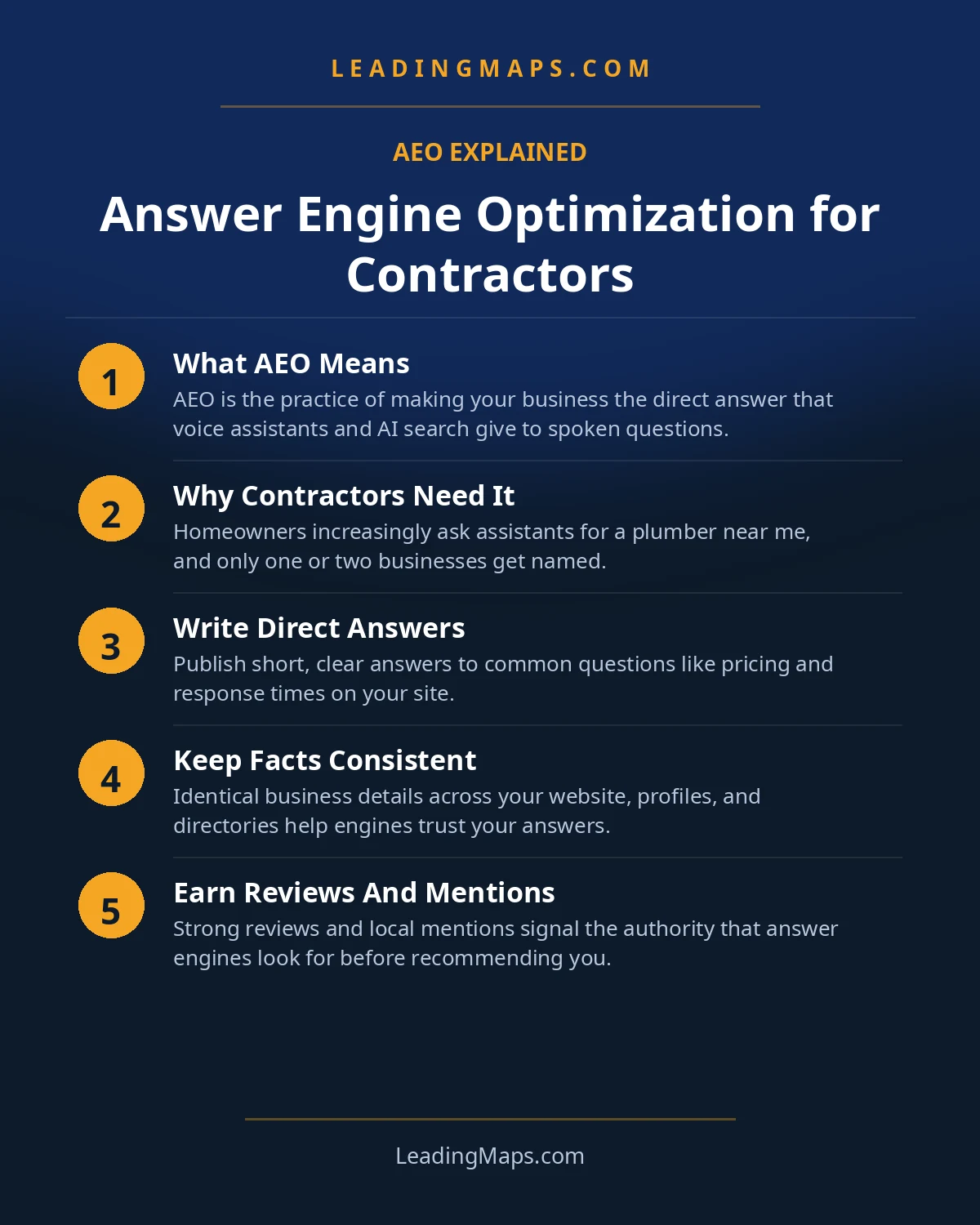
Forget the SaaS checklists about "optimizing for featured snippets." For a home service business, four things decide whether the assistant names you.
1. Entity Data: Can The Machine Assemble You?
An AI assistant does not "know" your business the way a neighbor does. It assembles you from structured facts scattered across the web: your name, address, phone, hours, services, and service area. When those facts agree everywhere, your website, your Business Profile, every directory, the model resolves one confident entity. When they disagree, you dissolve into fragments, and fragmented businesses do not get recommended. Entity consistency is the single highest-leverage AEO task for a contractor, and it is also the most boring. That is why nobody does it.
2. Reviews: The Quotable Record
Review text is where the model learns what you are actually good at, in human language. "Replaced our water heater the same afternoon" is a fact the assistant can quote when someone asks about water heaters. Fifty reviews that say "great service" are fifty copies of nothing. Recency matters too, a steady stream of fresh reviews tells the model you are active and currently trusted, not a business that was good in 2021. If you want the full playbook on building review momentum, our guide on getting more Google reviews covers the system; the AEO angle is simply this: reviews are your most quotable asset.
3. Citations: Independent Corroboration
Every consistent listing, Angi, Yelp, BBB, trade directories, manufacturer dealer locators, is another independent source confirming the same facts about your business. The model reads this the way a person reads references: one listing is a claim, dozens of consistent ones are a consensus. This is classic citation building, and it pulls double duty for Maps rankings and AI answers.
4. Quotable Content: Pages Worth Citing
When the assistant needs to explain what a job involves, what a sewer line replacement entails, what affects the cost of a panel upgrade, it looks for a page structured enough to quote. Most contractor service pages say "we do sewer lines, call for a quote." That is unquotable. The pages that get cited answer the customer's real questions with clear structure: what the job involves, what drives the price, how long it takes, what the warranty covers. Write the page the assistant wishes existed. See how this plays out trade by trade in our roofing and home services breakdowns.
That is the entire AEO playbook for a contractor: entity consistency, review depth, citation corroboration, and quotable content. No secret vocabulary, no prompt-engineering tricks, no second mortgage. The businesses winning AI recommendations are the ones that did the fundamentals well.
The Honest Stance: What AEO Cannot Promise
This is the section the enterprise explainers skip, and it is the most important one for a contractor deciding where to spend money.
AEO cannot guarantee you get recommended. AI assistants synthesize each answer from live sources at query time. There is no placement to buy, no inventory to reserve, no back door. Anyone promising "guaranteed ChatGPT placement" or claiming a "partnership with OpenAI" is selling fiction. We have written the full anti-hype list in our guide to getting recommended by ChatGPT, read it before you sign anything with anyone, including us.
AEO cannot work without the foundation. If your business data is inconsistent across directories, your profile is thin, and you have eleven reviews from 2022, no amount of "AI optimization" will make an assistant name you. The model has nothing to cite. AEO built on a broken foundation is decoration.
AEO is not a separate, mysterious discipline. It is local SEO measured against a new surface. The same signals, weighted slightly differently, evaluated by a machine that reads instead of ranks. An agency that sells you "SEO" and "AEO" as two unrelated black boxes is either confused or billing you twice for the same foundation.
What AEO can promise, honestly: a systematic build-up of the public signals AI assistants read, measured the way a contractor would measure anything, by whether the phone rings. Top-3 map-pack positions within 90 days, more inbound calls by month three, and AI answers that start naming you as the foundation compounds. That is our 90-day guarantee, in writing, and it covers the whole picture, not just the acronym.
How An Owner Measures It Practically
You do not need an enterprise dashboard. Here is the owner-grade measurement routine, once a month, twenty minutes:
- Ask ChatGPT the customer's question. "Who is the best [trade] in [your city]?" Run it 3–5 times in a fresh session. Write down who gets named and in what order.
- Check the citations. Which sources does the assistant cite, your site, your reviews, a directory? Cited sources are the levers. Missing sources are the gaps.
- Repeat on Gemini and Perplexity. They weight signals differently. The differences tell you where each one finds you weak.
- Track the trend, not the snapshot. Named in 1 of 5 runs, then 3 of 5, then consistently, that is progress. One good answer means nothing; a rising share of answers means everything.
- Watch the phone. "How did you hear about us?" still works. AI-driven callers will tell you "ChatGPT recommended you", and that sentence, from a real customer, is worth more than any visibility score.
That is the whole instrumentation a 6-truck shop needs. The $2,000-a-month platforms built for national brands will sell you prettier charts of the same data. Spend the money on the work instead.