On This Page
- Why reviews are your highest-leverage ranking factor
- Before you ask: set up the machine
- The three moments that produce reviews
- The follow-up cadence that doesn't annoy people
- Make every review worth more: the AI-search angle
- How to reply to reviews (templates included)
- Compliance: the rules that keep your profile alive
- What to track each month
- FAQ
Most home service businesses treat Google reviews as something that "just happens." A few trickle in after great jobs, a one-star lands after a bad day, and the total creeps up by three a month, while the competitor across town adds fifteen.
That gap isn't luck. It's a system. The companies with 200+ reviews and a 4.8 average got there by asking at the right moment, in the right way, every single time, and by never breaking the rules that get profiles suspended.
This guide is written for the trades, plumbers, HVAC techs, electricians, roofers, and the people who run them. You'll get the field-tech script, the dispatch SMS timed to job completion, copy-paste templates, and the compliance block most guides skip.
Why Reviews Are Your Highest-Leverage Ranking Factor
Reviews influence three things at once: where you rank, whether the customer clicks, and, increasingly, whether AI assistants recommend you at all.
On rankings: review signals, quantity, average rating, recency, and how you respond, are consistently ranked among the strongest map-pack factors in Whitespark's annual Local Search Ranking Factors survey. Google reads a steady stream of recent reviews as proof you're active, legitimate, and trusted.
On clicks: BrightLocal's 2026 consumer review survey found that 41% of consumers say they always read reviews before choosing a local business (up from 29%), 31% won't consider a business below 4.5 stars, and 74% say reviews from the last three months matter to them. Reputation's 2024 research found 54% of consumers trust online reviews more than recommendations from friends and family. In home services, where the buyer is often choosing in a hurry, a burst pipe, a dead AC in July, the business with 180 recent reviews beats the one with 22, before anyone reads a word.
On AI search: ChatGPT, Perplexity, and Google's AI Overviews increasingly pull from review content when answering "who's a good plumber near me" prompts. Reviews describing real work in real places are exactly what these systems quote, more on that below.
Of consumers say they always read reviews before choosing a local business in 2026, up from 29%, and 74% say reviews from the last three months matter. (BrightLocal, 2026 consumer review survey.)
Before You Ask: Set Up The Machine
A review system has three moving parts: a frictionless way to leave a review, a trigger that fires at the right moment, and someone accountable. Get the first one right before touching the others.
Get Your Direct Review Link
Every extra tap between "sure" and the review form costs you completions. Your Google Business Profile gives you a direct review link, grab it from the "ask for reviews" option in your dashboard, which also generates a QR code. Shorten it so it fits cleanly in a text.
Then put that link everywhere the customer already interacts with you:
- The invoice and receipt. Paper invoices get a QR code in the corner; emailed receipts get the link under the total.
- The tech's phone. Every field tech should have the short link saved, in a notes app, a text shortcut, or your dispatch app, so sending it takes five seconds.
- Your website's contact and thank-you pages. A "review us on Google" button on the page customers see after submitting a form catches the ones who found you online.
Make Sure Your Profile Can Receive Reviews Cleanly
Before you drive volume, confirm your profile is verified, the name and address match your website exactly, and there isn't an unclaimed duplicate siphoning off reviews. If your profile was ever suspended, fix that first, new reviews on a penalized profile help nobody.
The Three Moments That Produce Reviews
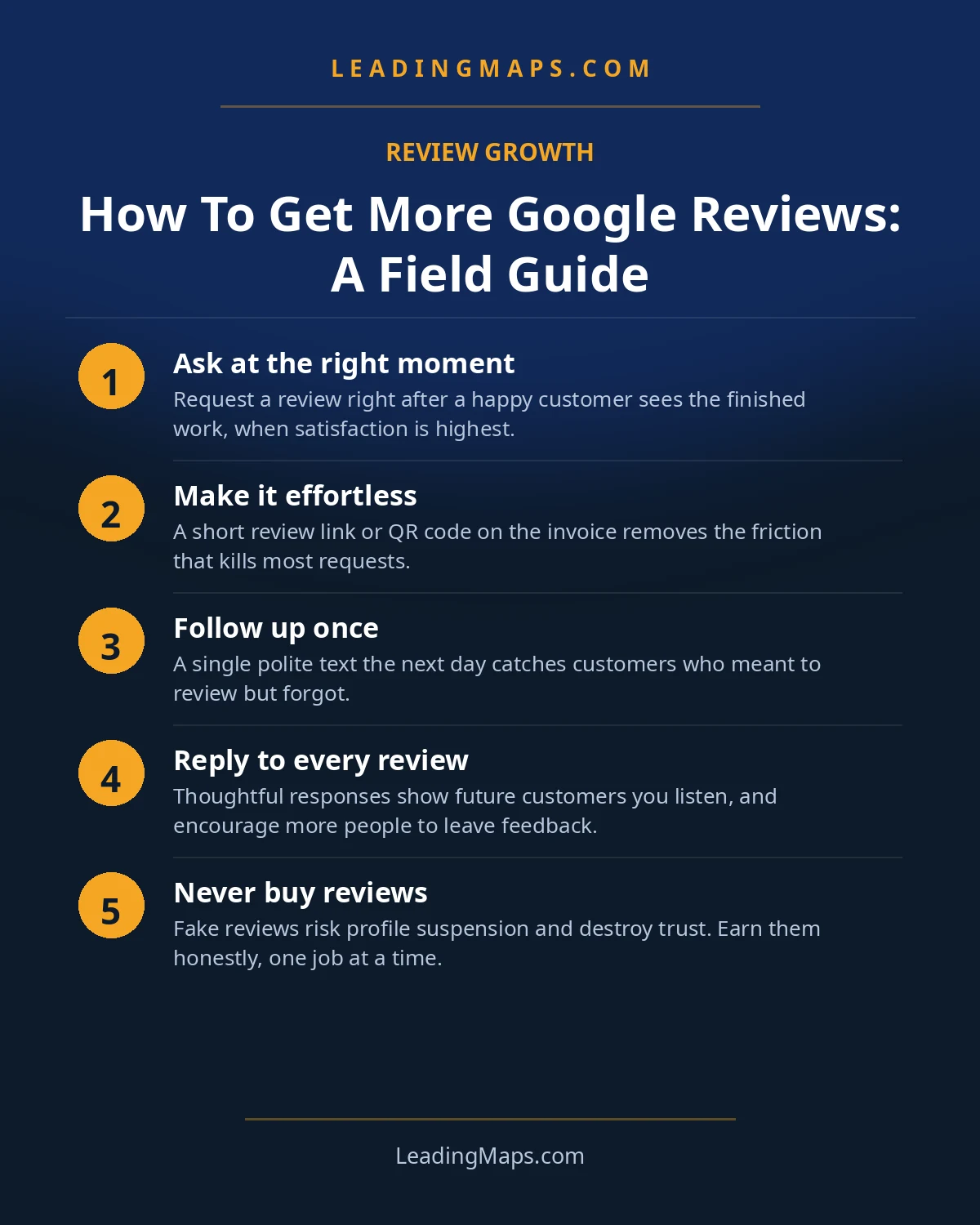
Satisfaction peaks the moment the job is done and paid for. After 48 hours, gratitude fades and you're a line item. Every effective review system in home services is built around three moments.
Moment 1: The Tech Asks On-Site
The in-person ask is the highest-converting review request in the trades, and most companies never train for it. Techs feel awkward asking, so they don't, or they mumble something forgettable at the door. Fix it with a script they can make their own:
"I'm really glad we got the [problem] fixed for you today, [name]. Quick favor, most of our new customers find us through Google reviews. If you're happy with the work, I'll text you a link after I head out. Takes about 30 seconds. Would that be okay?"
It works because it's specific, permission-based, and sets up the follow-up text. Train techs to ask right after the walkthrough, while the customer is still pleased, not while packing up at the truck.
One more line worth teaching: "If you mention what we fixed, it helps your neighbors find us." You're nudging the customer to describe the actual work, which produces the detailed reviews that rank and get quoted by AI. Never write the review for them, and never tell them what rating to leave.
Moment 2: Dispatch Sends The SMS At Job Completion
This is the workhorse. When the job is marked complete and invoiced in your dispatch software or CRM, an automated text goes out 30 to 60 minutes later, soon enough that the satisfaction is fresh, late enough that the tech is gone and the customer has seen the finished work. Copy-paste template:
Hi [first name], this is [tech name] from [company]. Glad we could get your [service] sorted today. If you have 60 seconds, a Google review would mean a lot to our crew: [short link]. Thanks!, [company]
Personalize the tech's name and the service performed, "glad we could get your water heater replaced today" beats a generic "thanks for your business." If your CRM can't insert the service, the tech's name alone still beats a blast message.
Moment 3: The Invoice And Receipt Leave-Behind
Not everyone responds to texts. The QR code on the invoice and the link in the emailed receipt catch the rest, especially where the person paying isn't the person who met the tech. One line above the QR code: "Happy with our work? Scan to review us on Google." A paragraph of pleading gets skipped; one line gets scanned.
The Follow-Up Cadence That Doesn't Annoy People
One ask gets the enthusiasts. One polite reminder gets everyone who meant to and forgot. A third ask gets you marked as spam:
- Day 0: the SMS, 30–60 minutes after job completion.
- Day 3–5: one reminder, only to customers who haven't reviewed. Template:
Hi [first name], [tech name] from [company] here, quick nudge in case you meant to leave us a Google review after your [service] visit: [short link]. No worries either way, and thanks for choosing us.
"No worries either way" signals you're not desperate, which paradoxically makes people more willing to help. After the reminder, stop permanently. Continued pestering earns you the one-star review complaining about your review requests.
The Email Backup
For customers who don't respond to texts, send one email the day after the job. Subject: "How did we do yesterday, [first name]?" Three sentences, thanks, what was done, the review link as a clear button. Don't bury the link in a newsletter or feedback survey; surveys siphon off the customers who would have reviewed you on Google.
Make Every Review Worth More: The AI-Search Angle
Here's what the generic guides miss: reviews aren't just social proof anymore. They're training and citation material for AI search.
When someone asks ChatGPT or Perplexity "who's a reliable electrician in Frisco," the assistant doesn't just check star ratings. It reads review text, looking for evidence that you actually do the work the person needs, in the place they need it. A review that says "great service, highly recommend" tells the AI almost nothing. A review that says "Mike replaced our panel and brought everything up to code the same day, best electrician we've used in Frisco" is quotable evidence.
You can't write your customers' reviews. But you can shape what goes into them, legitimately:
- Teach techs the detail nudge. The on-site line from earlier, "mention what we fixed, it helps your neighbors", produces reviews with service + outcome language. That's the raw material AI cites.
- Reply to every review with specifics. Your replies are indexed text you fully control. "Thanks, Sarah! Glad Tom got your AC back up same-day here in Mesa" adds service + city language even when the customer's review was brief.
- Keep velocity steady, not spiky. Forty reviews in one month followed by silence looks like a campaign; eight to twelve a month, every month, looks like a thriving business. AI systems weight recency heavily, a profile whose newest review is eight months old reads as possibly closed.
- Display reviews on your site. Embedding Google reviews on service pages gives AI crawlers the same evidence in a second location, and converts the visitors who land there.
Ten detailed reviews naming services and neighborhoods beat fifty generic five-star ratings when an assistant decides who to name, which is why our AEO and GEO work treats your review profile as an answer source. More on the AI review strategy.
How To Reply To Reviews (Templates Included)
Respond to every review. Response rate is a ranking signal, response time matters to customers, and your replies are keyword content you control. The owner or office manager should own this, with a 24-hour target.
Positive Review Reply Template
Thanks so much, [name]! Glad [tech] could get your [service] sorted [same-day / on schedule]. We appreciate you choosing [company] here in [city]., [owner name], [company]
Personalize the bracketed parts every time. Copy-pasted identical replies look automated and waste the keyword opportunity.
The Negative Review Playbook
A bad review feels like an emergency. Treat it like a job ticket instead:
- Respond within 24 hours. Silence reads as indifference to everyone who sees the review later.
- Never argue, explain, or blame, in public. Even when the customer is wrong, the audience is every future customer reading the exchange.
- Acknowledge, apologize for the experience, and move it offline. Give a direct phone number, not a generic "contact us."
- Resolve it for real, then ask for an update. If you fix the problem, it's fair to ask the customer to update the review. Many will.
- Flag only genuine policy violations. Fake reviews, competitor sabotage, or rants unrelated to your business can be reported. A harsh but honest review cannot, and trying makes you look worse.
Negative Review Reply Template
Hi [name], I'm sorry we missed the mark on your [service] visit, that's not the standard we hold ourselves to. I'd like to make this right personally. Could you call or text me directly at [number]?, [owner name], owner, [company]
Short, human, accountable, exactly what future customers hope to see when they hire a contractor.
Compliance: The Rules That Keep Your Profile Alive
The violations we see most often:
- Review gating. Sending customers to an internal survey first and only routing the happy ones to Google. Google explicitly prohibits this, every customer gets the same path to the review form.
- Incentives. Discounts, gift cards, entries into a raffle, or "leave us a review and get $20 off your next visit." All prohibited, even if you offer it for any review regardless of rating.
- Review stations. A tablet at the front desk or in the truck dedicated to collecting reviews on the spot. Google's guidelines prohibit soliciting reviews en masse at your place of business.
- Fake or conflicted reviews. Reviews from employees, family, or friends without disclosure; purchased reviews; review swaps with other businesses. The FTC now treats fake reviews as a straight violation with real penalties.
The safe version is boring, and that's the point: do great work, ask every customer once or twice, make it frictionless, respond to everything. Boring keeps your profile alive for a decade. Clever gets it suspended in a quarter.
What To Track Each Month
A review system without measurement drifts. Once a month, pull five numbers:
- Review velocity, new reviews this month vs. last month. The trend matters more than the total.
- Average rating, overall and for the last 90 days. A 4.9 lifetime average with a 4.2 recent average is a warning sign.
- Recency, date of your newest review. Anything older than 30 days means the system stalled.
- Response rate and time, are you answering everything within 24 hours?
- Service mentions, what share of reviews name the actual work done? This is your AI-quotability metric.
Then benchmark against the top three competitors in your map pack. If they're adding ten reviews a month and you're adding three, you know the gap, and the fix is the system above, run consistently.
Reviews compound. The first month feels slow; by month three the SMS automation, trained techs, and reply habit run themselves. If you'd rather have it built and managed for you, our profile optimization and Maps campaigns include exactly that, starting with a free audit.