On This Page
- Why citations still matter in 2026
- How to use this list
- Tier 1: Core citations every contractor needs
- Tier 2: Trade-specific sites (where the jobs come from)
- Tier 3: Local and authority citations
- Data aggregators: the multiplier most contractors miss
- The cleanup guide: audit, merge, claim
- The AI-search angle nobody covers
- FAQ
Search "best local citation sites for contractors" and you'll find listicles that name six sites, describe none of them, and pad the rest with generic advice. That's the gap this guide fills: the actual list, every directory worth a contractor's time, organized in tiers, flagged free or paid, followed by the cleanup process that makes the list work.
Citations are any mention of your business name, address, and phone number (NAP) on another website. Individually they're unglamorous. Collectively, they're the verification layer Google uses to confirm you're real, established, and located where you claim, and increasingly, they're the dataset AI assistants check before recommending you.
Why Citations Still Matter In 2026
Citations won't rescue a weak Business Profile or a business with no reviews. But they do three jobs nothing else does:
- Verification. When Google sees the same NAP on fifty trusted sources, it's confident your business is legitimate. That confidence feeds map-pack rankings, review and profile signals may be louder, but citations are the foundation they sit on.
- Distribution. Data aggregators feed hundreds of smaller directories, voice assistants, and in-car navigation systems. One correct submission propagates; one wrong address propagates too.
- Direct leads. Angi, Yelp, Thumbtack, and Facebook aren't just citations, they're places homeowners actually search. A complete profile on these sites is a second storefront, not just an SEO line item.
The rule the good agencies all agree on: consistency beats volume. Forty accurate citations outperform three hundred sloppy ones. A single wrong suite number or an old tracking phone number scattered across directories actively undermines the trust citations are supposed to build.
How To Use This List
Before you submit anywhere, do the unglamorous prep, it determines whether the next ten hours of work help or hurt:
- Standardize your NAP first. Pick one exact format, "1234 Main St, Suite 200" vs. "1234 Main Street #200", and use it everywhere. Decide on one canonical phone number (more on why in the cleanup section).
- Claim, don't duplicate. If a listing already exists for your business, claim it and correct it. Creating a second listing creates a duplicate you'll have to merge later.
- Enrich every profile. Categories, service lists, photos, hours, service area. A bare NAP-only listing is a missed opportunity, complete profiles rank better within directories and convert the homeowners who find them.
- Work in tier order. Aggregators first, then core, then trade-specific, then local. Details in the cleanup guide below.
Free/paid flags below reflect each site's basic business listing, most offer paid upgrades, ads, or lead programs on top. The flags tell you where the free listing gets you real value versus where you're really buying leads.
Tier 1: Core Citations Every Contractor Needs
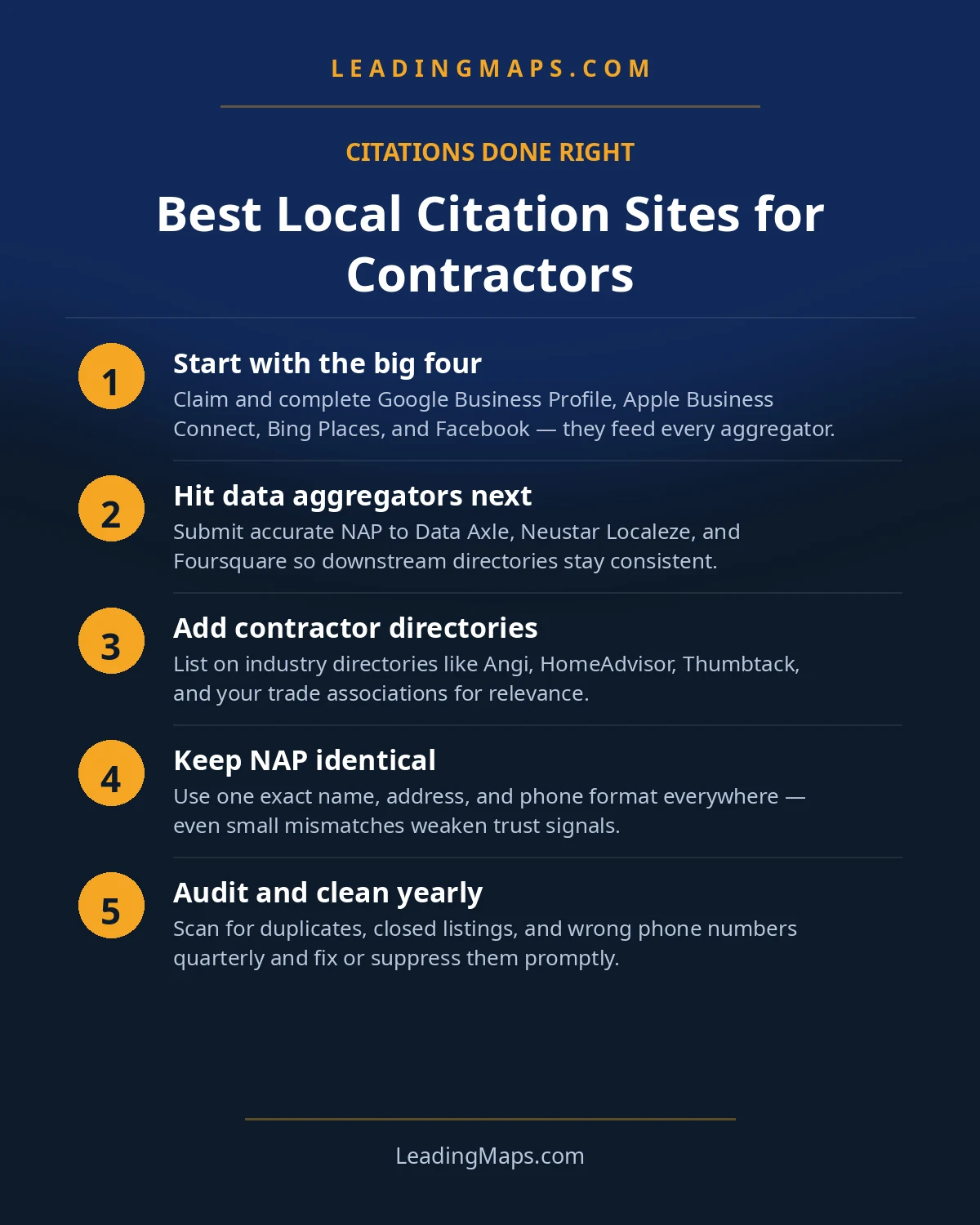
These apply to every trade, in every market. Build all of them.
Yelp, Free Listing; Paid Ads Optional
The highest-authority review platform after Google itself, and a genuine traffic source in residential trades. Claim the listing, pick precise categories (not just "Contractor"), add project photos, and respond to reviews. Yelp pages frequently rank for "[trade] + [city]" searches on their own.
Facebook Business Page, Free
Still the first place many homeowners check after Google. Keep hours, services, and contact info identical to your website, enable reviews, and post completed-job photos occasionally. An abandoned Facebook page with wrong hours actively loses jobs.
Better Business Bureau (BBB), Free Listing; Accreditation Is Paid
You don't need paid accreditation to benefit, the free listing is a trusted citation, and the BBB profile often ranks on page one for your brand name. If you do pursue accreditation, the badge converts well with older homeowners. Take complaint responses seriously; they're public.
Bing Places, Free
Five minutes of work for real coverage: Bing powers its own search, DuckDuckGo results, and voice assistants including Alexa. Import your Google listing data directly, Bing offers a sync, then verify the details carried over correctly.
Apple Maps (Apple Business Connect), Free
Feeds iPhone Maps, Siri, and CarPlay, which is to say, it feeds every iPhone user who asks for directions to a contractor. Claim it, add your service area and hours, and upload a proper logo. Contractors skip this constantly; that's why it's an easy win.
Yellow Pages (YP.com), Free Basic Listing
Not what it was in 2005, but the domain still carries authority and still ranks for trade + city searches in many markets. Claim the free listing, correct the NAP, and move on, ten minutes, done.
Nextdoor, Free
Neighborhood-level and heavily residential, exactly where plumbers, electricians, landscapers, and roofers get recommended. Claim your business page, keep the service area tight, and know that Nextdoor recommendations carry unusual weight because they come with a neighbor's name attached.
Chamber Of Commerce, Usually Paid Membership
Your local chamber directory is a citation and a trust signal in one, and chamber membership pages often rank well locally. If you're joining for networking anyway, the listing is a bonus, get the NAP exactly right when you submit it.
Tier 2: Trade-Specific Sites (Where The Jobs Come From)
These are the directories homeowners actually use to hire contractors. Prioritize the ones that match your trade:
Angi, Free Basic Listing; Paid Advertising And Leads
The highest-intent homeowner audience in home services. The free listing is a solid citation; the paid side is a lead-buying decision, not an SEO decision, evaluate it on cost per booked job, not rankings.
HomeAdvisor, Free Basic Listing; Pay-Per-Lead Model
Same network family as Angi, with its own homeowner traffic. Worth the free listing for every residential trade; the lead program suits high-ticket trades (roofing, HVAC, remodeling) where one job covers the lead cost.
Thumbtack, Free To List; Pay Per Lead/Contact
Strong for project-based trades, handyman, painting, landscaping, junk removal, where customers describe the job and pros respond. Complete the profile fully; response speed within the platform affects visibility.
Houzz, Free Basic Profile; Paid Pro Upgrades
The best platform for design-adjacent trades: remodelers, kitchen and bath, landscapers, flooring, custom builders. The audience is planning projects, not price-shopping emergencies, higher tickets, longer cycles. Photo quality matters enormously here.
Porch, Free Basic Listing
Home-improvement audience with moving and project-planning traffic. A straightforward free citation for most residential trades; worth claiming and completing.
The Blue Book, Free Basic Listing; Paid Upgrades
The commercial contractor's directory. If you do any commercial, industrial, or large-scale work, this is where GCs and property managers look. Residential-only shops can deprioritize it.
BuildZoom, Free
Contractor-focused, with license data displayed prominently, which makes it a trust amplifier for licensed trades. Claim it and make sure your license information is current.
HomeStars, Free Basic Listing
Strongest in Canada, if you operate there, it's Tier 1 for you. US contractors can claim the free listing but shouldn't expect meaningful traffic from it.
Tier 3: Local And Authority Citations
Fewer in number, higher in trust. These take more effort per listing, which is exactly why competitors skip them.
- Trade associations. PHCC (plumbing/HVAC), ACCA (HVAC), NRCA (roofing), NECA (electrical), NARI (remodeling), member directories are authoritative, trade-relevant citations. Membership usually costs money; the listing is part of the return.
- Manufacturer dealer locators. GAF and Owens Corning for roofers, Carrier and Bryant for HVAC, Kohler for plumbers, if you're certified, get listed. These pages rank well, carry manufacturer trust, and competitors can't buy their way in without the certification.
- Supplier directories. Supply houses and distributors sometimes maintain "find a contractor" pages. Ask yours, it's a five-minute email.
- Local sponsorships and news. Youth sports teams, charity events, local news "best of" lists, each produces a citation on a locally trusted domain, often with a link. This is also genuine community presence, not just SEO.
- City and county business directories. Many municipalities maintain business listings. Low traffic, real authority, ten minutes of work.
Tier 3 is where contractor SEO separates from generic local SEO, a national agency will never know your supply house runs a contractor directory. If you'd rather have someone build all three tiers for you, that's our citation building service.
Data Aggregators: The Multiplier Most Contractors Miss
Three companies supply business data to hundreds of downstream directories, navigation systems, and voice assistants:
- Data Axle (formerly Infogroup), the largest US business database; feeds a huge share of smaller directories.
- Foursquare, powers location data for countless apps beyond its consumer product.
- Neustar Localeze, long-standing aggregator feeding directories and search products.
Why they matter: submit your correct NAP to the aggregators and it propagates to directories you've never heard of, automatically. Have a wrong address at the aggregator level and that wrong address propagates just as efficiently. This is why the cleanup guide starts here: fixing three aggregator records can correct dozens of downstream listings at once.
You can submit directly to each aggregator or use a listing-management tool, either way, the aggregators come before individual directories in the work order. Note that aggregators are slow: allow 4–12 weeks for corrections to fully propagate downstream.
The Cleanup Guide: Audit, Merge, Claim
Most contractors don't have a citation shortage, they have a citation mess: old addresses, a previous owner's phone number, three slightly different business names, and duplicates from every lead-gen site that ever scraped them. Here's the cleanup order.
Step 1: Standardize Your NAP
Write down one canonical version and treat it as law: full legal business name (exactly as on your website and Business Profile), one street address format ("Suite 200" everywhere, not "Ste. 200" in half your listings), and one phone number. On the number: call-tracking numbers scattered across directories are one of the most common NAP killers we see. Use a single canonical number on every citation; if you need call tracking, run dynamic number insertion on your website only, so crawlers and directories always see the real number.
Step 2: Audit What Exists
Search Google for your business name + city, your phone number (try old numbers too), and your street address (try suite-format variants). Log every listing in a spreadsheet: URL, business name shown, address shown, phone shown, status (correct / wrong / duplicate / unclaimed). Check the top three competitors in your map pack while you're at it, directories where they appear and you don't are your priority gap list. A typical contractor audit turns up 60–120 existing mentions; roughly a third will have something wrong.
Step 3: Fix Duplicates Before Building New
Claim the listing first, then use the platform's merge or "report duplicate" flow, never just build a fresh listing alongside the old one. Duplicates split your reviews and confuse Google about which entity is real. This is slow, unglamorous work; it's also the highest-ROI part of the cleanup.
Step 4: Claim In Tier Order
Aggregators first (widest propagation), then Tier 1 core, then Tier 2 trade-specific, then Tier 3 local. Enrich every profile as you go, categories, services, photos, hours, service area, because a complete profile on Angi or Yelp is a lead source, not just a citation.
Step 5: Handle The Special Cases
- You moved. Update aggregators first, then everything else, and don't delete the old-address listings until the new ones are live, a gap reads as "closed."
- You rebranded. Same order. Keep the old name as a "formerly" reference on your website for a few months so humans and crawlers connect the dots.
- Multiple locations. Each location gets its own NAP, its own listings, and its own phone number or extension. Never share one listing across locations.
Step 6: Monitor Quarterly
Directories re-scrape, aggregators refresh, and well-meaning employees "fix" listings. Once a quarter, re-run the name/phone/address searches and correct drift. Fifteen minutes, four times a year, protects the whole investment.
The AI-Search Angle Nobody Covers
Here's the question no competitor guide answers: does citation data feed AI answers? Effectively, yes, through entity resolution.
When someone asks ChatGPT or Perplexity for a contractor recommendation, the assistant has to resolve a business as a real entity before it will name it. It does that by cross-checking: does this name, address, and phone appear consistently across trusted sources? Consistent citations across Yelp, BBB, Angi, Apple Maps, and the aggregators make you a verifiable entity the assistant can recommend with confidence. Inconsistent NAP, three phone numbers, two addresses, a DBA that doesn't match the website, makes you unresolvable, and unresolvable businesses don't get named.
Review platforms double as answer sources here: assistants frequently cite Yelp and BBB content when describing local businesses, which is another reason your Tier 1 and Tier 2 profiles should be complete and current, not just existing.
The practical upshot: the cleanup guide above isn't just local SEO hygiene anymore. It's the foundation of showing up in AI answers. A contractor with perfect NAP consistency and fifty detailed reviews is quotable; a contractor with four phone numbers across the web is invisible, even if they outrank everyone on Google. Our AEO and GEO work starts with exactly this entity lockdown, and Maps optimization keeps the profile side consistent with it.
If you're weighing DIY against hiring this out: the list above is very doable yourself over a few weekends. What's hard is the duplicate-merging, the aggregator submissions, and the quarterly monitoring, the boring parts that determine whether it works. That's what our citation building service handles, and it starts with a free audit showing your current citation footprint against your competitors'.