Picture the moment a pipe bursts at 9pm. The homeowner does not open a laptop, compare websites, or read your about page. They pull out their phone, type "plumber near me," and call one of the three businesses staring back at them at the top of Google Maps. That is the entire sales process for emergency home services: a search, a glance, a call.
This is why the map pack, those top-three Google Maps results, is the single most valuable piece of digital real estate a home-service business can own. First Page Sage's click-through research has put the local pack at roughly 44% of all clicks on local-intent searches. Positions four and below fight over scraps. If you are not in the top three, you are effectively invisible at the exact moment the customer decides who gets the job.
The good news: ranking on Google Maps is not mysterious, and it is not reserved for national franchises. It runs on a small set of factors, most of which your competitors are neglecting. This playbook covers how Google actually ranks map results, the five levers that move the needle for trades, the hidden-address trap that quietly kills service-area businesses, how to prove your rankings are real with grid tracking, and how all of this feeds the AI-search layer, ChatGPT, Gemini, Perplexity, that is already sending jobs to the businesses it can read.
On This Page
Why The Map Pack Decides Who Gets The Call
Home-service searches are different from almost every other kind of search. Nobody is browsing. The intent behind "emergency plumber near me," "AC repair," or "roof leak" is a problem that needs a person with tools, today. That urgency compresses the entire funnel into the search results page.
On mobile, where the overwhelming majority of these searches happen, the map pack dominates the screen. Reviews, ratings, hours, and a call button are all visible without a single tap. The homeowner never visits your website. They call, they book, they hang up. Your website matters for the ranking algorithm and for credibility, but the transaction happens on the listing.
This has a blunt consequence: map-pack rankings are measured in calls, not clicks. A #1 organic ranking below the map pack can be outperformed by a #3 map-pack position, because the map listing converts directly into a phone call. If your SEO reporting talks about traffic and keyword positions but not calls, it is measuring the wrong thing.
How Google Actually Ranks Map Results
Google's own documentation names three factors behind local rankings. They are worth understanding in plain English, because they explain exactly where to spend your effort:
- Relevance, how well your business matches the search. This is your categories, your services list, your business description, and the words on your website. Relevance is the factor you control most.
- Distance, how far the searcher is from your business location. You cannot move your shop closer to every searcher. For service-area businesses, Google uses your address on file and your defined service area.
- Prominence, how well-known and trusted your business is. Reviews, citations across the web, backlinks, and how people interact with your listing. Prominence is where most rankings are won.
The strategic takeaway: distance is mostly fixed, so the entire game is relevance plus prominence. Every tactic below is one of those two.
The Five Levers That Move The Needle For Trades
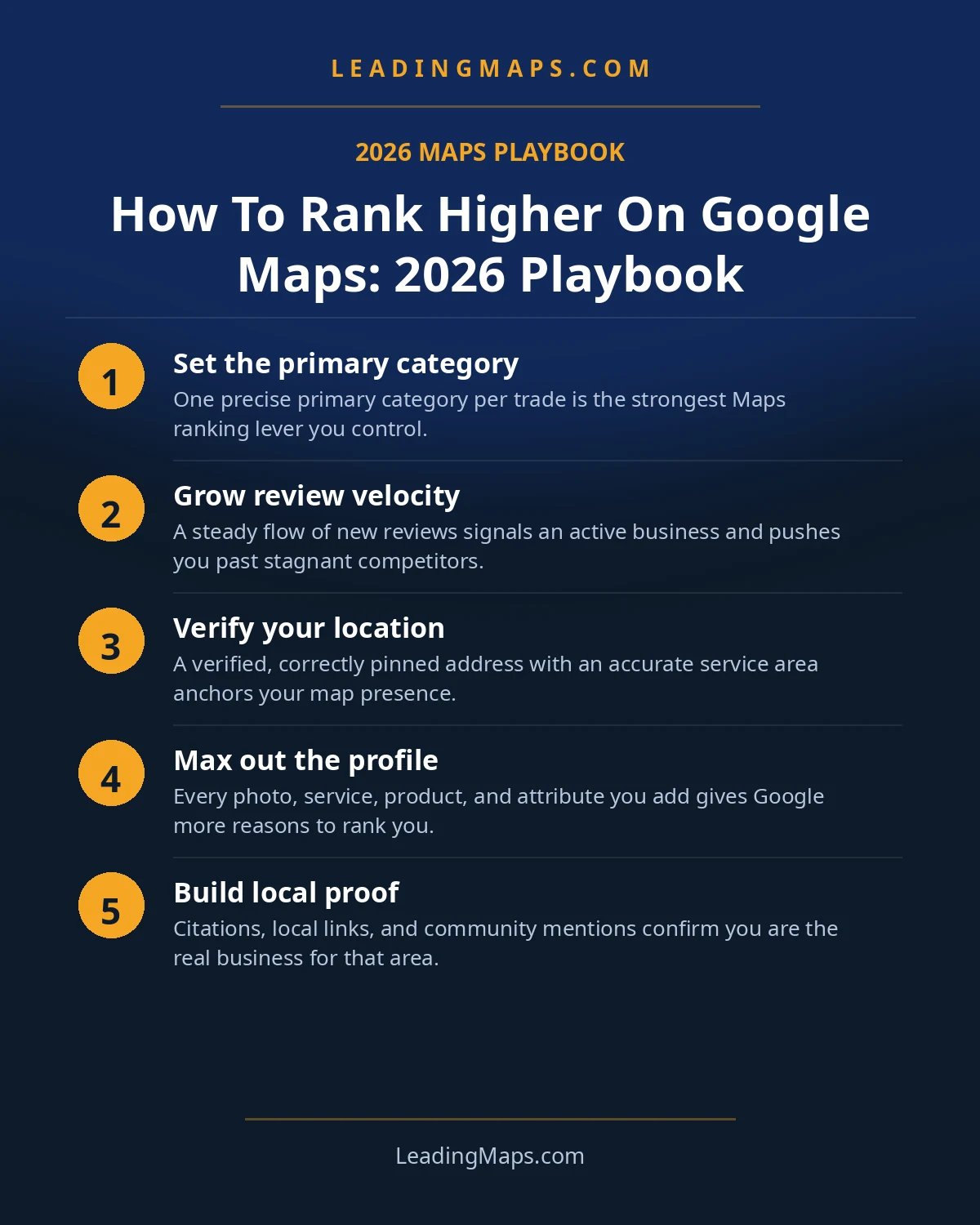
Forget the 200-factor checklists. For a plumbing, HVAC, roofing, or electrical company, these five levers decide where you land:
1. Categories, Primary And Secondary
Your categories decide which searches you are even eligible to appear for. "Plumber" alone does not cover drain or sewer searches. "HVAC Contractor" does not cover "furnace repair." Pick the single most accurate primary category, then add every secondary category you genuinely service: "Emergency Plumber," "Drainage Service," "Water Heater Repair Service," "Air Conditioning Repair Service." This is a twenty-minute fix that most competitors never bother with, which is exactly why it moves rankings. Start with our Google Business Profile optimization approach if your categories were set years ago and never touched.
2. Reviews, Velocity, Recency, And Responses
It is not just your star rating. Google reads how many reviews you get, how recently, and what they say. A business with 200 reviews from three years ago loses to one with 80 reviews from the last six months. Reviews that mention the actual work, "replaced our water heater same day", carry more weight than "great service," and they are the exact phrases AI assistants quote later.
The second half is responding. Answer every review, good and bad, with specifics. It signals an active, legitimate business to Google, it shows up publicly for every future searcher, and it is the cheapest trust signal in local SEO. Build it into your process: a text goes out after every completed job, and someone owns the responses.
3. Citations And NAP Consistency
Your name, address, and phone number need to be identical everywhere Google looks: your website, your Business Profile, and every directory and trade site that lists you. Stray suite numbers, old phone numbers, and "St." versus "Street" inconsistencies quietly erode the trust signal. Beyond the general directories, trade-specific ones matter disproportionately, Angi, HomeAdvisor, manufacturer dealer locators, trade associations. See how we handle citation building without the spam.
4. Service-Area Strategy For Service-Area Businesses
Most trades do not get customers at a storefront, you go to them. Google has a specific business type for this: the service-area business. Set your service area to the towns you actually serve, and do not try to game it by claiming a fifty-mile radius you cannot cover; it does not extend your ranking radius and it can look spammy. The honest version: define the real area, then earn prominence in each town through reviews from customers there, local pages, and local links.
5. Website Signals
Your website feeds the relevance side of the equation. Dedicated pages for each core service and each city you serve, "emergency plumber [city]," "water heater replacement [city]", written for a real homeowner, not stuffed with keywords. Your NAP in the footer of every page. An embedded map. Service schema so machines can read what you do and where. This is the foundation our home-services SEO work and Google Maps optimization campaigns are built on.
The Hidden-Address Trap
Here is a trap that quietly kills service-area businesses: the address setting. If customers never visit your location, you run the business from a home office or a yard, Google expects you to hide your address and operate as a service-area business. Hiding it does not hurt your ranking.
What does hurt: displaying a home address you later regret, using a PO box or UPS store address, or renting a "virtual office" to fake a storefront in a town you want to rank in. Google treats fake locations as a policy violation, and the penalty is suspension, your listing vanishes overnight. We cover the full recovery process in why your business isn't showing up on Google Maps, but the prevention is simple: one real location, honest service-area business settings, no shortcuts.
Related trap: assuming your service area equals your ranking area. Setting a 40-mile service area does not make you rank 40 miles out. Distance is still measured from your actual location. Ranking in neighboring towns takes prominence, reviews from customers there, dedicated town pages, local links, not a bigger circle on a map.
Grid Tracking: The Only Ranking Proof That Matters
Ask most agencies where you rank and they will give you a number from a rank checker: position #2 for "plumber near me." What they will not tell you is where that check was run from, usually a single point, often downtown or near your office. Move three miles in any direction and the answer changes completely, because distance from the searcher is a ranking factor.
Grid tracking fixes this. It lays a grid of scan points across your actual service area, dozens of locations, and checks your map-pack position from each one. The result is a heatmap: green where you are in the top three, red where competitors own the search. For the first time, you see what your customers see.
This matters for three reasons. First, it is the only honest baseline, you cannot improve what you cannot measure. Second, it shows exactly which neighborhoods and towns to prioritize: the yellow zones where you are #4–#6 are one push away from the top three. Third, it is proof. When we say your rankings improved, we show you the before-and-after heatmap, not a single cherry-picked number.
How to run it properly: scan weekly, use a grid sized to your real service area (a metro needs more points than a small town), track your money keywords per trade, the service searches, not just "[trade] near me", and keep the history. Rankings move slowly and then suddenly; the grid history is what lets you connect the work to the result.
Our average: top-3 map-pack positions for your main searches within 90 days, measured on grid scans across your service area, not a single rank-checker number. Backed by a written 90-day guarantee.
The AI Discovery Layer: How Map-Pack Work Feeds ChatGPT And Perplexity
There is a second search layer growing on top of Google, and it is already sending jobs. Homeowners ask ChatGPT, Gemini, and Perplexity "who's a good plumber near me", and the assistants answer from business data, not from Google's ranking order. Almost no home-service businesses are optimized for this yet, which makes it the widest-open channel in local marketing.
Here is what transfers from map-pack work, and what does not:
- What transfers: entity consistency (identical NAP and service data everywhere), review signals (recency, volume, specific service mentions), authoritative citations and mentions, structured data on your site, and answer-ready content the assistants can quote.
- What does not transfer: your map-pack rank itself. AI assistants do not read your #2 position; they read your data. A business ranked #5 on Maps with cleaner entity data and better-structured answers can get named by ChatGPT over the #1.
The practical overlap is large: everything in the five levers above doubles as AI-search fuel. The additions are structured data done properly (LocalBusiness and Service schema, FAQPage on answer content), citation-worthy pages that assistants actually quote, cost guides, "what to do when" guides, and monthly testing. We run real homeowner prompts across ChatGPT, Gemini, and Perplexity and track which businesses get named, so you see exactly where you stand in the layer your competitors cannot see. The full methodology is in our AEO, GEO and LLM optimization breakdown.
One warning: do not let anyone sell you "AI search optimization" as a separate product bolted onto nothing. If your categories are wrong, your reviews are stale, and your NAP is inconsistent, no amount of AI-specific work will help, the assistants will read bad data and recommend your competitor. Foundation first, AI layer second.