If you run a home-service business, your Google Business Profile is not a directory listing. It is the storefront you don't have. Nobody drives past your shop, because there is no shop, there's a truck, a phone, and a service area. When a homeowner's water heater dies at 9pm, they search, they see the map pack, and they call whoever looks legitimate and close. Your profile is the entire first impression, and it's over in about thirty seconds.
That's why generic optimization advice falls flat for contractors. "Add nice photos and ask for reviews" is fine for a café. A service-area trade business has different fields, different rules, and different stakes, including suspension risks that a restaurant will never face. This guide covers the whole thing the way it actually works for trades: the fields contractors get wrong, the review and photo tactics that move the needle in home services, how your profile feeds AI search answers, and a week-by-week 30-day checklist.
On This Page
Why Your Profile Matters More Than Your Website
For most local businesses the website is the hub and the profile is a spoke. For a contractor, it's reversed. The map pack sits above the organic results, and on a phone, where emergency searches happen, it often fills the whole first screen. A large share of your calls will come from people who never visit your website at all: they tap "Call" straight from your profile.
That makes your profile a conversion page, not a citation. Every field is either earning the call or losing it: the review count and rating in the headline, the photos a homeowner scrolls through in ten seconds, the hours that say whether you're open, the services list that confirms you do the thing they need. Google Maps optimization starts here, because the profile is what the map pack actually displays.
There's a second reason this matters more every month: AI search. When someone asks ChatGPT or Gemini for a plumber, or when an AI Overview summarizes local options, those answers are assembled from structured business data, and your profile is the richest structured source of it. The contractors who treat their profile as a data asset, not a listing, are the ones showing up in both places.
The Fields Contractors Get Wrong
Walk through these in order. Each one is a five-to-twenty-minute fix, and together they're the difference between a profile that ranks and one that just exists.
Primary Vs. Secondary Categories: The Eligibility Layer
Categories decide which searches you're even eligible to appear for. Get them wrong and no amount of reviews will put you in front of the right searches. The primary category should be the single most accurate description of your business: Plumber, HVAC Contractor, Electrician, Roofing Contractor. Then add every secondary category you genuinely offer, "Emergency Plumber," "Drainage Service," "Air Conditioning Repair Service," "Water Heater Repair Service." The high-value secondaries are the ones most contractors never add.
Two rules: never pick a category for work you don't do (it dilutes relevance and confuses customers), and never use a category as a keyword trick, "Plumbing Supply Store" when you're a service plumber will hurt you, not help. If you want the full breakdown of how we rebuild profiles around the right categories, that's the core of our Business Profile optimization service.
Business Name: Use The Real One
Your profile name must match your real-world business name, what's on your trucks, your invoices, your signage. Adding keywords ("Best Dallas Plumber 24/7") or locations to the name is against the guidelines and it's one of the most common suspension triggers for contractors. It might buy you a few weeks of visibility; it can cost you months when the profile goes down. If your profile does get suspended, we have a contractor-specific reinstatement playbook, but not needing it is better.
Address And Service Areas: The SAB Setup
Most contractors are service-area businesses: customers don't come to you. So hide the address and define service areas instead. That's exactly what the setting is for, and it's fully allowed, including when the underlying address is your home, as long as it's a real location where the business operates.
What gets trades in trouble: showing an address that isn't a real staffed location (virtual offices, PO boxes, and coworking spaces are the classic triggers), claiming a 100-mile service radius you can't actually serve, or setting up a separate profile per town. Keep the service area honest, the cities and zips your trucks actually reach, and keep it consistent with what's on your website.
The Services List: Most Contractors Leave It Half-Empty
This is the most underused field in home services. Google lets you list services per category with descriptions, and most contractor profiles have three generic entries or none at all. Build it out like a menu of everything you actually sell: water heater installation, sewer line replacement, drain cleaning, panel upgrades, AC repair, roof replacement, leak detection. Write one plain sentence per service describing what it is.
Why it matters: the services list is query-matching text. It helps you show up for specific searches ("sewer line replacement near me," not just "plumber"), and it's structured data that AI assistants can pull straight into their answers. List emergency services explicitly if you offer them.
Attributes: The Ones That Matter, And The Noise
Attributes are the checkmarks, "online estimates," "on-site services," and dozens of others. For a contractor, the useful ones are practical: online estimates, on-site services, and any credentials or service options that reduce friction for a caller. Ignore the ones that don't apply to your business, and never claim one that isn't true, a homeowner who calls expecting online estimates and gets told "we don't do that" is a one-star review waiting to happen.
Hours: Real Hours, Plus Special Hours
Set your actual hours and keep holiday hours updated, nothing tanks trust like driving a homeowner to call on a holiday you're closed for. Only mark yourself open 24 hours if someone genuinely answers around the clock; if after-hours calls go to voicemail until morning, say so in your description instead and set honest hours.
Description: 750 Characters, Keyword-First, Human
You get 750 characters. Lead with what you do and where: "Family-owned plumbing company serving [metro], emergency repairs, water heaters, sewer lines, available 24/7." Then add what makes you different in one sentence. Write it for the homeowner first and the algorithm second; keyword stuffing here reads terribly and doesn't help.
Photos And Video: Proof, Not Stock
A contractor's photos should answer one question: "is this a real company I'd let in my house?" That means branded trucks, uniformed techs at work, before-and-after shots of real jobs, and the owner or team, not stock photos of handshakes. Aim for 20+ photos to start, then add a few every month; recency is a freshness signal.
One myth to retire: geotagging photos doesn't move the needle the way old SEO guides claim, Google strips most EXIF data on upload anyway. What matters is uploading natively through the Google app or dashboard, using descriptive filenames, and showing real work in your real service area. Add a short video or two: a 30-second clip of a job in progress outperforms any written description.
Growth in monthly profile views our clients typically see once the profile is fully built out, categories, services, photos, and review velocity all working together.
Reviews: The Engine That Moves The Needle
BrightLocal's consumer research has repeatedly found that the overwhelming majority of consumers read online reviews before choosing a local business, and for a contractor, reviews are doing triple duty: they influence the map-pack ranking, they decide whether the homeowner calls you or the next listing, and they're a primary signal AI assistants read when recommending businesses.
The system that works for trades is simple and unglamorous:
- Ask after every job, by text, within 24 hours. Send the direct review link while the work is fresh. The tech mentioning it in person ("you'll get a text, a review really helps us") doubles response rates.
- Respond to every review. Every one, including the five-star ones. A short, specific reply ("Glad we could get your water heater replaced same-day, Sarah") signals an active, cared-for business.
- Want reviews that mention the actual work. "Replaced our water heater same day, clean job" carries more weight than "great service!!!", for Google's relevance matching and for AI assistants that read review text for specifics.
- Never buy reviews, never gate them. Asking only happy customers for reviews while filtering out unhappy ones violates policy, and fake reviews get profiles suspended. The steady, honest stream wins.
Velocity and recency beat lifetime totals. Ten detailed reviews this quarter will do more for you than fifty from three years ago.
Posts And Q&A: The Parts Everyone Abandons
Almost every contractor profile has the same graveyard: three posts from 2023 and an empty Q&A. Both are low-effort wins.
Posts: one a week is plenty. Rotate through what's real, a completed job with a photo, a seasonal reminder (frozen-pipe prevention in fall, AC tune-ups in spring), a current offer. Posts don't directly boost rankings, but they keep the profile visibly active, give searchers a reason to choose you, and create fresh content AI systems can reference.
Q&A: seed it yourself with the questions homeowners actually ask, "Do you offer emergency service?", "Which areas do you serve?", "Do you guarantee your work?", and answer them thoroughly. Then monitor it, because anyone can answer questions on your profile, including competitors. A wrong answer sitting unchallenged for months is more common than you'd think.
How Your Profile Feeds AI Search
Here's the part no generic guide covers. When someone asks ChatGPT "who's a good emergency plumber near me," or when Google's AI Overview summarizes local options, the answer isn't scraped from your homepage headline. It's assembled from structured business data, and your profile is the densest source of it: name, categories, services, hours, service area, review text, Q&A.
LLMs resolve businesses as entities. That means consistency is the whole game: your name, phone, hours, and service list need to be identical on your profile, your website, and every citation across the web. Inconsistent data doesn't just confuse Google, it makes you invisible to AI assistants that can't confidently resolve who you are. That's why citation consistency and profile accuracy are really the same project.
Practically, the AI-search checklist for your profile is:
- Complete services with descriptions, this is the structured inventory AI answers pull from.
- Specific review text, assistants weight reviews that mention actual services and outcomes.
- Answered Q&A, phrased the way homeowners ask, which is how AI systems match queries.
- Fresh posts and photos, recency signals an active, operating business.
We run monthly prompt testing for clients, real homeowner questions across ChatGPT, Gemini, and Perplexity, tracking which businesses get named. Almost no contractors have ever been tested. The full methodology is in our AEO and LLM optimization breakdown.
The 30-Day Optimization Checklist
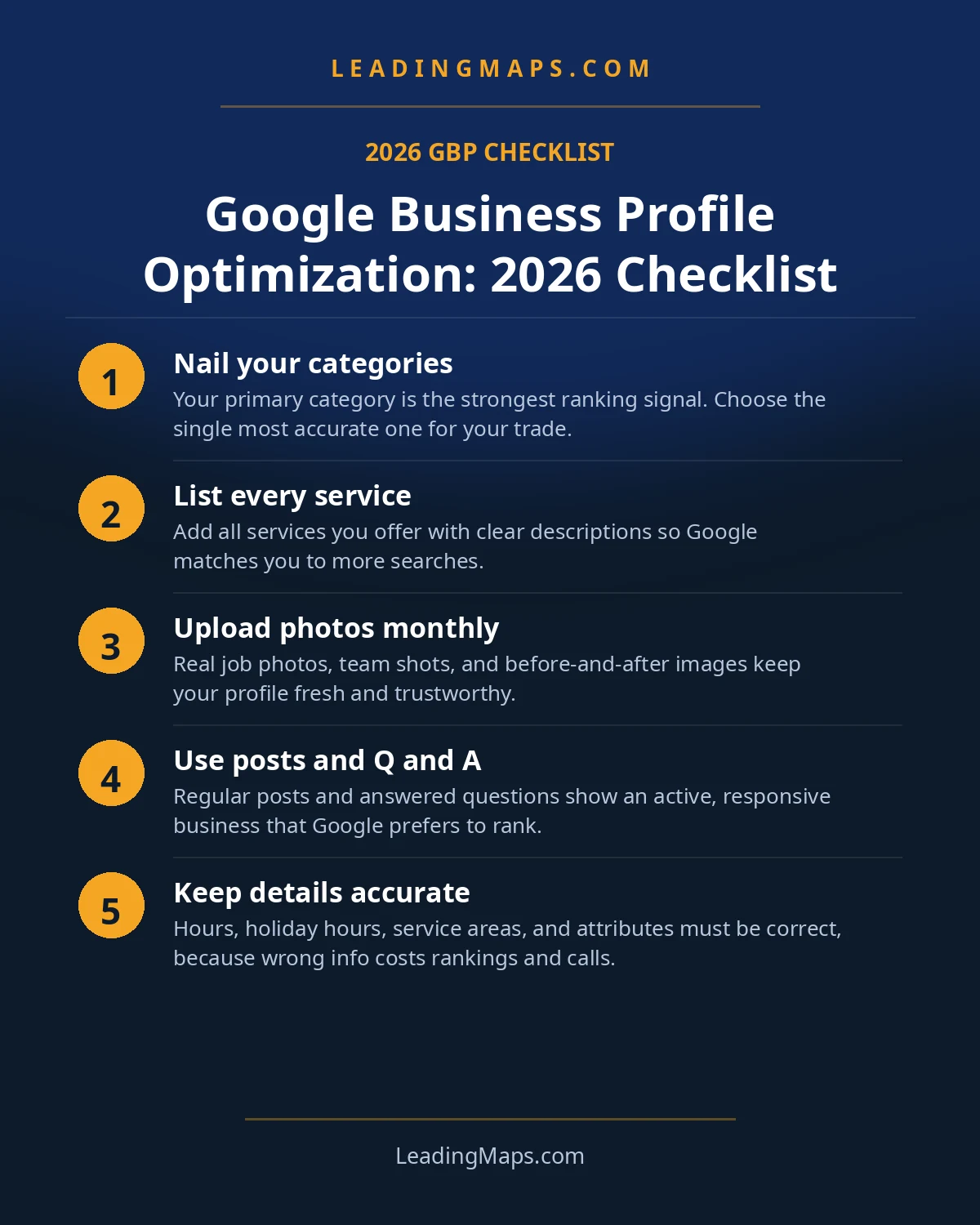
Here's the whole thing as a week-by-week plan. One focused session per week; nothing here requires an agency.
Week 1, Foundation (About 2 Hours)
- Claim and verify the profile if you haven't. Resolve any verification issues before touching anything else.
- Set your primary category to the single most accurate trade, then add every genuine secondary category.
- Fix the SAB settings: hide the address if customers don't visit you; set honest service areas (cities/zips you actually serve).
- Match your NAP (name, address, phone) exactly to your website. One phone number everywhere.
- Set real hours and add upcoming holiday hours now, not the week of.
- Write the 750-character description: what you do, where, and one differentiator. Homeowner-first language.
Week 2, Content (About 2 Hours)
- Build out the full services list, every service you sell, one plain sentence each. Include emergency services explicitly.
- Set accurate attributes (online estimates, on-site services), only what’s true.
- Upload 20+ real photos: trucks, team, jobs in progress, before/afters. Add 1–2 short job videos.
- Publish your first post, a recent job with a photo works perfectly.
- Seed 5–10 Q&A entries with the questions homeowners actually ask, answered thoroughly.
Week 3, Reviews (About 1 Hour To Set Up, Then Ongoing)
- Set up the SMS review request, direct link, sent within 24 hours of every completed job.
- Respond to every existing review, good and bad, with specific replies.
- Brief your techs: one sentence at the door ("you'll get a text, a review really helps us") is the highest-ROI part of this.
- Write reply templates for common situations so responding takes two minutes, not twenty.
Week 4, Measure And Maintain (About 1 Hour)
- Check profile insights: views, calls, direction requests, website clicks. Screenshot the baseline.
- Search your main keywords in an incognito map view and note where you rank today.
- Set the monthly cadence: 2–4 posts, a few new photos, review responses within 48 hours, Q&A check.
- Recheck quarterly: categories still accurate, hours current, no duplicate listings have appeared.
How To Tell It's Working
Don't judge the profile by ranking alone, judge it by what the profile produces. In your insights, watch profile views, direct calls, and direction requests month over month. Calls are the metric that pays for everything else; a profile climbing in views but flat in calls usually has a conversion problem (weak photos, thin reviews, unclear services), not a ranking problem.
Realistic timeline: ranking movement in 30–60 days, top-3 map-pack positions typically within 90 days for your main searches. If you're doing this yourself, that Week 4 baseline screenshot is what makes month-three progress visible. If you'd rather have it done and guaranteed, top-3 map-pack average within 90 days, or we work free, that's what we do, month-to-month, for home-service trades only.
Profile Questions Contractors Actually Ask.
Expect ranking movement within 30 to 60 days and top-3 map-pack positions typically within 90 days, assuming your categories, services, and review velocity are all fixed. Emergency-driven trades like plumbing often see calls sooner, because those searches convert on the first contact.
If customers do not come to your home, hide the address and set service areas instead. That is exactly what the service-area business setting is for, and it is fully allowed. What gets contractors in trouble is showing an address that is not a real, staffed location, or hiding it inconsistently across the web.
No. Your profile name must match your real-world business name and signage. Adding keywords or locations is against the guidelines and is one of the most common triggers for a suspension. If your profile gets suspended for this, getting it back is a long process.
There is no magic number. A steady stream of recent reviews beats a large stale total, and reviews that mention the actual work done carry more weight than generic five-star ratings. Ten new detailed reviews this quarter will do more for you than fifty from three years ago.
Posts are not a direct ranking factor, but they keep your profile active, give searchers a reason to call instead of scrolling past, and create fresh content that AI assistants can reference. One post a week about real jobs, seasonal issues, or current offers is enough.