"How much does SEO cost?" is the first question every contractor asks and the last question most agencies answer. You get vague ranges, "custom quotes," and a sales call. The reason is not mysterious: pricing without scope is meaningless, and agencies would rather have you on the phone than give you numbers you can compare.
This guide does the opposite. Real tiers. Real deliverables. The math that tells you whether SEO pays for itself at your ticket sizes. And the open question nobody else is answering: what does it cost to get found in AI answers?
On This Page
The Honest Range
Real local SEO for a contractor runs $500 to $5,000+ per month. That range is wide because the job is wide: a single-location shop in a small market and a multi-location company fighting for "HVAC repair" in a top-20 metro are not buying the same thing.
Anyone quoting you a flat number without looking at your market is guessing. Anyone quoting under $500 a month for ongoing work is selling automation dressed up as strategy. And anyone who will not put the deliverables in writing is selling you a black box.
Our own range sits inside that honest band: $500 to $5,000+/month, quoted after a free audit, month-to-month, no contracts. You pay for what your market actually requires. The rest of this guide will help you figure out where in the band you belong, whether you hire us or not.
Pricing Tiers: What You Actually Get
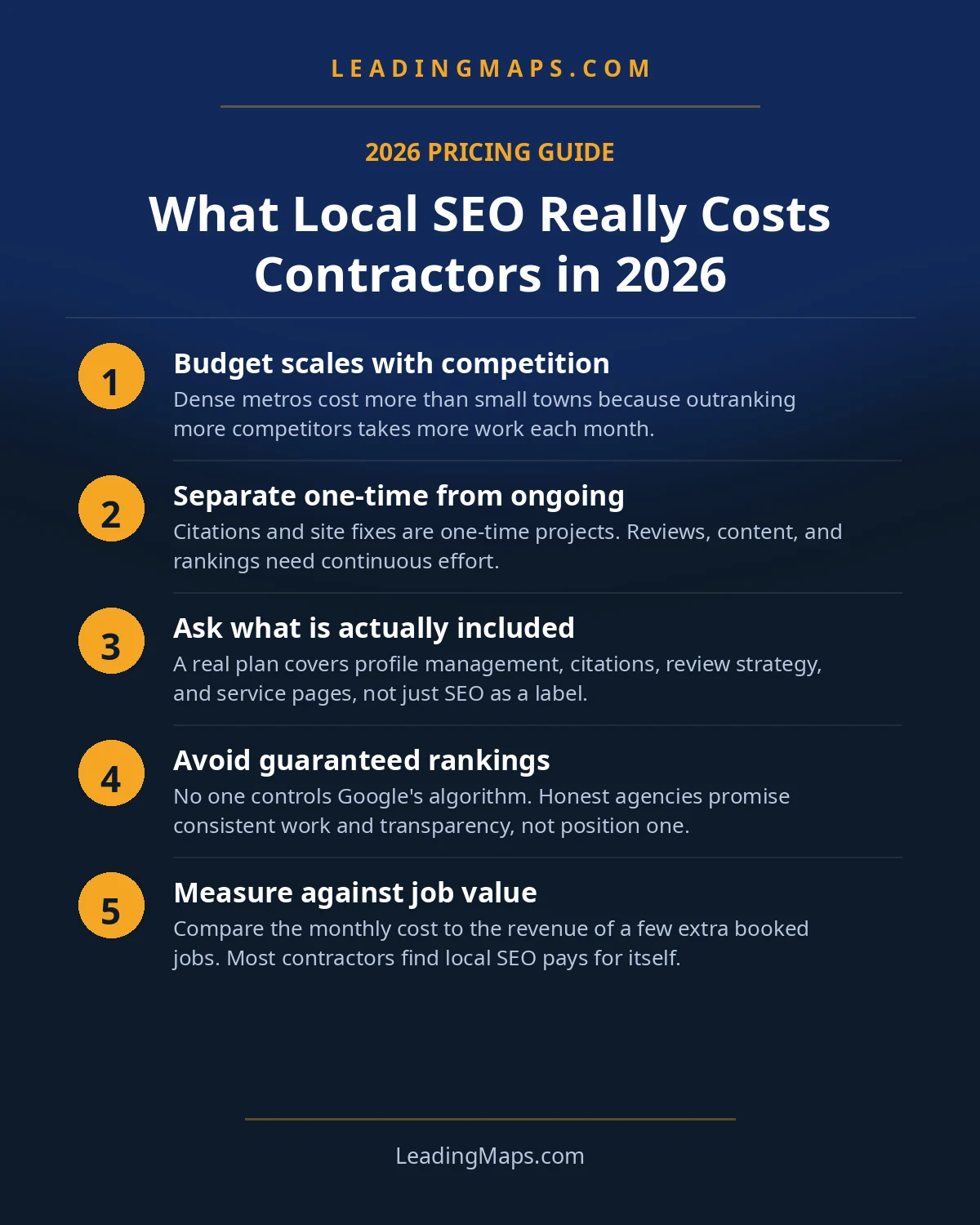
Forget package names like "Silver" and "Platinum." Here is what contractor SEO actually looks like at three real tiers, and what each tier should include to be worth the money.
| Deliverable | Starter · $500–$1,000 | Growth · $1,500–$3,000 | Multi-location · $3,000–$5,000+ |
|---|---|---|---|
| Best for | Single location, low-competition market | Single metro, competitive trade | Multiple locations or top-20 metros |
| Business Profile | One-time optimization | Monthly management + posts | Monthly management, all locations |
| Citations | Core cleanup (30–50 sites) | Full build + trade directories | Full build + ongoing monitoring |
| Reviews | Setup of request system | Managed engine + responses | Managed engine + responses |
| Service pages | , | High-ticket pages, monthly | High-ticket pages + location pages |
| Local links | , | Ongoing outreach | Ongoing outreach, per market |
| AI-search optimization | Entity cleanup | Full AEO: testing + quotable content | Full AEO, per location |
| Reporting | Quarterly rankings | Monthly: calls, rankings, AI answers | Monthly per location + rollup |
A few things this table reveals. First, the Starter tier is a foundation fix, not a growth engine, appropriate if you are the only game in a small town, insufficient if you are one of forty plumbers in a metro. Second, review management and content are the dividing lines: that is where Growth money goes, because that is what moves rankings month after month. Third, AI-search optimization is not a separate product at any tier, it is the same foundation, measured against AI answers too. (More on that below.)
If a proposal cannot map its deliverables onto rows like these, it is not a plan. It is a price.
The Break-Even Math
This is the only ROI calculation that matters for a contractor, and you can do it on a napkin:
At $1,500/month and $400 average gross profit per job, SEO pays for itself at roughly 4 jobs a month. Everything after that is profit, and unlike ads, the cost per call falls over time as rankings compound.
Run it with your numbers. A plumber averaging $450 gross profit on a service call breaks even on a $1,800 engagement at four calls a month, often a single good week once the map pack moves. A roofer landing one $12,000 replacement job from organic search can cover most of a year of SEO in a single ticket.
Two honest caveats. First, the math assumes you answer the phone, missed calls are the silent killer of SEO ROI, and no ranking fixes a full voicemail box. Second, month one is not month six: rankings compound, so the break-even gets easier every quarter you stay in. The contractors who quit at month two never see the part where the math gets good.
Compare that to the alternative most contractors know: emergency trade keywords cost tens of dollars per click in Google Ads, and the meter resets to zero every month. SEO is the only channel where this year's spend makes next year's leads cheaper.
DIY Vs Agency: The Decision Framework
Not every contractor needs an agency. Here is how to decide honestly.
DIY makes sense when you have ten or more hours a month to spend on marketing, you are in a low-competition market, and you are willing to learn three disciplines: Business Profile optimization, a review request system, and citation cleanup. Those three, done consistently, will move a small-market contractor a long way. The cost is your time and about $100/month in tools.
Hire when your billable hour is worth more than the work costs to delegate (do the math, for most owners it is not close), when you compete in a crowded metro where the top 3 are all professionally optimized, or when you want the full stack, content, local link outreach, and AI-search optimization, running without you. An agency should buy you results and time, not just activity.
The hybrid most contractors ignore: pay for a one-time foundation fix (profile rebuild, citation cleanup, review system setup), then maintain it yourself. A few thousand dollars once, then an hour a week of maintenance. For a disciplined owner in a mid-size market, this is the best ROI in the entire guide.
Whichever route you take, demand the same thing from yourself or any provider: monthly reporting tied to calls, not rankings. Rankings are a means. Booked jobs are the end. If the report leads with traffic graphs instead of call volume, the priorities are wrong.
Contractor Red Flags
The home services industry is a favorite hunting ground for bad SEO providers, because contractors are busy and the work is opaque. Memorize these:
- Guaranteed #1 rankings. Nobody can guarantee this, not on Google, and especially not in AI answers. A guarantee of a specific position is a confession of dishonesty or ignorance.
- Secret or proprietary methods. Local SEO has no secrets. It is profile depth, reviews, citations, content, and links, executed consistently. "Proprietary" means "we do not want you to see how little we do."
- No reporting, or reporting on vanity metrics. If you cannot see calls, rankings for your money keywords, and what was actually done each month, you are paying for a subscription, not a service.
- Long contracts with no performance clause. Twelve-month lock-ins exist to protect the agency from its own results. Month-to-month with a results guarantee is the honest structure, it is what we offer, and you should demand it from anyone.
- Suspiciously cheap. $199/month cannot buy human work. It buys automated citation blasts, spun content, and link schemes, the kind of "SEO" that can get a profile penalized and take a year to unwind.
- A separate, expensive "AI search" upsell. AI visibility runs on the same foundation as everything else. A large standalone retainer for it is double billing (see below).
What Does It Cost To Get Found In AI Answers?
This is the open gap in every pricing guide on the internet: nobody prices the AI-search piece, because most agencies have not figured out how to sell it yet. Here is the honest answer.
There is no separate price tag, because there is no separate product. Getting recommended by ChatGPT, Gemini, and Perplexity runs on the same foundation as ranking on Google Maps: consistent business data across the web, a deep Business Profile, review momentum with specific review text, citations on trade-relevant directories, and service pages worth quoting. That is the whole list. Read our AEO explainer if you want the full breakdown.
What that means for pricing: any agency charging a large standalone retainer for "AI search optimization", on top of an SEO retainer, is selling you the same work twice. The legitimate version is one engagement where AI-answer visibility is a measured outcome alongside Maps rankings and call volume. When we run the monthly prompt tests, real homeowner questions across the three assistants, tracking who gets named, that is reporting, not a second product.
The one real cost difference: quotable content takes actual writing. The service pages and answer content that AI assistants cite cannot be templated or spun, they need genuine trade expertise on the page. That is skilled work, and it is where a meaningful chunk of a Growth-tier budget should go. If an agency's "AEO package" does not include real content written for your trade, it is not AEO. It is a line item.