Ask five marketing people "SEO or Google Ads?" and you will get five answers shaped by what they sell. The SEO agency says ads are a treadmill. The ads agency says SEO takes too long. Both are telling you a convenient half of the truth.
We sell SEO, exclusively, for home-service trades, so read this with that bias disclosed. But the honest answer is not "SEO always." It is that the two channels do different jobs, at different costs, on different timelines, and the right answer depends on what kind of calls you need and when. Here is the full picture, including the AI-search economics nobody in the trades is writing about yet.
On This Page
The Honest Comparison Table
No spin. Here is how the two channels actually compare for a home-service contractor:
| Local SEO | Google Ads | |
|---|---|---|
| Typical cost | $500–$5,000+/mo, scoped to market | Tens of dollars per click; $2,000–$10,000+/mo all-in |
| Speed to first calls | 30–90 days for movement | Same day |
| Cost per lead over time | Falls every quarter as rankings compound | Flat or rising, the auction never gets cheaper |
| What happens when you stop | Rankings decay slowly; asset persists | Calls stop the same day |
| Risk | Low, month-to-month, guaranteed | Budget burn from bad setup is fast and silent |
| Best for | Durable lead flow, high-ticket jobs | Emergencies tonight, slow weeks, new markets |
| AI-search exposure | Same foundation wins AI recommendations | AI Overviews sit above ads and take the click |
The table tells the story in one glance: ads rent, SEO owns. Everything else is detail, important detail, but detail.
Compounding Math Vs The Auction Treadmill
This is the economic argument that decides the whole debate, so let us make it concrete.
With Google Ads, you buy clicks at auction. Emergency trade keywords routinely cost tens of dollars per click, "emergency plumber near me" has run $30–$80 a click in competitive markets for years. Your competitors bid against you, Google takes its cut, and next month you pay again for the same clicks. The cost per lead never falls. It usually rises, because more contractors discover the keyword every year.
With SEO, you buy an asset. Month one, you rank on page two and the phone barely moves. Month three, you are top 3 in the map pack for your main searches, our average, and inbound calls are up roughly 40%. Month six, the same monthly investment produces more calls than month three did, because rankings compounded while the price stayed flat. The cost per call falls every quarter. That is the entire economic case for SEO in one paragraph: it is the only channel where this year's spend makes next year's leads cheaper.
Put numbers on it the way a contractor would. Say SEO costs you $1,500/month and ads cost you $4,000/month for the same call volume in year one. In year two, the ads still cost $4,000/month, probably more. The SEO still costs $1,500/month, but it is now producing half again as many calls. By year three, the SEO channel is generating leads at a fraction of the ad cost per call, and it keeps going if you pause for a month. The ad channel generates exactly zero leads the day you stop paying.
What a single click on "emergency plumber near me" can cost in Google Ads. One month of those clicks can exceed an entire month of SEO, and the clicks vanish the moment the budget does.
Emergency Vs High-Ticket: When Each One Wins
The honest version of this debate admits that ads genuinely win in specific situations.
When ads win: the burst pipe tonight. A homeowner with water pouring through the ceiling does not scroll, compare, or read reviews, they call the first credible option. If you are not yet ranking in the map pack, ads put you at the top of that screen today, not in 90 days. Same logic applies to filling a sudden schedule gap, launching in a new service area, or promoting a seasonal offer with a deadline. Speed is the product, and ads are the only channel that sells it.
When SEO wins: everything else. Water heater replacements, sewer line work, panel upgrades, full system installs, the high-ticket jobs where the homeowner does compare. These searches have research behavior: reviews get read, websites get opened, "best" and "cost" queries get asked. Organic map-pack presence plus strong reviews plus quotable service pages wins these jobs at a cost per lead ads cannot touch. And for the emergency work too, once you own the top-3 map positions, the calls come free, no auction, no per-click meter.
The nuance most comparisons miss: emergency intent is where ads look best and SEO looks slowest, but it is also where SEO's payoff is biggest, because emergency clicks are the most expensive clicks in the trade. Ranking organically for the searches that cost $30–$80 a click is the highest-ROI position in home services marketing. It just takes 90 days to get there.
What AI Overviews Do To Ad Clicks
Here is the part of the debate nobody in the trades is writing about, and it changes the math.
Google now answers a large share of searches with an AI Overview: a generated summary sitting at the top of the results page, above both the ads and the organic listings. For a homeowner asking "how much does a water heater replacement cost" or "best plumber near me," the answer increasingly appears before they ever see a paid listing.
Follow the economics. When the AI answers the question on the page, fewer searchers scroll down and click anything, organic or paid. The clicks that remain get more expensive, because the same advertisers are now bidding for a smaller pool of clickers. Ad costs rise while ad inventory effectively shrinks. The treadmill gets faster.
Meanwhile, the same AI Overview cites its sources, and the businesses it names and the pages it quotes come from the same foundation as SEO: entity consistency, review depth, quotable content. The contractors who did the SEO fundamentals are now showing up inside the answer itself, above the fold, for free. The contractors who only bought ads are paying more per click for fewer clicks, positioned below the answer.
This is not a prediction about the distant future. It is the current direction of the page, and it is why the "rent vs own" argument is stronger now than it was two years ago. Owned visibility, organic rankings plus AI-answer presence, is the hedge against the auction getting worse. Our AEO work exists precisely for this: the same engagement that wins the map pack also builds the signals AI answers cite.
None of this means ads are dead. It means ads are a worse permanent strategy than they used to be, and a fine tactical tool for the jobs where speed matters. Price them accordingly.
The Sensible Answer: Foundation + Accelerant
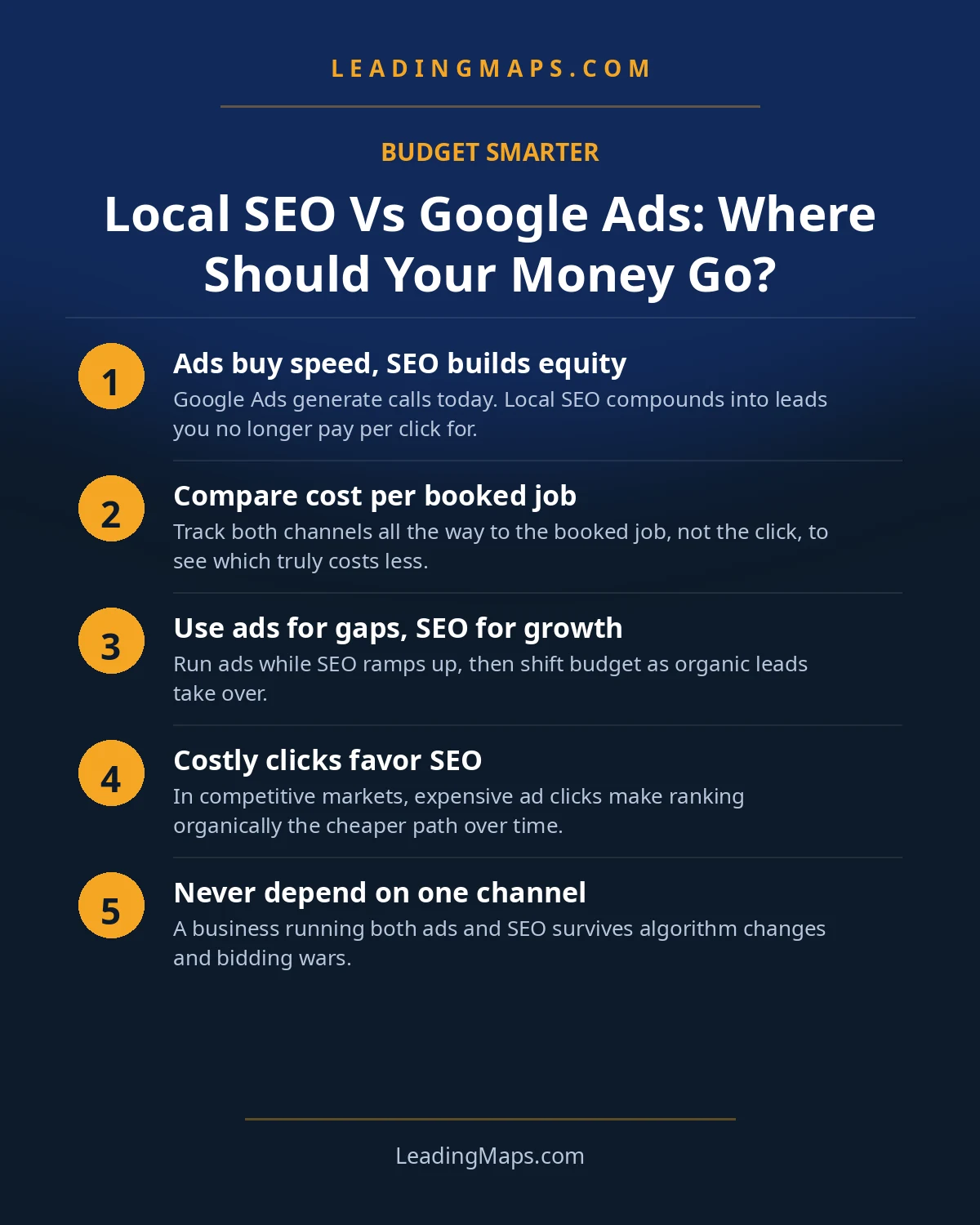
So where should your money go? Here is the allocation we would recommend to a contractor we liked, whether they hire us or not:
- Foundation first: local SEO. Map-pack rankings, profile depth, reviews, citations, service pages. This is the asset that compounds, the channel where cost per call falls, and the foundation AI answers are built on. Budget for it as infrastructure, not as an experiment. If you want the honest numbers, our 2026 pricing guide breaks down real tiers.
- Accelerant second: Google Ads, scoped tightly. Emergency keywords, slow weeks, new service areas, the situations where speed is worth auction prices. Set a budget, set an end date or a CPL ceiling, and treat it as a tap you turn, not a floor you stand on.
- Never let ads become the only channel. A business whose entire pipeline rents from an auction has no moat and no leverage. The day costs rise or the account gets suspended, the phone goes silent. Diversification is not a marketing concept here, it is business survival.
- Measure both in calls, not clicks. Cost per booked job is the only metric that survives contact with reality. An ad campaign with a great click-through rate and no booked jobs is a failure wearing a costume. Same for SEO that ranks but does not ring.
The contractors who win the next five years will not be the ones who picked a side in the SEO-vs-ads debate. They will be the ones who built owned visibility, Maps rankings, reviews, AI-answer presence, and used ads the way ads deserve to be used: as fuel on an already-burning fire, not as the fire itself.