On This Page
- Why categories are the fastest ranking lever you can pull
- The one rule for picking a primary category
- The complete category cheat sheet, by trade
- Emergency pairs: the combo that wins after-hours searches
- The rules, and the mistakes that cost rankings
- Categories and AI search
- How to change your categories (current steps)
- How to tell it worked, and when to revisit
- FAQ
Most contractors set their Google Business Profile category once, during setup, and never touch it again. That single choice then quietly decides which searches they can appear for, for years.
Categories are the relevance signal behind your map-pack rankings. Whitespark's 2026 Local Search Ranking Factors survey, 47 local search experts scoring 187 factors, puts your primary GBP category at #1 for map-pack rankings, with additional categories at #8. Google's own category guidance says the same thing in plainer language: the categories you select affect your local ranking.
That makes categories the fastest lever on your profile. Reviews take months to build. Links take longer. A category correction goes live in days and tells Google, in its own vocabulary, what you actually do. In our experience, ranking shifts from a fixed primary category often show within two to four weeks.
This is the genuinely complete list: primary and secondary categories for eight trades, the emergency pairs, the rules that keep your profile safe, and how your categories feed ChatGPT, Gemini, and AI Overviews. It is opinionated, because the generic advice, "pick what describes you," has left too many contractors invisible.
Why Categories Are The Fastest Ranking Lever You Can Pull
Google matches your primary category to the search term. When someone searches "plumbers," Google wants to show businesses categorized as Plumber, not general contractors who happen to mention plumbing on their website. The category is how Google classifies what you are, before it even reads your reviews or your site.
The data backs the instinct. Whitespark analyzed 1.8 million Google Business Profiles and found that a specific primary category is associated with roughly 36% higher presence in the top 10 results than a generic one. For contractors specifically, the numbers are blunt: Electrician, Roofing Contractor, Plumber, and HVAC Contractor all landed between 10 and 13% top-10 presence, while the generic "Contractor" sat at 8%. Read the full category study on Search Engine Land.
Additional categories matter too. That same study found that well-chosen additional categories correlate with 6 to 17 rank positions of improvement compared to businesses running a single primary category alone. Not because Google hands out points per category, but because each accurate category makes you eligible for more of the searches your customers actually type.
Primary GBP category is the top map-pack ranking factor in Whitespark's 2026 Local Search Ranking Factors survey, with additional categories at #8. Eight of the top ten factors come straight from your profile.
One honest caveat before you change anything: Google warns that adding or editing a category can prompt re-verification of your profile. Have your business documents ready, and do not make the change the week your busy season starts.
The One Rule For Picking A Primary Category
Forget the setup-wizard mindset. Your primary category is not a description of your company, it is a bid for the search term behind most of your revenue. The rule:
Pick the category that matches what customers call you, and what pays the bills.
Run the two-question test. First, when a customer describes your company in one word, what word do they use? Second, which service line produces the most revenue? If the answers agree, you have your primary. If 70% of your revenue is plumbing and you also do HVAC, your primary is Plumber, and HVAC gets a secondary category, not the other way around.
Specific beats generic every time. "Roofing Contractor" outranks "Contractor" for roofing searches, full stop. The one exception is the true multi-trade shop where no line dominates, and even then, pick the highest-margin core line as primary and cover the rest with secondaries plus your services list.
The Complete Category Cheat Sheet, By Trade
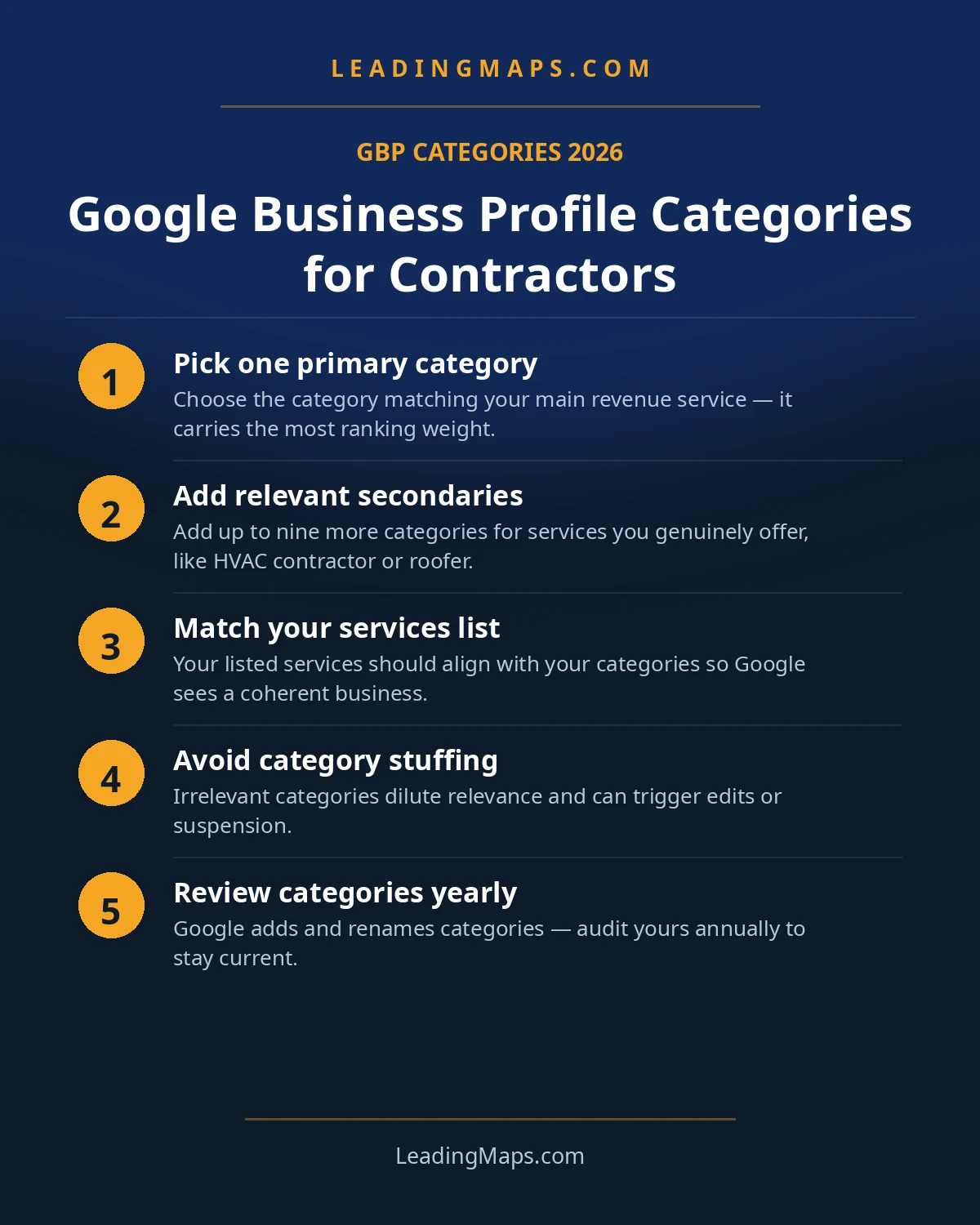
Primaries first, then secondaries in priority order. Only add a secondary if you genuinely staff that line of work, Google's guidance is explicit: pick categories that complete the sentence "this business IS a," not "this business HAS a." You get one primary and up to nine additional categories, but three to five accurate ones beat nine stretched ones.
Roofing
Primary: Roofing Contractor
Secondaries: Roofer, Gutter Cleaning Service, Siding Contractor (only if you do siding)
Note: "Roofing" alone also exists as a category, but Roofing Contractor is the more standard pick and matches how customers search. If gutters are a real revenue line, the Gutter Cleaning Service secondary is worth real money, the category study flagged Roofing plus Gutter Service as one of the best-performing primary-plus-additional pairs in the data.
Plumbing
Primary: Plumber
Secondaries: Emergency Plumber, Drainage Service, Water Heater Repair Service, Sewer Service, Septic System Service (only if you do septic)
Note: "Plumbing Service" is also a valid category, but Plumber is the exact-match term customers type and the one the data favors. Plumber plus Drainage Service was another top-performing pair in the Whitespark category study.
HVAC
Primary: HVAC Contractor
Secondaries: Air Conditioning Contractor, Heating Contractor, Air Conditioning Repair Service, Air Duct Cleaning Service (only if you offer it)
Note: resist splitting into separate profiles for heating and cooling. One strong profile with the right secondaries outranks two thin ones, and duplicate profiles for the same business are a suspension risk. Our HVAC SEO page covers the full playbook for heating and cooling companies.
Electrical
Primary: Electrician
Secondaries: Electrical Contractor, EV Charging Station Contractor (only if you install EV chargers)
Note: Electrician plus EV Charging Station Contractor was one of the strongest primary-plus-additional pairs in the category data, so if you do EV charger installs, that secondary is close to free money. More on the electrician SEO page.
Pest Control
Primary: Pest Control Service
Secondaries: only what you truly staff as a separate line
Note: most pest control companies are legitimately single-category shops, and that is fine. Do not invent secondaries to look bigger. Your services list, termite inspections, mosquito treatments, rodent exclusion, does the heavy lifting here, and your review velocity matters more than a second category ever will.
Flooring
Primary: Flooring Contractor
Secondaries: Floor Refinishing Service, Tile Contractor (only if you do tile), Flooring Store (only if you have retail)
Note: refinishing and installation are different searches with different customers. If you do both, the refinishing secondary earns its keep.
Painting
Primary: Painting Contractor
Secondaries: House Painter, Drywall Contractor (only if you do drywall)
Note: commercial painters, check whether your market searches "commercial painting contractor" and mirror that language in your services and description, since the category list itself does not split residential from commercial.
Landscaping
Primary: Landscaper
Secondaries: Lawn Care Service, Landscape Designer, Tree Service (only if you do tree work)
Note: maintenance and design are different businesses wearing one uniform. If design-build is your margin driver, some landscapers test Landscape Designer as primary. Pick the one behind the revenue, then prove it with project photos.
Emergency Pairs: The Combo That Wins After-Hours Searches
Emergency searches convert faster than any other query in home services, and they have their own category logic:
- Plumbing: Plumber + Emergency Plumber as a secondary. This is the cleanest emergency pair in the category system, use it.
- HVAC: HVAC Contractor + Air Conditioning Repair Service, then add "Emergency AC repair" as a service with your actual after-hours availability.
- Electrical: Electrician + Electrical Contractor, with emergency electrical work listed as a service and 24-hour hours set honestly.
The category pair only works if the rest of the profile backs it up. Set your real hours, including honest 24/7 hours if you answer around the clock, because "open at the time of search" ranks #5 in the 2026 Whitespark survey. A profile that claims emergency work but shows closed at 8pm loses the searches that matter.
The Rules, And The Mistakes That Cost Rankings
Categories are powerful, which means Google polices them. The mistakes we see most:
- Keyword-stuffing the business name to fake a category. Renaming yourself "Apex Plumbing Emergency Plumber Dallas" is against Google's guidelines and gets profiles suspended. Your real name, your real category.
- Using categories as keywords. Google's edit guidance is blunt: do not use categories solely as keywords or to describe features of your business. "Water heater," "tankless," and "drain cleaning" belong in your services list, not your categories.
- Adding categories for services, not the business. One more time: the category must complete "this business IS a." If you install water heaters but you are not a water heater company, the service goes in services.
- Category sprawl. Nine additional categories is the limit, not the goal. Every stretched category dilutes relevance and invites a competitor to report you.
- Creating your own category. You cannot. If the exact category you want is not listed, pick the closest general one and let services carry the detail.
Categories And AI Search
Here is the part the generic guides miss entirely: your categories are training and citation material for AI search, not just Google Maps signals.
On Google's own AI surfaces, Gemini and AI Overviews can read your profile's categories, services, Q&A, and description directly, because that data is Google's own structured source. When someone asks Gemini "find me a roofer near me," the assistant is working from the same entity data your categories define. Specific, accurate categories make you classifiable, and classifiable businesses get recommended.
ChatGPT and Perplexity lean harder on your website and the wider web, which is where most contractors leak. If your profile says HVAC Contractor but your website has no matching LocalBusiness schema, no service pages mirroring those categories, and citations calling you something else, the AI systems are reading three different businesses. Mirror your GBP categories and services in your website's schema and your service pages so every system sees one consistent entity. That is the core of our AEO and GEO work, and this guide walks through the full AI-recommendation playbook.
The practical takeaway: categories, services, descriptions, and reviews are the structured facts AI answers quote. Get them right on your profile first, then echo them everywhere else.
How To Change Your Categories (Current Steps)
The current workflow, straight from Google's help page:
- Search your business name on Google while signed in to the account that manages the profile, and open your Business Profile.
- Select Edit profile.
- Next to "Business category," select the edit icon.
- In the Primary category box, start typing and pick your category from the list that appears.
- Select Add another category for each secondary, or the remove icon to drop one you should not have.
- Select Save.
Changes typically go live within days, though Google notes you may be asked to re-verify. If verification is triggered, complete it promptly, a profile stuck in re-verification limbo helps nobody.
How To Tell It Worked, And When To Revisit
Give it two to four weeks, then check three things:
- Profile performance, are views, calls, and direction requests trending up in your GBP insights compared to the month before the change?
- Map-pack position, check your core terms, "plumber near me," "roof replacement [city]," from a few points across your service area, not just your office.
- AI answers, ask ChatGPT, Gemini, and Perplexity who they recommend for your trade in your city, and see whether your business starts appearing.
Revisit your secondaries quarterly. Seasonal businesses can rotate them honestly, heating-focused secondaries in winter for HVAC, storm-repair emphasis after hail season for roofers, as long as the work is real. What you should not do is flip your primary every month chasing terms. Pick it, prove it with reviews and photos, and let it settle.
Categories are step one of a full profile rebuild. The services list is step two, and it is where most contractors leave the most money on the table: how to add services to your Google Business Profile.