On This Page
A homeowner asks ChatGPT, "Who is the best roofer in Frisco?" The assistant answers with two names, a one-line reason for each, and phone numbers. It never shows a map pack. It never shows your website ranking. The buying decision happened inside the answer.
This is not a prediction about the future of local SEO. It is the present, and it is reshaping how home-service businesses get found. This guide explains what changed, brings real numbers to the conversation, and gives you the AI citation audit, a ten-query test you can run tonight to see exactly where you stand.
What Actually Changed
Local SEO used to be a ranking game: optimize your profile and site, earn reviews and citations, rank in the map pack, get the call. AI search adds a second game on top of it, the recommendation game. Google's AI Overviews and AI Mode now sit above the traditional results on a large and growing share of queries, and assistants like ChatGPT, Gemini, and Perplexity answer "find me a contractor" questions directly, often without showing a list of links at all.
The critical difference: the old game showed three to ten businesses. The new game often names one. An AI answer is a shortlist, not a directory, and the shortlist is built by a system that synthesizes your reviews, your profile data, your website content, and your consistency across the web, then decides whether it trusts you enough to name you.
What did not change: the evidence both systems read is the same. Reviews, profile data, structured content, citations, and consistent facts power rankings and AI answers alike. What changed is the payoff. You now need to be visible in two places, the ranking and the answer, and strong Google visibility does not guarantee AI visibility.
The Numbers: This Is Not Hypothetical
Most articles on this topic are pure opinion. Here is what measured research actually says.
AI answers are taking the clicks. Ahrefs re-ran its AI Overview impact study with December 2025 data across 300,000 keywords and found that when an AI Overview appears, the top organic result gets a 58% lower click-through rate than it would without one, up from 34.5% just eight months earlier. For every 100 clicks a top-ranking page used to earn, Google now keeps 58.
AI visibility is far harder than Google visibility. SOCi's 2026 Local Visibility Index, covered by Search Engine Land, analyzed nearly 350,000 locations across 2,751 multi-location brands and found that AI visibility is three to 30 times harder to achieve than ranking well in traditional local search. Only 1.2% of locations were recommended by ChatGPT, 11% by Gemini, and 7.4% by Perplexity, compared with 35.9% appearing in Google's local 3-pack. Fewer than half of the brands that lead in Google local visibility also appear among the most visible brands in AI results.
AI filters on reviews and data accuracy. The same report found AI recommendations consistently favor businesses with above-average sentiment, treating reviews as a filter rather than a ranking signal, and that business profile information was only about 68% accurate on ChatGPT and Perplexity, versus 100% on Gemini, which is grounded in Google Maps. In plain terms: the AI is pickier than Google, and it is working from your data, which is often wrong on the platforms it reads.
How much harder AI visibility is to achieve than ranking well in traditional local search, per SOCi's 2026 Local Visibility Index (nearly 350,000 locations analyzed). Only 1.2% of locations were recommended by ChatGPT.
Click-through rate lost by the top organic result when a Google AI Overview appears, per Ahrefs' study of 300,000 keywords (December 2023 vs December 2025).
The AI Citation Audit: Ten Queries To Run Tonight
Here is the framework nobody else on this topic offers: a step-by-step audit of your own AI visibility. It takes about an hour, it costs nothing, and it tells you more than any ranking report.
Step 1: Build Your Ten Queries
Write ten queries a homeowner in your market would actually ask, mixing emergency, cost, and best-of intent. Examples per trade:
- Plumbing: "emergency plumber near me open now," "water heater replacement cost in [city]"
- HVAC: "AC repair near me same day," "how much does AC replacement cost in [city]"
- Roofing: "best roofing company in [city]," "roof replacement cost [city]"
- Electrical: "electrician near me for panel upgrade," "licensed electrician [city]"
- Pest control: "pest control near me reviews," "termite treatment cost [city]"
Step 2: Ask Three Assistants
Run each query through ChatGPT, Gemini, and Perplexity. For each one, record: was your business named? Which businesses were named instead? What sources were cited? Gemini is grounded in Google Maps, so it behaves closest to the map pack; ChatGPT and Perplexity synthesize more broadly from web content and reviews.
Step 3: Check Google's AI Surfaces
Run the same queries in Google Search (private window) and note whether an AI Overview or AI Mode answer appears, which businesses it names, and which sources it cites. This is the surface your traditional SEO already feeds, and the gap between your ranking and your citation is the gap to close.
Step 4: Score And Prioritize
- Named nowhere, ranked well. Your facts are not quotable. Fix profile data, reviews, and answer-first content.
- Named on Gemini, nowhere else. Your Google data is fine; your web-wide presence (reviews, mentions, site content) is thin.
- Competitor named everywhere. Study their review detail, service descriptions, and cost content, then outbuild each one.
- Wrong information about you. Stale hours, old phone number, wrong services. Fix the source the AI cited, then the rest.
Repeat monthly. AI answers shift as reviews and content update, and a competitor can take your spot within weeks.
Per-Trade AI-Search Realities
AI search does not treat every trade the same. The query patterns, and what the AI does with them, differ by trade:
Emergency Plumbers: The AI Names One Provider
"Emergency plumber near me open now" is the purest AI-search query in home services. The assistant typically names a single provider with hours and a trust reason, because the homeowner cannot comparison-shop a burst pipe. The signals that win: accurate 24/7 hours, "emergency" in service descriptions, and reviews mentioning fast emergency response. Ambiguous hours mean you are not named at 2 AM.
Roofing: Synthesized Cost Answers Pre-Qualify The Buyer
Roofing queries skew toward cost: "roof replacement cost [city]." The AI synthesizes a price range from cited sources before the homeowner calls anyone, which means the answer pre-qualifies the buyer. If your cost content is what the AI quotes, you set the price anchor and you are already in the consideration set. If a competitor's content is quoted, they are.
HVAC: Seasonal Urgency Plus System Decisions
HVAC splits between emergency ("AC repair near me same day" in a July heatwave) and considered ("heat pump vs AC cost [city]"). The AI handles both, but the considered queries are where answer-first content wins: comparison tables, cost ranges, and FAQ schema on system-replacement pages get lifted directly into answers.
Water Heater And Niche Installs: Review Specificity Is Citable Data
For specific jobs like "water heater replacement in [neighborhood]," review text becomes the deciding data. Reviews that name the exact service and neighborhood are directly quotable facts; the AI can say "customers in [neighborhood] mention same-day water heater installs." Generic five-star reviews give it nothing to say.
Electricians: License And Entity Signals Carry Weight
Electrical work is permit-and-safety sensitive, and AI systems weight verifiable legitimacy signals more heavily: license numbers on your site and profile, trade association memberships, and consistent entity data across directories. For electricians, the "are they real" check is stricter than for a house cleaner.
What The Winners Are Doing
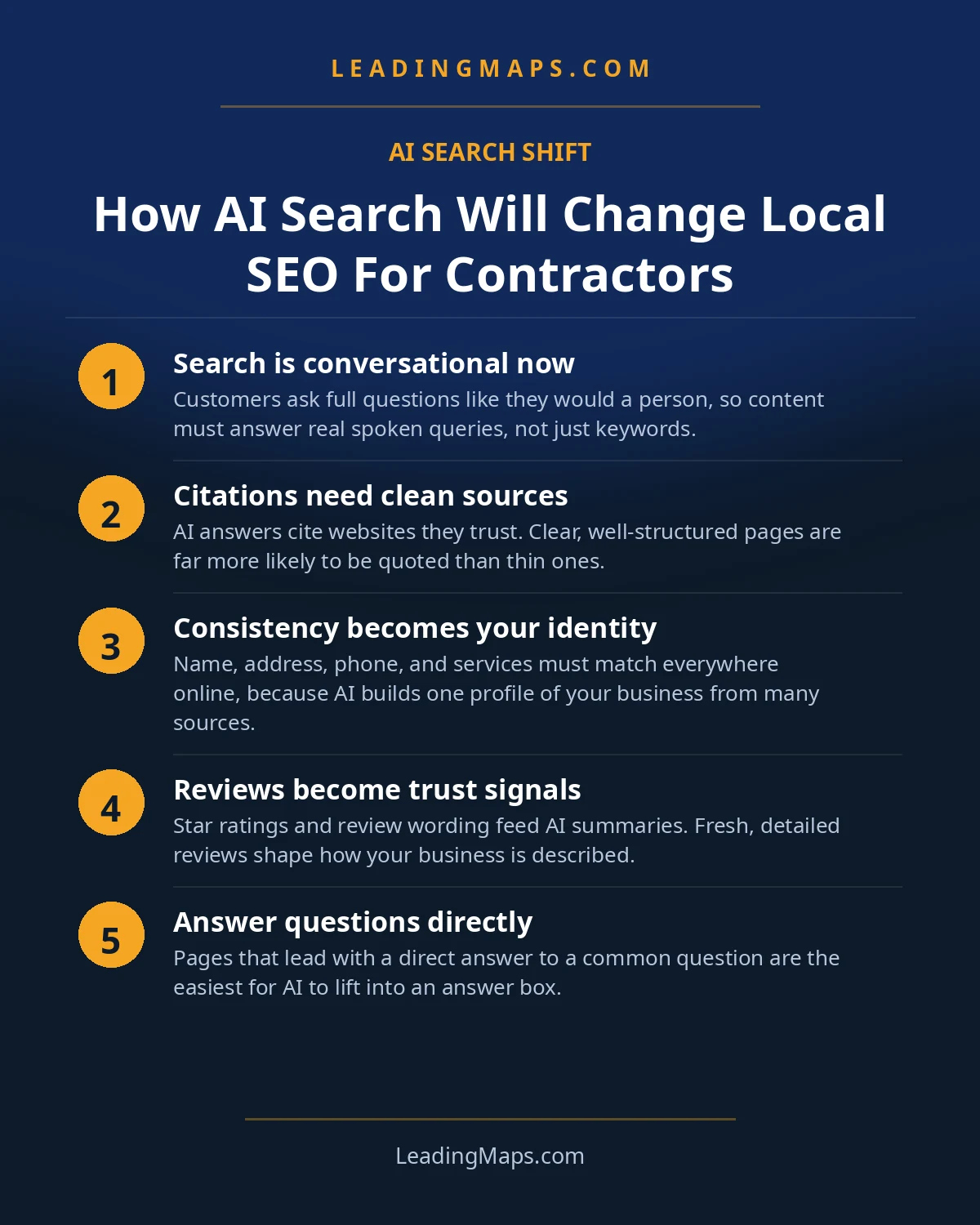
The businesses AI assistants name share a pattern, and it maps closely to what Search Engine Journal's AI Mode local SEO analysis prescribes for the new environment:
- They treat the profile as the verified core. Complete categories, full service lists with trade keywords, current hours and attributes. The profile is the single source of truth the AI trusts first.
- They run schema precisely. LocalBusiness and Service schema, Review and AggregateRating schema, FAQPage schema on cost pages, all matching the visible page text. Structured data is how the AI ingests facts without guessing.
- They enforce entity consistency. Identical name, phone, hours, and services across the website, the profile, and every directory. Conflicting facts make the AI skip you; consistent facts make you citable.
- They earn review sentiment, not just stars. Reviews describing real work in real places, replied to with specifics. Sentiment the AI can quote beats a silent 5.0.
- They publish answer-first content. Direct answers in the first 60 words, question headings, tables, FAQs. Content built to be lifted, not just ranked.
None of this is exotic. It is traditional local SEO done completely, with the intent of being quoted rather than just being ranked. That is the real change: same work, new standard for what "done" means.
Your SEO Job Description Just Changed
If you do your own marketing, or you pay someone to do it, the job description needs an update. Rankings, traffic, and calls are still the scoreboard, but they are no longer the whole game. Add these to the monthly checklist:
- Mention rate: the ten-query test across ChatGPT, Gemini, and Perplexity, logged monthly.
- Citation accuracy: is the AI's information about you correct? Hours, phone, services, areas.
- Review quotability: what share of recent reviews name the service and the area?
- Answer coverage: do your cost and service pages answer the questions AI Overviews ask, with schema?
The contractors who adapt now get the open lane. AI search has almost no contractor-specific competition yet, the ranking pages on these topics are generic, dated, or written for other industries. The ones who wait will be buying their way into answers their competitors already own.
Start with the ten-query test tonight. Then get the free AI visibility audit and we will show you exactly what to fix, in priority order, with the numbers from your own market.