On This Page
Most "LLM SEO vs traditional SEO" guides are written for SaaS companies and B2B blogs, businesses whose customers compare pricing pages over coffee. Contractors live in a different world. Your customer is standing in a flooded basement, or sweating through a dead AC in August, and they need one trustworthy name, fast.
That difference changes what LLM SEO means for the trades. This guide keeps the "vs" framing honest: what traditional SEO still does, what genuinely changed, and the review-and-profile layer where local contractors differ from every SaaS example you have read.
The Flooded Basement Test
Picture the moment. Water is spreading across the laundry room floor. The homeowner does not open a laptop, compare four websites, and read your about page. They grab their phone and ask, out loud or typed: "Who is the best emergency plumber near me right now?"
Increasingly, an AI answers. It does not give ten blue links, it gives a name. Maybe two. With a phone number, hours, and a one-line reason it picked them, "open now, 4.8 stars, 230 reviews, specializes in emergency calls."
Traditional SEO could put you at rank one below that answer and you would still lose the job, because the homeowner never scrolled. That is the entire case for LLM SEO in one image: the buying decision now happens inside the answer, not below it. Everything that follows is about making sure your name is in that answer.
What Traditional SEO Still Does For Contractors
Before anything else, the part the hype merchants skip: traditional SEO is the foundation LLM SEO stands on, and Google says so directly. Google's official guidance on AI features states that the same foundational SEO best practices apply to AI features as to Search overall, and that "all existing SEO fundamentals continue to be worthwhile."
The logic is simple. An AI Overview cannot cite a page that is not indexed, not crawlable, or buried on page nine. Your map pack rankings, your profile optimization, your citations, your reviews, your site speed, your schema, every one of those assets feeds both systems. The plumber who ranks in the top three and gets cited by the AI Overview is usually the same plumber, because both systems read the same evidence.
Traditional SEO also still owns the revenue layer for transactional queries. When a homeowner needs a contractor tonight, they click to call. Search Engine Land's analysis of the zero-click era puts it well: visibility-first SEO is a complement to traditional SEO, not a replacement. Rankings drive the clicks that book jobs; AI visibility decides whether you are named in the answer above the rankings. You need both, which is exactly why the "vs" framing is a starting point, not a strategy.
The Six Differences That Actually Matter
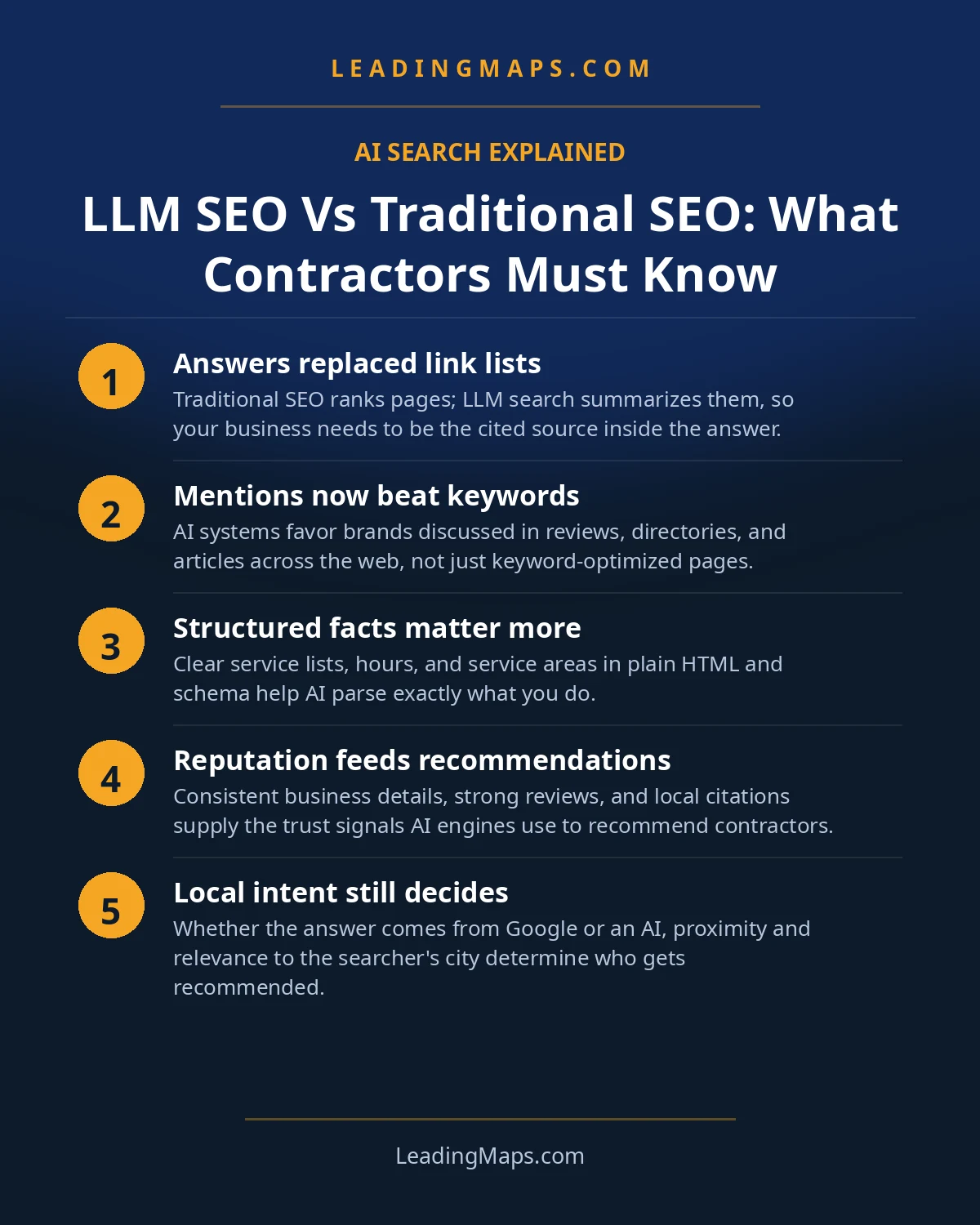
1. The Goal: Rank And Earn Clicks, Vs Be Named And Cited
Traditional SEO optimizes for position: rank one, get the click, convert the visitor. LLM SEO optimizes for inclusion: be the business the answer names, be the source the answer cites. Success is a mention, not a visit. For a contractor, that is a strange but real shift, you can "win" a search without a single click, because the AI hands the homeowner your phone number directly.
2. Keywords Vs Decision Criteria
Keyword research does not die, it changes shape. AI answers organize around the decision criteria buyers actually use, not keyword volume. Backlinko's analysis of AI Overview citations shows answers structured around criteria, and uses HVAC as the example: 24/7 emergency service, fast installation, energy-efficient systems, strong local reviews. The highest-impact move is to pick the criterion you can credibly own in your market and repeat it consistently across your site, profile, reviews, and the wider web until the AI associates it with you. Read their full breakdown of owning a criterion.
And keywords still matter inside AI tools. A user-behavior study covered by Search Engine Land found that 75% of ChatGPT sessions for local services included keyword-style prompts, "dentist in Chicago" rather than a paragraph of conversation. So track the keywords, then build the criteria behind them.
3. Backlinks Vs Brand Mentions
Backlinks still power traditional rankings, they are not going anywhere. But for AI answers, consistent brand mentions across the web, linked or not, carry growing weight: your name appearing with the same facts on directories, local news, trade associations, and community sites. One strong link from a local paper helps both; a hundred consistent mentions help the AI trust you are real.
4. Ranking Position Vs Quotable Evidence
Traditional SEO asks: where do I rank? LLM SEO asks: what can be quoted about me? The AI needs citable facts: services you offer, areas you serve, prices you charge, hours you keep, what customers say about the work. A page that states facts cleanly beats a prettier page that buries them. This is why answer-first formatting, FAQ schema, and cost tables matter more than ever.
5. Your Profile As A Listing Vs Your Profile As A Data Feed
In traditional local SEO, your Google Business Profile is a listing to optimize for the map pack. In LLM SEO, it is the verified data feed AI systems read when they answer. Categories, service descriptions with trade keywords, hours, attributes, reviews, and replies become the structured facts the AI synthesizes. Same profile, different job.
6. How You Measure: Rank Tracking Vs Prompt Testing
Traditional SEO measures rankings, traffic, and calls. LLM SEO measures mention rate: ask ChatGPT, Gemini, and Perplexity your ten most important contractor queries and log whether your business is named. Track it monthly like you track rankings. If your rank tracker says position two and the AI names your competitor, you are losing jobs your reports cannot see.
Still Works Vs What Changed: The Contractor Table
| Traditional SEO | LLM SEO | |
|---|---|---|
| Primary goal | Rank high, earn the click | Be named and cited in the answer |
| Success metric | Rankings, traffic, calls | Mention rate across ChatGPT, Gemini, Perplexity, AI Overviews |
| Keyword work | Volume, difficulty, intent | Decision criteria buyers use, plus real prompt patterns |
| Content format | Long guides built to rank | Answer-first blocks: 40-60 word answers, tables, FAQs, schema |
| Authority signal | Backlinks | Consistent brand mentions and facts across the web |
| Reviews' role | Ranking signal: count, rating, recency | Quotable evidence: service + city + outcome in the text |
| Profile's role | Listing optimized for the map pack | Verified data feed for AI answers |
| Measurement | Rank tracking, Search Console | Monthly prompt testing: ten queries, three assistants, logged names |
The Review-And-GBP Layer: Where Trades Differ From SAAS
Here is the part no generic LLM SEO guide covers, because it does not exist in SaaS. For a software company, LLM SEO is mostly a content and brand-mention game. For a contractor, the AI answer is built from local signals that have no B2B equivalent.
Review velocity and review-response content. When someone asks "best roofer in [city]," the AI synthesizes review text, not just star counts. A roofer with 40 recent reviews describing storm-damage repairs in specific neighborhoods is quotable; a roofer with 200 silent five-star ratings is a number. Your replies add indexed, keyword-rich text you fully control, "glad our crew got your hail damage claim handled same-week in Arlington" is a fact the AI can use.
GBP Q&A and services as citation material. Seeded Q&A entries ("Do you offer 24-hour emergency service in Mesa? Yes, ...") and detailed service descriptions are structured answers sitting inside Google's own data. When the AI needs a fact about your business, this is the closest source.
License and entity signals. License numbers on your site and profile, trade association memberships, and consistent NAP across Angi, BBB, Yelp, and trade directories give the AI verifiable proof you are legitimate. SaaS companies prove legitimacy with funding announcements; contractors prove it with a license number and 200 neighbors vouching in reviews.
Service-area-page extractability. Your service-area pages are the units the AI lifts when it answers "who serves [neighborhood]." Pages that state the service, the area, and a direct answer, with LocalBusiness schema, get cited. Pages that are thin doorway copy get skipped.
This layer is exactly why a generalist agency's LLM SEO playbook underperforms for contractors: it optimizes content while ignoring the review and profile signals that actually decide which trades business gets named.
Emergency Queries: The Pattern AI Handles Differently
Emergency queries are where the two SEOs diverge most visibly. A traditional search for "emergency plumber near me" shows a map pack and the homeowner picks. An AI answer for the same query typically names one provider, with hours and a reason: "open now, 4.8 stars, emergency specialist."
Winning that single slot requires emergency-specific signals: accurate 24/7 or extended hours on your profile, "emergency" in your service descriptions and categories, reviews mentioning fast emergency response, and service-area coverage stated plainly. The AI is risk-averse, it will not name a business whose hours are ambiguous for a 2 AM query.
Planned queries behave differently. "Roof replacement cost Dallas" gets a synthesized cost answer that pre-qualifies the buyer before they call, which means your cost content decides whether you are in the consideration set at all. Emergency is about availability signals; planned is about answer content. Plumbers and HVAC companies live in both worlds and need both.
What To Do This Week
You do not need a six-month project to start. Five moves, one week:
- Open your robots.txt and confirm GPTBot, PerplexityBot, and ClaudeBot are not blocked sitewide. Many security plugins block them by default.
- Rewrite your profile service descriptions with trade keywords: "tankless water heater installation," not "plumbing." Mirror the list on your website.
- Add FAQ schema to your top cost page with direct 40 to 60 word answers in the homeowner's language.
- Reply to your ten most recent reviews with service plus city specifics in every reply.
- Run the ten-query test across ChatGPT, Gemini, and Perplexity tonight. Log who gets named. That is your baseline.
Do those five and you are ahead of most contractors in your market. Do them monthly and you stay ahead. If you want the full system, profile, reviews, schema, content, and measurement, built and managed, that is what our LLM optimization program does, and the free audit shows you the starting point.