On This Page
- Why AI Overviews decide who gets the call
- How Google picks what the Overview cites
- Your profile is the data feed
- Reviews that name the service and the city
- FAQ schema on cost and service pages
- Answer-first content AI can lift
- Consistency: NAP everywhere
- Open the door for AI crawlers
- The llms.txt reality check
- Verify, don't guess
- FAQ
When a homeowner in Plano searches "water heater replacement cost," Google often answers with an AI Overview before the map pack even loads: a synthesized paragraph quoting a price range and naming a handful of providers. Most contractors never appear in it. Not because their work is worse, but because their online presence gives the AI nothing quotable.
That is the whole game with Google AI Overviews for home services. It is not a new ranking to chase, it is a new layer on top of search that decides who gets recommended when nobody clicks. The businesses that show up in AI answers share a set of signals any contractor can build: a complete profile, reviews that describe real work, structured content, consistent facts, and open doors for AI crawlers.
This guide translates every generic AI-visibility tactic into contractor terms. No theory, no hype, and an honest look at the llms.txt trend some agencies are trying to sell you.
Why AI Overviews Decide Who Gets The Call
For informational and cost queries, the AI Overview is now the top of the page. Ahrefs measured that when an AI Overview appears, the click-through rate of the top organic result drops by 58%, based on 300,000 keywords compared between December 2023 and December 2025. Ranking first below the Overview is worth less than half of what it used to be.
For contractors the stakes are sharper than lost clicks. On queries like "best emergency plumber near me" or "roof replacement cost Dallas," the Overview does not just summarize facts, it names one to three providers and frames the buyer's decision. The business named gets the call. The businesses listed below get scrolled past. It is winner-take-most, and the winners are chosen before the homeowner ever sees your website.
The queries that trigger Overviews for contractors are the money ones: cost questions ("AC replacement cost Phoenix"), best-of questions ("best electrician Frisco"), and comparison questions ("tankless vs tank water heater"). If you are not citable on those queries, your competitors are.
Click-through rate drop for the top organic result when a Google AI Overview appears, measured by Ahrefs across 300,000 keywords (December 2023 vs December 2025).
How Google Picks What The Overview Cites
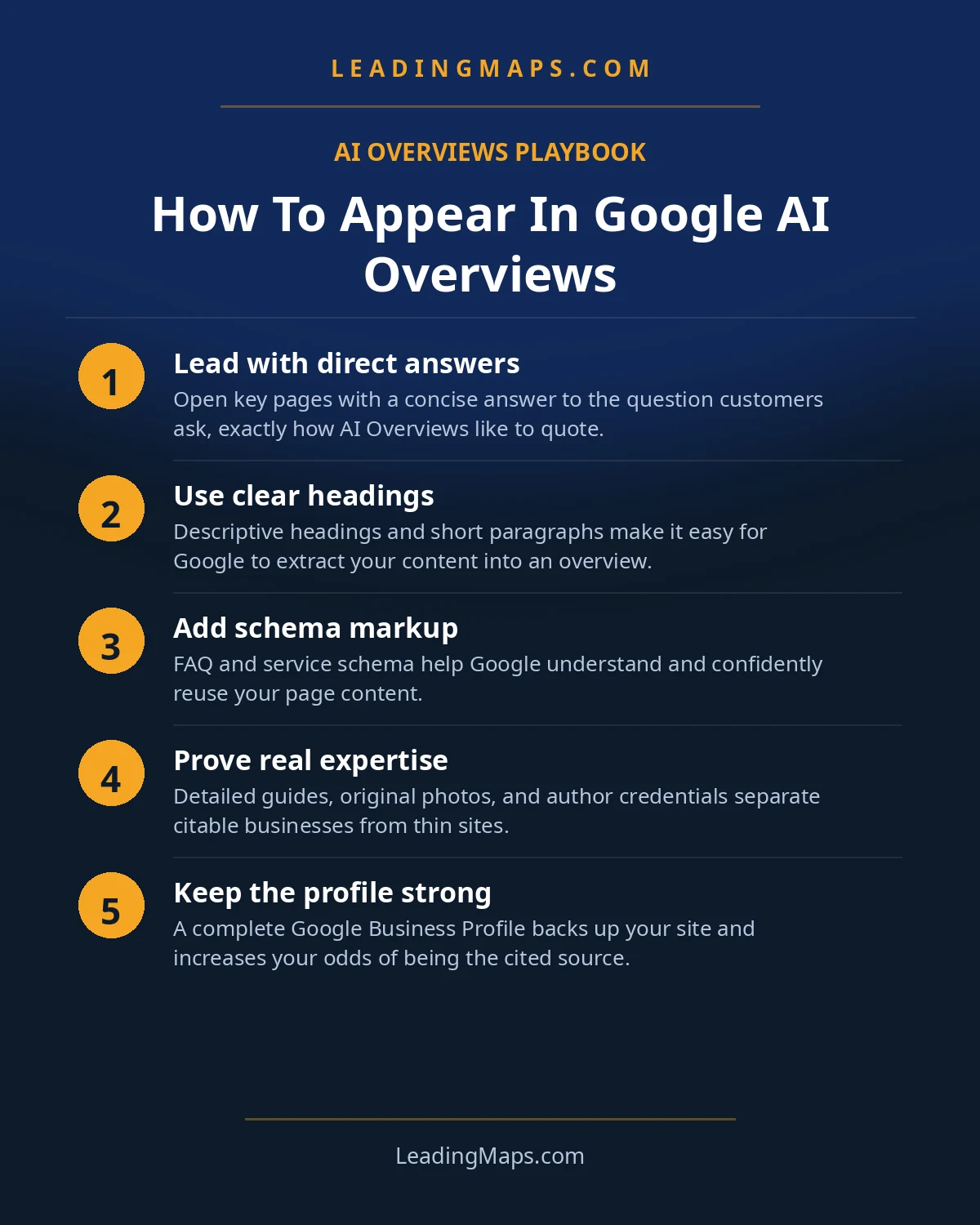
Google's official guidance on AI features is refreshingly plain: to be eligible as a supporting link in an AI Overview, a page must be indexed and eligible to be shown in Google Search with a snippet. There are no additional technical requirements. Good foundational SEO is the ticket in, and "all existing SEO fundamentals continue to be worthwhile."
The same docs describe query fan-out: one search triggers multiple related searches behind the scenes, which lets Google display "a wider and more diverse set of helpful links" than classic search shows. Translation: you do not need to rank number one to be cited. A well-built cost page sitting at position six can be the source the Overview quotes, as long as it is indexed, crawlable, and directly answers the question.
What the AI pulls from, in practice: your business profile data (services, hours, reviews), structured web content it can lift cleanly, and consistent facts about your business across the web. Everything below is about making each of those sources quotable.
Your Profile Is The Data Feed
Your Google Business Profile is not just a listing anymore, it is the verified data feed AI systems read first. Search Engine Journal's analysis of AI Mode identified the business profile as generative AI's most critical source of verified local data, the place AI Mode pulls business cards from when it replaces the traditional map pack.
For contractors, "complete profile" means trade keywords in the right fields:
- Service descriptions with trade terms. List every service with a description a homeowner would search: "tankless water heater installation," "AC repair and tune-up," "full roof replacement," not generic "plumbing" or "HVAC services." Include same-day and emergency services explicitly.
- Correct primary and secondary categories. Plumber, HVAC Contractor, Roofing Contractor, Electrician, plus relevant secondaries like Water Heater Repair Service or Air Conditioning Repair Service.
- Current hours and attributes. 24-hour or emergency hours, license mentions where supported, and every relevant attribute filled. The AI needs facts, and empty fields are missing facts.
Keep the profile's service list identical to the services on your website. When the two disagree, the AI cannot summarize your offerings with confidence, and it cites the competitor whose facts line up.
Reviews That Name The Service And The City
Review text is some of the most quotable material AI systems have about your business. When an assistant decides which plumber to name, it looks for evidence of real work in real places, and your reviews are where that evidence lives.
"Great service, highly recommend" tells the AI nothing. "Mike replaced our water heater the same day, best plumber we have used in Frisco" gives it a service, a city, and an outcome, a complete citable fact. You cannot write your customers' reviews, but you can shape what goes into them:
- Teach techs the detail nudge. On site, after the walkthrough: "If you mention what we fixed, it helps your neighbors find us." That one line produces reviews with service and outcome language.
- Reply to every review with specifics. Your replies are indexed text you fully control. "Thanks, Sarah, glad Tom got your AC back up same-day here in Mesa" adds service plus city language even when the customer's review was brief.
- Keep velocity steady. AI systems weight recency. Eight to twelve reviews a month, every month, reads as an active, thriving business; a profile whose newest review is eight months old reads as possibly closed.
We cover the full review system, tech scripts, SMS timing, and templates, in our field guide to getting more Google reviews.
FAQ Schema On Cost And Service Pages
The queries that trigger AI Overviews for contractors are questions, so the pages that answer them should be structured like questions. FAQPage schema on your cost and service pages tells Google exactly which answers to lift.
Build FAQ sections for pages like "water heater replacement cost in [city]" with direct 40 to 60 word answers:
How much does water heater replacement cost in Plano?
Most standard tank replacements in Plano run $1,400 to $2,800 installed, depending on tank size, code upgrades, and disposal of the old unit. Tankless installations typically run $2,800 to $5,500. We provide firm quotes after a free on-site assessment.
Rules that keep it working: every answer in the schema must appear verbatim in the visible page text (Google's docs are explicit that structured data must match visible content), keep answers factual rather than salesy, and use the homeowner's actual language, "how much does X cost" not "our competitive pricing structure."
Answer-First Content AI Can Lift
AI systems lift answers, not introductions. Put the direct answer in the first 60 words of every service and cost page, then expand. If your "roof replacement cost" page opens with three paragraphs about your company history, the AI will quote the competitor whose first sentence is the price range.
- Question headings. Use H2s phrased as the queries homeowners type: "How much does AC replacement cost in Phoenix?" not "Investment Considerations."
- Tables for comparisons. Tank vs tankless, repair vs replace, cost by system size. Tables are the most extractable format for AI answers.
- One service, one page. A dedicated page per service gives the AI a clean unit to cite; a "services" page listing twelve offerings in two lines each gives it nothing quotable.
Backlinko's analysis of AI Overview citations makes the deeper point: AI answers organize around decision criteria, and they cite the brand most clearly associated with each criterion. For HVAC, their example decision drivers were 24/7 emergency service, fast installation, energy-efficient systems, and strong local reviews. Pick the criterion you can credibly own in your market, then repeat it consistently across your site, your profile, and your reviews until the AI associates it with you. Read their full breakdown here.
Consistency: NAP Everywhere
Every AI system cross-checks your facts. When your phone number differs between your website and your Yelp profile, or your hours disagree between your site and your Google profile, the AI has conflicting data and no way to resolve it. The safe move for a system designed to avoid hallucinating is to skip you and cite the competitor whose facts agree everywhere.
Audit your name, address, phone, hours, and service descriptions across your website, your business profile, and the major directories (Yelp, Angi, BBB, Facebook). Identical everywhere is the standard; close enough is not.
Open The Door For AI Crawlers
AI Overviews are Google, but ChatGPT, Perplexity, and Claude run their own crawlers, and they can only cite what they can read. Check your robots.txt and confirm you are not blocking them sitewide. The bots to know:
- GPTBot, OpenAI's crawler, feeds ChatGPT's knowledge of your site.
- PerplexityBot, Perplexity's crawler, feeds its cited answers.
- ClaudeBot, Anthropic's crawler, feeds Claude's answers.
- Google-Extended, Google's token for AI training and grounding in some of its other systems, separate from regular Search crawling.
Google's official docs are clear about Search itself: the control is robots.txt directives for Googlebot, plus preview controls like nosnippet and noindex if you want content excluded from AI features. The third-party AI crawlers are separate decisions. Blocking them does not help your Google rankings, it just makes you invisible on those platforms.
The Llms.txt Reality Check
You may have been pitched an "llms.txt file" as the secret to AI visibility. Here is the honest version: llms.txt is a proposed standard that has not been adopted by Google. Google's published guidance lists the actual controls, robots.txt directives for Googlebot, preview controls like nosnippet and noindex, and Google-Extended for AI training in some of its other systems. There is no llms.txt anywhere in that list.
That does not mean AI-crawler access does not matter, the section above is real work. It means the work is robots.txt, schema, content, reviews, and profile data, the boring fundamentals, not a magic text file. If an agency quotes you for an llms.txt file, an "AI-flavored rewrite" of your service pages, or anything Google says it does not use, that quote is for work that will not move the needle.
Verify, Don't Guess
AI visibility is testable, which is more than you can say for most SEO advice. Run this check tonight:
- Search your money queries. In a private window, search "water heater replacement cost [your city]," "best plumber near me," and your other top queries. Note whether an AI Overview appears and which businesses it names.
- Ask the assistants directly. Ask ChatGPT, Gemini, and Perplexity "who is the best [your trade] in [your city]?" Log who gets named and what sources are cited.
- Check your profile against the winners. Compare their service descriptions, review recency, and review detail to yours. The gap is usually obvious.
- Repeat monthly. AI answers shift as reviews and content update. Monthly testing keeps you honest.
If you are named nowhere and a competitor is named everywhere, the playbook above is your fix list. If you would rather have it diagnosed for you, our free AI visibility audit runs these exact checks and hands you a prioritized plan.