On This Page
A homeowner searches "emergency plumber near me" and finds your Google listing with one phone number, your Angi profile with another, and a Yelp page showing an address you left three years ago. Which one calls you? None of them. Conflicting information reads as a business that might not exist, and customers move on to the competitor whose facts agree with each other.
That's NAP consistency, the boring-sounding discipline of keeping your Name, Address, and Phone number identical everywhere online. It's boring in the way that foundations are boring: everything visible sits on top of it.
This is the only NAP guide written for the AI-search era. In classic search, inconsistent NAP capped your rankings. In AI search, it can remove you from answers entirely, because an AI answer has no local pack to fall back on. If a model can't verify you're real, current, and reachable, it simply names someone else.
What NAP Consistency Actually Means
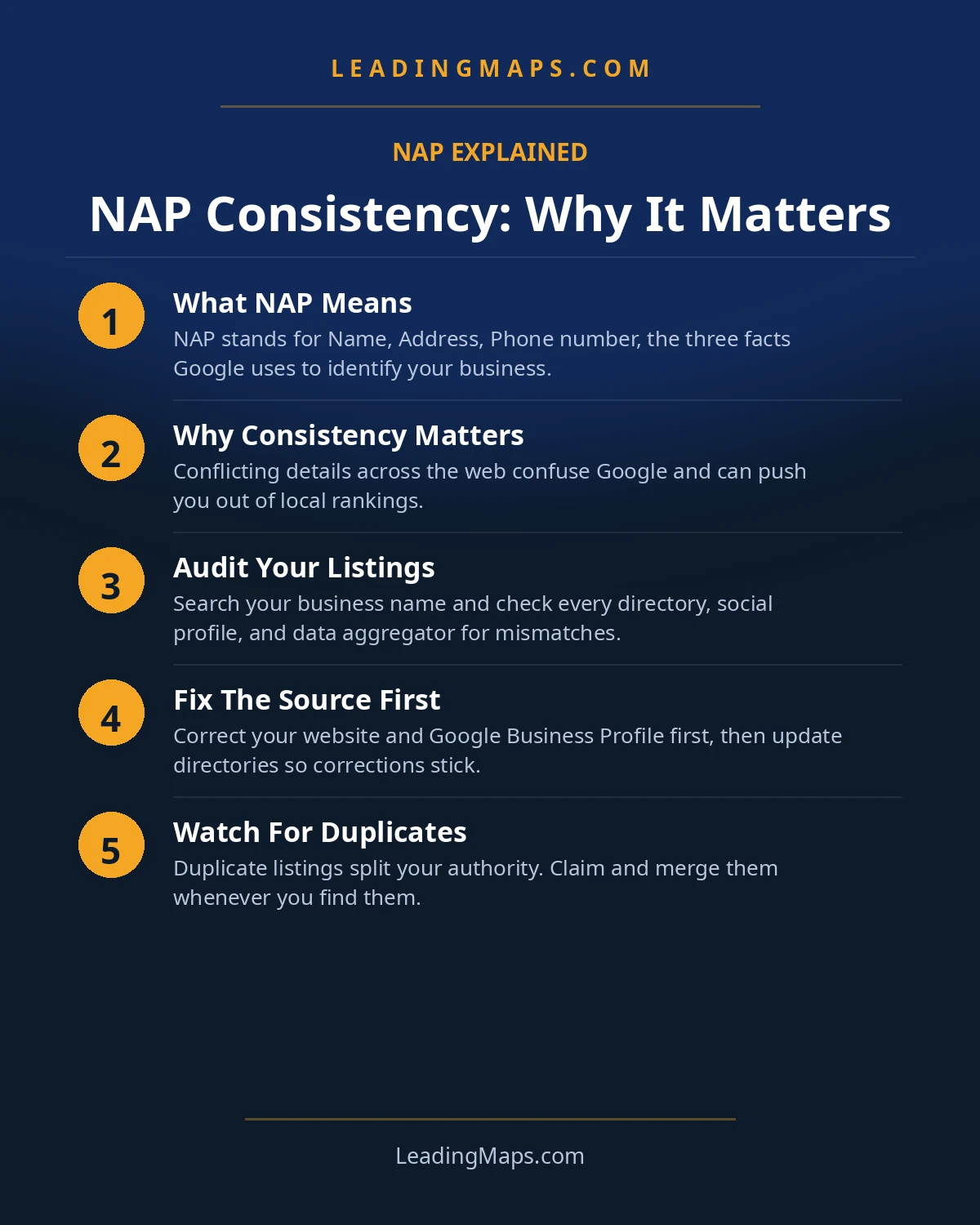
NAP stands for Name, Address, and Phone number, the three core facts that identify a business online. NAP consistency means those three facts appear identically across your website, your Google Business Profile, and every directory, review site, data aggregator, and social profile where your business appears.
Where it shows up in practice:
- Name: "Apex Plumbing Co." vs "Apex Plumbing Company" vs "Apex Plumbing Co LLC". Pick the one on your signage and stick to it.
- Address: "123 Main St, Suite 4" vs "123 Main Street #4" vs your old shop's address that still lives on Yellow Pages.
- Phone: your main office line vs the call-tracking number your marketing vendor injected vs the cell number a tech posted on a directory two years ago.
A citation is any online mention of your NAP, structured or unstructured: your Google Business Profile, Yelp, Angi, HomeAdvisor, Thumbtack, Nextdoor, the BBB, your Facebook page, and the data aggregators that feed them all. Every citation is a vote on who you are. When the votes disagree, Google and AI systems hedge, and hedged businesses don't get recommended.
Whitespark's 2026 Local Search Ranking Factors survey, where 47 local search experts scored 187 signals, still groups NAP consistency under citation signals as a foundational factor. It's not the flashiest lever, but it underpins the signals that are.
Why It Matters More Than Ever
NAP consistency works on two levels: customers and machines.
On customers, it's simple trust. BrightLocal's research has long shown that consumers avoid businesses with incorrect information, losing trust over wrong addresses and wrong phone numbers. In home services, the stakes are immediate: nobody calls the plumber whose listing shows a disconnected number. One wrong digit on one directory is a dead lead you never hear about.
On machines, NAP is entity resolution, the process by which Google decides that the plumber on Maps, the plumber on Angi, and the plumber on your website are the same plumber. Conflicting NAP splits your entity into two or three partial entities, and each partial entity is weaker than the whole. Reviews, proximity, and relevance signals can't fully attach to a business Google isn't sure exists.
In Whitespark's 2026 survey, experts weighted citation signals at 13% of AI search visibility, more than double their weight in the classic map pack. NAP consistency gained importance exactly as AI search grew. (Whitespark, 2026 Local Search Ranking Factors.)
Think of NAP as eligibility, not a growth hack. Inconsistent NAP rarely drops you directly, but it caps how far your other signals can carry you. Clean NAP removes friction so your reviews, your proximity, and your content can do their full job.
The AI-Search Reason: NAP Is How LLMs Decide You're Real
Here's the angle no other NAP guide covers, because none of them were written for AI search. When ChatGPT or Perplexity answers "who's a good roofer in Frisco," it doesn't show a map pack with three options and an organic list as backup. It names one or two businesses, in prose, or it names none. There is no local-pack fallback position.
To name a business, the model has to be confident in three things: that the business is real, that it's current, and that the customer can reach it. It builds that confidence by cross-referencing your NAP across sources: your Google Business Profile, your website, directories, review sites, and the aggregators behind them. When five sources agree on your name, phone, and service area, confidence is high. When your Angi listing shows a different number and your Yelp page shows a dead address, confidence collapses, and the model picks a competitor whose facts agree.
This is why AEO and GEO work starts with entity verification before any content tactics. BrightLocal's 2026 survey found 45% of consumers used AI tools for local business recommendations in the last year, up from 6% the year before, and explicitly advises businesses to keep websites updated and monitor listings for inaccuracies. The recommendation channel is growing; the verification layer underneath it is NAP.
There's a second AI layer: monitoring when AI surfaces stale numbers. Ask ChatGPT and Perplexity for your own business's phone number and hours every quarter. If an assistant quotes your old office line, that number lives somewhere on the web, in an aggregator feed or a legacy directory, and it's feeding both AI answers and the customers who trust them. Find the source and fix it at the root.
Accuracy Beats Formatting Perfection
There's an old debate in local SEO about whether "St." vs "Street" or "(555) 123-4567" vs "555-123-4567" matters. The practical answer, and the one the evidence supports: accuracy matters far more than formatting perfection.
A wrong phone number kills leads. An old address confuses customers and Google alike. A different business name on different platforms splits your entity. Those are real errors with real costs. But "Suite 4" vs "Ste. 4," or a hyphenated vs parenthesized phone format, are cosmetic differences that modern entity resolution handles fine, as long as the underlying facts are correct and the canonical version is consistent across your most important sources.
So spend your energy where it counts: correct facts, one canonical version, fixed at the source. Don't burn hours normalizing abbreviations across 80 directories while your Angi listing still shows a phone number you retired in 2022.
The Contractor NAP Playbook
Contractors break NAP in ways retail businesses never do. Here's the trade-specific hit list, in order of damage:
Service-Area Businesses And Hidden Addresses
Most contractors are service-area businesses: you visit customers, they don't visit you. Hiding your address on your Google Business Profile is correct and expected. It doesn't hurt NAP, your consistent name, phone, and service area still identify you.
The trap is partial hiding. Your profile hides the address, but an old aggregator record still publishes your home address from the DBA days, or a trade directory shows the shop you closed. That mismatch, hidden here, published there, is exactly what creates entity confusion. If you hide your address, audit every source to make sure nothing publishes a stale one.
Call-Tracking Numbers Injected By Vendors
Marketing vendors love call tracking, and it has its uses, but every unique tracking number published on a directory is a NAP inconsistency that Google and AI systems have to resolve. The worst pattern we see: a different tracking number on the website, the GBP, and three directories, so the business effectively has four phone numbers and zero confidence.
The safe setup: one primary business number everywhere public, call tracking behind it (dynamic number insertion on your own site is fine), and tracking numbers never published as the business's number on any listing. If a vendor already scattered numbers across directories, that cleanup is step one.
Rebrands, Mergers, And Legacy Trade Names
"Smith & Sons Plumbing" becomes "FlowRight Plumbing" after a buyout, or two shops merge and the old names linger. Legacy names live on in Angi, HomeAdvisor, and Thumbtack profiles for years, and each one is a competing entity claim. Rebrand cleanup means hunting every legacy name, merging or closing the old profiles, and updating aggregators, not just swapping the logo.
Trade Directories: Angi, HomeAdvisor, Thumbtack, Nextdoor, BBB
Trade directories carry extra weight for contractors because they're exactly where homeowners cross-check you, and exactly where AI assistants look for corroboration. They're also the directories contractors set up once and never touch again. Claim them, align the NAP to your canonical version, and keep the business description current.
The US Aggregation Chain
Data Axle and the other major aggregators feed hundreds of downstream directories. Fix your NAP at the aggregator level and corrections cascade downstream over weeks. Fix only downstream directories and the aggregator feed re-pollutes them on the next sync. Always fix upstream first: your Google Business Profile and website, then the aggregators, then the directories.
How To Audit And Fix Your NAP
Do this in order, because corrections flow downstream, not upstream:
- Lock your canonical NAP. Write down the exact business name, phone, and address format, and get everyone on the team using it. This is the version everything else matches.
- Fix your Google Business Profile first. Name, phone, categories, hours, service area. This is the source of truth most systems check first.
- Fix your website. Visible NAP in the footer of every page, matching LocalBusiness schema, no conflicting numbers in headers or old blog posts.
- Fix the aggregators. Data Axle and the other major feeds, so corrections cascade to the directories they supply.
- Fix the trade and major directories. Angi, HomeAdvisor, Thumbtack, Nextdoor, BBB, Yelp, Facebook, Apple Maps, Bing Places.
- Run a citation scan and clean up stragglers. Tools like Whitespark or BrightLocal catch the long tail of mismatches. Then re-check quarterly, new mismatches appear constantly.
The full directory list and tier system is in our guide to the best local citation sites for contractors. And if your NAP audit turns up a second Google Business Profile you didn't know about, read how to remove duplicate business listings before you touch it, the merge-or-delete decision has real consequences for your reviews.
NAP consistency is unglamorous work, but it's the verification layer everything else sits on. Rankings, AI recommendations, and actual phone calls all start from the same question: is this business real, current, and reachable? Consistent NAP is how you answer yes.