On This Page
Search your business name on Google and you might find two listings for the same shop. One has your current phone number and hours. The other has an old address, a different set of reviews, and a name you stopped using five years ago. Customers call the wrong one, reviews split across both, and Google isn't sure which business is real.
That's a duplicate listing, and contractors get them more than almost any other business type. Mergers, DBA changes, dispatch offices, service-area businesses run from home addresses, multi-truck shops adding locations, every growth event in the trades creates a new opportunity for a second profile to appear.
Generic duplicate guides cover the basics and stop there. This one is written for contractors: where your duplicates actually come from, the merge-or-delete decision with its review consequences, the AI-search reason duplicates are more dangerous than they used to be, and the prevention system that keeps growing shops clean.
What Counts As A Duplicate (And What Doesn't)
Google's rule is straightforward: one profile per business per location. A duplicate is two or more profiles representing the same business at the same location. Google's own documentation states that duplicates won't show properly on Search and Maps, and that violating listings risk suspension.
What counts as a duplicate:
- Two profiles for the same shop, one with your current name, one with a legacy name from a rebrand or merger.
- A profile at your old address that survived the move, collecting reviews at a location you no longer occupy.
- A dispatch office or warehouse that got its own profile even though it's not a customer-facing location.
- A service-area profile at your home address created years ago, plus a newer one at your shop.
What is not a duplicate: genuinely separate locations (different addresses, different phones, different service areas), or clearly distinct departments or brands operating from the same address with separate staffing and phone lines. If two locations are truly separate businesses, don't merge them, differentiate them with unique names, numbers, and categories instead.
Where Contractor Duplicates Come From
Nobody writes the contractor-specific causes, so here they are, ranked by how often we see them:
Legacy Trade Names From Mergers And DBA Changes
The number one source. "Smith & Sons Plumbing" gets bought and becomes "FlowRight Plumbing," but the old profile keeps living on Google, Angi, and HomeAdvisor for years, collecting reviews meant for the new company. Every rebrand or merger without a listing cleanup leaves a ghost profile behind.
Service-Area Duplicates At Home Addresses
The classic contractor origin story: you started the business from your house, created a profile with your home address, then opened a shop and created a second one. The home-address profile lingers, and because service-area businesses hide their addresses, customers can't tell which listing is current.
Dispatch-Office Duplicates
Your warehouse or dispatch office gets listed by a well-meaning office manager, a directory scraper, or an employee "helping out." It's not customer-facing and shouldn't have a profile at all, but now it exists and it's collecting misdirected reviews and calls.
The Multi-Truck Shop Problem
Growth creates duplicates. You open a second location and someone creates its profile with the same phone number as the first, or lists the same service area with a slightly different name. Now Google sees two profiles with overlapping data and can't tell whether it's one business or two, which is exactly the pattern that triggers suspension reviews.
Two profiles with 40 reviews each never carry the ranking weight of one profile with 80. Duplicates split reviews, clicks, calls, and photos across listings, and Google has to guess which one represents your business. Consolidation is a ranking move.
Why Duplicates Hurt More In The AI-Search Era
Duplicates used to be a Maps problem. Now they're an AI problem too, and the AI problem is worse.
AI Overviews and LLM answers draw on exactly the signals duplicates destroy: review content and volume, and a coherent knowledge graph entity. Two profiles with 40 reviews each don't just rank worse in the map pack, they give AI assistants two weak, conflicting evidence sets instead of one strong one. Conflicting names, addresses, and hours feed contradictory facts into the knowledge graph, and when a model is unsure which entity to recommend, the safest move is to recommend neither.
This is why AEO and GEO work starts with entity cleanup. Whitespark's 2026 Local Search Ranking Factors survey has experts weighting review signals heavily in both the map pack and AI search visibility. Every review sitting on a ghost duplicate is review signal your real profile isn't getting, in either system. And it costs you customers, not just rankings: BrightLocal's 2026 Local Consumer Review Survey found 97% of consumers read reviews for local businesses, so a profile split across two listings shows every buyer a weaker business than you actually are.
Ask ChatGPT or Perplexity for your business by name and watch which profile details it quotes. If the answer cites the old address or the legacy trade name, your duplicate is actively feeding AI answers, and it's training the model on facts you don't want associated with you.
Find Every Duplicate
Finding duplicates is usually easier than fixing them. The challenge is knowing where to look, because a duplicate often carries a slightly different name, an old phone, or an outdated address. Work through these in order:
- Search your exact business name on Google and Google Maps, then scroll the full results list, not just the first match.
- Search every name variant you've traded under, abbreviations, with and without LLC, misspellings customers make, and every former business name and DBA.
- Search your phone number. This is the highest-yield search: a duplicate created by someone else usually carries the right phone number even when the name is wrong.
- Search your current and every previous address, in alternate formats, since "Suite 4," "Unit 4," and "#4" are three different strings to a database.
- Run Google's "add your business" flow without finishing it. Google surfaces possible existing matches as you type, which is a useful backdoor list of profiles tied to your location. Stop before you create anything.
- Run a citation scan to catch aggregator-level duplicates that Google search misses.
Screenshot every duplicate before you touch it, profile URL, review count, and the reviews themselves. You'll need the record when you decide which profile survives.
Merge, Remove, Or Report: Pick The Right Path
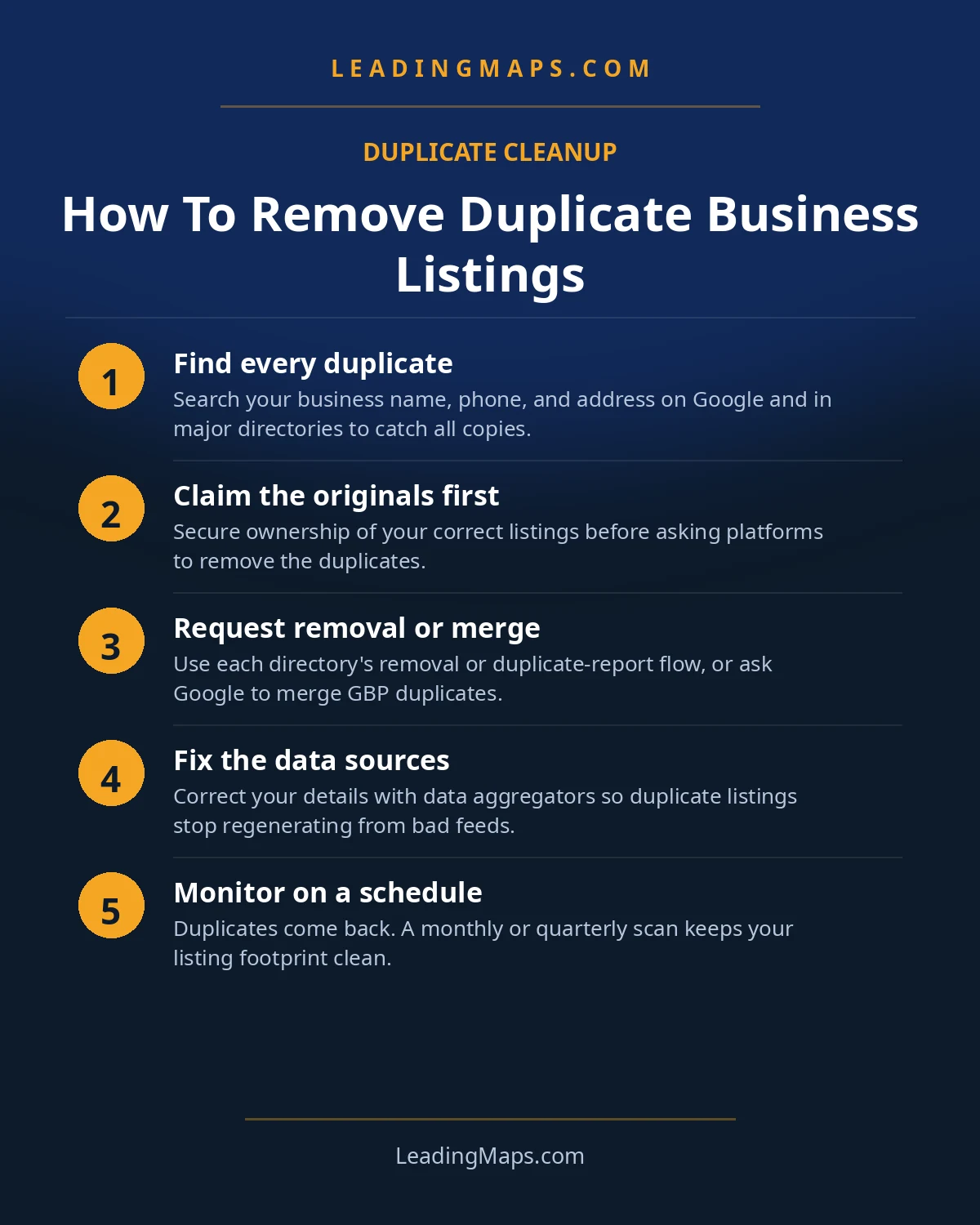
There are three paths, and the right one depends on who controls the duplicate. SocialPilot's duplicate listings guide lays out the mechanics well; here's the contractor decision framework:
Merge, When Both Profiles Are Real Duplicates And Reviews Matter
If you control both profiles (or can get access to the duplicate), and the duplicate carries reviews you want to keep, request a merge. Google's route is a Maps suggestion, "report a suggestion on Google Maps," and every merge request goes through review. Before you file it, align the name, address, phone, and category across both profiles as closely as reality allows, mismatched profiles get rejected. Reviews combine onto the surviving listing, but read the warning below first.
Remove, When The Duplicate Has Nothing Worth Keeping
If you created a duplicate by mistake and it has no reviews, no photos, and no traffic, remove it from the Google Account that manages it. Removal is absolute: all content and linked managers go with it. Only take this path when there's genuinely nothing to lose, and only after you've confirmed you're removing the duplicate, not your real listing.
Report, When Someone Else Controls It
If the duplicate is claimed by someone else, or you can't get access, open it in Google Maps, select "Suggest an edit," then "Place closed or not here," then "Duplicate of another place," and point at your real profile. If ownership was taken by a former employee or agency, request access first; if they don't respond, Google may let you claim it.
The Review-Loss Warning (Read Before You Merge)
This is the step contractors skip, and it's the one that costs real money. Two years of careful review responses, the kind that convert future customers and feed AI search with quotable service language, can vanish in a merge. The screenshots also protect you if the merge goes wrong and you need to appeal.
The math on merge vs delete: if the duplicate holds reviews you can't afford to lose, merge, because deletion destroys every review attached to the removed profile with no recovery. If the duplicate is empty and was created by mistake, deletion is clean and fast. When in doubt, merge, reviews are the hardest asset in local SEO to rebuild.
After the merge resolves, keep sending new reviews to the surviving profile, update your website schema and any QR codes to the surviving Maps URL, and watch Search and Maps for a week. If both pins still appear, don't create a third profile, re-check ownership and whether the suggestion was rejected.
Prevent Duplicates In Growing Shops
Cleanup is a project. Prevention is a policy. Growing shops should lock these in:
- One owner, one account. All profiles live in a single Google account controlled by the business owner, never in an agency's account, never in a former employee's personal Gmail. Every agency departure is a future duplicate.
- Canonical NAP document. The exact business name, phone, and address format, written down, shared with everyone. Our guide to NAP consistency covers the full setup.
- No new profiles without a checklist. Before any new location gets a profile: unique phone number, unique address, correct primary category, service area set properly. Two locations sharing a phone number is a duplicate factory.
- Rebrand and merger protocol. Every name change triggers a listing cleanup sprint: old profiles merged or closed, aggregators updated, trade directories corrected. The ghost profile should die the same month the new name launches.
- Quarterly duplicate scan. Ten minutes every quarter: search your name, phone, and addresses. Catch strays while they have three reviews, not thirty.
And if your cleanup turned up NAP mismatches beyond Google, work through the citation site list next, and rebuild your review momentum with the review engine. Duplicates are one half of entity cleanup; consistent citations are the other.