Here is the pitch nobody selling retainers will give you: most of local SEO for a contracting business is unglamorous, checkable work, and you can do the first 70 percent of it yourself. Claim the profile, fix the categories, clean up the listings, build a few pages, systematize reviews. None of it requires an agency. All of it requires follow-through, which is exactly why most contractors never finish it.
This checklist is the whole program, phased across four weeks so you can do it between jobs. It is written for service-area trades, plumbers, HVAC techs, roofers, electricians, not cafés. It includes the AI-search layer every DIY guide skips, because in 2026 the homeowner asking ChatGPT for a contractor is as real as the one typing into Google. And at the end, the honest math on where DIY stops working, so you know exactly when hiring help is the rational move.
On This Page
The Honest Math On DIY Local SEO
Start with what it costs: your time. The initial push below is roughly 20 to 30 hours spread over a month, an hour or two most evenings. After that, maintenance runs 6 to 10 hours a month: a post here, review replies there, a photo upload after each job. That is the real price tag, and you should weigh it against your billable rate before you start.
What DIY reliably wins: a complete and accurate profile, consistent listings everywhere, a review system that compounds, and a website that converts the traffic you already earn. In smaller markets and less competitive trades, that alone can carry you into the map pack. What DIY does not reliably win: outranking entrenched competitors in big metros, recovering from suspensions, or building the local links that separate number one from number four. Know which game you are in before you decide the budget is zero.
If you run the numbers and your evenings are worth more than a retainer, read our contractor pricing guide first. Either way, the checklist below is worth doing, because even hired work performs better on top of clean foundations.
Week 1: Your Google Business Profile
Everything starts here. For a contractor, the profile is not a directory listing, it is the storefront. A large share of your calls will come from people who never visit your website at all. Do this week properly and you have done the highest-ROI work in all of local SEO. Google's own guidance on improving local ranking names the same three pillars, relevance, distance, and prominence, and week one is almost entirely relevance.
- Claim and verify the profile. Finish verification before touching anything else.
- Set your primary category to the single most accurate trade, then add every genuine secondary category.
- Fix the service-area settings: if customers don't come to you, hide the address and set honest service areas, the cities and zips your trucks actually reach.
- Build the full services list: every service you sell, one plain sentence each. List emergency services explicitly.
- Set real hours plus upcoming holiday hours. Only claim 24 hours if someone genuinely answers.
- Write the 750-character description: what you do, where, and one differentiator. Homeowner-first language.
- Upload 20+ real photos: branded trucks, uniformed techs, before-and-afters. No stock photography.
- Seed 5 to 10 Q&A entries with the questions homeowners actually ask, answered thoroughly.
The deep version of this week, with the AI-search angle most guides miss, is our profile optimization checklist. If you only do one week of this entire guide, do this one.
Week 2: Citations And NAP Consistency
NAP is your name, address, and phone number, and consistency means identical everywhere, down to "Suite" versus "Ste." Inconsistent data does not just confuse Google, it makes AI assistants unable to confidently resolve your business as a real entity, which is how you become invisible to them too. Our NAP guide covers the why. This is the doing.
- Lock one exact NAP format and write it down. This is now law, everywhere.
- Search your business name and phone number. Open every listing that appears.
- Fix mismatches before building anything new. One wrong phone number undoes ten new citations.
- Claim the core platforms: Bing Places, Apple Business Connect, Facebook, Yelp, Nextdoor, and the BBB.
- Add your trade directories: Angi, Houzz, HomeAdvisor, plus your local chamber of commerce.
- Hunt duplicates. Same business, two listings splits your reviews and confuses rankings. Merge or remove them properly.
Do not buy a 300-citation blast. Consistency across the 30 places that matter beats volume everywhere else. If citations sound tedious, that is because they are, which is also why most of your competitors have them wrong.
Week 3: Your Website
You do not need a big website. You need a fast one with the right pages. Most contractor sites fail on three things: no dedicated service pages, no location pages, and a phone number you cannot tap on a phone.
- Build one page per core service (drain cleaning, AC repair, roof replacement), each with genuinely unique content.
- Build one page per town you actually serve, with local specifics, not swapped city names on duplicate text.
- Put your exact NAP in the footer of every page, matching week two's locked format.
- Make the phone number tappable and keep it above the fold on mobile, where emergency searches happen.
- Test speed and compress images until the mobile experience is fast. Slow pages lose the call before it happens.
- Add LocalBusiness schema with your name, phone, hours, area served, and services. This structured data is what both Google and AI assistants read to understand your business.
- Install Google Search Console and submit your sitemap. Check it monthly; it shows which queries actually bring visitors.
One strong service page and one strong town page beat twenty thin ones. Depth first, breadth later, and never publish a page you would not want a customer to read.
Week 4: Reviews
Reviews do triple duty: they influence map-pack rankings, they decide whether the homeowner calls you or the next listing, and they are a primary signal AI assistants read when recommending businesses.
- Text every customer a direct review link within 24 hours of job completion, while the work is fresh.
- Have techs mention it at the door. One sentence ("you'll get a text, a review really helps us") doubles response rates.
- Respond to every review, good and bad, within 48 hours. Specific replies, not copy-paste templates.
- Never buy reviews and never filter out unhappy customers. Both violate policy and both get profiles suspended.
The full system, with scripts and reply templates, is in our review guide. And when a bad one lands, the response playbook keeps it from costing you twice.
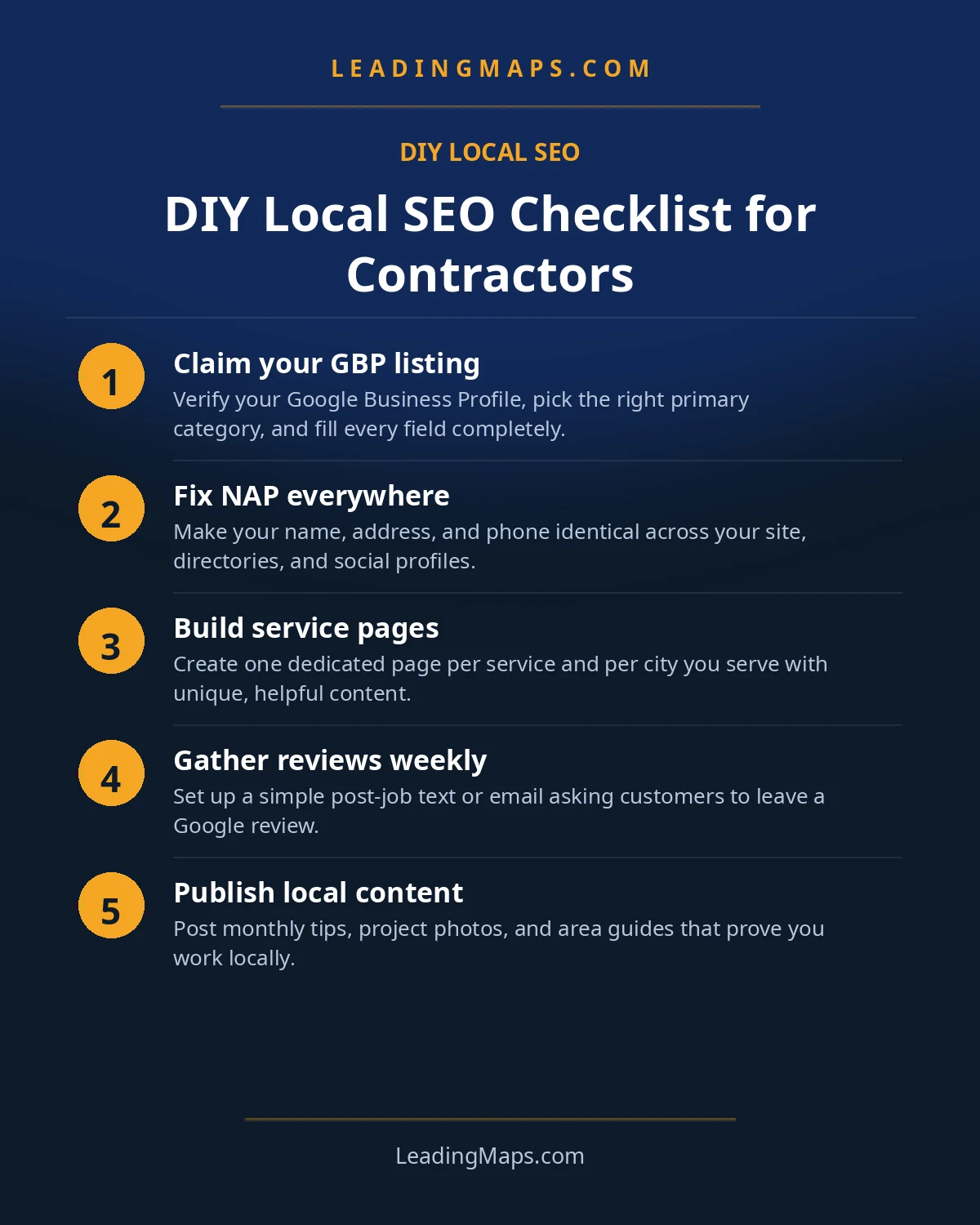
The full initial DIY push: four focused weeks, then a few hours a month to maintain. Most contractors never finish week one, which is why finishing all four puts you ahead.
The Monthly Rhythm That Keeps It Working
Local SEO decays. Competitors post, reviews age, hours go stale, duplicates reappear. The maintenance loop is small, but it never ends:
- Publish 2 to 4 profile posts a month: real jobs, seasonal reminders, current offers.
- Upload new job photos monthly. Recency signals an active, operating business.
- Reply to every new review within 48 hours, without exception.
- Quarterly: recheck categories and hours, and hunt for new duplicate listings.
- Monthly: open Search Console, note which queries grew, and check your map-pack positions in an incognito window.
The DIY AI-Search Layer (What Every Other Checklist Misses)
Here is the part no DIY guide covers, and in 2026 it matters. When someone asks ChatGPT or Perplexity for a contractor, the answer is assembled from structured business data, not scraped from your homepage headline. Almost everything you built in weeks one through four already feeds it, but a few additions aim straight at AI visibility:
- Complete services with descriptions. This is the structured inventory AI answers pull from when matching a query to a business.
- Q&A phrased the way homeowners actually ask. AI systems match queries to natural phrasing, so write questions like a customer talks.
- Reviews that mention actual work done. Assistants weight specific review text ("replaced our water heater same day") over generic five-star praise.
- Identical NAP everywhere. LLMs resolve businesses as entities, and inconsistent data makes you unresolvable, which means invisible.
- LocalBusiness schema on your site. Machine-readable facts about who you are, what you do, and where you do it.
The professional version, monthly prompt testing across ChatGPT, Gemini, and Perplexity with real homeowner questions, is what our AEO and LLM optimization service does. The DIY layer above gets you most of the way there, because the underlying asset, clean structured business data, is the same either way.
What DIY Can't Do, And When To Hire
Honesty requires the other side of the ledger. DIY has a ceiling, and it arrives faster in some markets than others:
- Big-metro competition. When the top three all have agencies, hundreds of reviews, and years of link building, evenings-and-weekends work rarely closes the gap.
- Multi-location or multi-trade operations. The checklist multiplies with every location, and consistency becomes a full-time job.
- Suspensions and penalties. Reinstatement is a specialized, high-stakes process, and wrong moves extend the outage by months.
- Your time math flips. When ten hours a month of your time is worth more than a retainer, DIY is the expensive option.
- The 90-day plateau. You did everything above, waited three months, and nothing moved. That is data, not failure. It means the market needs more firepower.
If you are at that point, vet agencies the right way: our 12-question hiring checklist starts with the AI-search questions nobody else asks. And if you have been burned before, the agency autopsy shows exactly what went wrong last time, so it does not happen again.
DIY Questions, Answered.
Expect early movement in 30 to 60 days as your profile, listings, and reviews come together, and meaningful ranking change within 60 to 90 days. Emergency trades often see calls sooner. If nothing has moved after 90 days of genuine execution, that is useful data: your market likely needs more firepower than DIY.
The initial push is 20 to 30 hours spread over about a month, roughly an hour or two most evenings. After that, maintenance runs 6 to 10 hours a month: posts, photo uploads, review replies, and a monthly check of rankings and Search Console. Consistency matters more than intensity.
Yes, up to a point. Your Google Business Profile alone can win calls in many trades and smaller markets, since most emergency searches end at the map pack. A website extends what the profile starts: service pages, town pages, and schema that both Google and AI assistants read. Profile first, website second.
Four cover nearly everything: your Google Business Profile dashboard, Google Search Console for queries and indexing, PageSpeed Insights for speed, and Google Analytics for what happens after the click. Add a spreadsheet for tracking rankings monthly. Everything else is optional until you outgrow the basics.
When one of four things is true: you have plateaued after 90 days of real work, you compete in a big metro against entrenched agencies, you are dealing with a suspension, or your time is worth more than the retainer. Hiring is not admitting defeat, it is buying back billable hours.
Finished The Checklist And Still Not In The Top 3?
Profile, Maps rankings, citations, reviews, competitors, plus whether AI assistants recommend you. A prioritized action plan, free, no pitch.
- AI visibility check, real homeowner prompts across ChatGPT, Perplexity, and AI Overviews, who gets named.
- Proposal scorecard, what your current or prospective agency should be doing, item by item.
- Competitor gap analysis, what the top 3 in your market are doing that you're not.
Get My Free SEO Audit
Delivered within 48 hours. Yours to keep.