On This Page
The invoices arrived on time, every month. The reports arrived too, full of green arrows and percentages. And the phone, the phone stayed quiet.
If that sounds familiar, this post is the autopsy: the specific ways agencies fail contracting businesses, the service-area pages built wrong, the GBP categories never fixed, the vanity keywords ranked while Local Services Ads ate the calls, and the failure your agency never diagnosed. You are invisible to AI search, and they never checked.
Read this before you sign with anyone again. It ends with a 15-point scorecard you can run on your last agency, and on the next one.
The Signs It Already Happened
You don't need an autopsy if the body is still warm, but most contractors misread the symptoms for months. Here is how a failed engagement actually feels from the owner's seat:
- The report says "up," the schedule says "empty." Impressions climbed, rankings "improved," and your booked jobs didn't move. The agency celebrates metrics that don't pay your techs.
- You stopped opening the reports. Forty pages of charts you can't connect to a single job. You stopped reading in month four because nothing in them ever changed a decision you made.
- Nobody can name your last five booked jobs' source. Ask the agency which jobs came from organic last month. If the answer is a shrug or a pivot to traffic, they never wired the business to the work.
- Your competitor's trucks are everywhere. You're paying for SEO, they're getting the calls, and nobody at the agency can explain why.
None of this means SEO doesn't work for contractors. It means the agency ran the wrong playbook, measured the wrong things, and sold you the report instead of the result.
Failure Mode #1: Invisible To AI Search
This is the diagnosis your last agency never made, because they never looked. About 45% of consumers now use AI tools like ChatGPT, Gemini, and Perplexity for local business recommendations. When a homeowner asks "who's a reliable roofer near me," the answer increasingly comes from an assistant, not a search results page. And in BrightLocal's 2026 study of 200,000 localized AI prompts, a tracked business showed up on Google Maps in 66% of searches but in AI answers only 32 to 38% of the time. Maps success does not automatically become AI visibility. Your agency optimized for one surface and left you dark on the other.
Here is what they never checked, any one of which can keep you out of AI answers entirely:
- AI crawler blocks inherited in robots.txt. Many sites block GPTBot, PerplexityBot, or Claude's crawler, sometimes copied over from an old template, sometimes added by a developer "for privacy." If the assistants can't crawl you, they can't cite you. Your agency never looked.
- No citation-worthy entity content. AI assistants quote pages that answer cleanly: who you are, what you do, where you do it, proof you do it well. Your site has a homepage, a contact page, and five thin service pages with stock photos. Nothing to quote, so nothing gets quoted.
- GBP data not structured for AI citation. Google's own AI products lean heavily on Google Business Profile data, and Google Business Profile made up more than a quarter of all AI citations in the BrightLocal study. But incomplete categories, missing services, and dead review velocity give the assistants thin material to work with, and ChatGPT barely uses GBP at all, it leans on Yelp and Bing sources your agency never touched.
- Zero presence tested, ever. The simplest check takes five minutes: ask ChatGPT, Perplexity, and Gemini for "[your trade] near me" and see who gets named. Your agency never ran that test, so they never knew you were absent, and they billed you while a competitor got recommended in your place.
This is the failure that stings most, because it compounds. Every month your competitor is the one AI names, their reviews, citations, and mentions grow, which makes AI name them more. Our AEO and GEO work starts by measuring exactly this gap, then closing it with entity-rich content and structured business data the assistants can verify and quote.
Of US Google searches ended without a click in early 2026, up from 60% in 2024, and when AI Overviews appear, click-through rates drop by nearly 60%. (SparkToro/Similarweb, via Search Engine Land.) Rankings that don't convert to AI citations are depreciating assets.
The Contractor-Specific Failure Modes
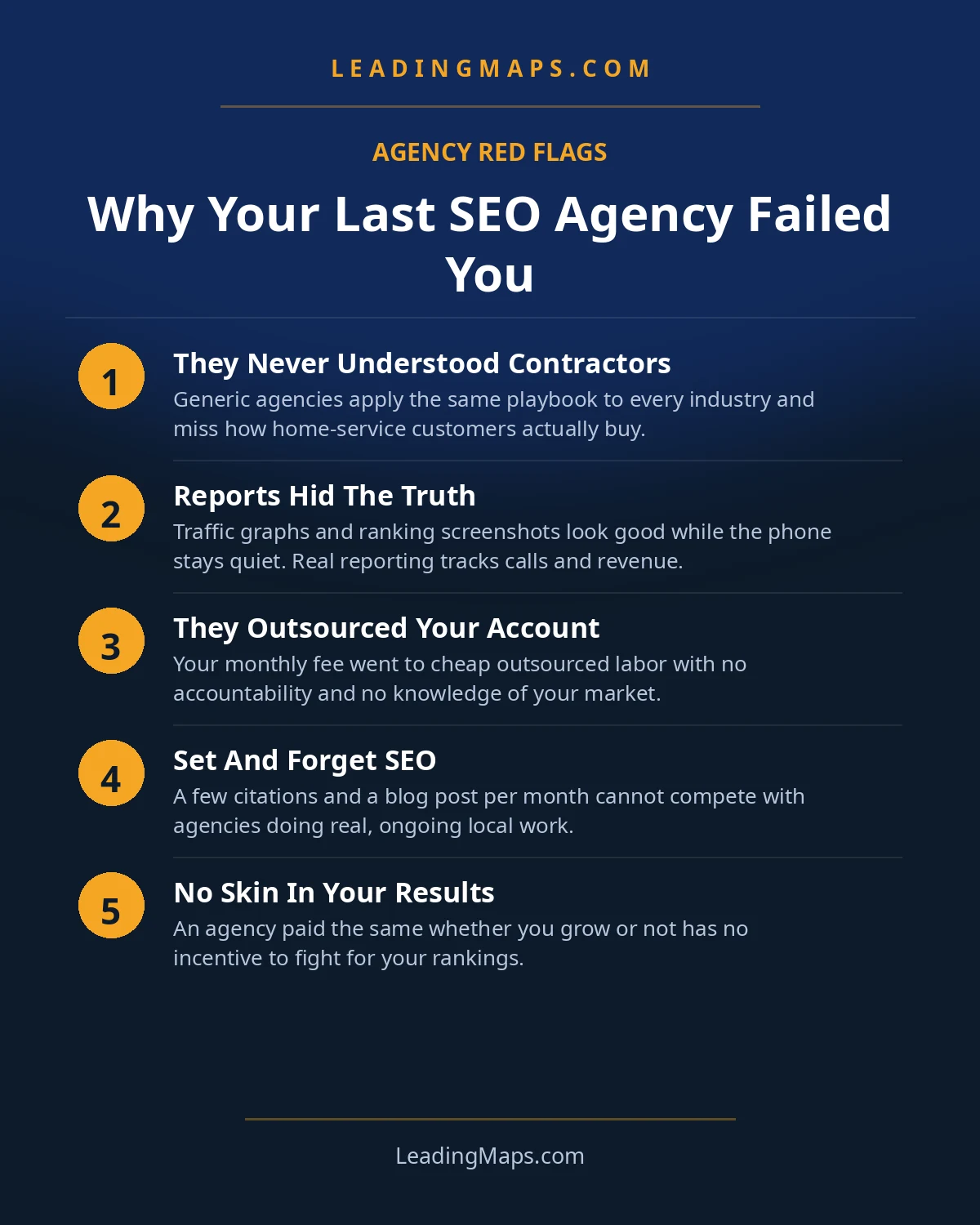
Generic agencies fail contractors in specific, predictable ways. If your last agency did any of the following, you were paying for a playbook written for someone else's business.
They Built Your Service-Area Pages Wrong
The classic move: fifty near-identical pages, one per suburb, with the city name swapped into the same paragraph. Google sees thin doorway content, homeowners see nothing useful, and the pages rank for nothing. Real service-area strategy is a handful of deep, genuinely different pages for your core services and the areas you actually serve, written to convert a homeowner with a burst pipe.
They Ignored Your GBP Categories And Review Velocity
Your primary category is the single highest-leverage setting on your profile, and agencies routinely leave it as "Contractor" when it should be "Roofing Contractor" or "HVAC Contractor," or stack secondary categories that confuse Google about what you do. Worse, nobody built a review engine. Your profile sat at 34 reviews while the competitor added eight a month, and in 2026, review recency and velocity feed both map rankings and AI recommendations. A proper GBP rebuild fixes categories, services, and the review machine in the first 30 days. Yours never got one.
They Chased Vanity Keywords While LSAs Ate The Calls
Here's a report we've all seen: "You're #1 for 'residential roofing company dallas'!" Meanwhile the homeowner with a leaking roof clicked the Local Services Ads at the top and called the first Google Guaranteed listing, never scrolling to organic at all. Your agency ranked you for terms that sound impressive in a report while the money keywords, "emergency plumber near me," "AC repair same day," were owned by ads and competitors. Rankings without call intent are decoration.
They Treated A $12k Roof Job Like A Blog-Traffic Exercise
Your agency published "10 Signs You Need a New Roof" and celebrated the traffic. But a homeowner reading that post is months from buying, and the post never mentions your service area, your warranty, or why to call you. One $12,000 roof replacement pays for a year of SEO. The content strategy should have been built around high-intent pages, roof replacement cost in your city, storm damage repair, financing, that convert a ready buyer, not a content calendar that feeds a traffic graph.
They Never Touched Your Actual Operation
The best local SEO lever in home services is your own crew: techs who ask for reviews on-site, dispatch that texts the review link after every job, an office that responds to every review within 24 hours. Your agency never trained a tech, never wrote a script, never looked at your review velocity. They stayed in their lane, the website, while the highest-impact work sat in your trucks.
They Measured The Wrong Scoreboard
Every failure above was invisible in the agency's reports, because the reports measured the wrong things. This is the meta-failure, the one that lets all the others hide for a year.
A typical failed-agency report shows keyword positions the agency chose, organic traffic from blog posts that never call, and impressions at scale. What it never shows: calls from organic, booked jobs, cost-per-job, or whether ChatGPT names you.
Real reporting for a contractor fits on one page: calls from organic and GBP this month, booked jobs attributed to organic, cost-per-job versus your other channels, map-pack positions on money keywords, and AI mention rates across the four platforms. If your agency's report couldn't produce that page, they weren't measuring your business. They were measuring their activity.
The 15-Point Agency Autopsy
This is the scorecard we run in our free audit, and the one you should run on any agency, past or future. Score your last agency honestly. If they fail more than a handful, you have your answer.
- Calls from organic and GBP, last 90 days. A real number, trending up, tied to source. Not "traffic."
- Booked jobs attributed to organic. Can they name jobs, not just calls?
- Cost-per-job from organic vs. your other channels. The only ROI math that matters.
- Money-keyword map-pack presence. "Emergency plumber [city]," not blog terms.
- ChatGPT recommendation test. Ask for "[trade] near me." Are you named?
- Perplexity citation test. Ask about your top services. Do your pages get cited?
- AI Overviews presence. Do you appear in Google's AI answers for your money queries?
- Robots.txt and AI-crawler access. Are GPTBot, PerplexityBot, and Claude's crawler allowed in?
- GBP primary category correctness. The exact trade category, not a generic one.
- Review velocity, last 90 days. Steady new reviews, or a profile gone quiet?
- Review response rate and quality. Every review answered, with specifics, within 24 hours?
- Citation and NAP consistency. Same name, address, and phone across the trade directories.
- Service-area pages. Deep, distinct pages for real services, not swapped-city doorway pages.
- Citation-worthy entity content. Pages an AI assistant could actually quote.
- Reporting honesty. Did every report tie the work to calls and jobs, or just rankings?
What A Competent Agency Does Differently
The autopsy is only useful if you know what healthy looks like. A competent agency for a contracting business:
- Starts with the profile, not the blog. GBP categories, services, and review engine in the first 30 days, because that's where the calls come from.
- Builds for money keywords and AI citations at the same time. Service pages written to rank and to be quoted by assistants, which is exactly what our home-services SEO and Maps campaigns are built around.
- Reports in jobs, not jargon. One page: calls, booked jobs, cost-per-job, map positions, AI mention rates.
- Earns the retainer monthly. No twelve-month lock-in. If the numbers don't move, you leave, and they know it, which is why the numbers move.
Our standard: top-3 map-pack average within 90 days, 3 to 5x profile views, +40% calls by month 3, backed by a 90-day guarantee. If an agency won't put its accountability in writing, its confidence is just a sales tone.
Switching Without Losing What Works
Handle the handover like a job handoff, with a checklist, and nothing breaks:
- Own everything before you give notice. Domain, Google Business Profile, Search Console, analytics, ad accounts, all in your name with you as owner. Confirm in writing that you keep the website content and citations your retainer paid for.
- Get the logins, then give notice. Agencies in the exit lane sometimes go quiet. Secure access first, then send the cancellation in writing.
- Demand a week-one audit from the replacement. A competent agency audits everything in the first week and ships fixes in the first five days. If the new agency needs "a month to get up to speed," you've hired the same movie with different actors.
Rankings rarely collapse in a clean handover. They collapse when the old agency owned the domain, the profile, or the data, and took them along. That's an ownership problem, not a switching problem, and it's exactly what the vetting checklist prevents next time.