On This Page
A $2,000-a-month retainer runs $24,000 a year: a work truck, if the agency earns it. If not, it's $24,000 of invoices, dashboards you never open, and a ranking report that says you're "up 12%" while the phone stays quiet.
That outcome is usually decided in a single sales call, by the questions you ask before you sign. Most contractors walk in unarmed: they ask about price, nod at the jargon, and sign. This is the weapon. Twelve questions, in the order that matters, starting with the questions no other vetting guide covers: the AI-search questions.
Keep this open on your phone and run every agency through it. The right agency answers fast and with specifics. The wrong one stalls, deflects, and pivots to credentials. That tells you everything before you spend a dollar.
Before The Call: Know What You Are Buying
Know your numbers before the first call: your goal in jobs, your average job value and close rate, and who owns the map pack in your market. These turn SEO from magic into math.
Google's own hiring guidance starts the same way: interview the SEO, ask about their experience in your industry and your market, and check their references. The questions below are that advice, sharpened for contractors in 2026.
The AI-Search Questions, Ask These First
About 45% of consumers now use AI tools like ChatGPT, Gemini, and Perplexity to find local businesses. BrightLocal's 2026 study found a business shows up on Google Maps in 66% of searches but in AI answers only 32 to 38% of the time. Map rankings do not carry into AI answers, so an agency whose whole plan is "rank on Google" leaves you invisible where customers increasingly ask.
Question 1: Will I Show Up When Someone Asks ChatGPT Or Perplexity To Recommend A Roofer Near Me?
This is the 2026 version of "will I rank on Google." Ask it word for word. Then listen.
What a good answer sounds like: they test it live, track mentions across ChatGPT, Gemini, Perplexity, and AI Overviews, and know Google's AI leans on GBP data while ChatGPT pulls more from Yelp and Bing, so the work differs per platform.
What a bad answer sounds like: "Our SEO covers everything," or "Google rankings feed AI answers." The first is evasion. The second is wrong, the study data says Maps success and AI visibility are different measurements.
Question 2: How Do You Measure AI Visibility?
AI answers have no rank tracker in the old sense, so ask for the method, not the tool.
What a good answer sounds like: a defined set of real homeowner prompts ("best plumber in Frisco," "emergency AC repair open now"), run across each platform and tracked monthly, with mention rates and competitor comparisons. They should explain that AI answers vary run to run, so they track trends, not single snapshots.
What a bad answer sounds like: "We watch your rankings and they feed AI," or "nobody can measure that yet." The first confuses two different surfaces. The second is a confession that they haven't tried.
Question 3: Do You Build Citation-Worthy, Entity-Rich Content That LLMs Quote?
AI assistants don't recommend businesses they can't verify. They cite pages that answer cleanly: who you are, what services you do, where you do them, and proof you do them well.
What a good answer sounds like: they describe service pages written as answer sources, FAQ schema, consistent business data, and reviews as trust signals, the mechanics of AEO and GEO for contractors. Ask to see one page they built: if it answers a homeowner's question in 60 seconds, that's the right shape.
What a bad answer sounds like: "We do blog posts for SEO." Blog traffic is not AI citation. If they can't explain the difference between content that ranks and content that gets quoted, they aren't doing AI search.
Of consumers now use generative AI tools like ChatGPT, Gemini, and Perplexity for local business recommendations, and AI surfaces name a given business roughly half as often as Google Maps does. (BrightLocal, 2026 AI local search study.)
The Trade Questions That Filter Out Generalists
A generalist ranks a dentist and a plumber with the same playbook. You have service areas instead of storefronts, emergency intent, and jobs worth thousands per call. The playbook is different, and these questions prove whether they've run it.
Question 4: Have You Ranked Plumbers, HVAC Techs, Or Roofers Before, And Can You Show Me?
What a good answer sounds like: yes, with specifics, the trade, the market, what the map pack looked like before and after, and how many calls came from it. Ask for a live example you can verify: search the trade plus city and see the result.
What a bad answer sounds like: "We work with all kinds of local businesses," with no trade examples. You're paying to be their tuition.
Question 5: How Do You Handle Service-Area Businesses Without A Storefront?
Most contractors run a service-area business with no customer-facing address. Agencies that don't know the difference will set you up wrong.
What a good answer sounds like: they hide the address and set service areas properly in Google Business Profile, they don't build spammy one-page-per-city sites, and they can explain how they build prominence without a storefront (reviews, citations, real service pages). Our GBP optimization process starts exactly here.
What a bad answer sounds like: confusion, or "we'll just list your home address." Listing a home address you don't want public is both a privacy problem and a setup Google can flag.
Question 6: Will You Track Booked Jobs And Cost-Per-Job, Not Just Rankings?
This is the question that ends most sales pitches early. Rankings are a means; booked jobs are the end.
What a good answer sounds like: yes, with a method: call tracking tied to source, GBP call data, and a monthly number like "organic brought 23 booked jobs at $87 per job." They should also know your close rate matters, because 50 calls at a 20% close rate beat 100 at 5%.
What a bad answer sounds like: "We report on traffic and rankings." Traffic that doesn't call is a hobby. If the agency can't connect its work to revenue, you'll never know if it's working.
Process And Reporting Questions
Strategy is what they promise. Process is what you get.
Question 7: Who Actually Does The Work, And How Many Accounts Do They Handle?
What a good answer sounds like: named people, their seniority, and accounts per specialist. A senior strategist with a dedicated executor is fine. A junior juggling forty accounts is not.
What a bad answer sounds like: "Our team," with no names, or core work outsourced with no oversight. Google's hiring guidance says to ask who changes your site and why, take that literally.
Question 8: What Will Month One, Two, And Three Look Like For My Business, Specifically?
What a good answer sounds like: a concrete 90-day plan: profile rebuild and category fixes first, review engine and citations second, service pages and AI-search groundwork third.
What a bad answer sounds like: "Every business is different, we'll audit first and see." Some discovery is normal, but an agency that can't sketch your first 90 days before you've paid has no playbook.
Question 9: What Does The Monthly Report Show, And Can I Read It In Five Minutes?
What a good answer sounds like: a short report answering four questions: what did you do, what moved, how many calls and jobs came from it, and what's next, walked through live on the call.
What a bad answer sounds like: a 40-page PDF of charts, or keyword positions for terms you don't recognize. Ask to see a real (anonymized) report before you sign.
Pricing And Contract Questions
Money questions feel awkward. Ask them anyway. The agencies worth hiring answer them without flinching.
Question 10: What Does The Retainer Cover, And What Costs Extra?
What a good answer sounds like: a clear scope, profile management, review system, citations, content, reporting, and exactly what costs extra. Reputable local SEO for home services runs $500 to $5,000+ per month depending on market and scope, so a number far below that should worry you, not delight you.
What a bad answer sounds like: a price with no scope, or a scope that grows every month with "recommended add-ons." Surprise billing in month three is a business model, not an accident.
Question 11: What Happens If I Leave? Who Owns What?
What a good answer sounds like: you keep your domain, your profile, your content, your citations, and your reporting access. Everything built with your money stays with you, on month-to-month terms. Ask them to put the ownership answer in the contract: hesitation there means they planned to keep your assets as leverage.
What a bad answer sounds like: "Our proprietary system," rented websites they take back, or a contract that holds your rankings hostage. If leaving means starting over, you were a subscriber, not a client.
Red Flags: When To End The Call
Some answers aren't just weak, they're disqualifying. Google's own guidance on hiring an SEO names several of these directly. Search Engine Journal's hiring guide covers the same ground from the buyer's side. If you hear any of the following, thank them and hang up:
- Guaranteed #1 rankings. Google states it plainly: no one can guarantee a #1 ranking. Guarantees hide lies or shortcuts that get you penalized.
- Fake reviews or review gating. Reviews from non-customers, incentives, or filtering unhappy customers away from Google violate policy and can suspend your profile.
- No reporting, or reports that dodge revenue. If they can't show calls and booked jobs, they're hiding the scoreboard.
- Long contracts with no exit. A twelve-month lock-in with no performance clause protects the agency, not you.
- They emailed you out of the blue. Google specifically warns against unsolicited SEO pitches. The "we noticed your site has problems" email is a volume business, not a strategy.
- Secrecy about methods. "Proprietary techniques we can't disclose" is how link schemes hide. You are responsible for what an agency does in your name.
The First 90 Days: How To Grade Them
The checklist doesn't end at the contract, it becomes your grading rubric. What the first 90 days should produce:
- Days 1 to 30: profile rebuilt (categories, services, service areas), citation errors fixed, review system live, AI visibility baseline measured.
- Days 31 to 60: review velocity climbing, map-pack positions moving on money keywords, profile views and calls trending up.
- Days 61 to 90: the trend is undeniable. Our standard: top-3 map-pack average within 90 days, 3 to 5x profile views, +40% calls by month 3.
If month three arrives and they can't show GBP call growth, ranking movement on money terms, and AI mention rates trending up, that's not "SEO takes time." Leave, keep your assets, and hire someone who can show you the scoreboard.
The Pocket Checklist
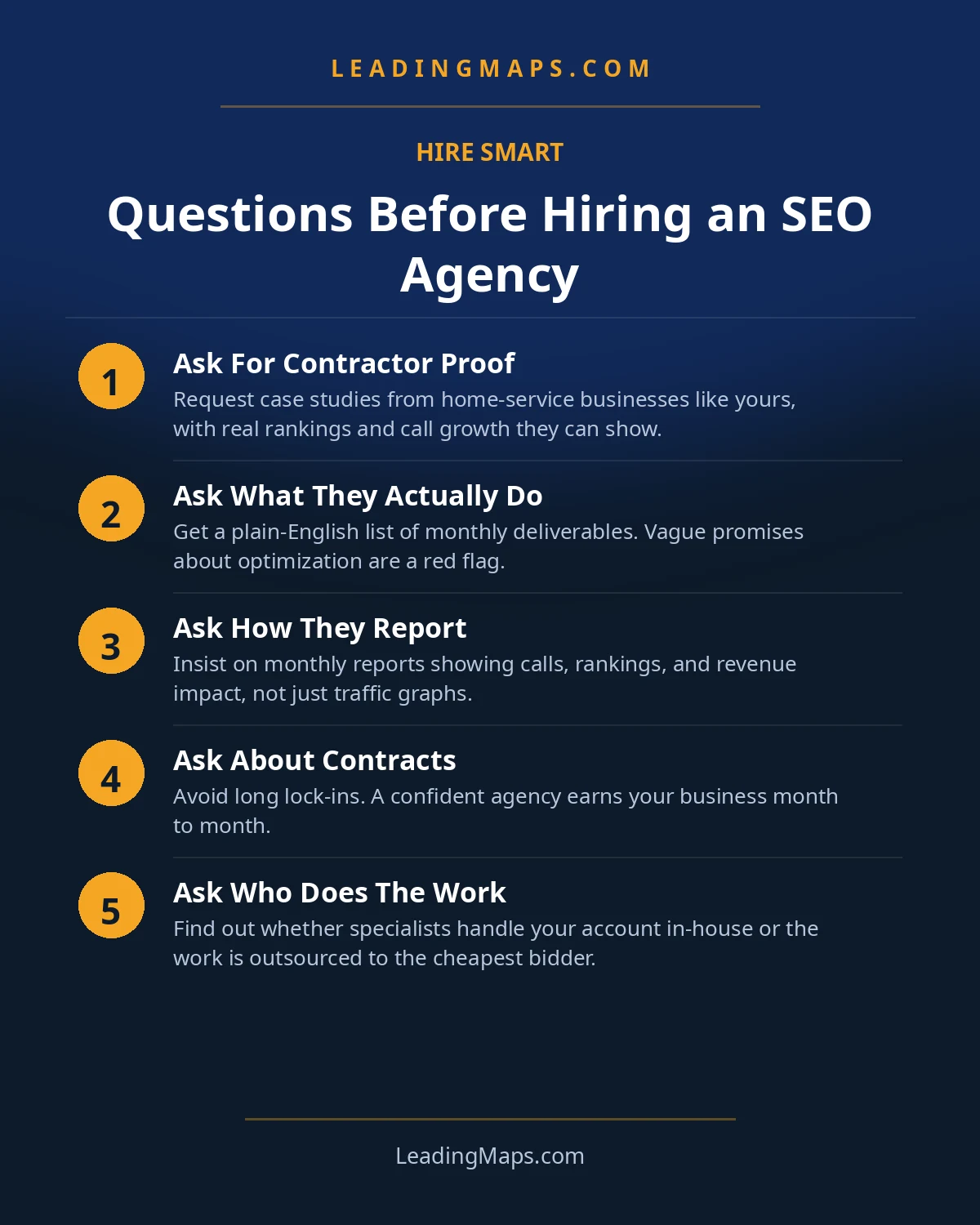
Screenshot this before the call:
- Will I show up when someone asks ChatGPT or Perplexity to recommend a [trade] near me?
- How do you measure AI visibility across platforms?
- Do you build citation-worthy, entity-rich content that LLMs quote?
- Have you ranked plumbers, HVAC techs, or roofers before, and can you show me?
- How do you handle service-area businesses without a storefront?
- Will you track booked jobs and cost-per-job, not just rankings?
- Who actually does the work, and how many accounts do they handle?
- What will month one, two, and three look like for my business, specifically?
- What does the monthly report show, and can I read it in five minutes?
- What does the retainer cover, and what costs extra?
- What happens if I leave? Who owns what?
- Can you put the ownership answer in the contract?
Answer all twelve with specifics, sign with confidence. Fail the first three and they're selling 2019 SEO in 2026.