On This Page
A one-star review on a contractor's profile is not like a one-star review on a coffee shop. The coffee shop loses a five-dollar sale. You lose a five-thousand-dollar job, because the next homeowner with a flooded kitchen reads that review while deciding who to call, and they read your reply right under it.
Most reply advice online is written for retailers and restaurants. It tells you to "stay professional" and "take it offline," which is correct and useless, because it never addresses the complaints contractors actually get: the no-show dispatch dispute, the price-shock invoice, the property-damage claim, and the suspicious review that smells like a competitor.
This playbook is built for the trades. You'll get the reply structure that works every time, copy-paste templates for all four scenarios, the liability rules for what never goes in writing, and the AI-search angle nobody else covers: your replies are indexed text you fully control, and large language models are reading them when they decide how to describe your business.
Why Your Reply Matters More Than The Review
The bad review itself is mostly out of your hands. The reply is entirely in your hands, and it's the part future customers study more closely. A one-star complaint with a calm, specific, accountable owner response reads as a company that handles problems. The same complaint with no response reads as a company that doesn't care.
The numbers back that up. BrightLocal's 2026 Local Consumer Review Survey found that 97% of consumers read reviews for local businesses, 41% always read them, 31% won't use a business under 4.5 stars, and 37% say the business owner's response to reviews matters to their trust. Response behavior is also a map-pack signal: active profiles with strong review response rates rank better, and Google explicitly notes that helpful replies help businesses stand out.
And replies are permanent in a way the review often isn't. Reviewers can edit or delete their review. Your reply sits under it for every search, on every device, for as long as the review exists. Search Engine Land's negative review guide puts it well: respond well and unhappy customers give your business a second chance and often update their rating. A good reply is one of the few marketing assets you get for free.
Of consumers say the business owner's response to reviews matters when they're deciding who to use, and only 31% will use a business under 4.5 stars. Your replies are doing conversion work every day. (BrightLocal, 2026 Local Consumer Review Survey.)
Write Replies For The AI Overviews Era
Here is what the generic guides miss: review replies are training and citation material for AI search. When someone asks ChatGPT, Perplexity, or Google's AI Overviews for a plumber recommendation, the assistant reads review content, including your replies, looking for evidence of what the business actually does, where, and how well. Your reply is indexed text you fully control, and it's becoming part of how LLMs describe your company.
BrightLocal's 2026 survey found that 45% of consumers used AI tools like ChatGPT for local business recommendations in the last year, up from 6% the year before. That's not a future trend, that's current customer behavior, and it's exactly why AEO and GEO optimization treats your review profile as an answer source. The contractors whose replies name services, cities, and outcomes are the ones whose profiles give AI assistants quotable, specific evidence.
The reply structure AI quotes is simple: service + city + outcome language. Compare these two:
- "Thanks for the review, we appreciate your business." The AI learns nothing. It could be describing any business on earth.
- "Thanks, Sarah. Glad Tom got your AC back up the same day here in Mesa, and that the maintenance plan keeps things running smoothly." The AI learns the trade, the city, the outcome, and the tech's name. That's quotable evidence.
This applies to negative review replies too, with one constraint: describe your standard, not the disputed facts. "That's not the standard we hold our techs to on water heater installs here in Plano" teaches the model your service, your city, and your quality bar, without litigating the complaint in public. More on getting recommended by AI assistants.
The Reply Structure That Works Every Time
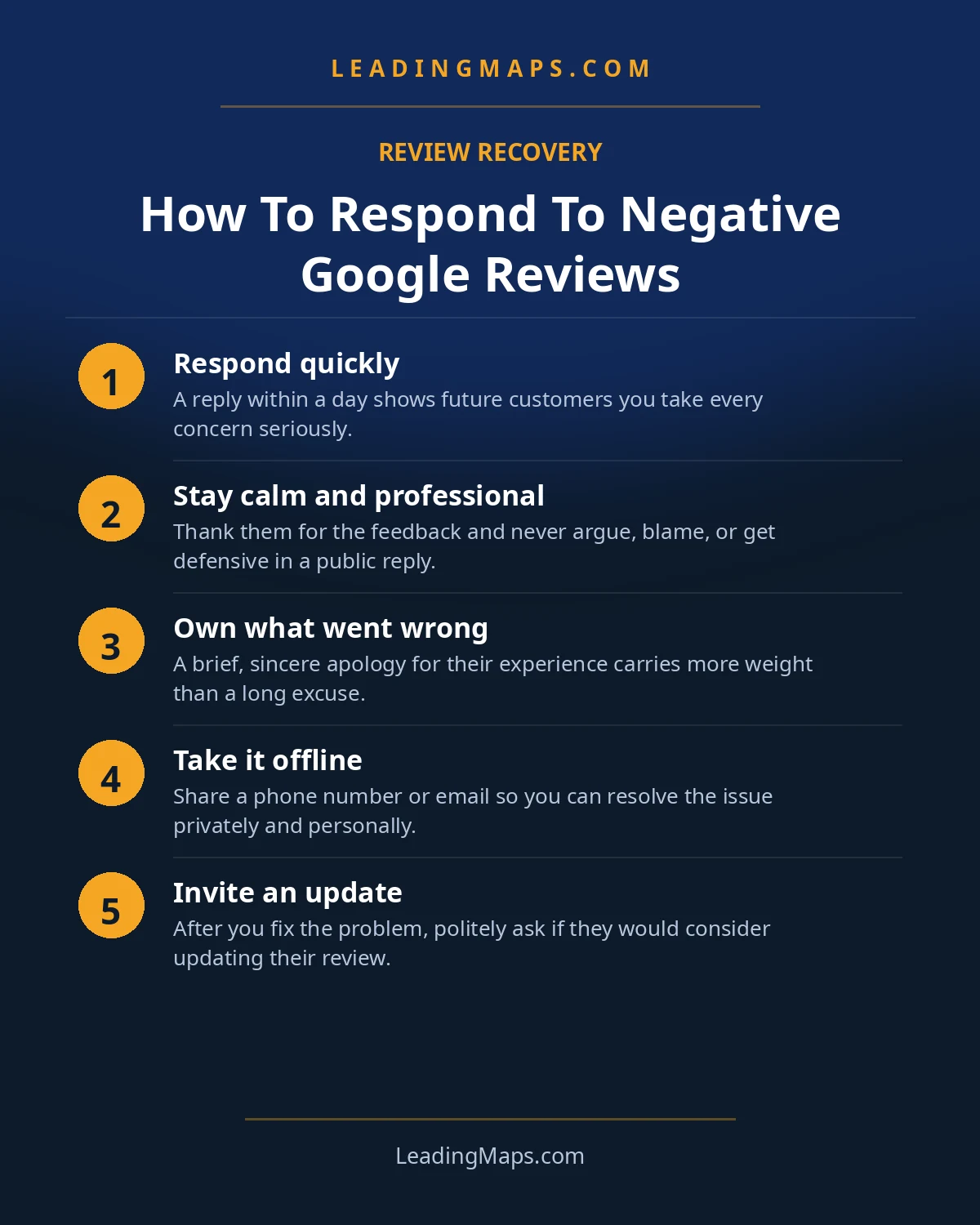
Before the scenario templates, the universal skeleton. Every negative review reply should have four parts, in this order:
- The name. Greet the reviewer by name. It signals this isn't a form letter.
- Acknowledge and apologize for the experience. Not "if you were offended." A clean apology for the experience they had, no qualifiers, no defense.
- Take ownership with a direct line. Give a name and a real phone number, not a generic "contact us." This is the single most important sentence in the reply.
- Sign as the owner. Name, title, business name, city. This turns the reply into accountable, specific content.
Hi [name], I'm sorry your [service] visit didn't meet the standard we hold ourselves to. I'd like to make this right personally, could you call or text me directly at [number]? Thanks for giving us the chance to fix it. [Owner name], owner, [Company] serving [city].
Google reviews your replies for content policy compliance, and your reply posts publicly with the reviewer notified, per Google's own documentation on managing reviews. Write each reply as if the reviewer will respond and as if fifty future customers will read it, because both happen.
Copy-Paste Replies: 4 Contractor Scenarios
Generic templates break down on contractor-specific complaints, because the wrong reply creates liability. Each scenario below has the reply plus what not to say, given trade liability. Personalize the bracketed parts every time.
Scenario 1: The No-Show Or Dispatch Dispute
The tech was late, or never arrived, or arrived in the wrong window. The customer is angry about disrespect for their time, not about the work. Don't argue the timeline in public.
Hi [name], I'm sorry we missed our arrival window on [day], that's on us. When a tech runs late we're supposed to call ahead, and that didn't happen here. I'd like to look into your appointment personally and get you rescheduled on priority. Please call or text me directly at [number]. [Owner name], owner, [Company] serving [city].
What NOT to say: never post the dispatch log, GPS timestamps, or the tech's excuse. Never blame the tech by name, future customers don't want to hire a company that throws its people under the bus. Never write "per our company policy," it reads as corporate deflection.
Scenario 2: The Price-Shock Complaint
"They charged me $X and I had no idea it would cost that much." This is the most common one-star in the trades, and the most tempting to argue about, because the price was probably documented. Argue it anyway and you lose every reader.
Hi [name], I understand the sticker shock, [service] work can run higher than people expect, and I'm sorry we didn't explain the options clearly before we started. We provide a written estimate on every job, and I'd like to walk through yours with you line by line. Call me at [number] and we'll sort it out together. [Owner name], owner, [Company], [city].
What NOT to say: never post invoice amounts, line items, diagnostic codes, or "our prices are standard." Never compare their bill to what others paid. The moment the invoice goes public, you've turned a complaint into a privacy problem and an argument you'll never win in front of an audience.
Scenario 3: The Property-Damage Claim
The highest-stakes reply you'll ever write. A cracked tile, a torn-up yard, drywall damage, whatever happened, keep the reply short, sympathetic, and fast. Every word is potential evidence.
Hi [name], I'm very sorry about the damage to your [property item]. That's not the result we accept, and I take it personally. Please call me at [number] today so I can see the photos and get our insurance claim started. [Owner name], owner, [Company], [city].
What NOT to say: never describe what happened, never admit fault in specifics, and never post photos of the damage or the customer's property. "We're sorry about the experience" is fine; "our tech cracked your tile when he dropped the wrench" is a legal document. Get the details, the photos, and the resolution onto the phone and into the insurance process, not into your public profile.
Scenario 4: The Suspected Competitor Or Fake Review
You check your records and there's no job, no name, no invoice. It's either a mistaken identity, a review bomb, or a competitor. Google lets you flag reviews that violate its policies, fake reviews, conflicts of interest, spam, and you should, but respond publicly in parallel, because removal takes time and often fails.
Hi [name], thank you for the feedback. We've searched our job records and can't find a service visit matching this review, so it may have been posted in error or for the wrong business. If you're a customer of ours, please call us at [number] and we'll resolve any issue right away. [Owner name], owner, [Company], [city].
What NOT to say: never accuse the reviewer of being a competitor, a fake, or a liar by name. A wrong accusation is defamation risk; a right one still looks paranoid to readers. Flag it through Google's reporting flow, keep the public reply calm and factual, and let the paper trail do the accusing. Search Engine Land's guide covers the flagging process in detail.
Trade Liability: What Never Goes In A Reply
Contractors carry liability exposure that restaurants and retailers don't. You're in people's homes, handling gas lines, electrical panels, roofs, and water systems. Your public replies should be written with that in mind.
Two reasons this matters beyond the legal one. First, Google reviews your replies against its content policies before they post, and replies that include personal information about the reviewer can be rejected or removed. Second, every future customer reads specificity as evidence: the contractor who calmly says "call me and we'll fix this" looks safe to hire, while the contractor litigating invoice details in public looks like someone you'll be arguing with in six months.
When in doubt, shorter is safer. Acknowledge, apologize for the experience, give a direct number, sign your name. Then pick up the phone and do the real work there.
Review Velocity: The System That Buries Bad Reviews
The best defense against a one-star review is the thirty five-star reviews above it. Review velocity, steady new reviews every month, dilutes the impact of any single complaint on your average, and it's one of the strongest ranking signals in Maps optimization. This is a system, not a hope.
- Dispatch hook: when a job is marked complete and invoiced, an automated text goes out 30 to 60 minutes later with the tech's name, the service performed, and your review link.
- Tech-ask script: the tech asks in person after the walkthrough, "If you're happy with the work, I'll text you a link. Takes 30 seconds, would that be okay?" The in-person ask is the highest-converting review request in the trades.
- Cadence target: aim for steady volume, roughly 8 to 12 new reviews a month for a typical shop, every month. Forty in one month followed by silence reads like a campaign; steady reads like a thriving business.
- Response ownership: the owner or office manager replies to every review, positive and negative, within 24 hours. Never let reply duty float.
Full details on building the engine, SMS templates, the cadence that doesn't annoy people, and the compliance rules, are in our guide to getting more Google reviews. Run the system and the velocity math works in your favor: one one-star on a profile adding ten five-stars a month is a rounding error within a quarter.
The loop closes here: steady reviews feed the AI-search layer too. Every new review is fresh, specific, human-written evidence about your business, and every one of your replies is your own controlled, indexed, quotable evidence. Contractors who run both sides of that loop, the ask and the reply, are the ones AI assistants describe with confidence.