Start with the 30-second self-test, because it decides whether this article is for you. Search your business name on Google. You show up, panel and all. Now search your money keyword, "emergency plumber" plus your city, or "AC repair near me" from your phone. Three competitors. Not you. If that is the pattern, your profile is not broken. Google just never picks you.
This is the exclusion problem, and it is different from the not-appearing-at-all problem. If your business does not show up even for its own name, that is verification, suspension, or indexing trouble, which our not-showing-on-Google-Maps diagnostic covers. This guide is for the narrower, more frustrating case: you exist, you are verified, and you still cannot crack the three listings that get the calls.
On This Page
- The brand search vs the service search
- Reason 1: the proximity filter is hiding you
- Reason 2: your category misses the money keyword
- Reason 3: a prominence gap vs the incumbent
- Reason 4: your reviews lose on recency and specifics
- Reason 5: entity confusion from duplicates and NAP drift
- Reason 6: a competitor simply out-built you
- The second front: AI answers do not use the 3-pack
- FAQ
The Brand Search Vs The Service Search
Understanding the difference between these two searches is the whole diagnostic. When someone types your business name, Google has exactly one right answer. Relevance is a foregone conclusion, distance and prominence barely matter, and you appear. When someone types "emergency plumber," Google has forty plausible answers in your metro and three slots. Now it weighs relevance, distance, and prominence, Google's stated trio from its local ranking guidance, and picks the three it trusts most for that searcher, in that place, at that moment.
So "showing for my name" tells you almost nothing about your competitive position. It only proves the profile exists and is indexed. Every exclusion reason below assumes that baseline and asks the harder question: for the searches that bring new customers, why does Google choose someone else?
Reason 1: The Proximity Filter Is Hiding You
This is the one that blindsides trades companies most. Google does not want the map pack to look like three copies of the same business, so when several listings share an address or overlap heavily in category and services, it filters the weaker ones out and shows only the strongest. You are not penalized. You are hidden for variety.
Trades companies trigger this constantly. Two plumbing companies operating from the same strip-mall suite. An HVAC contractor and an electrician sharing an office with identical secondary categories. A home-based business whose hidden address sits in the same residential block as another trade company with similar categories. To Google, these look like duplicates of each other, and the filter keeps one.
The tell: open Google Maps, search your money keyword, and zoom in tight directly over your location. If your listing suddenly appears at high zoom but vanishes when you zoom out, you are filtered, not outranked. The fix is differentiation: distinct primary categories where honest, distinct phone numbers, distinct business names without keyword stuffing, and services lists that do not mirror your neighbor word for word. If you share an address with a direct competitor in the same trade, the honest long-term answer is that one listing usually wins that address, so differentiation is survival.
Forty plumbers can serve a metro. Only three show in the pack. Exclusion is the default outcome, and inclusion has to be earned on every signal below.
Reason 2: Your Category Misses The Money Keyword
Primary category is one of the heaviest single signals in local search, and getting it wrong does not just lower you, it can make you ineligible. A plumbing company categorized as "General contractor" will struggle to surface for "emergency plumber" no matter how many reviews it has, because Google's first question is whether you are a plumber at all. Our contractor category list shows the exact picks by trade.
The trade-specific version of this mistake is the emergency mismatch. "Plumber" and "HVAC contractor" are fine as primaries, but the searches that bring the highest-value calls are things like "emergency plumber," "24 hour AC repair," "furnace repair." Your services list has to carry those explicitly, because the category alone does not promise emergency availability. A competitor with "Plumber" as primary and "emergency plumbing service" in their services list is more relevant for the midnight search than you are with "Plumber" alone.
Audit this in two minutes: search your money keyword in an incognito window, open the three businesses showing, and look at their primary categories. If all three carry a category you do not, you have found your gap. This is the cheapest fix in local SEO, and it is astonishing how often it is the whole problem.
Reason 3: A Prominence Gap Vs The Incumbent
Sometimes the answer is blunt: the three businesses in the pack are simply better known than you. Prominence is Google's measure of how established a business is, built from review volume and ratings, links to your website, citations across the web, and how long you have been accumulating all of it. The incumbent with 400 reviews and fifteen years of local links does not need to be better than you. They just need to be more prominent, and the algorithm does the rest.
This is the reason owners resist, because it cannot be fixed with a settings change. But it is also the reason with the clearest playbook. Prominence compounds: every review, every local link, every citation makes the next one easier to earn, because a more prominent business gets clicked more, and clicks feed back into prominence. You do not need to beat the incumbent everywhere. You need to close the gap on the weakest of the three, and the pack only has three slots.
Size the gap honestly before you start. Count their reviews, check their rating, look at how many local sites link to them. If the gap is 40 reviews, that is a six-month review campaign. If the gap is 400 reviews plus a decade of links, that market may need a different strategy, like owning a specialty keyword where the incumbent is weak, while you build. Our map pack ranking factors guide ranks every signal by how much it actually moves.
Reason 4: Your Reviews Lose On Recency And Specifics
Two businesses can both have 4.8 stars and 120 reviews, and Google will prefer one of them. The difference is usually recency and content. A profile whose newest review is from four months ago looks dormant next to a competitor getting three reviews a week. And reviews that say "great service" do less work than reviews that say "replaced our water heater the same day," because specific language feeds relevance for specific searches.
The trade tell: look at the three pack occupants and read their recent reviews like Google does. Do they mention the actual job, the town, the emergency? If their review text reads like a service menu and yours reads like generic praise, they are winning relevance you could be winning. This is fixable without a single new customer: change what you ask for. A text that says "please mention what we fixed" produces reviews that rank. Our review field guide has the scripts.
One warning that belongs here: do not buy reviews, do not review-gate by only asking happy customers, and do not post fake ones. Review manipulation is a suspension trigger, and a suspended profile ranks nowhere. The velocity has to be real.
Reason 5: Entity Confusion From Duplicates And NAP Drift
Google assembles its understanding of your business from everywhere: your profile, your website, directories, data aggregators. When that data disagrees, old phone number on Yelp, a duplicate profile from a previous address, "Street" vs "St." across listings, Google's confidence in the entity drops, and a business Google is unsure about does not get one of three slots.
Trades companies accumulate this cruft faster than most. The old shop address from before you went home-based. The second profile a marketing agency created and never deleted. The tracking number that leaked into half your citations. Each one is a small crack in the entity, and together they read as unreliability.
The fix is unglamorous: search your business name and phone number, open every listing, and reconcile them to one exact format. Merge or remove duplicate profiles properly, which our duplicate listings guide walks through. This work never shows up in a ranking report as a single dramatic jump, but it is often the reason a business that "did everything" still sits at number five.
Reason 6: A Competitor Simply Out-Built You
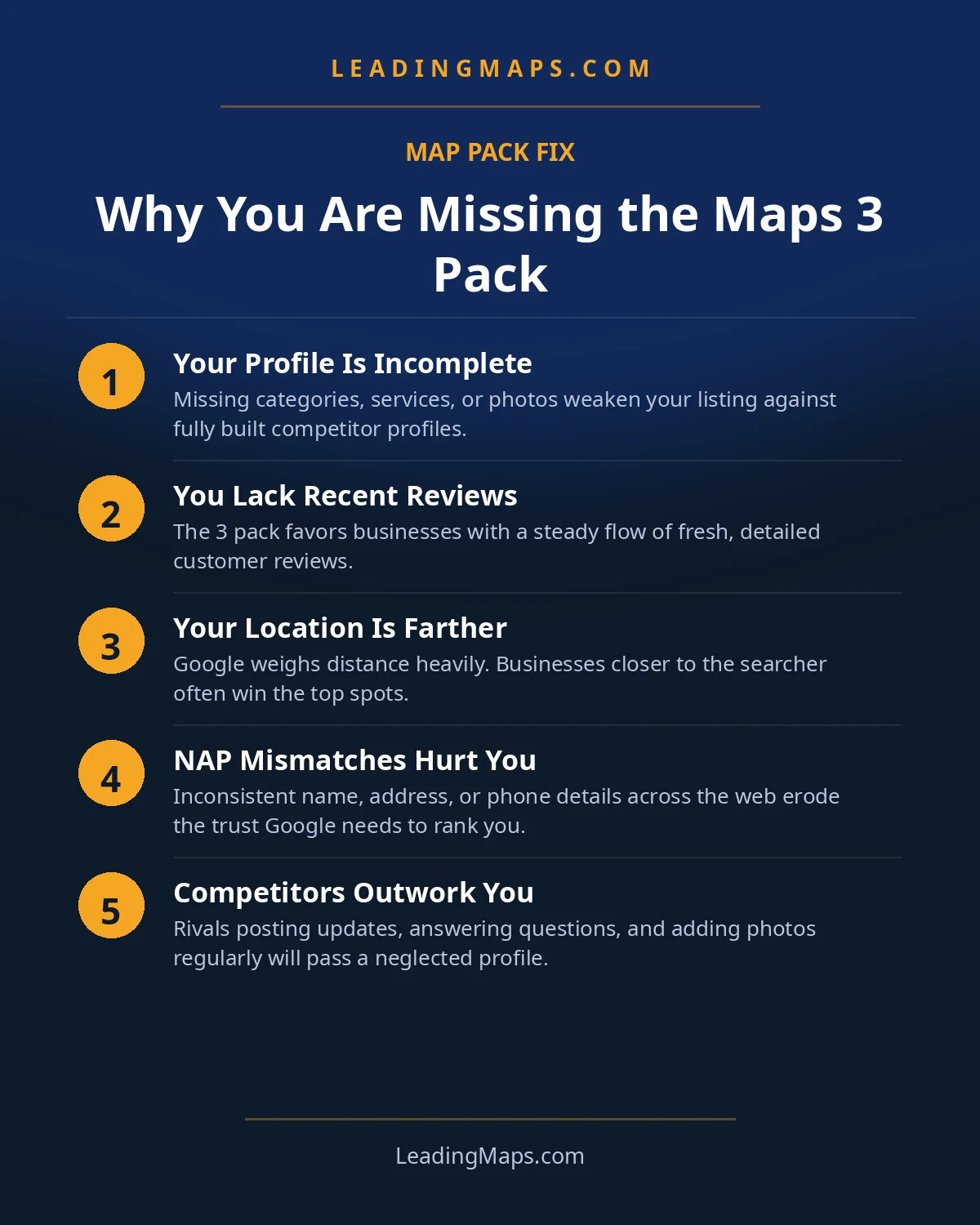
Sometimes there is no trick and no trap. The three businesses in the pack have better websites with real service pages, they post regularly, their photos are current, their hours are accurate, their Q&A is filled out, and their site backs up everything the profile claims. Google cross-checks the profile against the website, and a thin or outdated site drags the profile down with it.
This is the "complete profile vs ranking profile" distinction. A complete profile has every field filled. A ranking profile has every field filled with current, specific, proof-backed content, and a website behind it that says the same things. Audit yourself against the pack with fresh eyes: would a stranger trust your listing more than theirs? If the honest answer is no, the fix is not a tactic. It is out-building them, field by field.
The Second Front: AI Answers Do Not Use The 3-Pack
Here is the question nobody in the exclusion conversation is answering: if Google's AI Overview or ChatGPT recommends plumbers in your city, is it drawing from the same signals that keep you out of the 3-pack? Partly. Prominence feeds both surfaces, reviews, links, and citations make you recommendable everywhere. But AI answers do not have a three-slot limit or a proximity filter. An assistant can name five businesses, and it weighs entity clarity, review content, and structured service data in ways the map pack does not.
That creates a genuine second front. A business filtered out of the pack by a shared address can still be named by an AI assistant that never applies the filter. A business losing the prominence race in Maps can win the AI answer with better-structured services and richer Q&A content. Search Engine Land's reporting on AI local packs shows the businesses in AI answers often do not match the traditional 3-pack at all, which means the exclusion you are fighting on one surface may not apply on the other.
The practical takeaway: fix the six reasons above for the map pack, but build the AI layer in parallel, complete services with descriptions, Q&A phrased like customers talk, reviews that name the work, identical business data everywhere. It is the same prominence work, aimed at a surface with more slots and no filter. Our AI-search optimization service exists for exactly this, and our ChatGPT recommendation guide is the DIY starting point.
3-Pack Exclusion Questions, Answered.
A branded search has one right answer, so Google shows you easily. A service query like emergency plumber has dozens of candidates, and Google picks three based on relevance, distance, and prominence. Showing for your name proves your profile works; missing the 3-pack means you are losing on one of those three signals.
The local filter removes similar listings when several businesses share an address or overlap heavily in category and services, so searchers see variety instead of near-duplicates. It hits trades companies in shared offices, strip malls, and home offices hard. Test it by zooming the map in tight on your pin.
Yes. Primary category is one of the strongest local ranking signals, and a mismatch makes you ineligible for the queries that matter. A plumber categorized as a general contractor will not surface for emergency plumber searches. Match your primary category exactly to your money keyword, then add genuine secondary categories.
There is no fixed number, because it is relative to the three businesses currently showing. Audit their review counts, ratings, recency, and whether reviews mention the actual service. Your target is to beat the weakest of the three on the full review profile, not just the star count.
Sometimes, yes. AI assistants weigh entity clarity, review content, and service data differently than the map pack does, so a business excluded from the 3-pack can still be named by ChatGPT or an AI Overview. But the same prominence signals feed both surfaces, so 3-pack work and AI visibility work largely overlap.
Find Out Why The Pack Skips You.
We score your profile against the three businesses currently in your 3-pack, find the exact gap, and hand you the prioritized fix list. Free, no pitch.
- 3-pack gap analysis, your profile scored field-by-field against the three showing now.
- AI visibility check, real homeowner prompts across ChatGPT, Perplexity, and AI Overviews, who gets named.
- Filter and duplicate check, whether the proximity filter or entity confusion is hiding you.
Get My Free SEO Audit
Delivered within 48 hours. Yours to keep.