On This Page
- The 3-pack is shrinking, AI answers are growing
- How Google picks the top 3, contractor edition
- Step 1: get your categories right
- Step 2: build a review engine that names the job
- Step 3: jobsite photos beat storefront photos
- Step 4: set service areas like a contractor
- Step 5: citations, website, and the signal stack
- The AI-search layer: same signals, second surface
- Realistic timelines: what moves when
- FAQ
For a decade, the top 3 on Google Maps was the whole game for home-service contractors. Rank in the 3-pack for "plumber near me" and the phone rang. Rank fifth and you were invisible, no matter how good your work was.
The 3-pack still matters enormously. But something changed underneath it. A growing share of "who's the best plumber near me" now gets answered by ChatGPT, Gemini, Perplexity, or Google's AI Overviews before the map even loads. Homeowners are getting a short list of named companies from an assistant, and never touching the 3-pack at all.
Here is the good news most agencies won't tell you: the same signals that put you in the top 3 on Maps are the signals AI assistants read when they pick who to recommend. Categories, services, reviews with real job language, real photos, consistent business information. This playbook builds both at once, written specifically for the trades, because contractors have ranking levers that generic local businesses don't.
The 3-Pack Is Shrinking, AI Answers Are Growing
The map pack hasn't disappeared. For high-urgency trades, a burst pipe, a dead AC in August, a garage door stuck open at midnight, Google Maps is still the first screen a homeowner sees. Those three spots convert because the intent is immediate.
What shrank is everything around them. The 3-pack shows fewer listings than it used to, AI Overviews sit above it on many searches, and assistants answer "find me a roofer" in a chat thread with three named recommendations and no map at all. If your entire visibility strategy is "rank in the 3-pack," you're defending a shrinking patch of ground while the next battlefield goes uncontested.
That's why this playbook treats the top 3 as one surface of a two-surface game. Every step below moves you up in Maps and makes you more quotable to AI assistants.
Our average time to a top-3 map-pack position for contractor clients, with a 90-day guarantee and month-to-month terms. No annual contract, just results measured in calls.
How Google Picks The Top 3, Contractor Edition
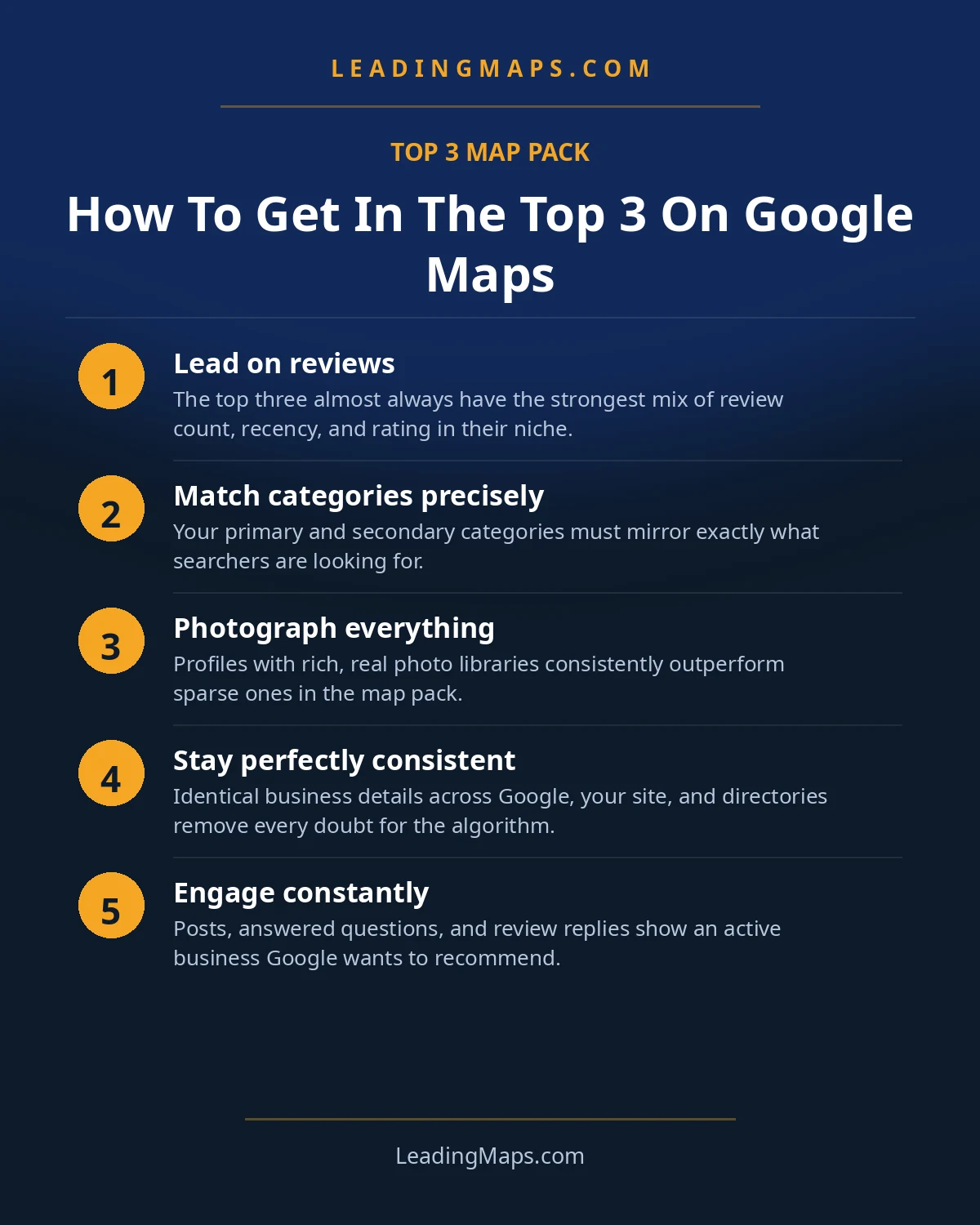
Google says local rankings come down to three things: relevance, distance, and prominence. Every other ranking factor is a detail under one of those headings. Here's what each one means for a contractor.
Relevance: Do You Do The Work They're Searching For?
Relevance is how well your profile matches the search. A homeowner searches "emergency water heater replacement" and Google asks which profiles best describe that exact service. Your categories, service list, business description, posts, and review text all answer that question. Contractors lose relevance constantly by being vague: one generic category, a half-empty service list, and a description that says "family owned and operated" instead of naming the work.
Distance: How Close Is The Searcher?
Distance is the one factor you can't fully control. Google ranks based on where the searcher is, not where your shop is. This is why a plumber can rank #1 from his office and be invisible ten miles away in a suburb he serves every day. You can't move your shop, but you can widen your effective footprint with service-area settings, suburb-specific website pages, and reviews from customers across your territory, more on that in Step 4.
Prominence: How Well-Known Are You?
Prominence is the stack of trust signals: review count, rating, and recency, citations across the web, links to your site, photos, and how often people interact with your profile. It's the largest lever you actually control, and it's where most contractors stall. Google's own guidance says it plainly: more reviews and positive ratings can help your business's local ranking.
The independent evidence backs this up. Whitespark's 2026 Local Search Ranking Factors survey of 47 local search experts found review signals and behavioral signals gaining importance this year, with Google Business Profile signals still the heaviest-weighted group. Notably, the 2026 edition added an AI-search visibility column for every factor, which is the data behind the dual-surface approach in this playbook.
Step 1: Get Your Categories Right
Categories are the single highest-leverage edit on a contractor's profile. One wrong primary category can keep you out of every relevant search; the right pair can move you within weeks. Google's rule is simple: use as few categories as possible, and make them as specific as possible.
Primary Category: Be The Trade, Not The Description
Your primary category should say what your business is, at the most specific level available. "Roofing Contractor" beats "Contractor." "Plumber" beats "Plumbing Supply Store." A roofing company that set its primary category to "Contractor" ten years ago is telling Google it's a generalist, and Google believes it.
Secondary Categories: The Emergency Pairs
Secondary categories are where contractors have an edge most local businesses don't. Emergency and specialty categories let you match urgent, high-value searches that carry a different intent from routine work. The classic example: a plumber runs "Plumber" as primary and "Emergency Plumber" as secondary, capturing both "plumber near me" and "emergency plumber near me" with one profile. The same logic applies across trades: HVAC companies pairing "Heating Contractor" with "Air Conditioning Repair Service," electricians pairing "Electrician" with "Emergency Electrician," roofers adding "Gutter Cleaning Service" when they actually do the work.
Two rules keep this clean. Never add a category for work you don't actually do, Google treats that as misleading. And don't use categories as keyword stuffing, a handful of accurate categories beats a dozen speculative ones. If your categories are wrong right now, fixing them is the fastest legitimate ranking move you can make.
Step 2: Build A Review Engine That Names The Job
Reviews are the heaviest prominence signal you control, and in the trades they do double duty. Google's algorithm weighs review quantity, rating, recency, and your response rate. AI assistants weigh the text, quoting review language when they describe your business to a homeowner.
That changes what you ask for. "Great service, highly recommend" helps your star count. "Mike replaced our water heater the same day we called, best plumber we've used in Frisco" helps your star count and gives ChatGPT a quotable sentence about what you do and where you do it. You can't write your customers' reviews, but you can shape them with a prompt from your techs:
"If you mention what we fixed today, it helps your neighbors find us when they search for the same thing."
One sentence, said at the right moment, produces reviews that name the service, the outcome, and often the area. That language feeds both the Maps algorithm and the AI answers that increasingly sit above the map. Reply to every review within 24 hours with specifics of your own, "Glad Tom got your AC back up same-day here in Mesa", because your replies are indexed text you fully control.
Velocity matters as much as content. Eight to twelve reviews a month, every month, beats forty in one month followed by silence. A profile whose newest review is eight months old reads as possibly closed to both Google and AI systems. For the full machine, the tech scripts, the SMS timed to job completion, the follow-up cadence, read our field guide to getting more Google reviews.
Step 3: Jobsite Photos Beat Storefront Photos
Open most contractor profiles and you'll see the same thing: a logo, a stock photo of a smiling family, maybe a van shot from 2019. Then open the profile of whoever ranks #1 and you'll see crews on roofs, panels mid-install, before-and-after shots of real jobs.
This isn't cosmetic. Real photos of real work do three things. They convert the homeowner comparing your profile to the competitor's in the 3-pack. They signal to Google that the profile is active and genuine, and the 2026 ranking data shows photo quantity, quality, and recency all moving the needle. And they give AI assistants visual evidence that you're a working trade business, not a listing shell.
The contractor photo standard is simple: photos of actual jobs, uploaded regularly. Every truck roll is a photo opportunity, the panel before and after, the roof mid-install, the tech in uniform at the door. Ten real jobsite photos beat fifty stock images. Storefront photos are for businesses with storefronts. Yours is the work.
Step 4: Set Service Areas Like A Contractor
Most contractors are service-area businesses: you travel to the customer, the customer doesn't come to you. Google's guidelines say exactly this: if you run the business from your home or a shop customers don't visit, hide your address and set a service area instead, up to roughly two hours of driving time.
Here's the trap. Distance is measured from the searcher, so your ranking footprint is strongest near your location and fades as the searcher gets farther away. The plumber who ranks #1 from his shop can be invisible in the suburb where he does half his jobs. That isn't a penalty, it's geometry, and contractors who don't understand it waste months chasing a "ranking drop" that was really a proximity shift. (Our recovery guide walks through how to diagnose exactly that.)
The legitimate ways to widen your footprint:
- Set your service area honestly. List the areas you actually serve and will drive to. Listing twenty cities you never visit is misleading and doesn't expand your radius the way people hope.
- Build suburb-specific website pages. A dedicated page for "AC repair in Woodway" with real service content, reviews from that suburb, and LocalBusiness schema gives Google and AI assistants something to match when the searcher is standing there.
- Earn reviews from across your territory. Reviews that name suburbs and neighborhoods are geographic evidence. When a Woodway customer writes "best plumber in Woodway," that text counts in ways a category never could.
- Don't fake a location. Virtual offices, PO boxes, and borrowed addresses are against Google's guidelines and get profiles suspended. One honest profile beats three fake locations that all get deleted.
Step 5: Citations, Website, And The Signal Stack
Once the profile is right, the rest of the stack is about consistency and authority. None of these is dramatic on its own; together they separate the top 3 from everyone else.
- Citations. Your name, address, and phone number need to match across the web, on trade directories like Angi, HomeAdvisor, Thumbtack, and the BBB, and on the core data aggregators. Inconsistent listings confuse Google's confidence in your entity and quietly cap how far your stronger signals can lift you. Our citation building covers 70+ directories with manual cleanup.
- Your website. The 3-pack links to your site, and Google reads it as corroborating evidence. City and service pages with real content, NAP that matches your profile exactly, and LocalBusiness schema all feed both Maps rankings and the AI assistants that crawl your site for citable facts.
- Posts and Q&A. Weekly profile posts with seasonal offers and real photos keep the profile visibly active, and a seeded Q&A answers the questions homeowners actually ask. Neither is a magic ranking lever, but an active profile outranks a dormant one over time.
- Behavioral signals. Clicks, calls, and direction requests from your profile tell Google people choose you. Everything above feeds this: better relevance and prominence win the click, the click reinforces the ranking.
The AI-Search Layer: Same Signals, Second Surface
Here's the part the generic top-3 guides miss entirely. When a homeowner asks ChatGPT or Perplexity "who's the best electrician near me," the assistant builds its answer from the same raw material Google ranks: your profile categories and services, your review text, your photos, your website content, and what the web says about you consistently.
The overlap is nearly total, but the emphasis shifts. AI assistants can't rank a map, so they lean harder on language: review text that describes the work, service descriptions in complete sentences, and consistent business facts everywhere they look.
This is why we treat Maps optimization and AI search as one project. The review engine in Step 2 is also your AI-quotability engine. The suburb pages in Step 4 are also the citable units AI assistants pull from. The consistent NAP in Step 5 is how assistants confirm you're real. Our AEO and GEO work layers structured data, entity setup, and prompt testing on top of exactly this foundation, and this guide goes deeper on the ChatGPT mechanics.
Realistic Timelines: What Moves When
Anyone promising overnight top-3 rankings is selling something. Here's what the timeline actually looks like when the work gets done properly:
- Days 1-14: the foundation. Profile rebuild: categories, services, description, hours, attributes, photos. Most contractors see early position movement in 30 to 45 days as Google re-processes the new relevance signals.
- Days 30-60: velocity kicks in. The review engine starts producing steady new reviews, posts go up weekly, citations get cleaned. This is when calls typically start climbing, clients average +40% calls by month 3.
- Days 60-90: the top-3 window. With relevance fixed and prominence compounding, this is when most contractor profiles break into the top 3 for their core terms in their core territory. Highly competitive metros and multi-trade profiles can take longer.
- Ongoing: defend the position. Rankings are rented, not owned. Competitors copy what works. The review engine, fresh photos, and monthly posts are what keep you in the 3-pack after you arrive.
The timeline compresses when you start further behind on fixable things, wrong categories, an empty service list, a stalled review profile, and stretches when the market is saturated or your proximity is genuinely weak. Either way, fix relevance first, build prominence steadily, and measure in calls, not just positions.