On This Page
It usually starts the same way. A contractor calls and says the phone went quiet. He checks his position from the shop, searches "plumber near me," and where he used to sit at #1 or #2 he's now nowhere. The instinct is to fix something immediately: change the categories, add keywords to the business name, call the agency, buy more citations.
That instinct is the most dangerous part of a Maps drop. Most ranking damage during a drop is self-inflicted in the first 48 hours, random edits made without a diagnosis. A guideline problem needs a different fix than a competitor getting better reviews.
This guide is the triage plan we run for contractors: how to confirm the drop is real, how to tell the four causes apart, a day-by-day plan for the first week, honest recovery timelines, and the part most recovery guides miss, AI assistants now answer "find me a plumber near me" without showing a map at all, so recovery has to rebuild both surfaces.
Step Zero: Confirm The Drop Is Real
Do not touch your profile until you've confirmed three things. This takes about an hour and saves weeks of wasted work.
Check Impressions, Not Just Position
Open your profile performance data and compare two similar periods, month over month, not week over week, since home-service demand is seasonal. The split tells you what's actually happening:
- If impressions dropped alongside your position, Google is showing you less. That's a real ranking loss, and the rest of this guide applies.
- If only clicks dropped while impressions held, you're still showing up, but an AI Overview or another SERP feature is capturing the traffic above you. Your position didn't move, the surface did. The fix for that is in the AI recovery section, not your categories.
Check From More Than One Spot
Your Maps ranking is different at every address. Checking from your shop, which is often the closest point to your business, gives you the most flattering reading in your entire market. Check from three to five points across your actual service area: a customer's neighborhood, a suburb you serve, a zip code across town. If you're #1 near the shop and invisible everywhere else, you don't have a ranking drop, you have a proximity problem. (See the proximity paradox below.)
Check Whether It Was Really You Who Moved
Write down who ranks in the top 3 today and compare it to who ranked there a month ago. If the names changed, note what's different about the new leaders: more reviews, newer reviews, a category you don't have, a completed profile where yours has gaps. A competitor improving looks exactly like you declining, and the fix is catching up, not repairing damage.
The Four Causes Of A Google Maps Drop
Every Maps drop we've seen comes down to one of four things. Each needs a different fix, which is why the diagnosis matters more than the repair.
Cause 1: A True Ranking Loss
Something changed about your profile or Google's treatment of it. Common triggers: an algorithm update re-weighted the factors, a profile edit went wrong (categories changed, address altered, hours set incorrectly), a suspension or soft penalty from a guideline violation, or a review event, a burst of fake reviews removed, a string of one-stars, or review velocity falling off a cliff. The signature is impressions falling across your whole service area, not just one spot.
Cause 2: A Proximity Shift
Nothing about your profile changed, but your ranking reads differently because the searcher moved. Since Google ranks by searcher location, "ranking #1" was always shorthand for "ranking #1 from here." Contractors feel this hardest because they serve wide areas from one location. The plumber who ranks #1 from his shop in Waco can be invisible in Woodway, a suburb he serves daily. The signature: strong rankings near your location, weak ones farther out, with no change in profile metrics.
Cause 3: A Competitor Improved
You didn't move; someone passed you. A competitor rebuilt their profile, fixed their categories, started a review engine, added real jobsite photos, or launched suburb pages on their site. The signature: one or two specific competitors climbing past you while the rest of the pack stays put. Check their review counts and velocity, their categories, and their profile completeness against yours, the gap is usually visible in ten minutes.
Cause 4: AI-Answer Displacement
Your position held, but the clicks moved. AI Overviews now sit above the map pack on many local searches, and ChatGPT, Gemini, and Perplexity answer "who's the best plumber near me" without a map at all. The signature is the split from Step Zero: impressions steady, clicks and calls falling. No amount of category editing recovers clicks that never reach the map, this one needs the AI layer rebuilt.
Causes cover nearly every Maps drop we diagnose: a true ranking loss, a proximity shift, a competitor improving, or AI-answer displacement. The triage plan below tells you which one you're dealing with in seven days.
The Proximity Paradox, Contractor Edition
The proximity paradox deserves its own section because it's the single most misdiagnosed "ranking drop" in the trades. Here's how it goes: a contractor ranks #1 for "plumber near me" from his shop. He drives to a job in a suburb ten miles out, checks again on his phone, and he's gone, not #5, gone. He assumes he's been penalized. He hasn't. He's just far from his own pin.
Google's distance factor got significantly stronger with the Vicinity update in late 2021, and it's been the dominant force in local rankings ever since: the closer the searcher is to your business location, the more likely you are to rank. For a restaurant that only serves its block, that's fine. For a contractor serving a 40-mile radius from one shop, it means your "ranking" is really a gradient, strongest at your door, fading with distance.
You can't fix geometry, but you can work with it:
- Stop measuring from your shop. Track rankings from a grid of points across your service area. Your real ranking is the average across the territory you serve, not the best reading at your desk.
- Build suburb-specific pages. A dedicated service page for each major suburb, with real content, reviews from that area, and LocalBusiness schema, gives Google and AI assistants something to match when the searcher is standing there instead of near your shop.
- Earn reviews that name suburbs. When a Woodway customer writes "best plumber in Woodway," that text is geographic evidence your pin can't provide. The review prompt that names the job works for the suburb too.
- Match your service area to reality. Google allows service-area businesses a radius up to roughly two hours of driving time. List the areas you genuinely serve, no more, no less.
The paradox has a second half: AI assistants now answer "find me a plumber near me" with named recommendations and no map at all. An assistant's answer isn't constrained by your pin, so a contractor invisible in Woodway on Maps can still get named in an AI answer for Woodway. That's why the recovery plan covers both.
Your 7-Day Contractor Triage Plan
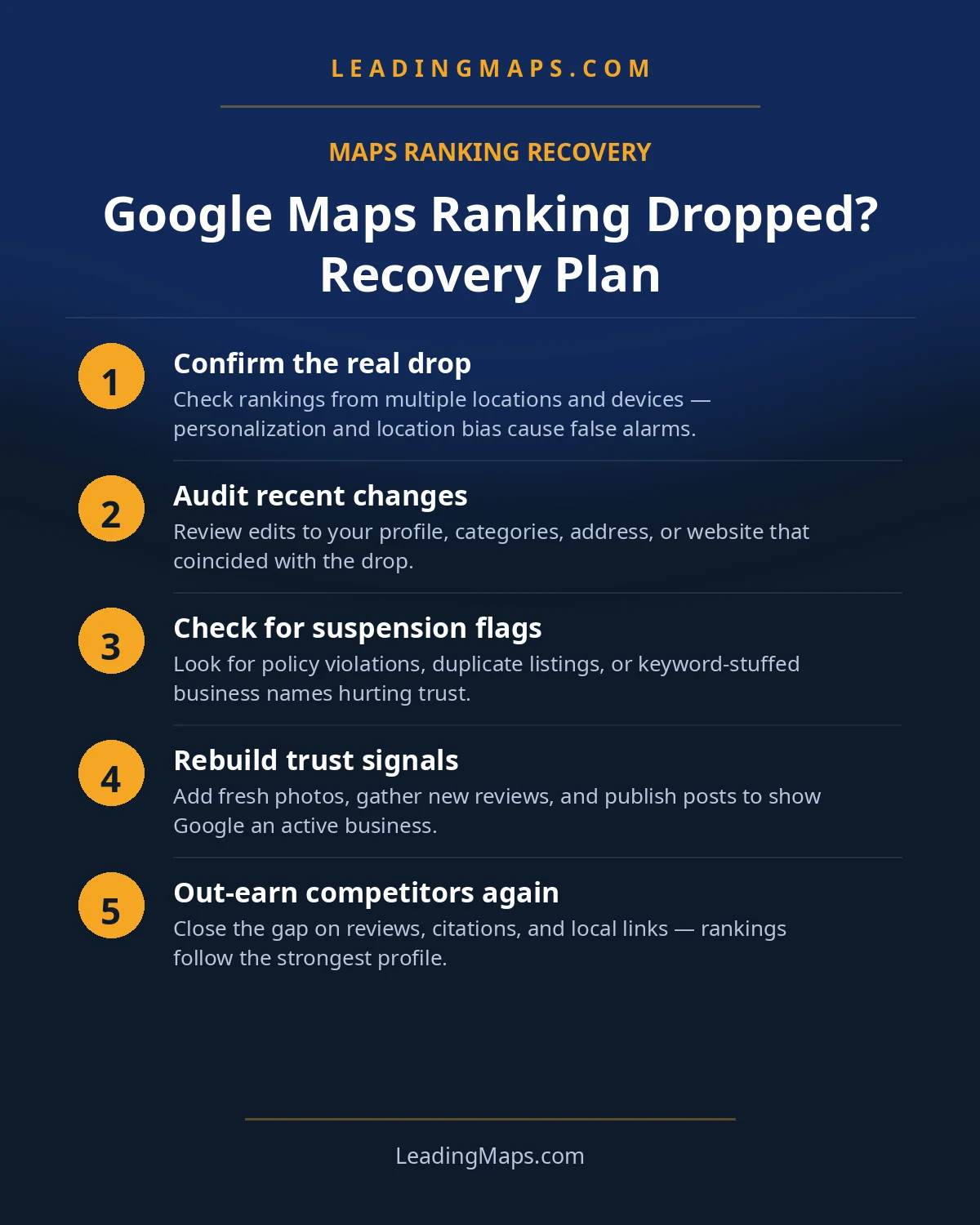
One week, one task a day, no guesswork. By day 7 you'll know which of the four causes you're dealing with and what the fix costs.
- Day 1: check profile health. Is the profile verified, live, and free of warnings? Any suspension notice or "needs attention" flag explains everything. Note your current categories, hours, and service area exactly as they stand, so no one edits them blindly this week.
- Day 2: pull the numbers. Compare profile impressions, calls, and direction requests month over month. Impressions down with position means a real loss. Clicks down with impressions steady means AI or SERP-feature displacement. Write down which one you have.
- Day 3: audit recent changes. What changed on the profile in the last 60 days? Category edits, address changes, name tweaks, a new website URL, hours changes. If the drop lines up with an edit, you have your prime suspect. Undo nothing yet, just document.
- Day 4: run the proximity test. Check your ranking from four or five points across your service area. Strong near the shop and weak farther out is a proximity pattern, not a penalty. Uniformly down everywhere points to a true ranking loss.
- Day 5: scope the competitors. Who sits in the top 3 now? Compare their review count and velocity, categories, photo count, and profile completeness against yours. If one competitor surged past you on reviews, that's your cause.
- Day 6: check the AI surface. Ask ChatGPT, Gemini, and Perplexity "who's the best [trade] in [your city]." Are you named? Are your competitors? If they show in AI answers and you don't, part of your lost calls moved there, and recovery needs the AI layer.
- Day 7: name the cause and the plan. Match your findings to the four causes. One cause means one plan. If you found two overlapping, fix the guideline or penalty issue first, then the prominence gap, then the AI layer.
Weeks 2-4: The Rebuild
Once the cause is named, the rebuild is straightforward. It's the same work that wins the top 3 in the first place, applied with focus:
- Fix what's broken, once. If the triage found wrong categories, incorrect hours, a bad service area, or a guideline violation, correct it in one clean pass. Then stop editing. Rankings wobble for a week or two after profile changes, and every additional edit restarts the clock.
- Restart review velocity. A stalled review profile is the most common prominence gap. Get the tech prompt and the post-job SMS running again: ask every customer, aim for eight to twelve reviews a month, and reply to everything within 24 hours. Review signals keep gaining weight in the 2026 ranking data from Whitespark's Local Search Ranking Factors survey.
- Refresh photos and posts. Upload real jobsite photos from recent jobs and restart weekly profile posts. An active profile outranks a dormant one, and fresh visual evidence matters to both Google and the assistants reading your profile.
- Close the citation gaps. Run a citation check on the core and trade directories. Fix NAP mismatches and claim any unclaimed duplicates, which split your reviews and confuse Google's confidence in your business. Our citation building handles the cleanup across 70+ directories.
- Support with website pages. If the proximity test showed suburb weakness, build or improve the suburb service pages. If a competitor passed you on authority, their site usually tells you why. The Maps optimization playbook covers the full sequence.
Realistic timelines: minor fixes can rebound in 7 to 21 days, review and prominence rebuilds take 6 to 12 weeks, and algorithm-driven drops take 2 to 6 months. Measure in calls, not just positions, and compare rankings across your service area, not just your shop.
When It's A Penalty, Not A Slump
Sometimes the drop isn't a ranking problem at all, it's a trust problem. Google suspends or restricts profiles that break its guidelines for representing your business, and a softened or suspended profile looks exactly like a ranking collapse from the outside.
The violations we see most in the trades: keyword-stuffed business names ("Apex Plumbing, Water Heater Repair Dallas" instead of the real business name), addresses that don't exist (virtual offices, PO boxes, borrowed suites), multiple profiles for one location, service areas set far beyond where the business actually drives, and categories that describe services instead of the business. Any of these can trigger a suspension, and fixing the underlying violation is the only path back.
If your profile shows a suspension notice or a "needs attention" flag, stop all other work and handle reinstatement first: bring the profile into full compliance, gather real-world proof (signage, license, utility bill, branded vehicle), and submit the appeal. While it's suspended, no amount of review generation or citation building will move it. If you've been through a suspension before, our suspension recovery guide walks through the full process.
Recovery Has To Cover AI Search Too
Here's the part the standard recovery checklists miss. Even a perfect Maps recovery only restores the traffic that still flows through the map. A growing share of homeowner decisions now happens in AI answers: ChatGPT, Gemini, and Perplexity naming three plumbers with no map in sight, Google's AI Overviews answering above the 3-pack. If your recovery plan only fixes Maps signals, you're rebuilding half your visibility.
The encouraging part: the AI layer runs on the same raw material. An assistant reads your profile's categories and services, your review text, your website content, and how consistently the web describes your business. The review engine you restart in week 2 is also your AI-quotability engine: reviews that name the job, the outcome, and the suburb are sentences an assistant can quote. Consistent NAP across citations is how assistants confirm you're real enough to recommend.
So the recovery sequence is: fix the profile, rebuild prominence, and while you're at it, make every piece of it quotable. Write service descriptions in complete sentences. Answer homeowner questions in your profile Q&A and on your site's FAQ pages. Keep review velocity steady, because a profile whose newest review is eight months old reads as possibly closed to an assistant too. Our AEO and GEO work layers structured data, entity setup, and prompt testing on top of this foundation, and it's included in every free audit, real homeowner prompts, who gets named, and what it would take to get you named instead.