Most local SEO audit guides have the same problem: twelve steps, all weighted the same, written for any business anywhere. You finish with a list of forty things and no idea which one is costing you jobs this week. This is not that guide. This is the audit for home-service companies, plumbers, HVAC shops, roofers, electricians, and it ends with a ranked fix list, not a pile of homework.
The method: seven phases, each scored by severity. Critical means it is costing you jobs right now. High means it is holding back rankings. Low means it is polish for when the big things are done. Run the audit, score everything, fix in order. If you would rather skip straight to execution, our DIY local SEO checklist is the doing companion to this post's diagnosing.
On This Page
Before You Start
You need three things open: your Google Business Profile dashboard, Google Search Console, and your website. Plan on four to six hours spread over a week, one evening per phase group. Keep a running document, not a mental note, with one line per finding: what it is, where it is, and your severity call. The audit is only as useful as the fix list it produces.
Phase 1: Your Google Business Profile
The profile is where emergency searches end, so it gets audited first and hardest. Check every item; mark anything wrong with its severity:
- Claimed and verified. If the profile is unverified or suspended, that is critical and nothing else matters until it is fixed.
- Primary category is the single most accurate trade. "Plumber" for a plumber, not "Plumbing supply store." Wrong category on a money keyword is critical.
- Service-area settings are honest. Hidden address if customers don't come to you; service areas your trucks actually reach. An inflated service area is high severity, not because Google punishes it, but because it wastes relevance where you cannot win.
- Services list is complete. Every service you sell, with a plain-language description. Missing emergency services is high severity for emergency trades.
- Hours are real, including holidays. Claiming 24 hours when nobody answers the phone costs you trust, not just rankings.
- Description, photos, and Q&A are filled in. Under 20 real photos and zero Q&A entries is high severity, it signals an inactive business to both Google and customers.
- No duplicate profiles. A second profile for the same business splits reviews and risks suspension. Run the detection sweep in our duplicate profile guide.
The field-by-field version of this phase, with the AI-search angle, is our profile optimization checklist. If Phase 1 comes back mostly red, start fixing before you audit anything else.
Phase 2: NAP And Citations
NAP is your name, address, and phone number, and this phase checks whether the internet agrees on what yours are:
- One exact NAP format, written down. "Suite" versus "Ste," area code included or not. Pick one. This is now the law everywhere.
- Search your brand name and phone number. Open every listing that appears and compare against the locked format.
- Core platforms claimed: Bing Places, Apple Business Connect, Facebook, Yelp, Nextdoor, BBB. Unclaimed listings get edited by strangers.
- Duplicate directory listings flagged. Same business, two Yelp pages is the directory version of the GBP problem, with the same fix-first priority.
Our NAP consistency guide covers why mismatches hurt, and the duplicate listings guide covers the cleanup. Severity call: one wrong phone number on a high-traffic directory is critical; a missing chamber-of-commerce listing is low.
Phase 3: Service And City Pages
Your website backs up everything your profile claims. For each core service and each town you serve, verify:
- One dedicated page per core service, with genuinely unique content, not three paragraphs shared across five pages.
- City pages only where you have real local proof, reviews from that town, jobs done there, local specifics. Swapped city names on duplicate text is high severity.
- Title tags and H1s lead with the keyword: "Drain Cleaning in Springfield," not "Welcome to Our Services."
- Phone number tappable and above the fold on mobile, where emergency searches happen.
- Exact NAP in the footer of every page, matching Phase 2's locked format.
Phase 4: Reviews And Reputation
Reviews pull triple duty: rankings, conversion, and AI recommendations. Audit them like a numbers person:
- Count versus the top 3 competitors. If they average 300 and you have 60, that gap is your highest-severity finding in this phase.
- Velocity: reviews in the last 90 days. A profile with 200 reviews and none since spring looks dormant.
- Response rate. Every review answered within 48 hours is the standard; anything under 80 percent answered is high severity.
- Review content. Do reviews mention actual services ("replaced our water heater same day")? Specific service mentions feed both rankings and AI answers; generic five-star praise does neither well.
Phase 5: Local Links And Prominence
Prominence is the third pillar of local ranking, and for trades it mostly means: does the local web know you exist? Check for links from your chamber of commerce, local supplier or distributor pages, community sponsorships, and local news mentions. Then check the top 3 competitors for the same. A competitor with twenty local links and you with two is a high-severity gap, but it is also the slowest to fix, which is why it sits at Phase 5 and not Phase 1.
Phase 6: Technical Basics
Keep this phase short and binary; either it passes or it goes on the fix list:
- Mobile experience is genuinely usable. Test on your own phone, not an emulator: tap the number, scroll a service page, submit the form.
- Speed is acceptable on mobile. Run PageSpeed Insights on your homepage and top service page; anything in the red is high severity for emergency searches.
- Structured data validates. Run your homepage and one service page through Google's Rich Results Test. Your LocalBusiness schema should parse with name, phone, hours, and area served intact.
- No coverage errors in Search Console. Pages that should be indexed but are not, and 404s from old service pages, both go on the list.
The audit phase no other guide does properly. Your Google dashboard tells you about Google surfaces only. Phase 7 measures the growing share of discovery happening inside AI assistants.
Phase 7: The AI Visibility Audit
This is the phase that separates a 2026 audit from a 2023 one. When a homeowner asks ChatGPT, Gemini, or Perplexity for a contractor, none of your Google Business Profile metrics predict the answer. Run this protocol:
- Ask each assistant your money queries. "Best emergency plumber in [your city]," "HVAC repair near me," "roof replacement [city] cost." Ask as a homeowner would, conversationally, and note whether your business gets named.
- When a competitor gets named instead, diagnose why. Check their entity completeness: fuller services list, more specific reviews, cleaner structured data, stronger local links. The winner is usually the more complete entity, not the better website.
- Check entity consistency across the web. The exact same name, address, and phone everywhere. Inconsistent data makes you unresolvable to an LLM, which reads as invisible.
- Check answer-block formatting on your service pages. Can each page answer its core question in one clear paragraph or FAQ block? That is the unit AI Overviews lift and cite.
- Verify LocalBusiness schema validates. Machine-readable facts about who you are, what you do, and where you do it, checked with the Rich Results Test from Phase 6.
The professional version, monthly prompt testing with real homeowner questions across every major assistant, is our AEO and LLM optimization service. The DIY protocol above tells you where you stand today.
Turn The Findings Into A Fix List
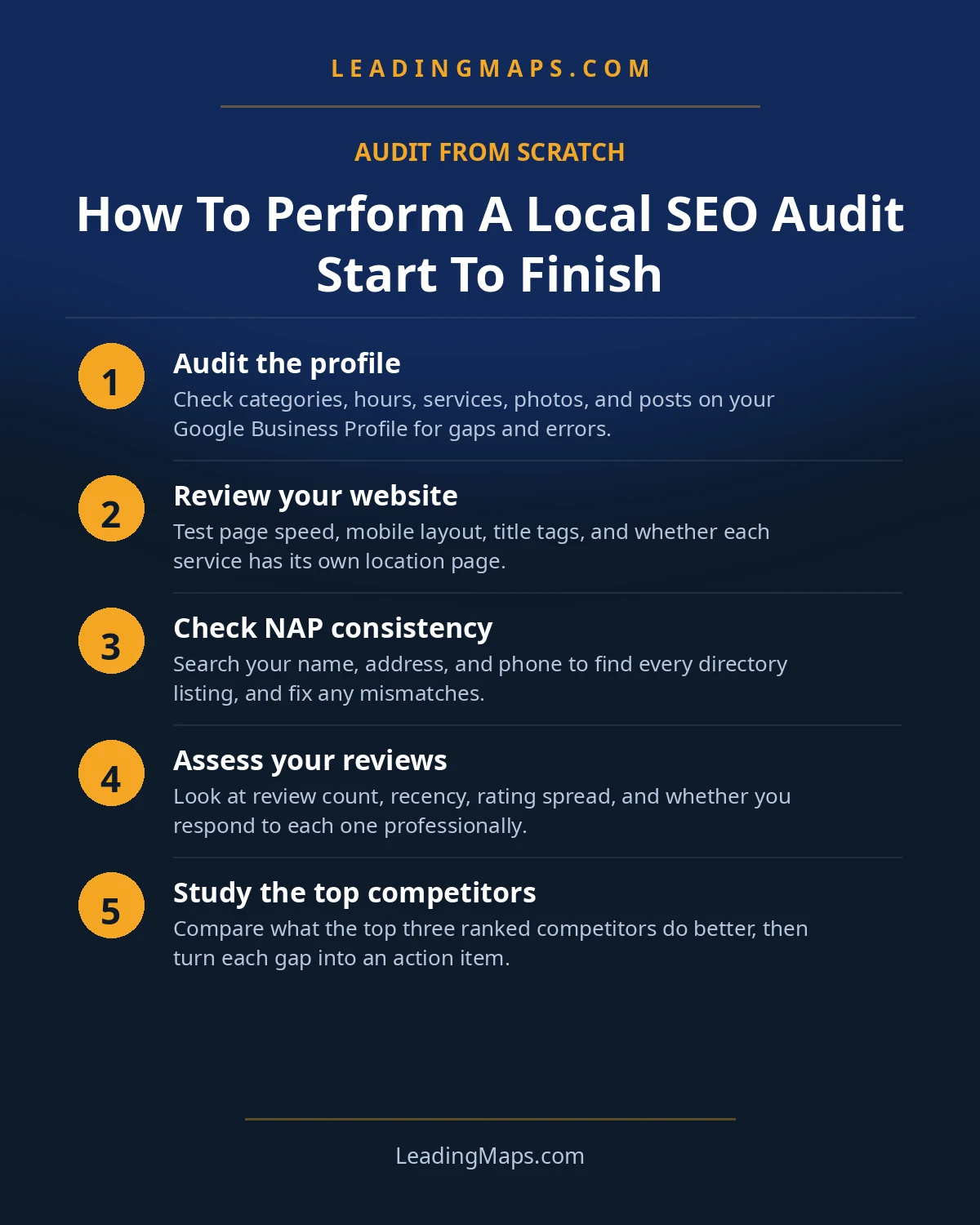
An audit that ends with forty items ends with nothing done. The final step is prioritization, and it has one rule: fix the three highest-severity findings completely, re-audit in thirty days, then take the next three. Severity times revenue impact is the sort order: a critical finding on your highest-margin service outranks a critical finding on a page that gets ten visits a month. Write the list down, date it, and keep the old versions. In six months you will have a record of exactly what moved and when, which is more valuable than any single fix.
If the list is longer than your evenings, that is useful data too. Our Google Maps optimization service runs this entire audit as the first step of every engagement, and the fix list becomes the first ninety days of work.
Audit Questions, Answered.
A focused DIY audit takes four to six hours spread over a week: one evening each for your profile, citations, pages, and reviews, plus an hour for technical checks and the AI visibility test. The first audit is the slow one. Repeating it quarterly takes half the time, because you are checking for changes instead of discovering everything from scratch.
Quarterly for a full audit, monthly for the high-signal checks. Every month, glance at your profile performance, new reviews, and Search Console queries. Every quarter, run the full sweep: citations, service pages, local links, and AI visibility. Audit immediately after anything big changes: a move, a rebrand, a suspension, or a sudden rankings drop.
Yes. Your Google Business Profile dashboard, Google Search Console, and Google's Rich Results Test cover most of an audit for free, and a manual search of your brand, phone, and address catches what tools miss. Paid tools like BrightLocal or Whitespark add speed and geo-grid tracking, but they do not change what you are looking for.
Fix in the order that books jobs: your profile first, then review generation, then NAP consistency, then service and city pages, then links. Most audits end with a long list, and most owners stall trying to do it all. Pick the three findings with the highest severity, finish them completely, and re-audit in thirty days before touching the rest.
A checklist tells you what good looks like; an audit tells you where you stand against it, scored by severity. The audit also includes the diagnostic layer: why a finding matters, what it costs you in lost calls, and what to fix first. Run the audit to get the prioritized list, then use the checklist to execute each fix correctly.
Audit Done And The List Is Longer Than You Hoped?
We run this entire seven-phase audit for you: profile, citations, reviews, pages, competitors, plus whether AI assistants recommend you. A prioritized action plan, free, no pitch.
- Full seven-phase diagnosis, every finding scored by severity, ranked by what books jobs.
- AI visibility check, real homeowner prompts across ChatGPT, Perplexity, and AI Overviews, who gets named.
- Competitor gap analysis, what the top 3 in your market are doing that you're not.
Get My Free SEO Audit
Delivered within 48 hours. Yours to keep.