Search your company name on Google Maps. Now imagine what a homeowner sees: two listings with your name. One has your current phone number. The other has the old shop address from three years ago, four of your reviews, and information you never entered. That second listing is a duplicate Google Business Profile, and it is quietly splitting your reviews, confusing Google about which listing is the real one, and handing calls to nobody.
This post stays strictly inside Google: finding duplicate profiles, deciding whether to merge or report them, and doing it without losing your reviews. Duplicates across Yelp, Apple Maps, Bing, and directory sites are a different cleanup with different steps, and we cover that separately in our guide to removing duplicate listings.
On This Page
- Why trades companies end up with two profiles
- Why a duplicate costs you real money
- The five-search detection sweep
- Merge, remove, or report: the decision tree
- How to request a merge, step by step
- One thing to do before you merge
- How to stop duplicates from coming back
- Duplicates confuse AI systems too
- FAQ
Why Trades Companies End Up With Two Profiles
Duplicates almost never start with malicious intent. They start with a business that changes, hires, and moves, and nobody owns the cleanup. The sources we see most often in home services:
- Lead aggregators auto-create one. Directory and lead-gen sites feed business data into Google, and a second profile can appear with an old address and no owner.
- A former employee or partner made one. The tech who started the company page, the office manager who verified it under her email, the partner who left and took the login with him.
- You moved. The old shop address profile never got closed when the business moved to a new shop, or to a home office with a hidden address.
- An agency made a second one. Some marketing companies create a fresh profile instead of asking for access to the existing one, often with keyword-stuffed names like "Apex Plumbing 24 Hour Emergency."
- Franchise or dealer locator duplicates. A manufacturer or franchise directory creates a profile for your location that you never claimed.
- Name variants. "Apex Plumbing" versus "Apex Plumbing and Heating" can each end up as its own profile, and Google treats them as different businesses until you tell it otherwise.
Any one of these is ordinary. The damage comes from leaving them in place for years.
Why A Duplicate Costs You Real Money
A second profile does not double your visibility. It divides your strength, in four ways:
- Your reviews split. Eighty reviews on one profile beats fifty on one and thirty on another. Social proof only converts when it is concentrated where customers look.
- Google gets confused. Two profiles with slightly different names, addresses, or phone numbers give Google conflicting entity signals. Neither listing ranks as well as one clean profile would.
- Customers take the wrong path. The duplicate with the old number gets the call that goes nowhere. The duplicate with the old address gets the drive-by visit that never happens.
- Duplicates invite suspension. Google's guidelines are explicit: "There should only be one profile per business," and violations can lead to profiles being removed or suspended. If you are already fighting a suspension, read our suspension fix guide first.
That is Google's rule, in its own words. A duplicate is not a spare listing, it is a policy problem that splits your reviews and weakens both profiles.
The Five-Search Detection Sweep
Before you fix anything, find everything. Run this sweep quarterly; it takes twenty minutes:
- Search your exact business name on Google Maps. Note every result with your name or a close variant.
- Search your phone number on Google, in quotes. This is the highest-yield search: duplicates often surface here even when the name differs.
- Search your current and old addresses. The old shop you left in 2022 can still have a live profile pinned to it.
- Zoom out on the map around your service area and scan for extra pins carrying your name or a variant.
- Start the "add your business" flow. Google often surfaces existing matches before letting you create a new profile, which reveals duplicates tied to your details.
Then confirm each one is a true duplicate: the same business at the same location, not a legitimate second location. Two shops in two towns are two profiles. One shop with two listings is one problem.
Merge, Remove, Or Report: The Decision Tree
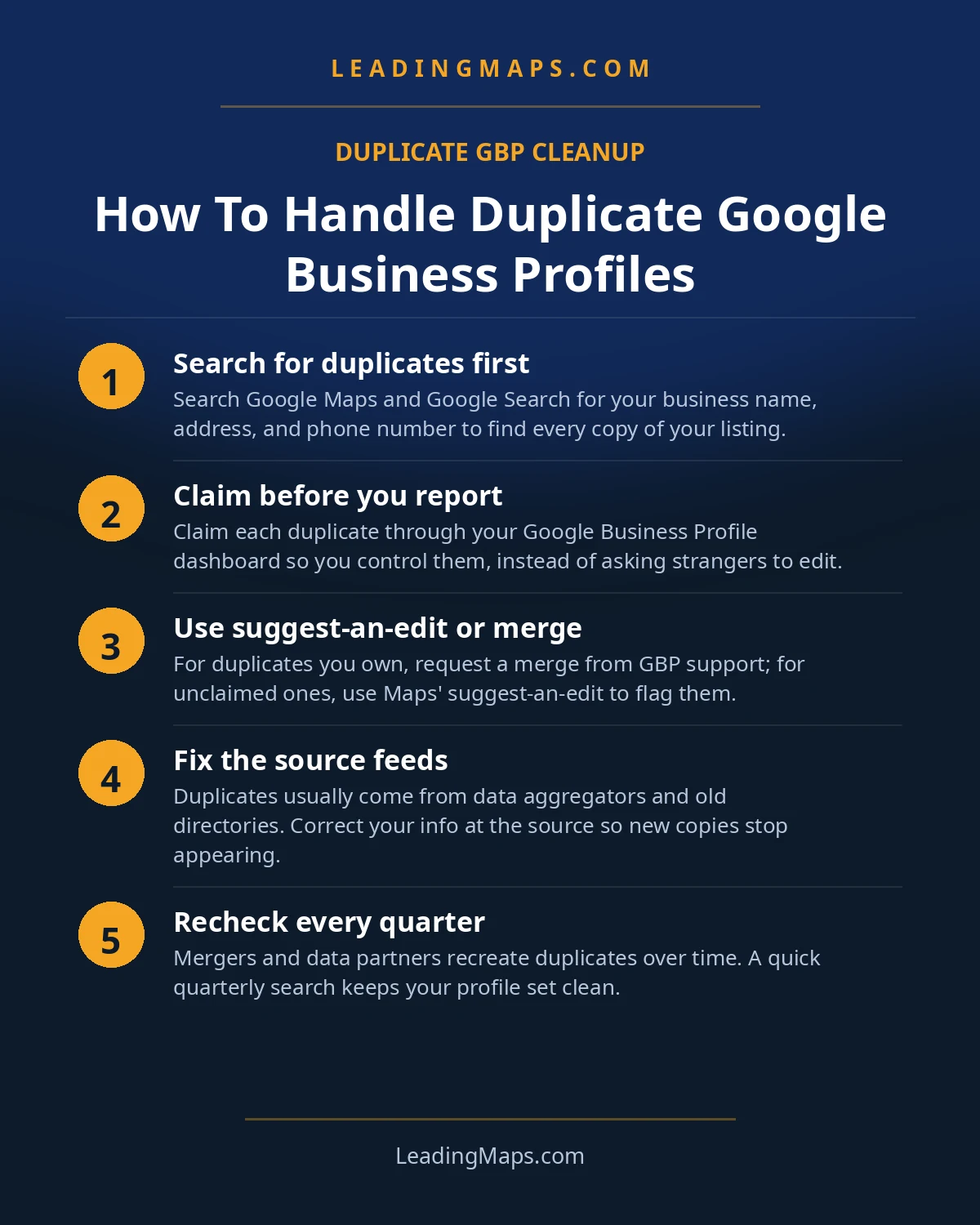
The right move depends on one question: what is your relationship to the duplicate?
If You Own Both Profiles: Merge
This is the best case. Keep the stronger profile (more reviews, longer history, better-completed information) and merge the weaker one into it. Merging moves the reviews to the surviving profile, which is why it beats every other option.
If You Created Neither But Can Claim It: Claim, Then Merge
Many unclaimed duplicates can be claimed through the normal verification flow. Claim it, bring it under your control, then merge it into your main profile. While it is unclaimed, nobody is managing its information, which is exactly how wrong hours and old phone numbers survive.
If You Cannot Claim It: Report It
Open the duplicate on Google Maps, choose Suggest an edit, and report it as a duplicate of your main profile. If the report stalls, escalate through Google's Business Redressal complaint process. What you must not do: create a third profile to "compete" with it. That turns one problem into three.
If It Is Spam Or A Competitor's Fabrication: Report As Invalid
Fake listings (a "business" at your address that is not you, or a duplicate created to divert your calls) should be reported through Suggest an edit as "does not exist" or spam, with the same escalation path if the first report goes nowhere.
How To Request A Merge, Step By Step
- Claim both profiles under one Google account. Nothing else works until this is done.
- Align the details. Make the name spelling, phone number, and address format match as closely as possible. Google merges what it recognizes as the same business, and identical NAP data is how it recognizes one.
- On the weaker profile, open it on Google Maps and choose Suggest an edit. Select the option that marks it as a duplicate of another place, then pick your main profile as the surviving listing.
- Wait for review. Straightforward merges between profiles you own usually complete in days to a few weeks. Do not submit the request twice; duplicate requests slow the queue.
- If the merge option is missing, tighten the NAP alignment further, complete ownership verification on both, and if it still does not appear, escalate through Google Business Profile support with both profile links.
- After the merge, verify. Confirm the reviews carried over, check that the surviving profile points at your real website, and repost any owner replies you backed up.
One Thing To Do Before You Merge
Merging keeps the reviews but it does not keep everything. Owner replies to reviews live on the profile that gets absorbed, and they may not survive the merge. Before you request anything, save copies of your responses, screenshots or a simple document is enough. After the merge completes, repost the important ones on the surviving profile. Ten minutes of copying now beats rewriting fifty replies from memory later.
How To Stop Duplicates From Coming Back
Duplicates are a recurring condition, not a one-time fix. The prevention routine:
- Adopt a one-profile policy. One business, one profile. No exceptions for new services, new marketing campaigns, or new locations that are not really new locations.
- Keep an access register: which Google account owns the profile, who has manager access, and when access was last reviewed. Duplicates love the chaos of departed employees.
- When you move, use the relocation process. Update the address on the existing profile instead of creating a fresh one.
- Tell agencies: request manager access, never create. Any agency that creates a second profile for you is creating this exact problem.
- Run the five-search sweep quarterly. Aggregators recreate profiles; a yearly check is not enough.
Once the profile situation is clean, the next highest-ROI work is making that one profile complete: our Google Business Profile optimization service rebuilds every field, and Google's own guidance on improving local ranking covers the same fundamentals we build on.
Duplicates Confuse AI Systems Too
Here is the angle nobody else covers. When someone asks an AI assistant for a contractor, the system has to resolve your business as a single entity before it can recommend you. Two profiles with conflicting names, addresses, and phone numbers make that resolution fail, and a failed resolution means you simply do not get named. One clean, merged profile is also the profile an AI can cite with confidence. Fixing duplicates is not just Google hygiene anymore; it is entity hygiene for the AI-search era.
Duplicate Profile Questions, Answered.
Claim both profiles first, then make the name, address, and phone match closely so Google recognizes them as one business. On the weaker profile, choose Suggest an edit and report it as a duplicate of the stronger one. Google reviews the request, which usually takes several days to a few weeks, then merges them.
No, and that is the main reason merging beats deleting. Google moves the reviews from the duplicate profile onto the surviving one. What you may lose is owner replies to reviews, since responses live on the deleted profile. Save copies of your replies first, then repost them on the surviving profile after the merge completes.
Yes, it happens more than owners expect. A former employee, a lead aggregator, or a marketing agency can create a profile for your company, sometimes by accident and sometimes to control the listing. Search your business name and phone number regularly, claim any profile you find, and report ones you cannot claim through Google's suggest-an-edit flow.
Expect days to a few weeks for a straightforward merge between two profiles you own. Cases where you cannot claim the duplicate take longer, because Google has to investigate the report before acting. If a request stalls for more than a month, escalate through Google Business Profile support instead of submitting duplicate requests, which can slow things down.
This post covers duplicate Google Business Profiles only, because the process is unique to Google. For duplicates across Yelp, Apple Maps, Bing, and directory sites, the cleanup process is different, and we cover it in a separate guide: How to Remove Duplicate Business Listings. Fix both sides, since inconsistent data anywhere confuses Google and AI systems.
Two Profiles, Split Reviews, Calls Going Nowhere?
Our free audit finds every duplicate Google Business Profile, citation mismatch, and split review for your business, plus whether AI assistants name you or your competitor. A prioritized action plan, free, no pitch.
- Duplicate and NAP audit, every duplicate profile, citation mismatch, and split review, found and mapped.
- AI visibility check, real homeowner prompts across ChatGPT, Perplexity, and AI Overviews, who gets named.
- Competitor gap analysis, what the top 3 in your market are doing that you're not.
Get My Free SEO Audit
Delivered within 48 hours. Yours to keep.