A plumber calls us with the same complaint every month: "I am number one on Google." Then a homeowner in the next town over searches "plumber near me" and gets three competitors. Both of them are right. Google Maps does not have one ranking for your business. It has dozens, one for every place a customer stands, and the number you see from your own shop is the flattering one.
This is the question almost nobody answers properly for service-area trades. The generic explanations use pizza shops and coffee houses, businesses where the customer drives to the location. You are the opposite: the customer never comes to you, and most of you hide your address entirely. That changes how location affects your rankings, and it changes what you can do about it.
On This Page
Why It Happens: Relevance, Distance, Prominence
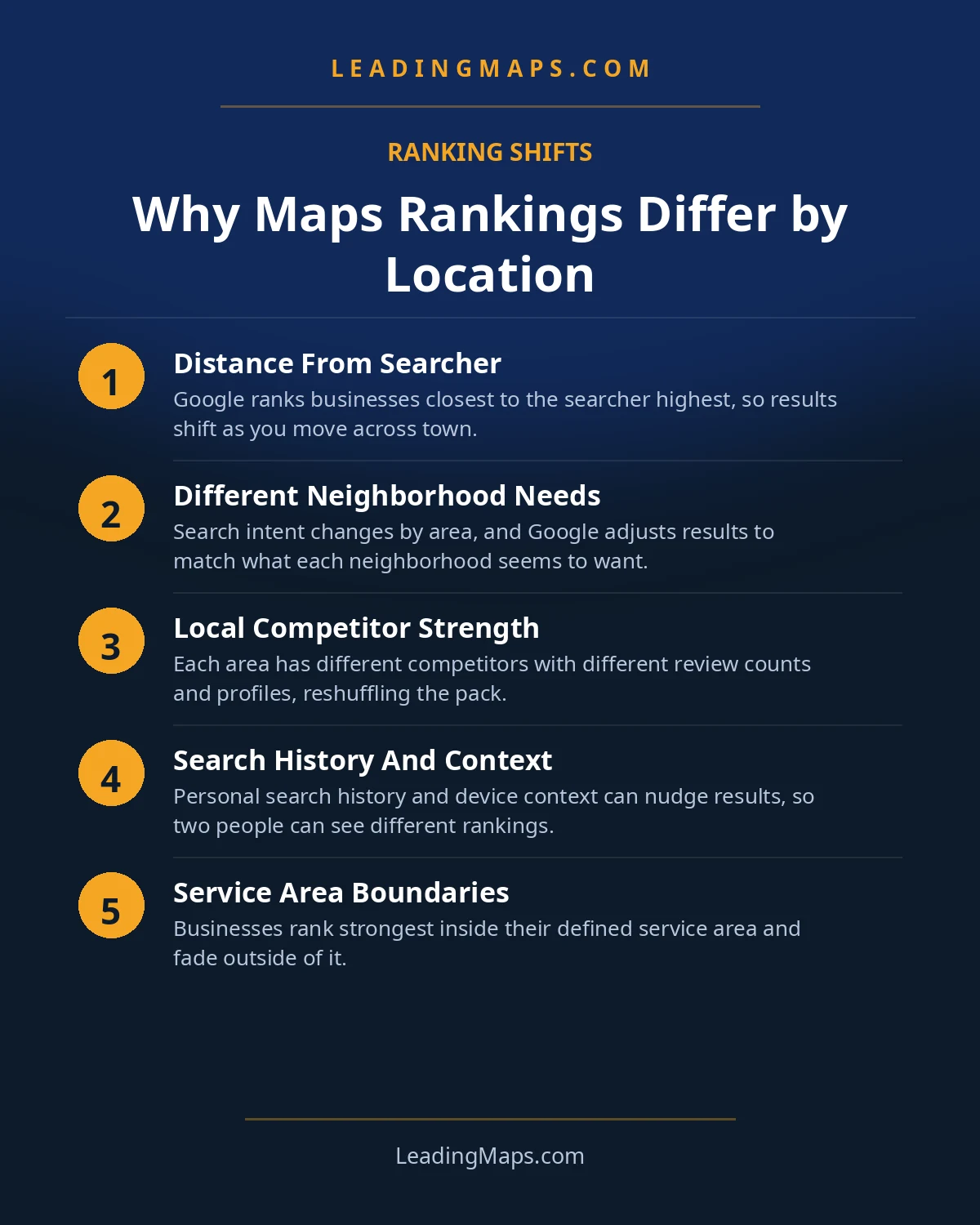
Google says it plainly in its own local ranking guidance: local results are based on relevance, distance, and prominence. Relevance is how well your profile matches the search. Prominence is how well known you are, reviews, links, overall reputation. Distance is how far each business is from the person searching. Every local search recomputes all three against the searcher's location.
So the ranking is never yours. It belongs to a moment: this searcher, standing here, typing this. A homeowner two blocks from your office searches "emergency plumber" and you win on distance before anything else is weighed. The same search from eight miles away, and distance stops helping you, so relevance and prominence have to carry the whole result. They usually cannot, not against the three plumbers who are physically close to that searcher.
Think of it as proximity decay. Right at your pin you are nearly unbeatable, all else being equal. A few miles out you are competitive. Further out you fade, and the fade is faster in competitive markets where every mile has a plumber, and slower in rural areas where Google has to reach further to fill the map. Search Engine Land's walkthrough of proximity bias shows this decay on real grid maps, and the pattern is always the same: strong at the center, fading with distance.
Different rankings you effectively have, one for each neighborhood in your market. Checking your rank once, from one place, tells you almost nothing about what your customers see.
Your Hidden Address Is Still Your Anchor
Here is the part that confuses most trades owners. You hid your address in your profile because customers do not visit you, and you assumed that meant your location stopped mattering. It did not. Google still knows your real address, it is verified, it is on file, and it is the point your distance calculations are measured from. Hiding the address hides it from customers, not from the ranking system.
This is why your shop location still decides your visibility pattern even though nobody ever drives there. A plumber based in a residential suburb will dominate the suburbs around the house and fade as searches move toward downtown, exactly like a storefront would. The only difference is psychological: a storefront owner sees foot traffic confirm their centrality, while you never do, so the decay pattern comes as a surprise.
It also means you cannot move your pin somewhere more convenient and pretend you did. The address is verified against real documentation, and mismatching it is how profiles get suspended, not how they rank further. If you want to serve a new town, the honest lever is prominence and relevance built for that town, not a pin trick.
Why Your Service Area Does Not Create Coverage
The service-area settings in your profile, the list of cities and zips you typed in, feel like a coverage map. They are not. They tell Google where you are willing to drive. They do not move your anchor, they do not extend your ranking radius, and they do not make you eligible to rank in places where relevance and prominence do not already carry you.
The common failure looks like this: a roofer in one county lists six neighboring counties as service areas, then wonders why he cannot crack the map pack in any of them. The answer is that each of those counties has its own roofers, each with their own anchors, each physically closer to the searchers there. Your willingness to drive forty minutes does not enter the calculation. Proximity is measured from your pin to the searcher, full stop.
Service areas still matter, just not the way owners hope. Keep them honest, matching the towns your crews actually reach, because accuracy feeds the relevance side of the equation. But never treat the polygon as a promise of rankings. Our profile optimization checklist covers the settings that do move the needle.
How Far Rankings Travel Depends On The Keyword
Not every search decays at the same rate. Google adjusts the radius to the intent. A search like "coffee" is treated as hyperlocal, results cluster tight around the searcher, because nobody drives twenty minutes for a latte. A search like "roof replacement" casts a wider net, because Google knows homeowners will consider contractors from further away for a five-figure job.
For trades, this creates a useful asymmetry. Your generic keywords, "plumber," "HVAC repair," "electrician near me," decay fast because every neighborhood has options. Your specialty keywords, "tankless water heater installation," "slab leak detection," "whole-home generator installation," travel much further, because fewer businesses are genuinely relevant for them and Google has to reach further to assemble three good answers.
This is worth knowing when you pick what to compete on. If you are a one-truck plumber, fighting three entrenched shops for "plumber" across the whole metro is a losing game on distance alone. Owning "trenchless sewer repair" across the metro is achievable, because relevance and prominence for a specialty can outweigh the proximity gap. The map is not one battlefield. It is one battlefield per keyword.
What You Can Actually Do About It
You cannot move your anchor, and you should stop trying. Everything below works within that constraint:
- Stop checking from your driveway. The rank you see from your own location is your best-case number, personalized and proximity-boosted. If you are going to check manually at all, use a location-spoofing search from the towns where the jobs actually are. Better: use grid tracking to see the whole pattern, which our service-area tracking guide walks through.
- Build prominence that travels. Distance is fixed, so the lever is the other two signals. Reviews that mention specific services and towns, local links from the communities you want to reach, and a website with real service-area pages give Google reasons to rank you where proximity alone would not.
- Match relevance per town. One generic "areas we serve" page with a list of cities does little. Town-specific pages with genuine local content, real job photos from that town, reviews from customers there, give Google town-level relevance to weigh against the distance.
- Pick keywords whose radius favors you. Specialty and high-ticket services rank across wider areas. Put your content and review-generation effort behind the services where Google casts a wide net, not the generic terms where proximity decides everything.
- Accept the map you have. If you are based on one side of a metro and want the other side, that is a second location problem, not an optimization problem. No profile tweak moves a pin thirty miles.
The short version: your visibility is a radius, not a rank. The businesses that dominate their service area are the ones that stopped asking "what is my ranking" and started asking "where do I show up, for which searches, and what do I build to push each boundary outward." Our map pack ranking factors guide breaks down exactly which levers move those boundaries.
The Second Map: AI Search Has Its Own Geography
Now the part no proximity-bias explainer covers. When someone asks ChatGPT, Gemini, or Perplexity to recommend a plumber, there is no map pin for your business in the model's head. AI assistants do not compute searcher-to-business distance the way Google Maps does. They work from entity data: your categories, your services, your reviews, how consistently the web describes who you are and where you operate.
That makes AI geography different in a way that favors prepared trades businesses. In Google Maps, a competitor two miles closer starts every search with a built-in advantage you cannot take away. In an AI answer, the playing field is flatter: the assistant weighs your review profile, your service list, your Q&A, and the consistency of your business data across the web. A contractor with 300 detailed reviews and clean structured data can get named by an AI assistant for a town where Google Maps would never show them in the 3-pack.
The location still enters the query, "recommend an HVAC company near me" carries a location context the assistant uses, but your leverage is prominence and entity clarity, the two things you can actually build, rather than pin distance, the one thing you cannot change. This is why AI-search optimization is not a separate project from local SEO for trades. It is the second map, and on this map your address matters less than your reputation. Our AI search breakdown goes deeper on how the two surfaces differ.
Location And Ranking Questions, Answered.
Because distance is one of Google's three main local ranking signals, alongside relevance and prominence. The closer the searcher is to your business, the higher you tend to rank, and the further away, the lower. Two customers searching the same phrase from different neighborhoods will routinely see different map packs.
Searching from your own shop is the best-case scenario: maximum proximity and often personalized results. Customers across town see you with far less proximity benefit. This is why owners overestimate their visibility. Measure rankings from where your customers actually search, not from your own location.
No. Service areas tell Google where you are willing to travel; they do not create ranking coverage. Your ranking anchor is your real business location, even if you hide your address. Expanding service areas is an operations statement, not a visibility strategy.
Yes, when relevance and prominence outweigh the distance gap. A contractor with a dominant review profile, strong local links, and exact category and service matching can outrank nearer competitors. Low-competition rural markets also let rankings travel much further than they do in crowded cities.
AI assistants have no map pin for your business the way Google Maps does, so their answers lean harder on entity clarity: categories, services, reviews, and consistent web data. Location still matters in the query context, but prominence and a clean, consistent business profile carry more of the weight in AI answers.
See Your Rankings From Every Town You Serve.
We map your Google Maps visibility across your whole service area, score your profile against the top 3 in each town, and check whether AI assistants recommend you. Free, no pitch.
- Service-area visibility map, where you rank town by town for your money keywords.
- AI visibility check, real homeowner prompts across ChatGPT, Perplexity, and AI Overviews, who gets named.
- Competitor gap analysis, what the top 3 in your market are doing that you're not.
Get My Free SEO Audit
Delivered within 48 hours. Yours to keep.