It is 2:14 a.m. A pipe has burst under someone's kitchen sink, water is spreading across the hardwood, and the homeowner is standing there with a phone in a wet hand, typing "emergency plumber near me." Three businesses appear in a neat row under the map. The homeowner taps the first one with the most reviews. The call gets answered. That entire chain of events, from the burst pipe to the answered call, is what local SEO is.
Local SEO is the work that decides which businesses win those three spots, and it is simpler than the industry makes it sound. There is no secret to bribe, no trick that ranks you overnight. There is a profile, a set of listings, a reputation, and a website, and Google scores them on three things: relevance, distance, and prominence. This guide walks through how each piece actually works, using the businesses it is written for: plumbers, HVAC companies, roofers, electricians, and the trades that live or die by the phone ringing.
On This Page
The 2 A.m. Test: What Local SEO Really Is
Local SEO is search engine optimization for businesses that serve a local area. That is the whole definition. When someone searches for something with local intent, "plumber near me," "AC repair Dallas," "roof replacement," Google answers with a different layout than it gives for "how to fix a leaky faucet." You get the map pack: three highlighted business listings under a map, with star ratings, hours, and call buttons, with the classic blue links below them.
The map pack is where the money is for trades. In an emergency search, the homeowner is not reading blog posts. They are comparing three listings and tapping a call button. That is why local SEO centers on your business profile, not your homepage. Your website's organic ranking still matters, for research queries and for everything below the map, but for "need it now" searches the map pack is the entire game.
The Three Levers: Relevance, Distance, Prominence
Google's own guidance on local ranking names the three factors it weighs. Each one maps to a specific set of actions, and most struggling businesses are failing at exactly one of the three.
Relevance: Do You Offer What Was Searched?
Relevance is the match between the search and your business. When the query is "tankless water heater installation," Google looks for businesses whose categories, services list, reviews, and website content say plainly that they install tankless water heaters. This is the lever you control most. A plumber whose primary category is "Plumber," whose services list names thirty specific services, and whose reviews mention water heaters will beat a more famous competitor who left those fields empty. Relevance is earned with completeness: every field filled, every service named, every question answered.
Distance: How Close Are You?
Distance measures how far your business, or the area you serve, is from the searcher or from the location named in the query. It is the one lever you cannot fully control; you cannot move your shop. What you can control is honesty: accurate service-area settings on your profile, town pages for the areas your trucks actually reach, and listings that never claim a location you do not serve. Inflating your service area does not widen your rankings. It dilutes them, because Google can tell when the distance story does not hold together.
Prominence: How Well Known Are You?
Prominence is Google's estimate of how notable your business is, built from review count and recency, mentions across the web (listings and local links), and how established your profile is. A company with 400 recent reviews, listings on 70 directories, and a write-up in the local paper outranks a newcomer with a perfect profile and five reviews. Prominence compounds. It is the reward for being a real, reviewed, referenced business for a long time, which is also why it is the hardest lever to fake.
Google lays out these three factors in its guidance on improving local ranking, and every serious local SEO guide, including Backlinko's local SEO breakdown, builds on the same frame. When someone tries to sell you a shortcut, check which lever it claims to pull. If the answer is "none of them," walk away.
How The Map Pack Really Works
The map pack is not a directory. It is a live auction of relevance that reruns on every single search. Same query, different phone, different result: a homeowner standing downtown sees different plumbers than one searching from the suburbs, because distance recalculates for every searcher. Two neighbors on the same street can get different orders. That is not a bug. That is the system working as designed.
The practical consequence is that your rank is not one number. You can be number one for "emergency plumber" from one zip code and invisible from the next. This is normal, and it is why serious trades track rankings on a grid, checking positions across the towns they serve, instead of celebrating a single top spot. It is also why proximity is both your ceiling and your moat: competitors cannot easily steal the jobs that happen near you, and you cannot easily steal the ones that do not.
Below the three, Google shows a link to "More businesses," leading to the local finder, positions four through twenty and beyond. Rankings there are won by the same three levers, just with less prominence behind them. Our map-pack ranking factors breakdown goes deeper into each one if you want the full mechanics.
The Five Assets You Actually Control
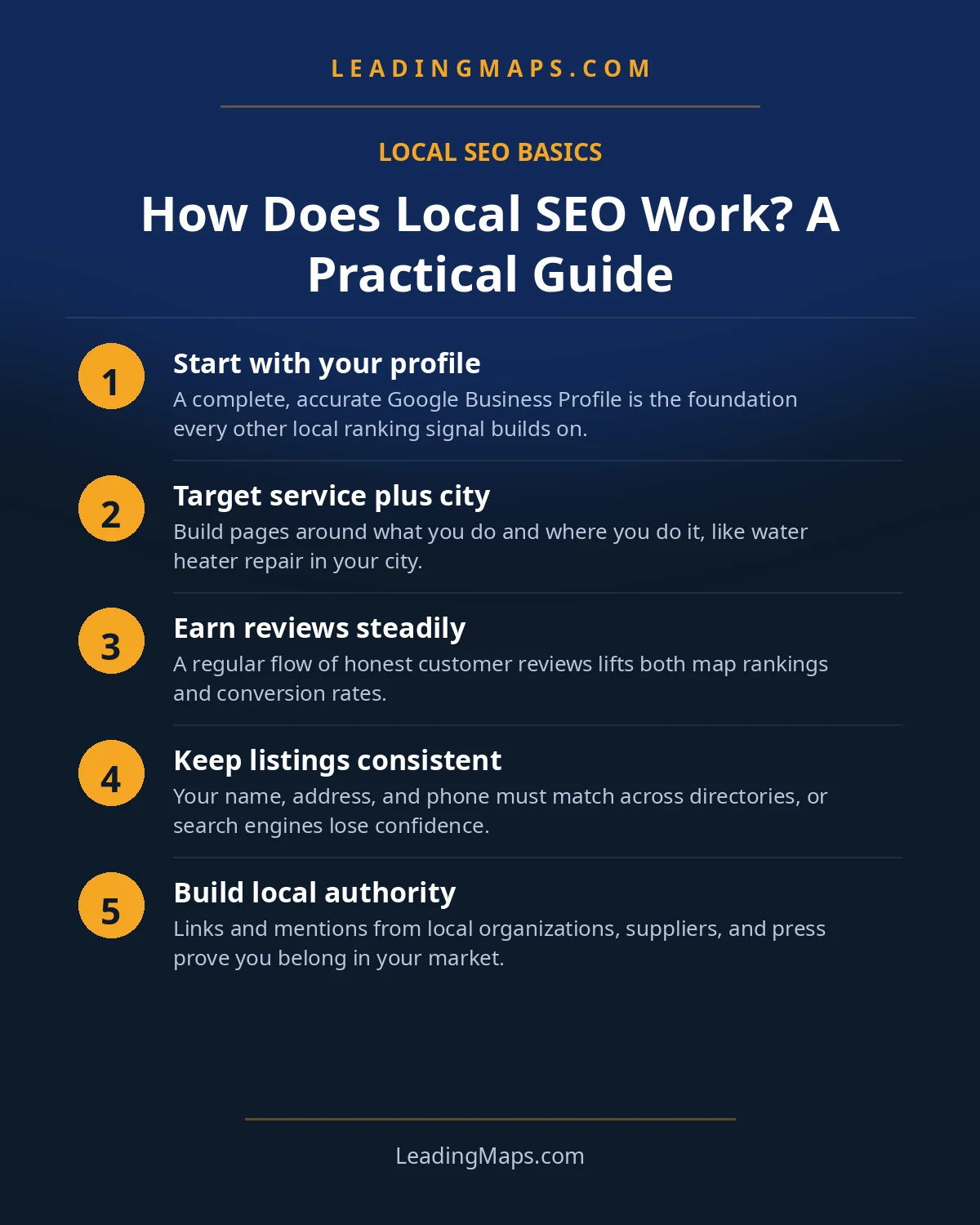
Strip away the jargon and local SEO is five assets, each feeding one or more of the three levers:
- Your Google Business Profile. The storefront. Categories, services, photos, Q&A, posts, hours. This single asset drives more ranking power and more calls than everything else combined, because it is what the map pack is built from.
- Your reviews. Count, recency, and, most overlooked, the words inside them. Reviews feed prominence and relevance at once, especially when customers mention the actual work done: "replaced our water heater same day" beats "great service" every time.
- Your listings. Your name, address, and phone number on the directories that matter: Apple, Bing, Yelp, Facebook, the BBB, and your trade directories. Consistency is the asset, not volume. One wrong phone number undoes a hundred clean listings.
- Your website's local pages. One page per core service and one per town you serve, with real local specifics. These win the organic results below the map and feed relevance for everything above it.
- Your local proof. Mentions, links, and photos from local sources: the chamber of commerce, a sponsored little league team, a supplier's dealer page. This is prominence you build a little at a time, and it is the piece competitors cannot copy quickly.
Nothing here is exotic. That is the point, and also the trap: because the work is simple, most businesses do half of it and wonder why half a strategy does not rank. For the full treatment of the first and biggest asset, our profile optimization checklist walks the fields that matter.
The honest window most trade businesses need for meaningful movement: 30 to 60 days of foundation work, then ranking shifts that stick. Our timeline guide breaks down how long local SEO takes, month by month.
The 2026 Layer: How The Same Work Feeds AI Answers
Here is the part the 2022-era guides never saw coming. When someone asks ChatGPT, Gemini, or Perplexity "who is a good plumber in Denver," the assistant does not invent a name. It assembles an answer from structured, verifiable business data, and that data is exactly what local SEO produces: your profile's services and attributes, the wording inside your reviews, your Q&A entries, your consistent listings, and the schema markup on your site.
So the five assets above now do double duty. Complete services lists become the inventory AI matches against queries. Review text that says "replaced our water heater same day" becomes the evidence assistants cite when recommending you. Q&A written the way homeowners actually talk becomes the phrasing AI matches. And inconsistent business data makes you an unresolvable entity, invisible to AI the same way it makes you invisible to Google.
This is why AI search optimization is not a separate project bolted onto local SEO. For a trade business, it is the same foundation read by a second kind of reader. Our AI-search guide explains the shift in full, AI Overviews covers Google's own answers, and how Gemini chooses businesses walks the recommendation logic step by step.
Your First-Moves Ladder
If this is all new, do it in this order. Each step is sequenced by lead impact, and the list is short on purpose:
- Claim and verify your profile, set the right primary category, and fill in every service you actually sell.
- Fix your name, address, and phone number everywhere it appears. Consistency first, new listings second.
- Start the review system: a text with a direct review link, within 24 hours of every finished job.
- Build one page per money service on your website, each with genuinely unique content.
- Add LocalBusiness schema to your site so both Google and AI assistants can read your facts as data.
- Upload real job photos monthly and post updates twice a month. Activity signals an operating business.
That ladder is the 80 percent. The remaining 20 percent, local links, review velocity engineering, competitive gap analysis, is where hired help earns its keep. Until then, run the ladder and do not buy anything.
Local SEO, Explained.
Local SEO is the work of making your business the obvious choice when someone nearby searches for what you do. It covers your Google Business Profile, reviews, local listings, and website content, and it decides which businesses appear in the map pack, those three highlighted results under the map, when a customer searches something like emergency plumber near me.
Google weighs three things: relevance (do you offer what was searched), distance (how close are you to the searcher or the area they mean), and prominence (how well known and trusted you are, measured mostly through reviews, listings, and links). Relevance is the lever you control most directly, through categories, services, and content.
Expect early movement in 30 to 60 days once your profile, listings, and review system are fixed, and meaningful ranking change within 90 days in most markets. Competitive metros take longer. It is compounding work: reviews and links stack, so the effort you put in this quarter keeps paying into the next.
Google Maps is where local SEO shows up, but they are not the same thing. Local SEO is the work: your profile, reviews, citations, and website. Maps is the battlefield: the map pack and Maps app where that work competes. You can exist on Maps with zero local SEO, and you will simply rank where nobody looks.
Yes, and this is where 2026 changed the game. AI assistants build answers from the same structured business data local SEO produces: your profile details, review text, Q&A, listings, and schema. A well optimized business becomes the kind of verifiable entity assistants recommend, so your local SEO now doubles as AI-eligibility work.
See Exactly How Your Local SEO Stacks Up
Profile, Maps rankings, citations, reviews, competitors, plus whether AI assistants recommend you. A prioritized action plan, free, no pitch.
- AI visibility check, real homeowner prompts across ChatGPT, Perplexity, and AI Overviews, who gets named.
- Proposal scorecard, what your current or prospective agency should be doing, item by item.
- Competitor gap analysis, what the top 3 in your market are doing that you're not.
Get My Free SEO Audit
Delivered within 48 hours. Yours to keep.