On This Page
Ask any contractor who has hired an SEO company what they really want to know, and it is not about backlinks or citations. It is one question: how long until the phone rings? Everything else is noise.
This post answers it straight. No "it depends" dodge, no inflated promises. You will get honest timelines for real trades, framed in calls booked per month, a month-by-month scorecard with the leading indicators that tell you whether your provider is working, and the timeline nobody else will give you: how long until AI assistants start recommending your company.
The short version: most contractor campaigns show early traction in weeks 6 to 12, real call growth by month 3, and an average top-3 map-pack position within 90 days. The longer version is where the useful detail lives, so keep reading.
The Short Answer: What Most Campaigns Actually Look Like
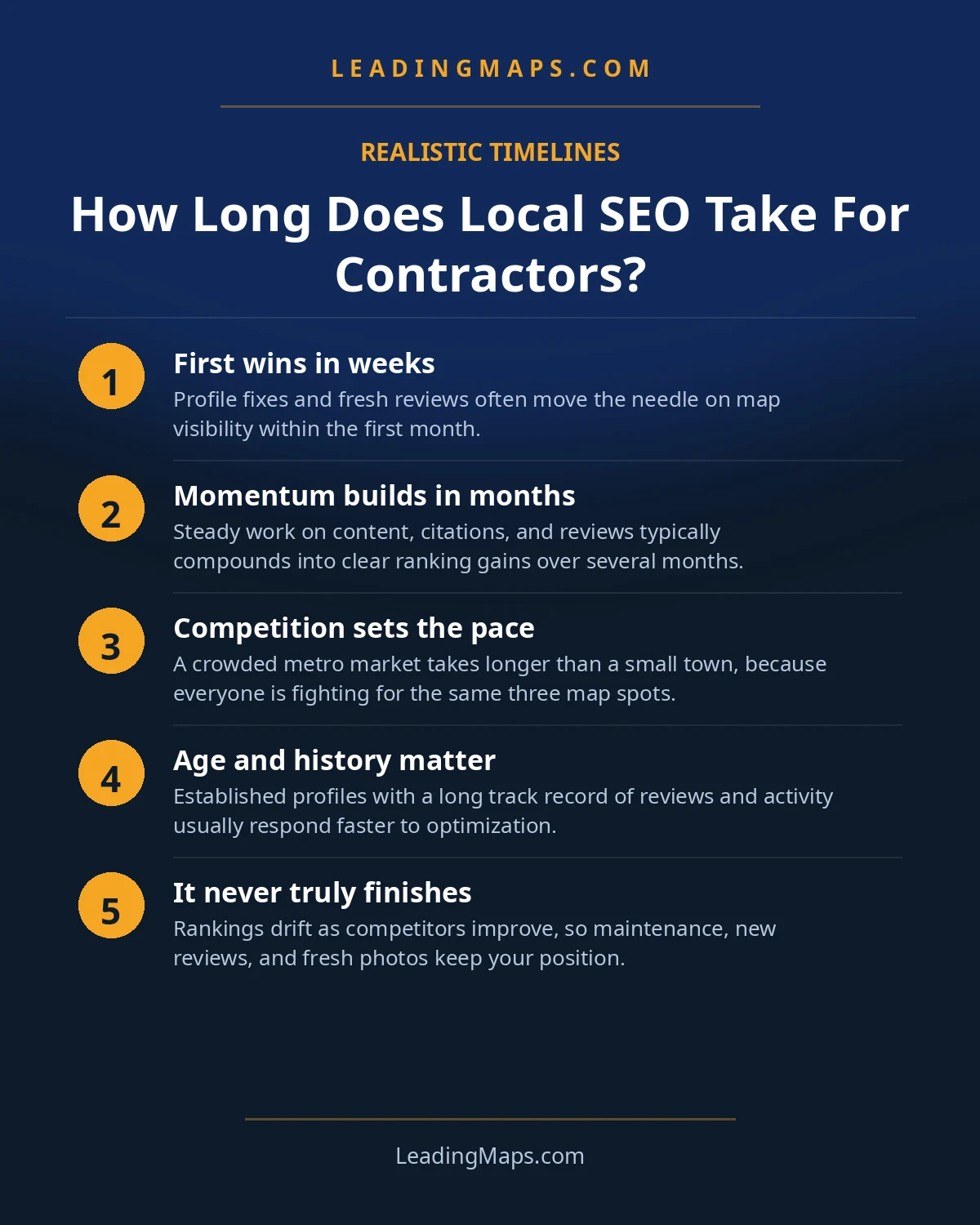
Local SEO timelines cluster more tightly than the industry admits. The work is nearly the same for every contractor: rebuild the Google Business Profile, clean up inconsistent name, address, and phone data, list every service properly, fix or build the website's local pages, and run a steady review engine. The clock starts when that foundation work lands, and how long each stage takes depends on your trade, your market, and where you are starting from.
Here is the honest shape of it:
- Weeks 1 to 4: foundation. Profile rebuild, NAP cleanup, services list, review request system live. Expect completed work, not results.
- Weeks 6 to 12: early movement. Google starts showing you for more searches, profile views climb, and the first review-driven gains appear.
- Month 3: the first honest checkpoint. Calls, direction requests, and profile interactions from the profile itself should be visibly up. If your provider cannot show growth here, that is your answer.
- Months 3 to 4: top-3 averages. Core service keywords settle into the top-3 map-pack positions on average across our campaigns.
- Months 4 to 6: compounding. Reviews accumulate, the profile keeps winning a growing share of clicks, seasonal demand gets captured.
- Months 6 and beyond: ownership. You defend a position instead of chasing one, and AI assistants start naming you reliably.
Our average time to a top-3 map-pack position across contractor campaigns, with about 40% call growth by month 3 and 3 to 5 times the profile views. That is the benchmark we hold ourselves to, backed by a 90-day guarantee, on month-to-month terms.
Plumber Vs Roofer Vs HVAC: Trade-Specific Timelines
Timelines are not one-size-fits-all because buying behavior is not one-size-fits-all. Here are the three archetypes we see constantly, and how the math works for each.
The Emergency Plumber In A Mid-Size Metro
Broken pipes and backed-up sewers do not wait. Search intent is almost pure emergency, and the customer calls the first trustworthy-looking option in the map pack. In a mid-size metro with a dozen real competitors, this is the fastest clock in the trades: early movement in weeks 6 to 12, a top-3 average inside 90 days, and call growth that compounds quickly because demand never takes a season off.
The lead math here is unforgiving in the best way. When you move from buried in the finder into the top 3 for your core service searches, it is not a small lift, it is a step change. That is where our average of roughly 40% call growth by month 3 comes from, and why emergency trades see the fastest payback on the foundation work. If you run plumbing, this timeline is your best case, and it is the one to measure everything else against. Our plumber SEO program is built around exactly this clock.
The Roofer In Dallas
Roofing is planned intent with a competitive twist. Nobody books a roof replacement in a midnight panic scroll, but they do compare three companies and read every review. Dallas is a deep market: dozens of established roofers, storm-chasing crews appearing every hail season, and review counts that take real work to compete with.
Expect the same foundation work but a longer climb: meaningful movement by months 3 to 4, and a stable top-3 position closer to month 5 or 6, because you are outrunning competitors who have been stacking reviews for years. The upside makes it worth it, average job values are high, so a handful of extra booked inspections a month changes your year. In roofing, review velocity matters more than anywhere else, because the customer is choosing carefully, not panicking.
The HVAC Company In Phoenix
Phoenix HVAC is the seasonal stress test. From May to September, "AC repair near me" is a survival search, and whoever holds the map pack during those months books the season. The timeline wrinkle is all about when you start: begin in February and you can own the summer; begin in June and you are climbing during peak season, against competitors whose review velocity is spiking with every completed no-cool call.
Plan around the curve. The smart move is to build review velocity and profile strength in the shoulder months so the profile peaks exactly when demand does. AI assistants also weight recency, so a profile with 15 fresh summer reviews beats one with 200 old ones when a homeowner asks ChatGPT in July. Our HVAC SEO program times the work to these demand curves.
How Long Until AI Recommends Your Company?
This is the timeline question almost nobody answers, so let us answer it honestly: for most contractors, expect 3 to 6 months before AI assistants reliably name your company, and only after your Google foundation is already solid.
Here is the honest mechanics. ChatGPT, Gemini, Perplexity, and Google AI Overviews do not rank you the way Google does. They recommend businesses they can verify and quote. That requires four things, in roughly this order:
- Consistent business facts everywhere. Name, service area, phone, and hours matching across your profile, website, and directories, so the model never sees contradictions.
- Steady review velocity. Reviews that name real services and places are the quotable evidence assistants cite when answering "who is the best plumber near me."
- Entity-rich content. Service pages that say exactly what you do, where you do it, and what it costs, in plain language an assistant can extract and repeat.
- LocalBusiness structured data. Schema markup mirroring your profile data, so Google's systems can machine-confirm what your pages say. Google publishes the full LocalBusiness specification for exactly this purpose.
The caveats matter, and any agency that skips them is selling. First, different assistants weigh different signals. The 2026 edition of Whitespark's Local Search Ranking Factors survey, in which 47 local search experts score 187 factors, found exactly this tension: a factor can score near zero for ChatGPT visibility while scoring meaningfully for Google AI Mode and Gemini, because Google's assistants read Google's data directly.
Second, models work from training data and live retrieval with lag, so week-to-week guarantees about any single assistant are fiction. Third, no single query defines your AI visibility. Test a basket of real homeowner prompts every month, "who is the most reliable plumber in [your city]" and its variations, and track whether you get named.
The good news: everything that feeds AI recommendations is also everything that feeds the map pack, so you are not running two campaigns. One strong foundation, two surfaces. If you are not being named in AI answers by month 4 or 5 of a real campaign, the foundation is thin, and that is worth saying to your provider's face. Our AEO and GEO optimization service and the ChatGPT recommendations guide go deeper on the mechanics.
The Contractor's Month-By-Month Scorecard
Stop judging your provider by how busy they sound on the monthly call. Judge them by leading indicators, the numbers that move before revenue does. Here is the scorecard we recommend to every contractor:
Month 1: Foundation
The profile is rebuilt end to end: categories, services, hours, photos, business description. Name, address, and phone data is consistent across the profile, the website, and the major directories. A review request system goes live with your techs and office staff. Leading indicator: profile completeness and data accuracy, not rankings.
Month 2: Indexing
Google processes the changes. Impressions and profile views in your business performance data start trending up, and the first new reviews arrive on a steady cadence. Leading indicator: impressions growth and review velocity. Are you adding reviews every month now?
Month 3: The Checkpoint
This is the one that matters. Calls, direction requests, and website clicks from the profile should be visibly up. We average about 40% call growth by month 3, and if your provider cannot show growth in the profile's own numbers, not website traffic, not "visibility scores," walk. Month-to-month terms exist so you can.
Months 4 To 6: Compounding
Rankings settle toward the top 3 for core service searches, review velocity becomes self-sustaining, and the profile keeps winning a growing share of clicks. Leading indicator: month-over-month call growth and your review count against the top 3 competitors.
Months 6 And Beyond: Ownership
You defend a position instead of chasing one, and AI assistants start naming you in their answers to homeowner prompts. Leading indicator: branded searches rising and your AI prompt tests returning your name. Our Google Maps optimization campaigns are designed to reach this stage and stay there.
What Speeds It Up, What Slows It Down
Two contractors can start the same week and land months apart. The difference is usually one of these:
- Steady review velocity speeds everything up. It is the highest-leverage lever for both the map pack and AI answers, so start it in week one.
- An existing profile with history and reviews starts ahead of a brand-new one, sometimes by a full quarter.
- Suspensions, duplicates, or a wrong-category setup stop the clock entirely until they are fixed, so audit first.
- Hyper-competitive metros with entrenched competitors take longer. Expect 5 to 6 months to a stable top 3 in the deepest markets.
- Seasonal timing compresses the payoff. Foundation work finished in the shoulder season pays off when demand spikes.
Pricing sets expectations too. Serious local SEO for contractors typically runs $500 to $5,000+ per month, and at the low end of that range, expect the timeline to stretch, because fewer hours go into reviews, content, and citations each month. Our breakdown of local SEO cost for contractors maps each price tier to what actually gets done. And for the record on how Google evaluates you, Google's own guidance says local ranking rests on relevance, distance, and prominence, which is exactly what the foundation work above builds.
Timelines are not promises, they are patterns, and the pattern for contractors is clear: foundation in month 1, early movement by weeks 6 to 12, call growth by month 3, top-3 averages inside 90 days, and AI recommendations within 3 to 6 months once the foundation holds. If your current provider cannot show you their version of this scorecard, find out why with a free audit, or find one who can.