On This Page
- How Gemini picks, in three steps
- Three doors, same brain: Gemini app vs Ask Maps vs AI Mode
- The four sources Ask Maps reads
- Why service-area businesses are harder to recommend
- Gemini reads the words, not just the stars
- Gemini vs ChatGPT vs Perplexity: which AI actually sends contractors jobs
- The playbook: get picked by Gemini
- FAQ
The existing guides on this topic explain Gemini for hotels, Indian restaurants, and law firms. This one is for the trades, because how Gemini treats a plumber who works out of his house is genuinely different from how it treats a hotel with a street address and a thousand photos.
If a homeowner asks Gemini for a contractor and your business is not named, there is no second page to fall back on. The answer is the whole result. Here is the mechanics of that answer, and what you can do about it.
How Gemini Picks, In Three Steps
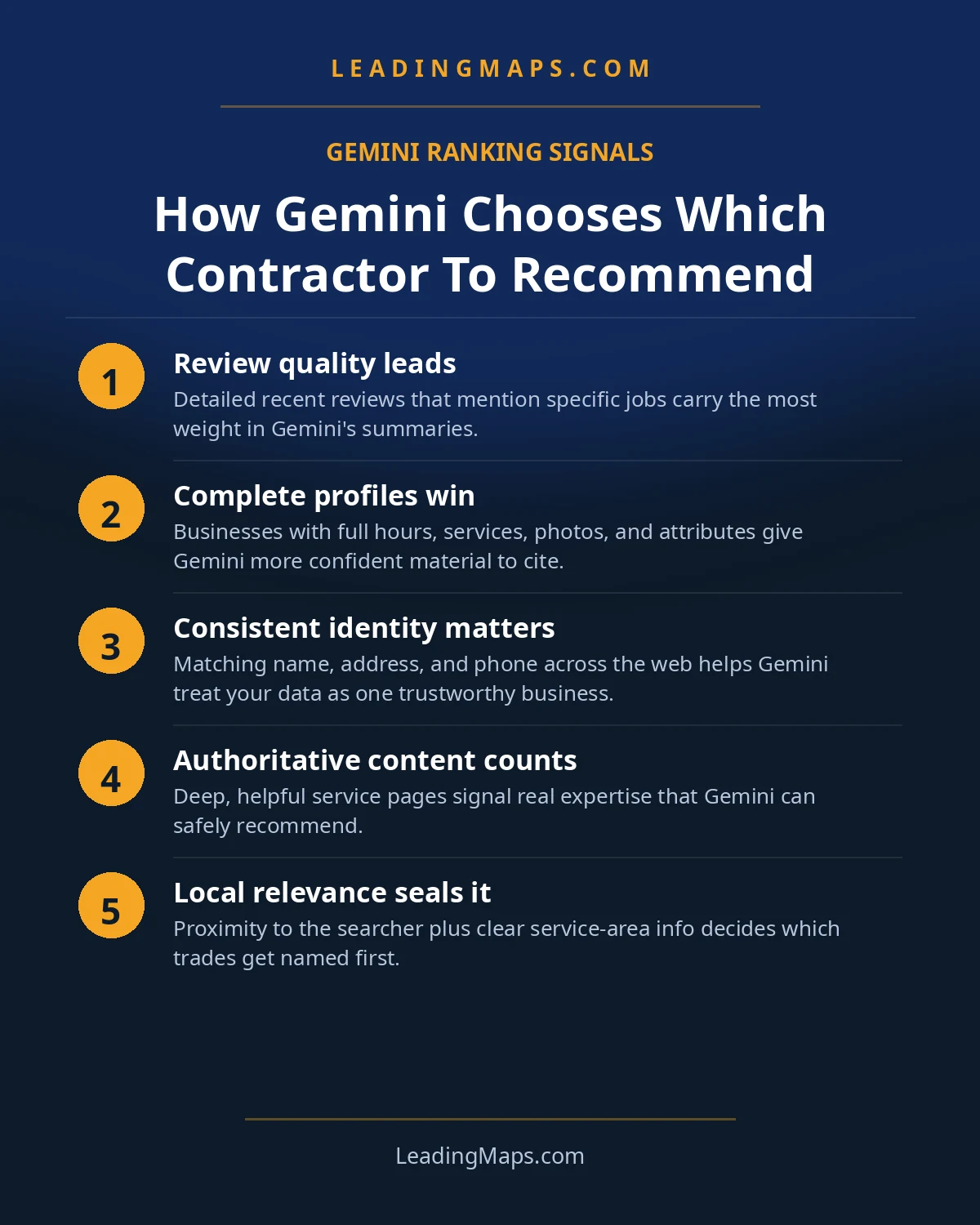
Every Gemini recommendation, whether it comes from the app, from Maps, or from Search, runs through the same three-stage workflow:
- Intent detection. Gemini parses the query into conditions: what trade, what urgency, what hours, what location, what price sensitivity. "Emergency plumber open now" is not a keyword search, it is a set of filters: plumbing category, emergency service, currently open, near the searcher.
- Retrieval. Gemini pulls candidate businesses from its data sources, which for local queries means Maps places data, Business Profiles, reviews, website content, and third-party mentions. This is the stage where most contractors are silently eliminated, not because they are bad, but because their data does not clearly satisfy the conditions.
- Synthesis. Gemini composes the answer, naming one to three businesses and justifying each with a line or two drawn from the retrieved evidence. It only names businesses it can describe with confidence. Vague data produces vague answers, and vague answers do not include your name.
The practical takeaway: you are not competing for a ranking position. You are competing for confidence. Every specific, consistent, verifiable fact you publish about your business is another reason for Gemini to name you instead of hedging.
Three Doors, Same Brain: Gemini App Vs Ask Maps Vs AI Mode
Homeowners meet Gemini in three places, and the grounding, the data each surface leans on, is different in each one:
The Gemini App
The standalone app answers from the model plus live retrieval across the web. For "best HVAC contractor near me," it synthesizes review platforms, business websites, directories, and editorial content. It knows your location and reasons over it. This is the surface most like ChatGPT, and it rewards broad, consistent web evidence.
Ask Maps, Inside Google Maps
In March 2026 Google launched Ask Maps, a Gemini-powered conversational layer inside the Google Maps app. Users ask full natural-language questions, "who can install a mini-split in my garage this week," and get AI-generated recommendations on a map. As Search Engine Journal reported on the launch, it draws on over 300 million places and reviews from more than 500 million contributors.
Ask Maps is the surface that matters most for trades, because it is where "open now" and "near me" live, and it grounds almost entirely in Maps data: your Business Profile, your reviews, and places information. If your GBP is thin, Ask Maps has nothing to reason with.
AI Mode, Inside Google Search
AI Mode is Gemini's conversational surface in Google Search, built for complex comparisons and multi-part questions, "compare tankless vs tank water heaters, then find installers near me." Per Google's own documentation on AI features, it uses a query fan-out technique, issuing multiple related searches across subtopics and sources, then synthesizing with links. For contractors, AI Mode is where research queries get answered, and it cites web pages heavily, which is why citable service pages matter here more than anywhere.
Places in Google's Maps database that Ask Maps reasons over, plus reviews from more than 500 million contributors, according to Google's launch announcement and Search Engine Journal's coverage.
A contractor needs all three surfaces, because homeowners ask all three the same hiring questions at different moments: the app for advice, Maps for "who is open right now," Search for research. Same homeowner, same week, three different doors.
The Four Sources Ask Maps Reads
Ask Maps is the most important Gemini surface for contractors, so it is worth knowing exactly what feeds it. Industry analysis of Ask Maps describes four source layers it reads before recommending a business:
- Your Google Business Profile. Categories, services, hours, attributes, description, photos. This is the structured backbone. Ask Maps cannot recommend what it cannot verify, and the profile is where verification starts.
- Structured website data. Your site's service pages, FAQ schema, LocalBusiness markup. When Ask Maps needs detail the profile does not hold, like pricing context or how a service works, it goes to your site, and structured pages are easier to quote.
- Review text. The words customers wrote, weighted far beyond the star rating. Gemini reads reviews for service mentions, outcome language, and location references, then uses them as independent corroboration of everything you claim about yourself.
- Documented surroundings. Third-party corroboration, directories, trade platforms, local mentions, the broader web footprint that confirms you are a real, established business in that market.
Notice the pattern: one source is you (profile), one is your site, and two are other people talking about you (reviews, surroundings). Gemini trusts you less than it trusts the internet about you. Every tactic below is really about feeding one or more of these four layers.
Why Service-Area Businesses Are Harder To Recommend
Here is where the trade-vertical treatment matters. A hotel has a street address, a lobby, and photos of the lobby. You have a truck, a service radius, and a home office you do not want on the internet. Gemini has to work harder to place you, and harder means more chances to lose you.
Service-Area Radius Vs GEO Coordinates
With a storefront, Gemini anchors recommendations to coordinates. With a service-area business, it must infer your coverage from the service areas you list on your profile. If those areas are too broad, a 60-mile radius around a suburb, or inconsistent with the towns your site and reviews mention, Gemini's confidence in "do they actually serve me" drops. Keep service areas tight and realistic, and mirror them exactly on your website.
Emergency And 24-7 Hours Signals
"Emergency plumber open now" is the highest-value query in the trades, and it is pure attribute matching. Gemini filters by your listed hours, including special and holiday hours, and by emergency service attributes. If your profile says 8 to 5 and you actually take emergency calls at midnight, Gemini will filter you out at midnight. Set hours that reflect reality, including 24-hour or emergency designations, and keep them current through holidays.
License Numbers
Your state license number is a verifiable fact in a world of unverifiable claims. Put it on your profile description, your website footer, your service pages, and your About page. When a homeowner asks "is [company] licensed" or "licensed electrician near me," Gemini can only confirm what is published. An unlisted license is, to the AI, an unheld one.
Booking Attributes
Online booking links, "request a quote" buttons, messaging availability, these are action attributes that Ask Maps uses to turn a recommendation into a conversion. A homeowner asking at 10pm wants the company they can book at 10pm. Fill every booking and contact attribute your trade supports, and make sure the links actually work.
Gemini Reads The Words, Not Just The Stars
Ask Maps replaced Google's old Q&A section. That matters, because the crowdsourced Q&A thread was unreliable and often unanswered, and Gemini now answers customer questions about your business directly, from your profile data, whether that data is ready or not.
And the data it leans on hardest is review text. Gemini reads reviews semantically, looking for evidence that matches the query's conditions. A homeowner asks for "an electrician who does panel upgrades," and Gemini scans your reviews for panel, upgrade, panel replacement. Fifty five-star reviews that say "great service" contain zero evidence for that query. Five reviews that describe panel work in detail are five matches.
This is why our review playbook treats review content as an AI asset, not just social proof:
- Coach the detail nudge. Techs asking customers to mention what was fixed produces reviews with service and outcome language, the raw material Gemini quotes.
- Reply with specifics. Your replies are indexed text you control. "Glad Tom got your AC back up same-day here in Mesa" adds service and city language even when the customer's review was brief.
- Keep velocity steady. Gemini weights recency. A profile whose newest review is eight months old reads as possibly closed, and closed businesses do not get recommended.
Gemini Vs ChatGPT Vs Perplexity: Which AI Actually Sends Contractors Jobs
Not all AI engines are equal for the trades. They have different grounding, different user moments, and they send different kinds of jobs:
- Gemini, the dispatch line. Dominates "near me," "open now," and emergency queries through Maps, Search, and Android. The homeowner is hiring now, often from a phone, often after hours. Highest intent, shortest decision window. If you could only win one engine, win this one.
- ChatGPT, the sales rep. Wins researched purchases: comparing roof types, getting mini-split install cost ranges, asking whether a tankless water heater is worth it. The homeowner is pre-qualifying before they call, which means your citable content, cost guides, FAQ pages, is what gets quoted. Lower urgency, bigger tickets, and the AI's framing shapes the whole project.
- Perplexity, the researcher. Sits between the two, with inline citations homeowners can click. It synthesizes reviews, guides, and directories into sourced answers. Visibility here compounds: every citation is a link a motivated homeowner can follow.
The smart play is not picking one, it is understanding that the same foundation feeds all three differently. Your profile and attributes feed Gemini's emergency answers. Your citable pages feed ChatGPT's research answers. Your reviews feed all of them. Our ChatGPT guide covers that surface in depth, and our GEO guide lays out the underlying discipline.
The Playbook: Get Picked By Gemini
Everything above compresses into one working checklist. Do these in order:
- Complete the profile. Every category, service, hour, and attribute filled on your Google Business Profile. This is Gemini's primary training data for your business.
- Set honest emergency hours. If you take after-hours calls, say so on the profile. "Open now" queries filter on this field first.
- Publish your license number. Profile description, website, service pages. Verifiable facts raise Gemini's confidence in naming you.
- Tighten service areas. Realistic radius, mirrored on your site, matching the towns your reviews mention.
- Build the review evidence. Steady velocity, detail-rich reviews, specific replies. This is the layer Gemini trusts most.
- Add booking attributes. Online booking, quote requests, messaging, every action path a 10pm homeowner can take.
- Make service pages citable. Structured data, FAQ schema, real pricing context, local specifics. This feeds AI Mode and the Gemini app.
- Test monthly. Ask Gemini, Ask Maps, and the Gemini app your customers' actual queries, in your market, from a logged-out device. Track who gets named.
None of this requires a new platform, a new tool, or a new acronym. It requires your business to be documented the way an AI needs to read it: specifically, consistently, and everywhere the AI looks. If you would rather have that built and managed, our profile optimization and AI search program do exactly this for plumbers, HVAC companies, and every home-service trade, starting with a free audit.