On This Page
- What GEO actually is (and where the name comes from)
- The research that named GEO, and what it proved
- Why this matters to contractors: AI is already picking your competitor
- The queries homeowners actually ask AI
- What AI reads when it answers a trade query
- Five GEO tactics that work for home-service trades
- The citation gap: why good plumbers lose to loud websites
- Your contractor GEO readiness checklist
- GEO vs SEO vs AEO: how the three fit together
- FAQ
Every GEO article online explains it for ecommerce stores, SaaS companies, and enterprise brands. None of them explains it for the guy in the truck.
This one does. It is about what happens when a homeowner with a flooded kitchen asks ChatGPT, "emergency plumber open now near me," and the AI names two companies. If yours is not one of them, you never even got to compete.
What GEO Actually Is (And Where The Name Comes From)
Generative engine optimization is the practice of making your content easy for AI search engines, ChatGPT, Perplexity, Google's AI Overviews and AI Mode, Gemini, Claude, to find, trust, and cite inside their answers.
Traditional SEO optimizes for where you appear in a list of links. You rank, the customer clicks, your website sells. GEO optimizes for what happens when there is no list of links at all. The AI reads sources, synthesizes an answer, and names businesses directly. Your job is to be one of the sources it reads and one of the businesses it names.
The term itself comes from academia, not from an agency's marketing department. In late 2023, researchers from Princeton, Georgia Tech, the Allen Institute for AI, and IIT Delhi published "GEO: Generative Engine Optimization," the paper that gave the field its first formal framework. Search Engine Land's coverage of the paper is a good plain-English summary, and the full text is on arXiv if you want the source itself.
The Research That Named GEO, And What It Proved
The researchers built a benchmark of roughly 10,000 queries and tested nine ways of editing content to see which ones made a source more visible inside AI-generated answers. As Search Engine Land reported, adding relevant statistics, quotations from credible sources, and citations could lift a source's visibility by up to 40%.
Three findings from that research matter specifically for contractors:
- Evidence beats keywords. Keyword stuffing, the classic SEO reflex, produced no visibility gain. What moved the needle was specific, sourced, verifiable information: numbers, quotes, citations. For a trade business, real service descriptions with real details beat generic "we are the best plumber in Dallas" copy every time.
- The underdog effect is real. Lower-ranked websites benefited more from these edits than top-ranked ones. One method lifted visibility by over 115% for sources that had been sitting in fifth position. You do not need to outrank the big franchise's homepage to get cited more than them.
- It is domain-specific. What worked best varied by topic type. There is no universal GEO trick, only the version that fits your trade, your market, and your customers' questions.
One honest caveat: the researchers tested on systems resembling Bing Chat and Perplexity, not on Google's AI Overviews. The direction is well-supported, the exact numbers come from a lab. Treat the research as guidance, then measure against your own prompts.
The visibility lift the original GEO research measured from adding statistics, quotations, and citations to content, reported by Search Engine Land. Keyword stuffing, by contrast, produced no gain.
Why This Matters To Contractors: AI Is Already Picking Your Competitor
Enterprise GEO articles talk about AI traffic and share of voice. For a contractor, the math is simpler and sharper, because your jobs have real price tags.
A roof replacement runs $12,000 to $20,000, a full HVAC changeout $8,000 to $15,000, a water heater install $1,500 to $3,000. Now picture a homeowner asking an AI assistant, "who is the best roofer near me," and getting back two names. If yours is not one of them, you did not lose a website click. You lost a shot at a five-figure job you never got to bid on.
This is what zero-click means in the trades. The customer asked a question, got an answer with names in it, called one of those names, and nobody ever saw a search results page. Every month you are invisible in AI answers is a month of jobs donated to whoever the AI trusts more than you.
And here is the uncomfortable part: the AI is not picking the best contractor. It is picking the best-documented one. The company it can describe with confidence, because its profile, reviews, and website all say the same specific things, wins over the company that does better work but leaves no evidence the AI can read.
The Queries Homeowners Actually Ask AI
The enterprise GEO guides imagine people asking AI to compare software. Your customers ask things like:
- "Who is the best roofer near me?"
- "Emergency plumber open now."
- "Mini-split install cost in [city]."
- "Why is my AC freezing up, and who fixes it in [neighborhood]?"
- "Is [company name] a good electrician?"
Notice what these have in common. They are long, specific, conversational, and loaded with conditions: service type, urgency, hours, location, price. The AI has to understand the conditions and match them to businesses it can describe confidently. That matching is where GEO is won or lost.
Also notice the research query, "mini-split install cost in [city]," which pre-qualifies the buyer before they ever call. GEO for contractors covers both the research answer and the reputation answer: being the cited source, and being the company the AI describes well.
What AI Reads When It Answers A Trade Query
When an AI assistant answers "who is the best plumber near me," it retrieves from a small set of source types, cross-checks them for agreement, and synthesizes. For local trades, the source set is remarkably consistent:
- Your Google Business Profile. Categories, services, hours, attributes, photos, posts. This is the canonical identity record Google feeds its own AI products. An incomplete profile is an incomplete identity, and AI does not recommend what it cannot describe.
- Your reviews, specifically the words. AI systems read review text, not just star ratings. Fifty reviews that say "replaced our water heater the same day, fair price" are quotable evidence that you do water heater replacements, fast, at fair prices. Fifty "great service, highly recommend" reviews are noise. Our review playbook covers how to shape this legitimately.
- Your website's service pages. Specific, well-organized pages for each service and service area give the AI passages to cite. A page that says "we install mini-splits" is a claim. A page that explains mini-split sizing, typical install ranges, and the neighborhoods you serve is a citation.
- Your consistency across the web. Your name, address, phone, hours, and service list need to agree across your site, your profile, and major directories. Conflicting information makes the AI hedge, and a hedging AI names your competitor.
Google's own documentation on AI features in Search confirms the foundation: the same SEO fundamentals apply, crawlable pages, helpful people-first content, accurate Business Profile information, and up-to-date structured data. GEO for contractors is doing that foundation thoroughly, then adding what the research points to: specific, citable, sourced content.
Five GEO Tactics That Work For Home-Service Trades
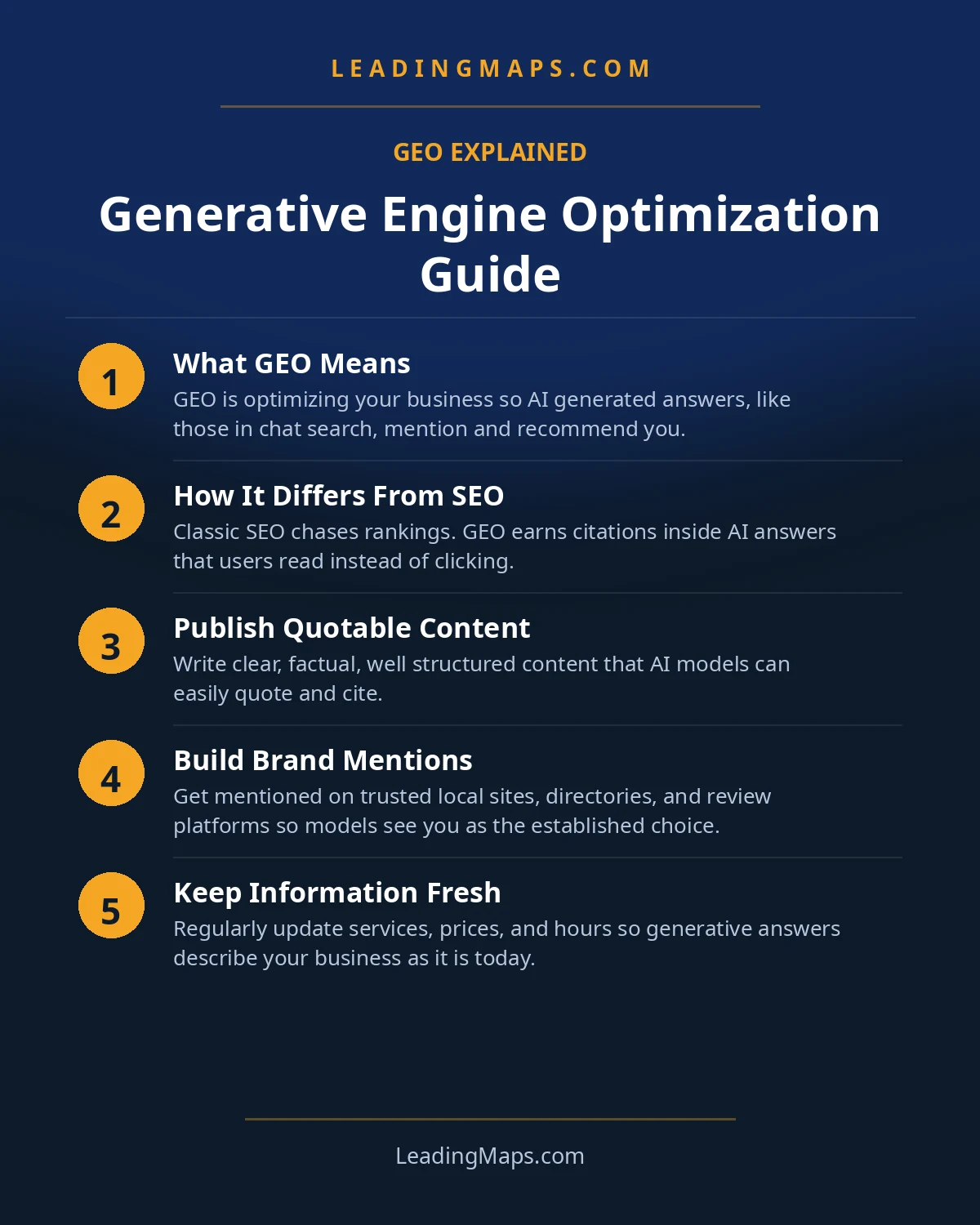
Forget the enterprise playbooks. Here is what actually moves AI recommendations for a trade business, in the order we would install it:
1. Make Your Google Business Profile The AI's Source Of Truth
Your profile is the local entity record. Fill every field: categories for your trade, the full service list with specific descriptions, hours including emergency and holiday hours, every relevant attribute. For Gemini in particular, attributes are how conditional queries get matched, "open now," "online estimates." A bare profile is an unquotable business. Our GBP optimization service rebuilds all 23 fields with this exact purpose in mind.
2. Turn Reviews Into The AI's Trust Signal
Reviews are the most heavily weighted trust signal in local AI answers, because they are independent corroboration. Coach techs to ask customers to mention what was fixed, and reply to every review with service and city specifics. Volume matters, recency matters more, and specificity matters most: a review that reads "Tom replaced our panel same-day, best electrician in Frisco" is quotable evidence the AI can cite.
3. Lock Down NAP Consistency
AI systems cross-reference your business across the web to decide you are real. Every conflicting phone number, old address, or mismatched name is a reason for the model to lower its confidence and name someone else. Contractors are especially prone to this: call-tracking numbers, old DBA names on directories, a dispatch address floating around. One canonical NAP, everywhere.
4. Build Service-Area Pages As Citable Units
Your service-area pages are the units AI cites for "in [city]" queries. Each one should read like a quotable brief: the services offered there, the problems common in that area, real response-time and pricing context, and an FAQ answering the exact questions homeowners ask. One templated page with the city name swapped in is not citable.
5. Publish With Stats, Quotes, And Citations
This is the direct application of the GEO research to a trade business. Your cost guides should include real price ranges, your service pages should cite manufacturer specs and code requirements, your posts should quote your own techs by name. "Water heater installs in Plano typically run $1,500 to $3,000 depending on tank vs tankless" beats "we offer affordable water heater services" for humans and machines alike. Specific, sourced facts get quoted, marketing adjectives do not.
The Citation Gap: Why Good Plumbers Lose To Loud Websites
There is a documented phenomenon in AI search that hurts trades especially hard. Only a small fraction of the sources an AI answer cites also rank in the organic top ten. Ranking well and getting cited are increasingly separate games.
For contractors, this means the map-pack leader and the AI-recommended company are often different businesses. The AI answer for "best HVAC company in [city]" might cite a competitor's detailed mini-split guide while the top-ranked map-pack business, with the better reviews and the better techs, goes unnamed, because its website is five thin pages and its profile is half empty.
This is actually good news. The citation gap is a window, not a wall. A smaller contractor with specific, well-organized, citable content can win AI recommendations against a bigger competitor that outspends them on traditional SEO. The research's "underdog effect" was measured in a lab, but the mechanism is visible in local markets right now: the best-documented business wins the answer.
Your Contractor GEO Readiness Checklist
Run through this once. Every unchecked box is a reason an AI assistant names someone else:
- Profile completeness. Every GBP field filled, categories and services listed, hours and emergency hours current, attributes set.
- Review engine running. New reviews every month, techs nudging customers to name the work done, every review replied to with specifics.
- NAP locked down. One canonical name, address, and phone across your site, profile, and directories. Call-tracking numbers documented, not leaking.
- Citable service pages. One detailed page per core service, with real details, pricing context, FAQs, and structured data.
- Service-area briefs. Genuinely useful local pages answering the questions homeowners in each area actually ask.
- Cost and FAQ content. Real price ranges, real timelines, real answers, the research-backed material AI quotes.
- Crawler access. AI crawlers can reach your site. Check robots.txt and confirm key pages are indexed and snippet-eligible.
- Prompt testing cadence. A standing set of 10 to 15 customer prompts, run monthly across ChatGPT, Gemini, and Perplexity.
If you want this measured properly instead of guessed, our free AI visibility audit runs the prompt tests for you and scores every item above against the top three competitors in your market.
GEO Vs SEO Vs AEO: How The Three Fit Together
The terminology gets tangled, so here is the plain version:
- SEO gets you ranked in the list of links: map pack, organic results, the surfaces people click.
- AEO (answer engine optimization) gets you featured as the direct answer: featured snippets, voice assistant responses, the single answer read aloud. Our AEO guide covers this in depth.
- GEO gets you cited and named inside generative AI answers: ChatGPT, Perplexity, Google AI Overviews, Gemini.
They are not competitors, they are layers. The same foundation, a complete profile, steady reviews, consistent NAP, specific service pages, feeds all three. The difference is the target surface. SEO wants the click, AEO wants the featured answer, GEO wants your name in the AI's sentence.
For a contractor in 2026, the honest priority order is: SEO and GBP work first, because they still drive the most calls today, with GEO built on top as the growth layer. Anyone selling you GEO instead of local SEO is selling the roof before the foundation. Our breakdown of LLM SEO vs traditional SEO goes deeper on how the two compare for trades.
One more thing worth knowing: nobody can guarantee you an AI citation. The engines are black boxes, the models change constantly, and anyone promising "we will get you cited in ChatGPT" is selling certainty they do not have. What you can control is the evidence: make your business the best-documented answer in your market.