You are spending money on AI visibility, directly or in evenings of your own time, and "feels like we're showing up more" is not a measurement. The problem is that AI search has no rank tracker: there is no position 1 through 10 to watch, just answers that change every time someone asks. So contractors need a different scoreboard, one built for how assistants actually work.
That scoreboard has four numbers: mentions, citations, sentiment, and share of voice. This post defines each in trade terms, gives you the manual tracking template (no paid tool required), shows you how to benchmark against the two or three competitors who keep beating you, and maps each metric to the work that moves it. A one-time diagnostic tells you where you stand today; this is the system that tells you whether you are gaining or losing, month after month.
On This Page
The Four Metrics, In Trade Terms
Borrowed from the enterprise playbook and translated for a contractor's reality. The HubSpot analysis of answer-engine visibility frames these as the new positions, and the framing holds for local trades too:
- Mentions. How often your business name appears across the web in sources AI systems read: directories, review platforms, local press, sponsorship pages, social profiles. Mentions are corroboration. They are what lets an assistant confidently resolve your business as a real entity, which is the precondition for being recommended at all.
- Citations. How often AI answers name you or link to your pages as a source. This is the visible outcome: your business appearing inside the answer, not just existing somewhere in the training data.
- Sentiment. What the assistants say about you when they do name you. Positive, neutral, wrong, or (worst) absent while competitors get the glowing paragraph. Sentiment is where review content and factual accuracy show up.
- Share of voice. How often you get named relative to the competitors in your market for the same prompts. This is the only metric that tells you whether you are winning or losing, because AI answers are zero-sum: every recommendation has a fixed number of names in it.
Used Versus Cited: The Distinction That Changes Everything
Before you build the tracker, internalize the one distinction that makes AI measurement different from SEO measurement. Search Engine Land's analysis describes two separate technical states: an answer can be used, drawing on your facts without naming you, or cited, naming you or linking to your pages. Your pricing page can power an answer that recommends a competitor. That is used-without-cited, and it is the cruelest outcome in this game.
The citation data sharpens the point. Research covered by Search Engine Journal found AI tools recommend brands but cite other sites: third-party pages receive the large majority of citations, brand-owned pages a small minority. Translation for a contractor: citations to your own website are only part of the score. Your reviews, your directory profiles, and what local press says about you are citation sources too, and they are often the ones the assistant actually links. Track mentions and citations separately, because a business can be heavily mentioned and rarely cited, and the fix for each is different.
Mentions, citations, sentiment, share of voice. Tracked monthly against the same competitors, these four numbers tell you more about your AI visibility than any single audit ever will.
The Manual Tracking System
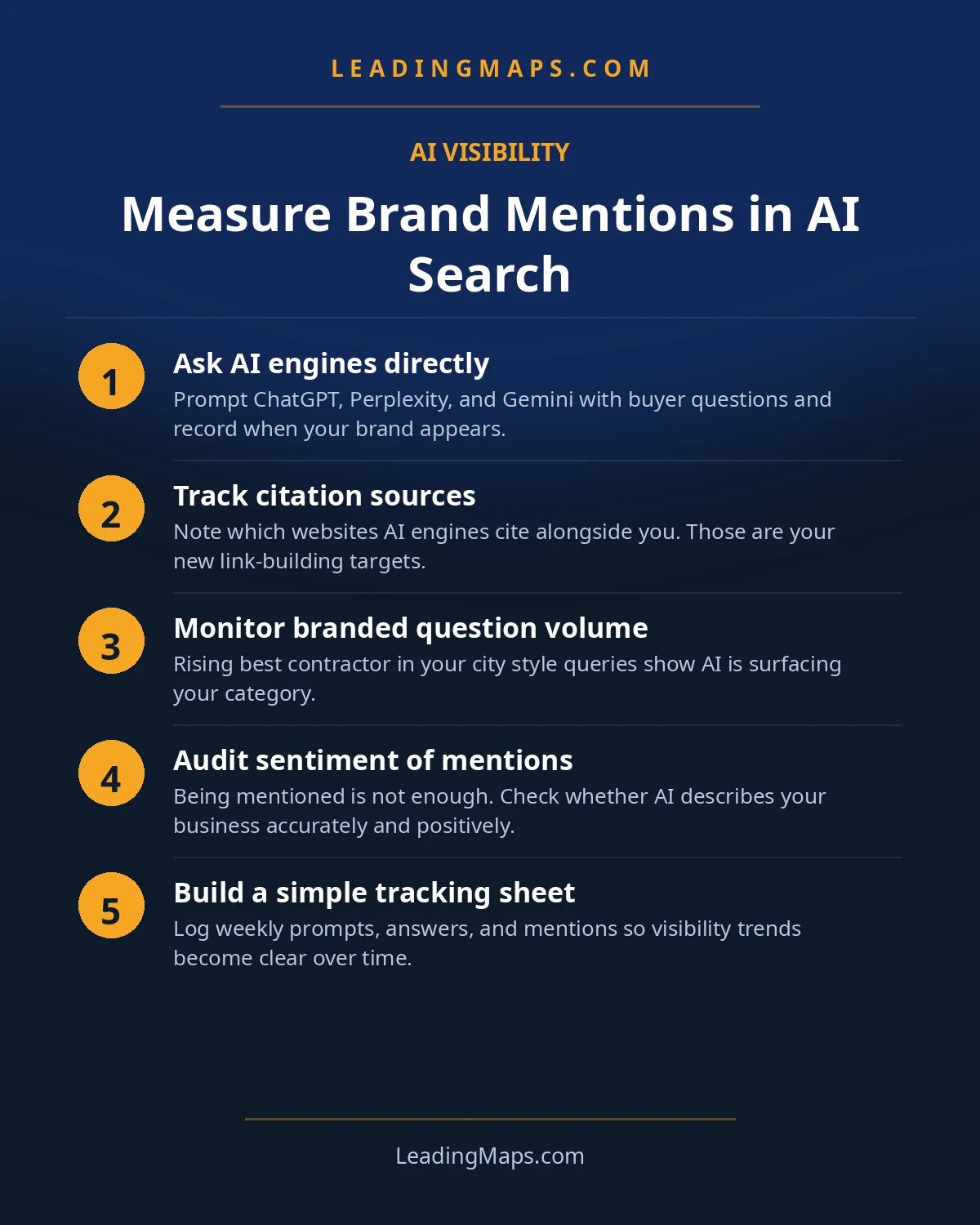
No free tool gives you the full picture, and the paid ones vary wildly in how they sample. The reliable method is manual, and it takes about an hour a month once the system exists:
Step 1: build the prompt bank. Twelve to fifteen prompts covering the four query types a homeowner actually uses. Write them the way a customer talks, with your market in them:
- Emergency: "my water heater burst, who can come tonight in [your city]"
- Cost: "how much does AC replacement cost in [your city]"
- Best-of: "best plumber in [your city]" / "who is the most reliable HVAC company near [town]"
- Brand vs competitor: "[Your Business] vs [Competitor], which is better for [service]"
Step 2: run them on three platforms. ChatGPT, Gemini, Perplexity. Run each prompt two or three times per session; AI answers vary run to run, and a single sample lies.
Step 3: log every answer in the sheet. One row per prompt per platform per run. Columns: named (yes/no), cited (yes/no, and which page), position in the answer (first named, mentioned in passing), tone (positive, neutral, wrong facts, absent), and competitor named instead (who). That last column is the most valuable one you will fill.
Step 4: score the month. Tally the columns. Named-rate, cited-rate, wrong-fact count, and the competitor leaderboard. Save the sheet; the trend across months is the measurement, not any single month.
For the diagnostic version of this exercise, the one-time "am I visible and what's broken" pass, see our ChatGPT recommendation playbook, which includes the testing method this monthly system is built on.
Share Of Voice: The Competitor Benchmark
Here is the math that turns a spreadsheet into a strategy. Pick the two or three competitors who keep beating you, the names you see in the map pack and hear from lost bids. Run your prompt bank for your business and for each of them, same prompts, same platforms, same month.
Share of voice is simple: your namings divided by total namings across all tracked businesses, times one hundred. If four businesses get named 40 times in a month and you account for 6 of them, your share of voice is 15 percent. Track it monthly. The absolute number matters less than the trend and the gap: are you closing on the leader, and which prompt types are you losing (emergency, cost, best-of)?
Two honesties about this metric. First, it is zero-sum, which is the point: an assistant's answer has room for a few names, and every name that is not yours is a job you did not get to bid on. Second, do not expect fast movement. Share of voice moves on the timescale of mentions and reviews, months, not days. A flat quarter is normal; a declining two quarters is a strategy problem.
Break the number down by prompt type and it gets more useful. Most contractors find they win cost questions (their pricing content is quotable) while losing emergency queries (their after-hours signals are weak) or the reverse. That split tells you exactly which layer to work: lost cost questions mean a content problem, lost emergency queries mean an entity and hours problem, lost best-of prompts usually mean a review problem. The aggregate number tells you whether you are winning; the breakdown tells you what to do on Monday morning.
What Moves Each Metric
Measurement without action is bookkeeping. Each metric has levers, and they are different levers:
- Mentions move with presence. Directory profiles claimed and completed, local press and sponsorships, community involvement that gets written up, review platforms, trade association listings. Mentions are the corroboration layer: the more independent sources say you exist and do what you do, the more confidently AI systems resolve you.
- Citations move with quotable pages. Original, crawlable, quotable content: cost guides, checklists, comparison pages, FAQ sections with direct answers. Third-party sources get cited more than brand pages, so reviews and directory content count here too. If your cited-rate is low while mentions are healthy, your content is not quotable enough.
- Sentiment moves with reviews and accuracy. Review text is the raw material of sentiment, and review responses are the correction mechanism. Wrong facts in AI answers (old hours, wrong services) drag sentiment down; our business information accuracy guide is the fix protocol. Our review generation system feeds the positive side.
- Share of voice moves with everything, consistently. There is no share-of-voice hack. It is the composite outcome of mentions, citations, and sentiment, compounded over months. The contractors winning it are not doing anything exotic; they are doing the fundamentals without stopping.
Cadence And Reading The Trend
Monthly for the core prompt set, same prompts, two to three runs each. Quarterly, re-benchmark the competitors and review the trend lines together. Yearly, refresh the prompt bank, because the questions homeowners ask shift (new services, new pricing concerns, new competitors to include in the brand-vs prompts).
Weekly checking is a trap. AI answers fluctuate run to run, and reacting to one bad week will have you rewriting pages that were fine. Only sustained movement across a month or more means something changed. When a metric does move, diagnose before acting: a citation drop after a site redesign is a crawlability problem; a sentiment drop after a bad review cycle is a review problem; a share-of-voice drop with no change in your numbers is a competitor doing something, go find out what.
And keep the end goal in view. The scoreboard exists to produce booked jobs, not to win the spreadsheet. If your share of voice is climbing and the phone is not, the problem is not measurement, it is conversion, and no metric in this post will fix a website that cannot close. If the phone is ringing and you want to know why, or you want the whole program run for you, our AEO, GEO, and LLM optimization service includes this tracking as part of the engagement.
Measurement Questions, Answered.
Any appearance of your business name across the web in sources AI systems read: directory profiles, review platforms, local press, social profiles, sponsorship pages, and forum threads. Mentions build the corroboration that lets an assistant confidently resolve your business as a real entity, which is the precondition for being recommended at all.
A mention is your brand name appearing somewhere AI systems read. A citation is an AI answer naming you or linking to your pages as a source. Mentions are the raw material, citations are the outcome. Research shows third-party sites receive most AI citations, so citations to your own pages are only part of the picture.
Monthly for the core prompt set, with the same prompts run two or three times each to smooth out answer variance. Quarterly, re-benchmark against competitors and review the trend lines. Weekly checking creates noise, not signal: AI answers fluctuate run to run, and only sustained movement across a month means something changed.
No free tool gives you the full picture reliably. The honest stack is manual: a spreadsheet, a fixed prompt set, and disciplined monthly runs across ChatGPT, Gemini, and Perplexity. Google Alerts covers new web mentions, and Search Console shows AI-feature traffic from Google. Paid AI-visibility platforms exist, but the manual method keeps you honest about what the numbers mean.
Run the same prompts for your business and two or three named local competitors, and log who gets named, cited, or described per answer. Your share of voice is your namings divided by total namings. Track it monthly; the trend against the same competitors matters more than any single month's number.
Know Your Numbers, Then Move Them.
Profile, Maps rankings, citations, reviews, competitors, plus your AI share of voice against the businesses beating you. A prioritized action plan, free, no pitch.
- AI visibility check, real homeowner prompts across ChatGPT, Perplexity, and AI Overviews, who gets named.
- Proposal scorecard, what your current or prospective agency should be doing, item by item.
- Competitor gap analysis, what the top 3 in your market are doing that you're not.
Get My Free SEO Audit
Delivered within 48 hours. Yours to keep.