Picture the scene. A homeowner asks ChatGPT whether your company handles after-hours emergency calls, or what your Saturday hours are. The assistant answers confidently, and it is wrong. It quotes hours you changed last spring, a phone number you retired two years ago, or a service area you stopped covering. The homeowner never calls. You never find out you lost the job.
This is the accuracy problem, and it is getting sharper every month AI assistants take more of the "who should I hire" workload. An AI does not phone your office to verify. It assembles your business from facts scattered across your profile, your website, directories, aggregators, and reviews. When those sources disagree, it trusts whichever version has the most corroboration. The stale version usually wins that contest, because stale listings have had years to multiply while your correct update exists in exactly one place.
The fix is one source of truth, pushed consistently everywhere, plus a routine that hunts down the wrong facts AI systems repeat and corrects them at the source. This post is that routine. It sits next to three related jobs on this site, and it pays to know the boundaries: our NAP consistency guide keeps your name, address, and phone identical; our profile field-by-field rebuild gets the profile itself right; and our AEO and LLM optimization service handles the broader AI-visibility program. This post is the accuracy layer across all of them: making sure the facts about your business are correct everywhere AI systems look.
On This Page
The 12 Fields AI Systems Read About Your Business
Every AI answer about your company is assembled from a short inventory of fields, pulled from your Google Business Profile, your website, directories, and reviews. Know the inventory and you know exactly what to keep accurate:
- Business name. The exact canonical name. Extra keywords stuffed into the name ("Apex Plumbing 24/7 Emergency") do not help AI accuracy; they create a second identity.
- Primary and secondary categories. These tell AI systems what you actually are: Plumber, HVAC Contractor, Roofing Contractor. Wrong category, wrong recommendations.
- Attributes. Identifies as women-led, offers 24/7 service, licensed. AI assistants use these as filters when homeowners ask for specifics.
- Hours, plus special and holiday hours. The single most-quoted fact in AI answers, and the single most commonly stale one.
- Service areas. The cities and zips your trucks genuinely reach. Too broad and AI sends you jobs you cannot take; too narrow and you vanish from towns you serve.
- Services with descriptions and prices. The structured menu of what you sell. Vague service names ("general repairs") give AI nothing to match a query against.
- Phone number. One canonical number. Tracking-number sprawl creates duplicate identities, which is its own kind of wrong.
- Address, coordinates, or the service-area-business flag. For contractors who go to the customer, the flag matters more than a street address, and the two must not contradict each other.
- Questions and answers. The Q&A section is structured text AI systems can quote directly. Empty or outdated Q&A is a missed accuracy lever.
- Photos. Branded trucks, uniformed techs, real job sites. AI systems treat current photos as evidence of an active, real business.
- Review text, not just stars. Assistants read what reviews say ("replaced our water heater same day") and use it as evidence of what you do.
- Website facts and schema. Your site is the tiebreaker source for service details, pricing, and areas served. Structured markup makes those facts machine-readable.
That is roughly the entire inventory of business facts AI assistants pull about your company. Every field that is wrong or inconsistent somewhere is a field the AI can get wrong in front of a homeowner.
Why Your Facts End Up Wrong In AI Answers
AI systems do not have a fact-checking department. When two sources disagree about your hours, the system resolves the conflict by weight of corroboration: whichever version appears in more trusted places wins. That is the whole mechanism, and it explains why stale data is so durable. Your correct update exists on your profile; the wrong version exists on eight directories, two aggregators, and an archived review page.
The usual ways a contractor's facts go stale:
- Hours changed, updates did not follow. Summer hours, storm-season extensions, Saturday mornings added or dropped. The profile got updated; the directories did not.
- Phone number changed. Or worse, call-tracking numbers multiplied: a different number on every landing page, each one now a competing "fact" about your business.
- Service area drifted. You stopped driving to the far county, or added a new one, and nobody updated the listings that still claim both.
- Rebrands and DBA changes. A new name on the truck, old name on five directories. AI systems now see two businesses.
- Duplicate profiles. Same business, two listings, slightly different data on each. Every fact now has a twin.
- Aggregator scraping. Data brokers scrape your old info and sell it downstream to dozens of sites you have never heard of. Google's own guidance on AI features puts it plainly: keep your Business Profile information up to date, because that is the information feeding the answers.
The pattern is always the same: the correction happened in one place and the stale copies kept circulating. Accuracy work is circulation work.
The Conflict-Hunt: Find Out What The AIs Believe
You cannot fix what you cannot see, so start by asking. Run these four questions about your own business on ChatGPT, Perplexity, and Gemini, and log exactly what each one says:
- "What are [Your Business Name]'s hours? Are they open on Saturdays?"
- "What is [Your Business Name]'s phone number?"
- "Does [Your Business Name] serve [town you actually serve]?"
- "What services does [Your Business Name] offer?"
Flag every answer that is wrong, incomplete, or conflicts with what another assistant said. Then trace each wrong fact to its source: search the exact wrong fact in quotes and you will usually land on the directory or aggregator feeding it. That source is the thing to fix, not the AI. Rank what you find by business impact: wrong phone or hours is lost calls today; a wrong service list is lost jobs this week; a wrong address or a competitor's number attached to your name is a five-alarm fire.
The Correction Playbook, In The Right Order
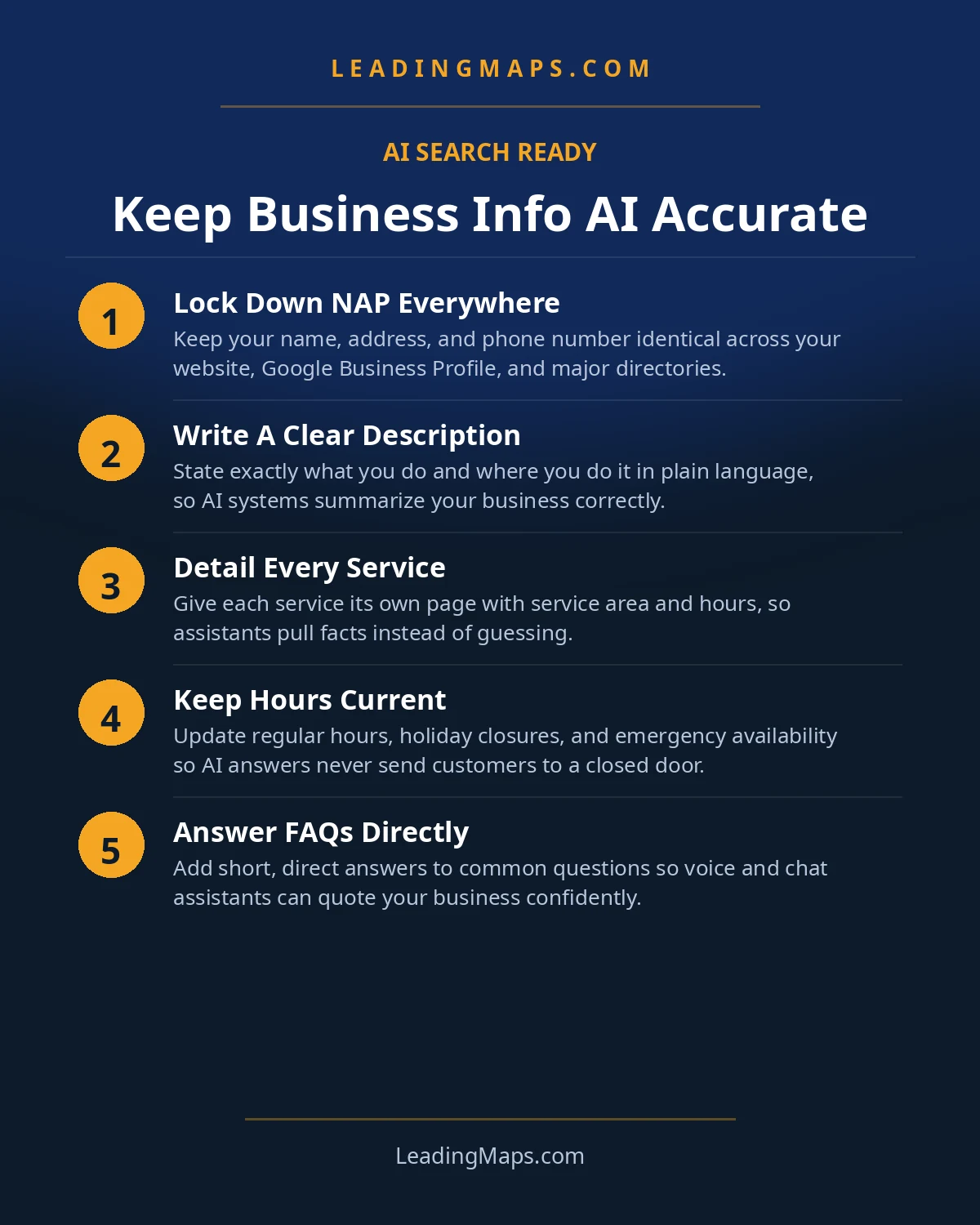
Order matters. Fix at the source, not at the symptom, because you cannot edit an AI's memory. You can only change what it reads the next time it looks:
- Your Google Business Profile first. It is the primary entity source for local facts. Hours, categories, services, service areas, phone: correct here before anywhere else.
- Your website second. Contact page, footer, service pages, and the schema markup, which must match the visible text. Google requires that structured data match what visitors see, and AI systems read the same rule.
- The top-tier directories third. Bing Places, Apple, Yelp, Facebook, Nextdoor, Angi, Houzz, HomeAdvisor, the BBB. Our citation directory guide has the full tiered list and the cleanup order.
- Request corrections on aggregators fourth. The data brokers feeding dozens of small sites. Slower, but this is where the long tail of stale copies comes from.
- Publish the corrected fact somewhere crawlable. A profile post, a Q&A entry, a line on the relevant service page. AI assistants ingest fresh crawlable content, and a published correction gives the right version something to cite.
- Fix duplicates and bad third-party content. Merge duplicate listings with the proper process; respond publicly to reviews that state wrong facts (a polite correction in a review reply is crawlable too).
Then set expectations honestly. Profile edits surface within hours to a few days. Directory corrections take days to weeks. AI answers update on their next crawl and index cycle, and no assistant publishes a timeline for that. If a fact matters enough to cost you calls, the quarterly re-check below is how you confirm the correction landed.
The Trade-Specific Accuracy Items
Generic businesses get the generic twelve fields. Contractors have a few extra facts AI systems quote, and each one is worth getting exactly right:
- Emergency and after-hours flags. If you take emergency calls, say so explicitly in services and attributes, with the real response behavior. If you do not, say nothing; claiming 24/7 when nobody answers is how you earn one-star reviews.
- License numbers. Display them on your profile and your site. They are entity identifiers: a license number ties your business to a government record, which is about as authoritative a corroboration as exists.
- Service areas as actual truck reach. Not wish-list territory, not the whole state. The cities and zips you will genuinely roll a truck to.
- Pricing honesty. You do not need a price list for every job, but "starting at" ranges or flat-rate callout fees on the site give AI systems quotable facts. Invent nothing; vague beats wrong.
- Seasonal and holiday hours. Storm season, freeze season, holiday closures: set special hours before the season, not after the first missed call.
Third-party mentions shape what AI systems "remember" about a brand, which is why off-site accuracy matters as much as on-site accuracy: the HubSpot analysis of answer-engine visibility makes the same point about off-site signals. Your facts live on other people's websites whether you manage them or not.
The Maintenance Rhythm
Accuracy decays the same way rankings do. Keep it cheap and routine:
- Quarterly: run the four conflict-hunt questions on the three major assistants, log the answers, and trace anything wrong to its source.
- Same-day rule: any change to hours, phone, services, or areas gets updated on the profile, the website, and the top directories the same day it happens.
- Set Google Alerts on your exact business name and phone number, so new stale copies surface in your inbox instead of in an AI answer.
- Yearly: re-verify your full citation footprint against the directory list and merge any new duplicates.
Accuracy is the unglamorous half of AI search. Nobody pitches it on a webinar, and it will not make a case study. But every AI recommendation your competitors win starts from the same foundation: facts the system can trust.
Accuracy Questions, Answered.
They assemble your business from facts scattered across your profile, website, directories, and reviews. When those sources disagree, the system trusts whichever version has the most corroboration, which is often the stale one, since old listings have had years to multiply. The wrong answer is a data problem, not an AI problem.
Your Google Business Profile is the primary entity source for local facts like hours, categories, and service areas, because Google corroborates it against your website and directories. Your website is the primary source for service details and pricing. Everything else is corroboration, which is why consistency across all of them matters.
Profile edits usually surface within hours to a few days. Directory corrections take days to weeks depending on the platform. AI answers update on their next crawl and index cycle, and there is no fixed timeline, which is why you fix at the source and publish the corrected fact somewhere crawlable rather than waiting on the assistant.
Use one canonical number on your Google Business Profile, website, and every directory, and do tracking at the website level instead. A different number on each page splinters your entity data and teaches AI systems that your business has several identities. If you must use tracking numbers, keep the canonical number as the primary listing everywhere.
Quarterly, plus immediately after any change to hours, phone, services, or service areas. The quarterly pass is simple: ask the major AI assistants four basic questions about your business, log what they say, and trace every wrong fact to its source. A stale fact you ignore is a fact your competitors' clean data will beat.
What Are The AIs Saying About Your Business?
Profile, Maps rankings, citations, reviews, competitors, plus whether AI assistants recommend you, and whether the facts they quote are right. A prioritized action plan, free, no pitch.
- AI visibility check, real homeowner prompts across ChatGPT, Perplexity, and AI Overviews, who gets named.
- Proposal scorecard, what your current or prospective agency should be doing, item by item.
- Competitor gap analysis, what the top 3 in your market are doing that you're not.
Get My Free SEO Audit
Delivered within 48 hours. Yours to keep.