Picture the owner of a three-truck HVAC shop opening his monthly SEO report. He is between jobs, reading on his phone, with about ninety seconds before the dispatcher calls. What he gets from most agencies: eleven pages of impressions, positions, and acronyms, and a conclusion that says "visibility is up." He closes it having learned nothing. He paid for a report and received a sedative.
The fix is not dumbing anything down. It is respecting the reader. A contractor owner understands his business perfectly; he just does not speak agency. Build the report in his language, in a fixed order, and it becomes the most useful document his marketing produces. Below is the exact format: six short sections, the seasonal math trades need, and the AI-search block every 2026 report should carry.
On This Page
- The two-minute rule
- Section 1: the plain-English summary
- Section 2: calls and booked jobs
- Section 3: map coverage across service towns
- Section 4: reviews
- Section 5: what was done, and what is next
- Section 6: the monthly AI-answers check
- Seasonal math: compare winters to winters
- What to leave out
- FAQ
The Two-Minute Rule
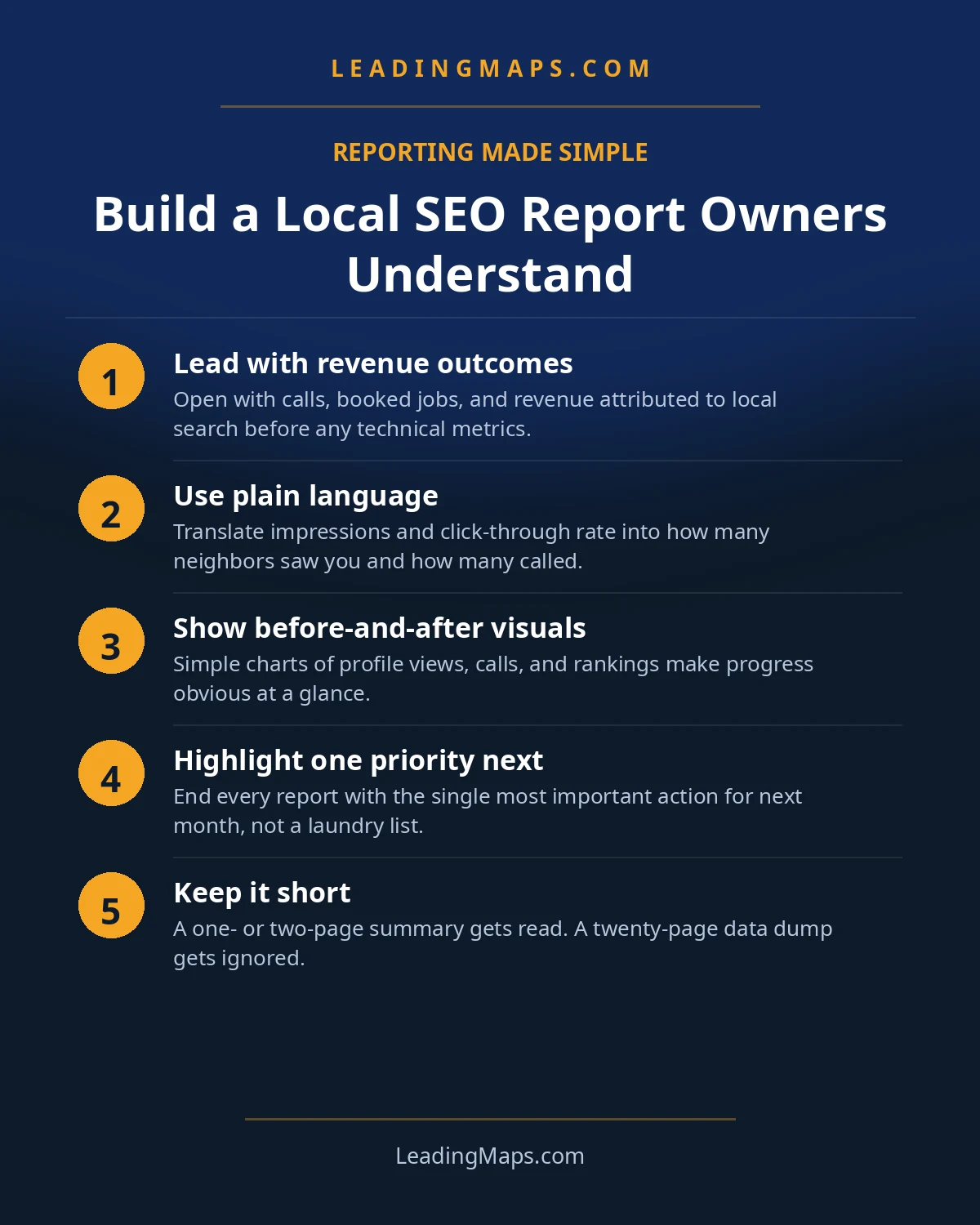
Every section of the report must pass one test: after reading it for two minutes, can the owner repeat back what happened and what happens next? If not, the section failed, not the owner. This is the only formatting rule that matters, and it kills more agency jargon than any style guide.
That also fixes the order. Outcomes come first, explanations second, activity last. Nobody opens with "we built 14 citations" and closes with "calls are up." You open with calls, then explain what drove them, then show the work. An owner who reads only section one still knows whether the month was good.
Section 1: The Plain-English Summary
Three sentences, maximum four. No numbers yet, just the story:
- What happened. "Calls from Google are up for the third month running."
- Why, in one clause. "Your map coverage expanded into two new towns and reviews kept climbing."
- What is next. "This month we are targeting the east side towns where you are still outside the top 3."
This section is also where context lives. If a heat wave inflated HVAC calls or a slow February is normal for roofing, say so here in plain words before the numbers make it look alarming. The summary is the difference between a report that informs and a report that scares.
Section 2: Calls And Booked Jobs, The Honesty Section
This is the section the whole report exists to serve. Three rows, month over month:
- Answered calls from organic search and Maps. Real conversations with real homeowners.
- Missed calls. Shown plainly, no hiding. A marketing report that ignores missed calls is a story about the phone, not the business.
- Qualified leads and booked jobs. The number that touches revenue. If you track it, show the cost per lead beside it, so the owner sees the economics in one glance.
Google's Business Profile performance documentation defines what the profile natively reports (calls, bookings, website actions), and one honest caveat belongs in a footnote: Google removed the native call-history log in 2024, so call detail now comes from call tracking, not the dashboard. State the source of your numbers. Owners trust a report that admits its limits more than one that hides them.
The missed-call row earns its place every month. Visibility you paid for, ringing out, is the single most expensive leak in a trade business, and putting it in the report is what turns a marketing document into an operations document.
Section 3: Map Coverage Across Service Towns
One rank from the owner's office tells him nothing. His trucks work six towns; the report should show all six. For each service town, show the average map-pack position trend for the main keywords, and whether the top-3 coverage is widening or shrinking.
The question this section answers: "Are we winning where our crews actually work?" A plumber whose home city rank is number one but who is invisible in the two towns producing half his calls is losing, and the report should say so. Our rank tracking guide covers which method produces this coverage data for service-area businesses.
Section 4: Reviews
Four numbers, all owner-legible:
- New reviews this month and the current average rating.
- Review velocity trend, three months, so the owner sees the line going up or down.
- Response rate. Did every review get a reply? Owners understand this one instantly.
- Competitor gap. Your count versus the top 3 competitors' counts. Nothing motivates an owner like seeing the rival with 40 more reviews.
Keep this section visual and short. Reviews are the part of SEO an owner can feel, and the report should make that feeling concrete. The full system behind these numbers lives in our review guide.
Five standing sections every month, one new AI-answers block. The same format, on the same date, every month. Trends only become visible when the report stops changing shape.
Section 5: What Was Done, And What Is Next
This is the accountability section, and it is what separates a report from a receipt. Two short lists:
- Completed this month. Plain descriptions: "rebuilt your services list," "fixed 9 duplicate listings," "added city pages for two new towns." No jargon, no padding.
- Planned next month. Tied to the gaps in sections two through four. If coverage is weak in two towns, next month's work targets those towns. The owner should be able to draw the line himself.
This section is also where retainer value becomes visible. An owner who sees "what was done" mapped to "what changed" stops asking what he is paying for. If you are evaluating an agency, this section is the one to interrogate first. Our agency hiring checklist shows exactly how.
Section 6: The Monthly AI-Answers Check
No 2026 report is complete without this block, and no template on the market includes one. Owners are starting to ask "do I show up when people ask ChatGPT for a plumber?" and the report should answer before they ask.
The method is simple and repeatable. Once a month, run the same five homeowner prompts through ChatGPT, Gemini, and Perplexity. Examples: "best plumber in [city]," "emergency HVAC repair near [town]," "how much does roof replacement cost in [area]." Record, per prompt:
- Were you cited or named? Yes or no.
- Who was named instead? The competitor to beat.
- Was the mention favorable? Named as a recommendation versus mentioned in passing.
One row per prompt, one table per month. It is directional, not precise, and the report should say so. But it is the only window an owner has into a channel that is quietly sending competitors his calls. The deeper method lives in our AEO and LLM optimization breakdown and our guide to getting recommended by ChatGPT.
Seasonal Math: Compare Winters To Winters
Trade businesses breathe with the seasons, and a report that ignores that will manufacture panic. Roofers slow in January. HVAC peaks in heat waves and cold snaps. A month-over-month comparison in a seasonal trade is mostly a weather report.
The fix is year-over-year: this January beside last January, this July beside last July. Google's Search Console performance docs note the tool's 16-month data window, which conveniently covers a full seasonal cycle plus change. Use the Compare tab against the same period last year for the demand layer of the report: queries, clicks, and impressions, YoY.
Write the season into the summary in plain words: "February is historically your quietest month; you are up 18% on last February." One sentence like that is worth ten charts.
What To Leave Out: The Vanity Section
A report that respects the owner is also a report that refuses to pad. Leave these out, or relegate them to an appendix:
- Impressions without actions. A thousand extra views that produced no calls is not progress.
- Office-chair rankings. A screenshot of ranking number one, checked from your own desk, proves nothing about where customers search.
- Brand searches. People Googling your own business name are already yours. Celebrating them is taking credit for the sun rising.
- Raw traffic without intent. Visitors who read a DIY article and never call are not a win.
None of this means the data is useless to the agency. It means it does not belong in the owner's two minutes. Keep the diagnostics in the appendix; keep the decisions in the body.
Reporting Questions, Answered.
Monthly, on a fixed date, with the same sections every time so trends are visible. Owners do not need weekly snapshots unless ad spend is in play. Once a quarter, add a strategy page: what the next three months target and why. Consistency of format matters more than frequency.
Calls and booked jobs, split into answered, missed, and qualified. Every other section exists to explain that one number. If the report opens with impressions or rankings instead of calls, it is written for the agency, not the owner. Outcomes first, always.
Compare the same month last year, not last month. A roofer's January is supposed to be quiet; showing last January beside this January turns a scary dip into a real comparison. Note the weather and the season in the summary, and set the expectation before the slow months arrive.
Yes, but as coverage across your service towns, not a single rank from your office. Show whether visibility is widening into the towns that feed your crews, with an average-rank trend per town. One home-city ranking tells the owner nothing about where the trucks actually work.
Test five standard homeowner prompts across ChatGPT, Gemini, and Perplexity each month. Record whether you were cited, who was named instead, and whether the answer was favorable. Add it as a standing section beside the map coverage: the monthly AI-answers check, one row per prompt.
Want A Report Worth Opening?
Profile, Maps rankings, citations, reviews, competitors, plus whether AI assistants recommend you. A prioritized action plan, free, no pitch.
- AI visibility check, real homeowner prompts across ChatGPT, Perplexity, and AI Overviews, who gets named.
- Proposal scorecard, what your current or prospective agency should be doing, item by item.
- Competitor gap analysis, what the top 3 in your market are doing that you're not.
Get My Free SEO Audit
Delivered within 48 hours. Yours to keep.