Service-area businesses have a tracking problem that storefronts do not. A plumber with one shop and six towns of work does not have one ranking. He has dozens, shifting block by block, because proximity is a ranking factor and his customers are never standing in his parking lot. The question "where do I rank?" has no single answer, and most owners never get told that.
This guide compares the four real ways to track local rankings, with honest tradeoffs for each: what it measures, how accurate it is, what it costs, and when it is the right tool. No vendor pitches. Then a fifth method for the channel with no stable ranks at all: AI search. Pick the method that answers your actual question, and stop paying for precision you do not need.
On This Page
Method 1: Manual Spot Checks
What it measures: what a specific search looks like, once, from where you happen to be standing. Accuracy: low. Your phone personalizes results around your location, your search history, and the fact that you visit your own site. It is a mirror, not a meter. Cost: free. Effort: minutes.
Manual checks get dismissed by every tracking vendor, which is unfair, because they have a legitimate job: quick sanity looks. You just rebuilt your profile categories and want to see whether anything looks different in an incognito window. That is a fine use. The abuse is reporting a manual check as your ranking, to yourself or to a client. One search from one couch is an anecdote with a battery percentage.
Rule of thumb: use manual checks to notice, never to measure.
Method 2: Traditional Rank Trackers
What it measures: your position for a list of keywords, checked from a fixed point (usually a ZIP code or a lat/long), on a schedule, over time. This is the trend question: are we climbing or falling? Accuracy: good for the point it checks, misleading if you read that point as your whole market. One fixed point cannot see that you rank number two two miles east and number nine two miles west. Cost: subscription, from budget tools up to agency platforms. Effort: low once the keyword list is built.
Trackers are at their best on organic rankings for service and city pages, where position is genuinely one number per keyword per location. They are at their weakest on the map pack for service-area businesses, where position is a surface, not a point. Google's Search Console documentation makes the same caution about average position: one number averages away the differences that matter.
Right tool when: you want keyword trend lines for a defined list, you have city pages to watch, or you need a number for a monthly report that is at least consistent.
Method 3: Geogrid Scans
What it measures: your map-pack position for one keyword, at many points laid in a grid across your service area, all at one moment. This is the coverage question: where are we strong and where do we disappear? Accuracy: excellent for the question it answers, but it is a snapshot, one keyword, one moment, one grid. Cost: pay per scan or subscription, cheap per scan, adds up across keywords and towns. Effort: low to run, real to interpret.
For a service-area trade, this is the method that matches the actual problem. You do not have one ranking; you have a map of rankings, and a geogrid scan draws it. The scan tells you the east side towns are green and the west side is a problem, which is exactly the information that decides where your next city page, review push, or citation batch goes.
This post is the comparison, not the tutorial. For the full how-to on running geogrid scans across your service area, see our service-area ranking guide. Here is the decision that matters: reach for a geogrid when the question is "where," and reach for a rank tracker when the question is "are we trending up." Most growing service-area businesses eventually run both.
Method 4: Google Business Profile Performance Data
What it measures: not rankings at all, but what rankings are for: views, calls, direction requests, bookings, and website actions on your profile. Accuracy: first-party Google data, so the numbers are real, but they describe outcomes, not positions. Cost: free, built into your profile dashboard. Effort: nearly zero.
This is the method owners underuse and agencies overcomplicate. If your map-pack position improved but calls did not move, the ranking was not the story. Profile data is the only tracking method on this list that measures money-adjacent outcomes, which makes it the best cross-check on every other method.
Two honest caveats. First, Google discontinued the native call-history log in 2024, so the profile shows call counts, not who called or what was said; call detail needs call tracking. Second, Google's own performance documentation notes the data mixes organic and ad interactions, so treat it as directional if you also run ads.
Every tracking decision reduces to two questions: "are we trending up?" (rank tracker) and "where are we winning?" (geogrid scan). Everything else is a cross-check. Know which question you are asking before you pick the tool.
The Comparison: Pick Your Method
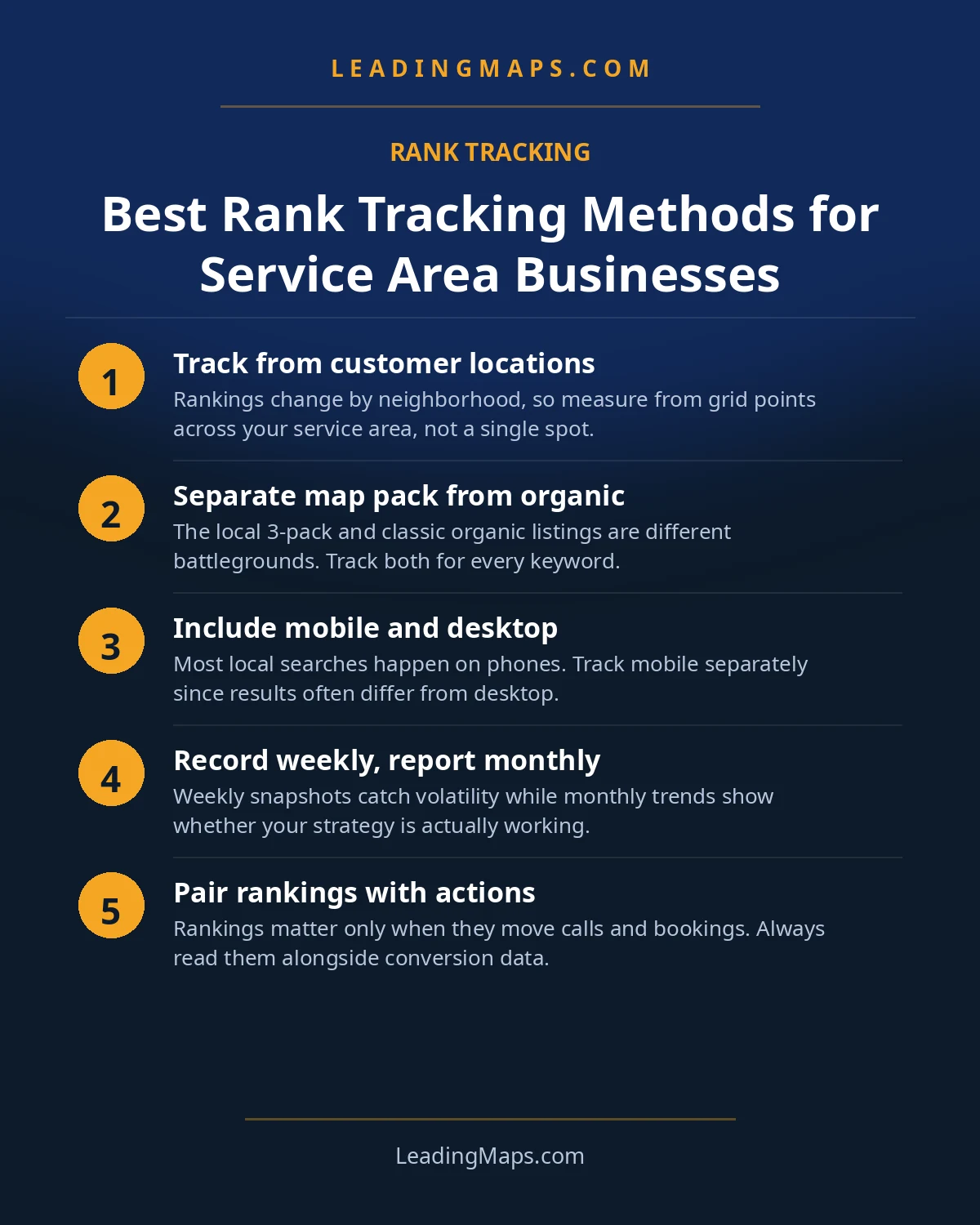
Match the method to the business, not the other way around:
- The one-truck plumber in one town. Profile performance data plus monthly manual sanity checks plus Search Console for organic queries. Free stack, entirely adequate. Your market is small enough that one point approximates the whole territory.
- The multi-crew HVAC shop across several towns. Add a rank tracker for your keyword list and city pages. You now have enough territory that one point lies to you, and trend lines earn their subscription.
- The multi-town roofer chasing five-plus markets. Add periodic geogrid scans on your money keywords. Coverage is your whole game now, and you need to see the map to allocate work: which towns get the next city page, which get the review push.
The minimal viable stack, at any size: profile data for outcomes, one trend method for direction, one coverage method when your territory outgrows one point. Anything beyond that is agency furniture.
The Tracking Mistakes That Waste Money
Most tracking budgets die from misuse, not from the wrong tool. The greatest hits:
- Tracking keywords nobody searches. If a keyword has no local volume, its trend line is decoration. Audit the list against real queries in Search Console quarterly.
- Mixing methods in one report. A rank-tracker point and a geogrid average are different numbers. Label the source on every chart, or you will compare apples to heatmaps.
- Checking from the office. Your shop sits at one point in your territory. Every manual check you run there answers a question about your shop, not your market.
- Paying for precision you never act on. If no decision in the last quarter came from your tracking data, downgrade the stack until a decision does.
Method 5: Tracking AI Visibility (The Honest One)
None of the four methods above can tell you whether ChatGPT recommends you, because AI answers have no stable rank to track. Positions in AI Overviews and chatbots shift by query phrasing, location, platform, and Tuesday. Anyone selling you an "AI rank tracker" with one clean number is selling a fantasy.
What you can measure, honestly, is mentions. Run a fixed battery of homeowner prompts through ChatGPT, Gemini, and Perplexity once a month, the same prompts every time, and log three things per prompt: were you cited or named, who was named instead, and whether the mention was favorable. That log is your AI-visibility trend line. It is directional, it is manual, and it is the best instrument that exists right now.
Search Engine Journal's local SEO guide is a solid grounding on the traditional signals behind all these methods; the AI layer is new, and the measurement discipline for it is still being invented. Our ChatGPT recommendation guide covers what actually moves the mentions you are logging.
How Often To Check
Monthly is the right cadence for nearly every trade business. Local rankings bounce daily, and reacting to daily noise causes more harm than patience. Check monthly for trends, scan after major changes (new city pages, a profile rebuild, a suspension recovery), and compare quarter to quarter for the real story. If your agency reports weekly rank movements as progress, ask what changed in the business that week. Usually nothing.
Rank Tracking Questions, Answered.
No, and not because you did it wrong. Your phone personalizes results: your location, your search history, and your own site visits all skew what you see. A manual check is useful as a quick sanity look after a change, but it is not data. Never report a manual check as your ranking.
A rank tracker checks your position from one point, usually a ZIP code, over time: the trend question. A geogrid scan checks one keyword from many points across your service area at one moment: the coverage question. Different tools, different answers, and service-area trades usually need both.
Monthly is enough for most trade businesses. Local rankings bounce day to day, and reacting to daily noise causes more harm than patience. Check monthly for trends, scan after any major change (new city pages, a rebuild, a suspension recovery), and compare quarter to quarter for the real story.
Yes, but do not expect a rank. Run a fixed battery of homeowner prompts through ChatGPT, Gemini, and Perplexity monthly and log whether you were cited, who was named instead, and whether the mention was favorable. There is no stable position in AI answers, so you track mentions, not ranks.
Start with free data: your Google Business Profile performance report and monthly spot checks, plus Search Console for organic queries. That is enough until growth forces precision. Add a rank tracker when you target multiple towns, and geogrid scans when you need to see coverage town by town.
See Your Coverage Town By Town.
Profile, Maps rankings, citations, reviews, competitors, plus whether AI assistants recommend you. A prioritized action plan, free, no pitch.
- AI visibility check, real homeowner prompts across ChatGPT, Perplexity, and AI Overviews, who gets named.
- Proposal scorecard, what your current or prospective agency should be doing, item by item.
- Competitor gap analysis, what the top 3 in your market are doing that you're not.
Get My Free SEO Audit
Delivered within 48 hours. Yours to keep.