Search "how to improve local search rankings" and you get the same flat checklist everywhere: optimize your profile, get reviews, build citations, post content, build links. It is all true and none of it is useful, because a list with no order is a plan with no priorities. A roofer with ten hours a month does not need twelve equal tasks. He needs to know which one moves the needle first.
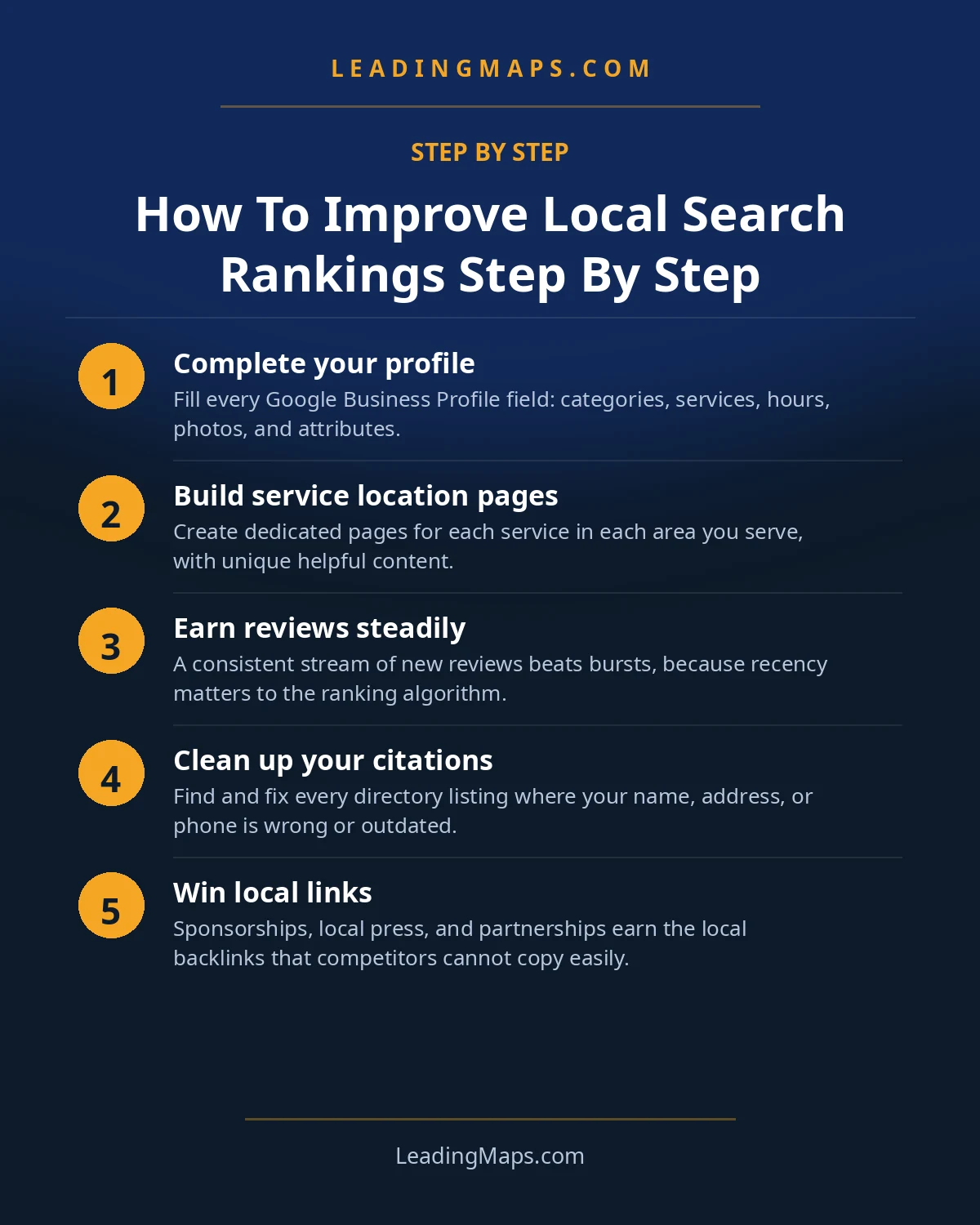
This is that order, built for home-service trades. Five steps, sequenced by lead impact: the afternoon fixes that can move you in weeks, the compounding systems that pay out over quarters. Each step gets a plain answer to the only question that matters, "what does this do for my calls," plus the AI-search payoff most guides skip entirely. If you want the factor-by-factor theory behind the sequence, our map-pack ranking factors guide is the deep dive.
On This Page
Why The Order Matters More Than The List
Local SEO work falls into two buckets: relevance fixes, which tell Google what you do, and prominence building, which convinces Google you are the trusted choice. Relevance fixes are fast, cheap, and one-time. Prominence compounds slowly and never ends. Doing them in the wrong order is the most common waste in local SEO: businesses grind out links while their primary category is wrong, which is like advertising a restaurant with no sign on the door.
So the rule is simple: fix relevance before building prominence. Tell Google exactly what you do first, then spend the next six months becoming the obvious proof of it.
Step 1: Fix Your Categories And Services (The Afternoon Win)
This is the single highest-leverage afternoon in local SEO. Your primary category is the strongest relevance signal you have: it is how Google answers "what is this business." A water heater specialist filed under "Plumber" instead of the right primary category loses relevance for every water heater search. Secondary categories matter too, but the primary one is the anchor.
What to do: open your profile and check that the primary category is the single most accurate description of what you sell, not the broadest one. Add every genuine secondary category. Then build the services list completely: every service you sell, one plain sentence each, emergency services listed explicitly. Most profiles we audit are missing half their services, which means they are invisible for half their keywords.
What it does for your calls: category and service fixes can move rankings in weeks, because you are handing Google relevance it did not have. If you have been stuck at position eight for a money keyword while competitors with similar reviews sit at three, this is the most likely culprit.
The AI payoff: categories and services are structured data, the exact inventory AI assistants match against queries. When ChatGPT decides who installs tankless water heaters in your town, it reads the same fields. The full field-by-field treatment is our profile optimization checklist.
Step 2: Restart Review Velocity (The Prominence Engine)
Reviews do triple duty: they feed prominence (Google's trust estimate), they feed relevance (the words customers use), and they decide whether the homeowner calls you or the next listing. But the metric that moves rankings is not your star average. It is velocity: a steady stream of new reviews beats a big old pile.
What to do: build the system before chasing the count. Text every customer a direct review link within 24 hours of job completion. Have techs mention it at the door, one sentence, "you will get a text, a review really helps us," which roughly doubles response rates. Respond to every review within 48 hours, good and bad, with specific replies. Aim for consistency over bursts: ten reviews a month beats fifty in January and silence after.
What it does for your calls: review velocity is the fastest prominence signal you can generate yourself, and it converts directly, because homeowners read reviews at the moment of decision. This is also where most businesses stall: no system, no velocity, no movement.
The AI payoff: assistants weight specific review text when recommending businesses. A review that says "replaced our water heater same day" is quotable evidence; "great service" is noise. Velocity plus descriptive reviews is AI fuel. The full system is in our review field guide.
Step 3: Build One Strong Page Per Money Service
Your profile wins the map pack; your website wins everything else, and it feeds relevance back into the profile. The mistake is building twenty thin pages. The move is building one strong page per money service: drain cleaning, AC repair, roof replacement, whatever your top revenue lines are, each with genuinely unique content.
What to do: each page gets a keyword-first headline, a plain-English explanation of the service, the process a homeowner can expect, honest pricing guidance or ranges, photos of real jobs, and a clear call to action with a tappable phone number. Add town pages the same way for the areas your trucks actually reach, with local specifics, not swapped city names on duplicate text. Then add LocalBusiness schema to your site, which both Google and AI assistants read as structured facts about your business.
What it does for your calls: service pages capture the organic results below the map pack and the longer research queries ("tankless vs tank water heater") that the profile never reaches. They also raise your relevance ceiling for every map-pack ranking you hold.
The AI payoff: structured, specific service content is exactly what AI Overviews cite when they recommend contractors. A deep service page is your AI-eligibility document for that service.
Step 4: Clean Your Citations (Consistency, Not Volume)
Citations, your name, address, and phone number on other sites, are Google's cross-check that you are a real, locatable business. They still matter, but the game changed: consistency across the thirty directories that matter beats a blast of three hundred automated listings. One wrong phone number on a data aggregator quietly undoes ten new citations.
What to do: lock one exact business name, address, and phone format and write it down. Search your business name and phone number, open every listing that appears, and fix mismatches before building anything new. Claim the core platforms, Bing Places, Apple Business Connect, Facebook, Yelp, Nextdoor, the BBB, plus your trade directories. Hunt duplicates, because two listings for one business split your reviews and confuse rankings. Our NAP consistency guide covers the why in full.
What it does for your calls: citation cleanup rarely produces a dramatic jump, but it removes a silent ceiling. Businesses with messy data underperform their reviews and wonder why. Clean data lets everything else you built actually count.
The AI payoff: large language models resolve businesses as entities, and inconsistent data makes you unresolvable. Clean, identical listings everywhere is what makes you a verifiable business an assistant can confidently recommend.
Step 5: Earn Local Links (The Slow Compound)
Local links, mentions from other websites in your area, are the hardest prominence lever to move and the most durable once moved. The chamber of commerce, a supplier's "find a dealer" page, a local news story about a charity install, a sponsorship of the youth league: each one is a vote that you are a real, established local business.
What to do: stop thinking about link building as a campaign and start thinking of it as a habit. Join the chamber. Ask suppliers for dealer-page listings. Pitch the local paper when you do something worth covering. Sponsor one local thing a year and make sure the website mention is part of the deal. Five good local links beat fifty directory submissions, and nobody can replicate them overnight.
What it does for your calls: this is the lever that separates number one from number four in competitive markets. It is slow, quarters not weeks, but it is the piece entrenched competitors have and newcomers do not.
The AI payoff: assistants treat independent local mentions as corroboration. When your business appears across local sources saying the same thing, you become the kind of entity AI recommends with confidence.
One afternoon for step one, a system for step two, and steady compounding after that. Google's own ranking guidance names the same three levers these steps pull, and Backlinko's local guide confirms the mechanics.
What To Track As You Climb
Two rules. First, track calls, not just positions. Profile calls, direction requests, and form fills are the outputs that pay you; a higher rank that does not ring is a signal problem, and a flat position with rising calls is a win in progress. Second, measure positions on a grid, not a point: check your map-pack rank from several spots across your service area, because proximity means your rank genuinely differs by location. A single screenshot of "I'm number one" from your office parking lot is the least informative data point you own.
If you want the Maps-specific execution manual that pairs with this sequence, the 2026 Maps playbook covers the profile rebuild, the review engine, and the weekly habits that hold the top three.
Ranking Questions, Answered.
Fix your Google Business Profile categories and services list first. Wrong or incomplete categories are the single most common reason a real business underperforms its market, and the fix takes an afternoon. Next, restart review velocity: steady new reviews are the fastest prominence signal you can generate.
There is no fixed number. What matters is your review count and velocity relative to the three businesses above you. If they average 300 reviews and add ten a month while you have 40 and add none, that gap is your deficit. Close it with a system: a review text after every job, not a one-time push.
Yes, but consistency matters far more than volume. Google uses your name, address, and phone number across the web to confirm you are a real, locatable business. Fix mismatches on the 30 directories that matter before buying anything new, because one wrong phone number can undo a hundred clean listings.
Profile and category fixes can move rankings in weeks; review velocity and new service pages typically take 60 to 90 days to convert into noticeably more calls. Track calls, not just positions: a higher rank that does not ring is a signal problem, and a flat position with rising calls is a win in progress.
Yes, and that is the hidden payoff. Every step that lifts your map-pack position, precise categories, steady review velocity with descriptive text, service pages with clear structure, consistent listings, also builds the structured data AI assistants read when recommending businesses. Better rankings and AI visibility are two outputs of the same work.
Know Exactly Which Step You're Missing
Profile, Maps rankings, citations, reviews, competitors, plus whether AI assistants recommend you. A prioritized action plan, free, no pitch.
- AI visibility check, real homeowner prompts across ChatGPT, Perplexity, and AI Overviews, who gets named.
- Proposal scorecard, what your current or prospective agency should be doing, item by item.
- Competitor gap analysis, what the top 3 in your market are doing that you're not.
Get My Free SEO Audit
Delivered within 48 hours. Yours to keep.