You check your Google rankings. You check your reviews. But when a homeowner asks ChatGPT for an emergency plumber, do you know what it says? Most trades businesses have never checked, and the answer is often uncomfortable: the AI names your competitors, describes your business wrong, or has never heard of you at all.
This is the one-time diagnostic audit. It is not a tracking system and not a tactics playbook, it is thirty minutes of honest measurement that tells you exactly where you stand. Run the prompts, log the results, triage what you find. When you are done, our ChatGPT recommendation guide covers the fixes, and our AI search mechanism explainer covers why the answers look the way they do.
On This Page
What You're Actually Checking
AI visibility is not one thing. HubSpot's answer engine visibility playbook breaks it into four signals, mentions, citations, sentiment, and share of voice, and for this audit you are measuring all four in their simplest form:
- Named: does the AI name your business at all in its answer?
- Cited: when it names you, does it cite a source, and which one? Note that AI systems cite third-party pages far more than business websites, so the citation is usually a review site or directory, not your homepage.
- Accuracy: is what it says about you correct? Hours, services, area, phone number.
- Share of voice: for a given query, are you the first name, one of three, or absent while competitors take the slots?
You are not checking rankings. AI answers do not have positions the way search results do. You are checking presence, correctness, and position in the shortlist, across platforms, because each platform can give you a different answer.
The Trade Prompt Bank (Copy And Paste)
Generic advice says to ask "questions your customers ask." That is not specific enough to be useful. Homeowner queries for trades fall into four types, and you need prompts from all four, because your visibility can differ by type. Adapt these to your trade and city, and use your actual city name, not "near me," so results are comparable month to month:
- Emergency (2 prompts): "emergency plumber in [city] who can come tonight" and "24 hour HVAC repair [city]". These are the highest-intent queries in the trades.
- Cost (2 prompts): "how much does water heater replacement cost in [city]" and "AC replacement cost [city] average". You are checking whether the AI names anyone when it answers, and who.
- Best-of (2 prompts): "best roofing company in [city]" and "most reliable electrician in [city]". These test your reputation evidence: reviews, ratings, mentions.
- Brand (2 prompts): "what do you know about [your business name] [city]" and "is [your business name] a good plumber". These test entity recognition and accuracy directly.
Eight prompts is enough for a first audit. The temptation is to ask twenty; the value is in running the same eight every month and watching the pattern move. Write them down exactly as you ask them, because rewording between audits makes the results incomparable.
The Five-Platform Run
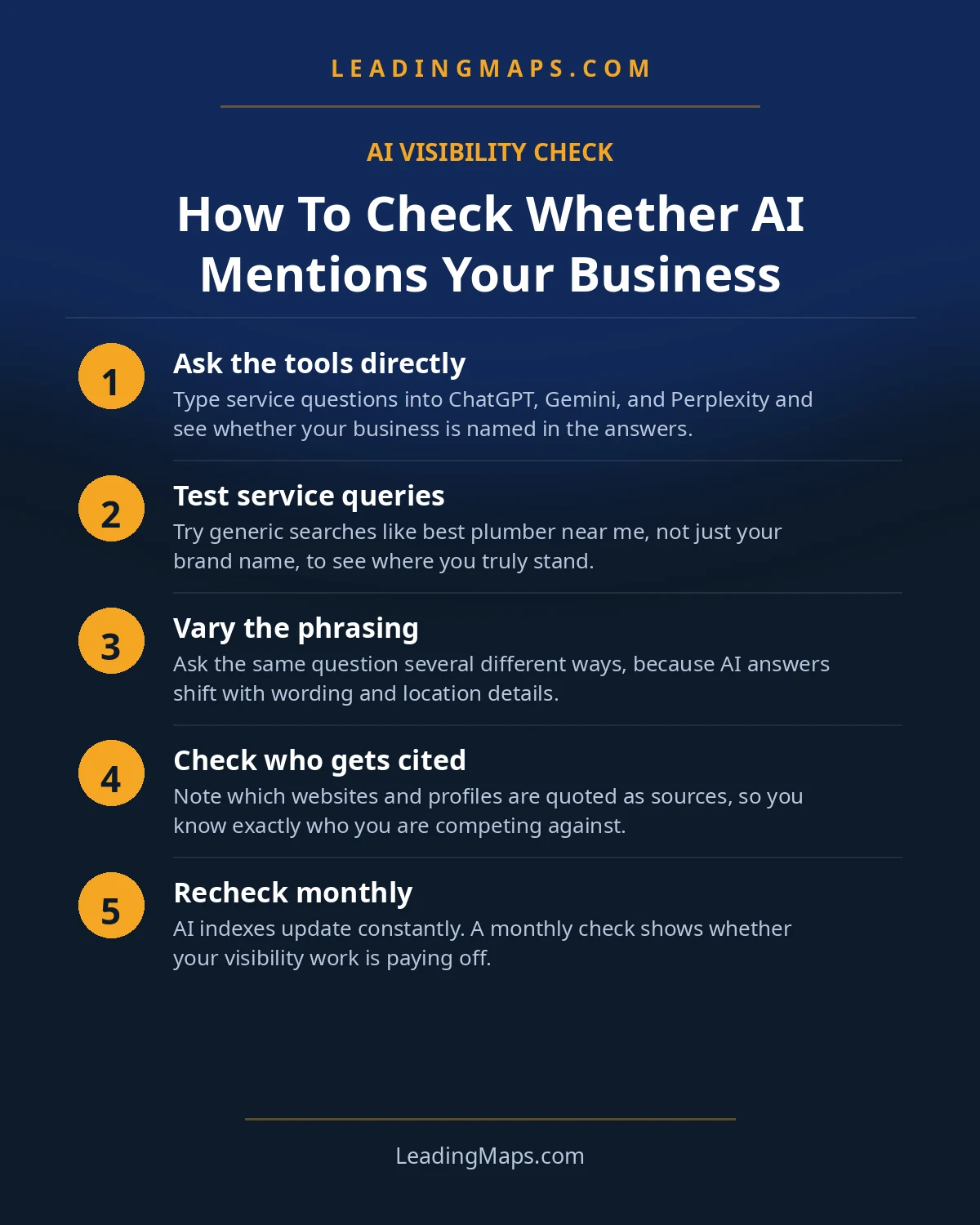
Run all eight prompts on five platforms: ChatGPT, Gemini, Perplexity, Google AI Overviews, and Google AI Mode. This takes about thirty minutes if you stay disciplined: ask, screenshot or copy the answer, log it, move on. Do not argue with the AI mid-audit. You are measuring, not optimizing, today.
Expect the platforms to disagree. Google's surfaces lean on your business profile data, so a complete profile usually shows up there first. ChatGPT and Perplexity lean harder on third-party content and live retrieval, so your review presence and directory footprint matter more to them. A business can be present on AI Overviews and absent from ChatGPT, and that split is itself a finding: it tells you which side of your footprint is thin.
Eight prompts across five platforms, logged once: thirty minutes for a complete picture of whether AI search engines mention your business. Monthly after that, half the time.
The Log Sheet: What To Record
A spreadsheet with one row per prompt per platform. These are the columns that matter:
- Named (yes/no): did the answer name your business?
- Cited source: if named, what did it cite? Your site, a review platform, a directory, a news article, or nothing.
- Shortlist position: first named, one of three, or buried. The AI shortlist is tiny; position within it is everything.
- Accuracy: quote anything it says about you that is wrong: hours, services, area, phone. Wrong facts need tracing to their source.
- Competitor named instead: who got your slot? This is your AI-competitor list, and it may differ from your Google-maps competitor list.
- Tone: positive, neutral, or hedged. Hedged language ("some customers report") usually signals thin or conflicting evidence.
After forty rows, the pattern will be obvious. The three findings that matter: where you are absent entirely, where you are misdescribed, and which competitor keeps taking your slot. Those three findings drive the triage below.
The Fix-First Triage
Not all gaps are equal. Fix in this order, because each layer gates the next:
- 1. Wrong information. If AI states your old hours, wrong phone, or a service you do not offer, ask the assistant where it learned that fact, trace it to the source page (usually an outdated directory), and fix it at the source. Wrong facts actively cost you calls.
- 2. Entity confusion. If the AI mixes you up with another business or hedges about who you are, your business data is inconsistent somewhere. Lock your NAP, clean up old names on directories, and make your profile complete. Our NAP guide covers the cleanup.
- 3. Absent on specific platforms. Absent from Google's surfaces but present on ChatGPT? Your profile data is thin. Absent from ChatGPT but present on Google? Your third-party footprint is thin. Fix the side that is weak.
- 4. Absent everywhere. The foundation problem: thin reviews, incomplete profile, no structured data, little third-party presence. This is the full local SEO and AI visibility build, and it is what our recommendation playbook walks through.
Notice what is not on the list: obsessing over wording, or asking the AI again hoping for a better answer. AI answers reflect your evidence footprint. Change the evidence, and the answers follow.
Check The Traffic Hiding In Your Analytics
One more check while you are in audit mode: AI-driven visits are probably already reaching your site, disguised. AI assistants often send traffic without a proper referrer, so it lands in your analytics as Direct or Unassigned instead of a named source. Google's own AI features documentation explains how AI-feature traffic is counted in Search Console, which gives you one measurement anchor.
In your analytics, look for the tells: a slow rise in Direct traffic to pages that rank for question-style queries, Unassigned sessions with unusually high engagement, or brand searches growing faster than your ad spend would explain. None of this is precise, but it tells you whether AI-driven discovery is already a real channel for you, or whether you are building it from zero.
Turning The Audit Into A Monthly Habit
The audit above is a one-time diagnostic. Its real value compounds when you repeat it. Save your eight prompts exactly as written, keep the log sheet, and re-run monthly. You are watching for three movements: your name appearing where it was absent, wrong facts getting corrected as source fixes propagate, and your shortlist position improving.
Monthly is the right cadence. Weekly adds noise, because reviews and listings move slowly and models shift gradually; quarterly is too slow to catch a new competitor moving into your slots. After each run, update only the triage items that changed. The month your brand prompts come back clean and your emergency prompts name you is the month the foundation work is done.
AI Visibility Audit Questions, Answered.
Ask it the way a homeowner would: recommend a plumber in my city, and a brand query with your business name. Log whether you are named, cited, or absent, and what it says about you. Run the same prompts on Gemini, Perplexity, and Google AI Overviews, since each platform uses different sources and your visibility can differ wildly between them.
Run the full audit monthly, because AI answers change as the underlying sources update and models shift. Weekly checking adds noise without insight, since reviews and listings move slowly. Re-run immediately after you change something material: a profile overhaul, a new batch of reviews, or a website rebuild.
It means the assistant trusts your business as a recommendation but trusts a third party as the source: a review site, a directory, or a news article that corroborates you. This is normal and common; AI systems cite independent sources far more than business websites. Strengthen your third-party presence, especially review platforms, rather than chasing citations to your own site.
Wrong AI-stated facts almost always come from wrong source data: an outdated directory listing, an old address on a review site, or inconsistent hours. Ask where it got the fact, trace it to the source page, and fix it there. Correcting the source is the only durable fix; the AI will pick up the correction on its next pass.
Five: ChatGPT, Gemini, Perplexity, Google AI Overviews, and Google AI Mode. ChatGPT and Perplexity lean on third-party content and live retrieval; Google's surfaces lean on your business profile data. Checking all five takes about thirty minutes and shows you exactly where you are strong, weak, or entirely absent.
Checked AI And Didn't Like The Answer?
Profile, Maps rankings, citations, reviews, plus the full AI visibility test across every platform. A prioritized fix list, free, no pitch.
- AI visibility check, real homeowner prompts across ChatGPT, Perplexity, and AI Overviews, who gets named.
- Proposal scorecard, what your current or prospective agency should be doing, item by item.
- Competitor gap analysis, what the top 3 in your market are doing that you're not.
Get My Free SEO Audit
Delivered within 48 hours. Yours to keep.