When a homeowner asks ChatGPT for the best plumber in town, no human reads the question and no plumber's website "submits" an answer. A machine runs a pipeline: it collects information from the web, figures out which businesses are real and what they do, retrieves the most relevant evidence for this specific question, assembles an answer, and names names. Your business either survives each stage or disappears at it.
This post explains the mechanism, how AI search engines find and recommend local businesses, stage by stage. It is deliberately not a tactics guide. For the what-to-do versions, read our ChatGPT recommendation playbook, our GEO explainer, and our Google AI Overviews guide. Everything below is the machinery those playbooks operate on.
On This Page
Stage 1: Crawl And Index
Everything starts with collection. AI systems gather web content through their own crawlers, through licensed search indexes, through APIs, and through the structured data feeds businesses publish. The important part for you: they are subject to the same rules as every other crawler. A page that blocks crawlers in robots.txt, a site that renders its key content in JavaScript the crawler cannot execute, a business whose details live only inside images, none of that gets collected.
Google has said this explicitly in its documentation on AI features and your website: AI features have no additional technical requirements. Being crawlable and indexable, the fundamentals of SEO, is the price of admission. For a home-service business, this stage reads your website, your business profile, your directory listings, and your reviews. If those sources contradict each other, the machine collects the contradiction too, and that problem lands in stage two.
Stage 2: Entity Resolution
This is the stage almost nobody talks about, and it is the one that decides whether you exist at all to an AI system. Entity resolution is the machine's answer to a basic question: is "Apex Plumbing Co." on this directory the same business as "Apex Plumbing" on that review site and the phone number on this other page?
The system resolves this by corroboration. It compares names, addresses, phone numbers, categories, service lists, hours, photos, and reviews across sources, and it assigns confidence. Ten sources agreeing you are a plumber in Plano with the same phone number produces a confident, single entity. Three different phone numbers, two business names, and a service list that mentions cities you do not serve produces low confidence, and low-confidence entities do not get recommended. They get skipped, quietly.
This is why consistency work, the boring NAP cleanup, the category hygiene, the identical service areas everywhere, matters more for AI search than for classic SEO. Classic SEO has proximity and reviews to fall back on. An AI answer has nothing but its confidence in the entity, and confidence is built entirely from agreement across sources.
Stage 3: Retrieval And Query Fan-Out
Now the homeowner asks the question: "emergency plumber near me who can come tonight." The system does not just search that sentence. It fans the question out into multiple retrieval queries: plumbers with emergency services, businesses open now, businesses serving this area, recent reviews mentioning emergency work. Google describes this query fan-out in its AI features documentation, and every major AI search system does some version of it.
Retrieval pulls candidate evidence from the collected index: your business profile fields, your services list, review text, directory entries, and content pages that answer pieces of the question. Notice what this rewards. A business whose profile lists "emergency plumbing" as a service, whose reviews mention same-day emergency calls, and whose hours show it is open now will surface across multiple fan-out queries. A business with the same capabilities but none of it written down anywhere structured will surface in none of them. The machine cannot retrieve what was never published.
Your business must survive all five stages to be recommended. Most trades businesses that are invisible to AI fail at stage 2 (entity confidence) or stage 3 (nothing retrievable), not at the final recommendation step.
Stage 4: Synthesis
Retrieval hands the system a pile of evidence. Synthesis turns it into an answer. The model weighs the evidence, checks it against what it knows about the user's situation (location, urgency, the specifics in the question), and composes a response. This is the generative part: the answer did not exist before the question was asked.
Two things about synthesis matter for local businesses. First, the model cites specifics, not superlatives. A review that says "replaced our water heater the same afternoon" is usable evidence; "great service, highly recommend" is nearly useless. Second, synthesis has a strong bias toward independent corroboration, which research from Search Engine Land on how brands appear in AI search describes as the distinction between being used and being cited. Your own website can inform the answer, but third-party sources, reviews, directories, news, carry more weight in it, because they are evidence from someone other than you.
Stage 5: The Recommendation
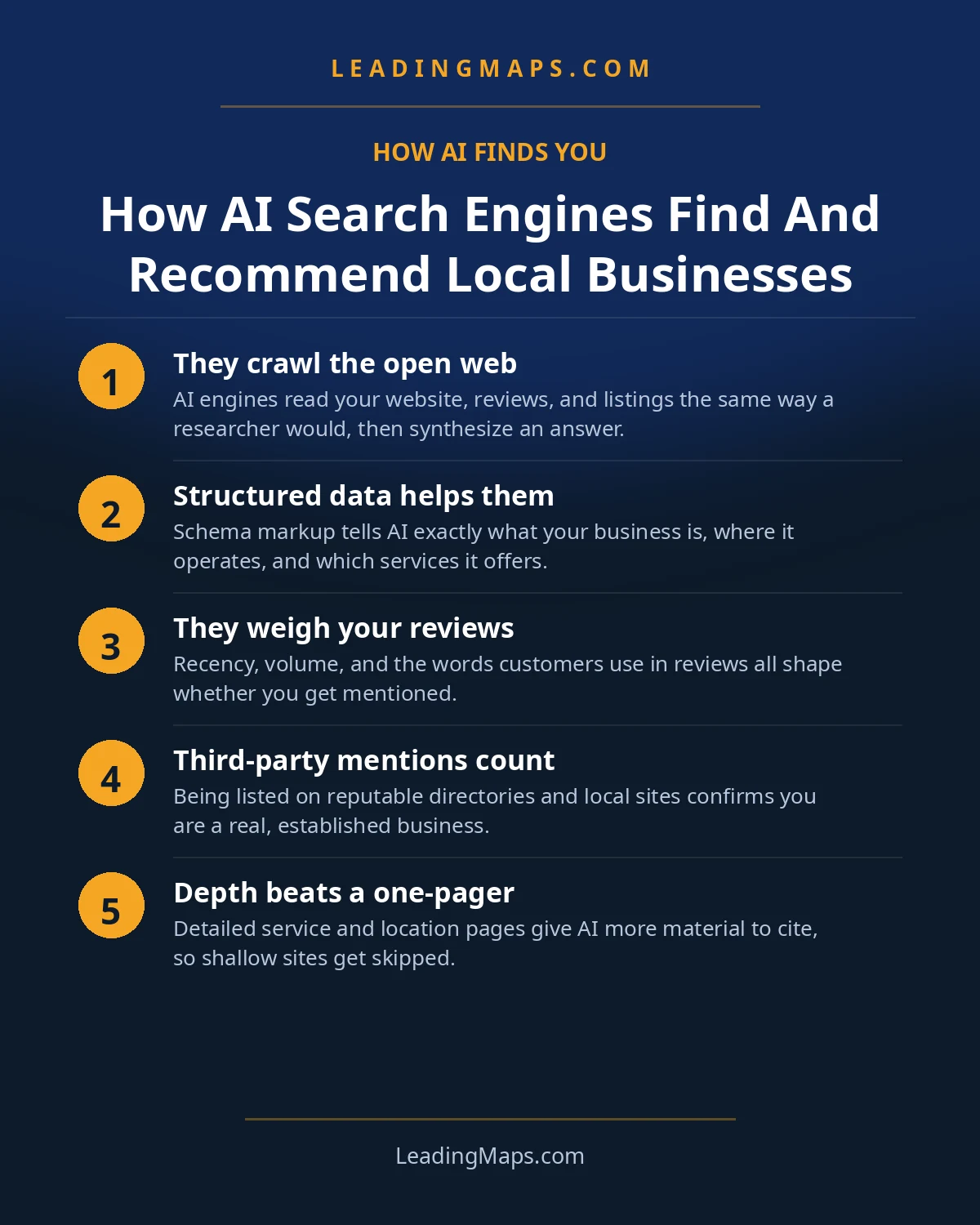
Finally, the system names names. It recommends the businesses for which it has the highest confidence: the right trade, the right area, verifiable details, recent positive evidence, and content that matches the specific ask. The businesses it cannot resolve confidently, the ones with contradictory data, thin reviews, or no retrievable evidence for this particular question, simply do not appear. There is no penalty notice, no Search Console warning. You are just absent from the shortlist.
Notice the asymmetry with classic search. Google Maps shows you ten results and the user compares. An AI answer shows two or three names, or one, and the user calls the first. The stakes of each stage are higher because the shortlist is shorter. Being fourth-best in the pipeline is the same as being invisible.
How The Platforms Differ
The five stages are the shared machinery, but the platforms run them on different fuel:
- Google AI Overviews and AI Mode draw on the same business data that feeds the map pack: your business profile fields, categories, services, hours, and reviews. They are the most profile-driven of the four.
- ChatGPT blends its training data with live search retrieval, and leans heavily on third-party content: review platforms, directories, and articles that describe your business. What others say about you matters more here than anywhere.
- Perplexity is the most retrieval-driven, pulling live from the web and citing sources per answer. Fresh, quotable content on your site and third-party pages is what gets picked up.
- Gemini sits closest to Google's data, with strong profile and maps grounding, plus the same synthesis behavior as the other models.
The practical upshot: you cannot optimize for one platform. The shared foundation, consistent entity data everywhere, rich structured business information, specific and quotable content, serves all four, and each platform's quirks sit on top of that base.
Where The Pipeline Breaks For Trades
Walk a typical mid-size plumbing company through the stages and the failure points are predictable:
- Stage 1: key facts trapped in images or JavaScript, profile half-empty, no structured data on the site.
- Stage 2: three phone numbers across directories, an old business name lingering on review sites, service areas that contradict the website.
- Stage 3: no written emergency offering, no service list a machine can parse, reviews that praise "great guys" without mentioning any actual work.
- Stage 4: nothing quotable anywhere: no specifics about license, tenure, or neighborhoods for the model to cite.
- Stage 5: absent from the shortlist, silently, while a competitor with cleaner data gets the call.
The good news is that the fix for most of these is the same unglamorous work as local SEO: complete profiles, consistent listings, detailed services, systematic reviews, structured data. AI search did not invent a new game. It raised the stakes of the consistency game you were already playing.
What To Do With This Knowledge
Understanding the pipeline tells you what to fix, in order. Stage 1 and 2 problems come first: crawlability and entity consistency, because nothing downstream works without them. Then stage 3: publish retrievable, structured, specific business information. Then stage 4: earn the third-party corroboration, reviews and mentions, that synthesis weights.
When you are ready for the playbook version, the tactics live here: our ChatGPT recommendation guide for the assistant-specific moves, our GEO explainer for the discipline behind them, and our AI Overviews guide for Google's surface. This post was the map; those are the routes.
AI Search Mechanism Questions, Answered.
AI search engines retrieve candidate information from their index and trusted sources, resolve your business as a single consistent entity, and select the businesses with the strongest corroborated evidence: matching services, consistent details, and strong reviews. Confidence is the deciding factor, and it comes from consistent, verifiable facts appearing across many independent sources.
Yes, broadly. AI systems use their own crawlers alongside licensed indexes and APIs to collect web content, and they face the same rules: blocked or broken pages cannot be read. Google states plainly that AI features have no additional technical requirements beyond being crawlable and indexable, so standard SEO fundamentals still apply.
AI systems prefer independent corroboration over a business's own claims. A review platform or directory mentioning you is third-party evidence you are real; your own homepage is just an assertion. Research shows AI tools cite third-party sites for the large majority of business citations, which is why your directory and review presence matters as much as your site.
Yes, for Google's AI surfaces it is one of the primary sources: AI Overviews and AI Mode draw heavily on the same business data that feeds the map pack, including your categories, services, hours, and reviews. For ChatGPT and Perplexity, your profile data reaches them through indexes, directories, and review platforms that republish it.
Maps rankings and AI recommendations run on different machinery. Maps leans on proximity, categories, and reviews; AI answers lean on entity corroboration across many sources plus content that directly answers the question asked. A business can win Maps on proximity while being unquotable to AI because its facts are inconsistent or its reviews lack specific detail.
Know How The Machine Works. Now See Where You Stand.
Profile, Maps rankings, citations, reviews, entity consistency, plus whether AI assistants recommend you. A prioritized action plan, free, no pitch.
- AI visibility check, real homeowner prompts across ChatGPT, Perplexity, and AI Overviews, who gets named.
- Proposal scorecard, what your current or prospective agency should be doing, item by item.
- Competitor gap analysis, what the top 3 in your market are doing that you're not.
Get My Free SEO Audit
Delivered within 48 hours. Yours to keep.