On This Page
Every contractor eventually asks the same budget question: should I put my money into my Google Business Profile or my website? Agencies answer based on what they sell. GBP-only shops say the profile is everything. Web design shops say the site is everything. Both are half right, which is the most expensive kind of wrong.
Here's the contractor's answer: it's not a choice, it's a sequence. Your profile catches demand that's already on Google. Your website multiplies it, converts it, and feeds the AI assistants that now sit between the homeowner and your phone number. Get the order wrong and you pay for it twice.
This guide gives you the sequencing: where each dollar goes first, the cost-per-call math for plumbing, HVAC, and roofing, where AI Overviews and ChatGPT actually pull their answers from, and a 90-day plan built for the trades.
The Short Answer: Sequence, Don't Choose
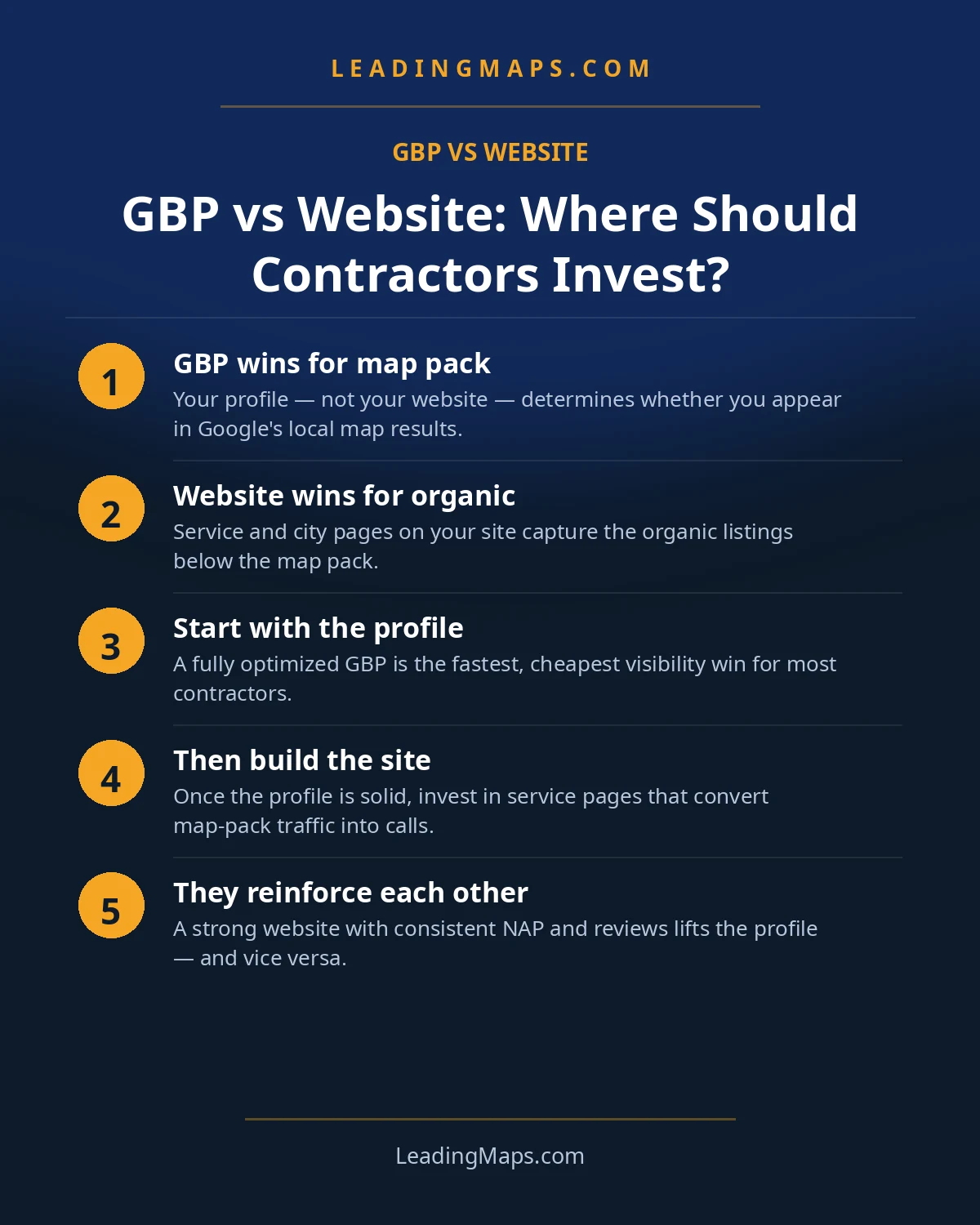
For most contractors starting from zero visibility, the order is: profile first (weeks 1 to 6), reviews and citations second, website layers third. Not because the website doesn't matter, but because the profile produces calls fastest and cheapest, and those calls fund everything that comes after.
The exception: if you already rank in the top three on the map, the profile has done its job and the website is your growth lever. And if you're in a brutal metro where the map is locked up by entrenched competitors, the website plus AI visibility can be the faster path around them. Sequence follows your starting position, which is exactly what our free audit measures first.
One more thing worth saying up front: most of the "GBP vs website" content online treats this as a loyalty question, as if you pick a side. Contractors don't have that luxury. A homeowner's journey touches both: they find you on the map, they vet you on the site, they ask an AI assistant to compare you with two competitors, and then they call from your profile. Every dollar should be judged on where it is in that journey, and whether the step before it is already working.
Where Your Google Business Profile Wins
The profile wins anywhere the customer is already on Google and ready to call. That's most of emergency home services.
Speed. Profile changes go live in days. Category fixes, service lists, photos, hours, a full GBP rebuild shows movement in weeks, not quarters. Google's own guidance says complete, accurate profiles are more likely to show up in local results, and that relevance, distance, and prominence are the whole game. Google's local ranking guide lays it out plainly.
Cost. The profile is free, and the work that moves it, optimization, reviews, citations, costs a fraction of paid search. That's not a slogan; it's arithmetic we'll do below.
The call button. On mobile, the profile puts a tap-to-call button in front of a homeowner with a burst pipe. No page load, no form, no friction. For emergency trades, that button is the highest-converting asset in local marketing.
Google's AI home field. Google's AI surfaces, AI Overviews, AI Mode, Gemini, Ask Maps, read Google's own data first. Your profile is their primary source of structured facts about your business. A complete profile is step one of showing up in Google's AI answers. See our GBP optimization service for what "complete" actually means.
Where Your Website Wins
The profile wins the pack. The website wins everything around it.
Localized organic. Below the map pack, Google ranks pages, not profiles. Whitespark's 2026 Local Search Ranking Factors survey puts on-page signals at roughly a third of local organic weight, the largest single group, with a dedicated page for each service as the top individual factor. The survey data is worth reading in full. A plumber with twelve service pages outranks a plumber with one "Services" page, every time.
Conversion. Profile viewers still click through to the site before calling, especially for big-ticket work. Nobody buys a $15,000 roof from a profile. The profile is the ad; the website is the salesperson. Pricing guides, before-and-after galleries, license info, financing options, that's what closes.
The rest of AI. ChatGPT, Perplexity, and Copilot don't read your GBP fields the way Google does. They cite web pages: your service pages, your reviews embedded on your site, articles about you, structured FAQ content. No website, no citations from half the AI layer. Our AEO and GEO service exists because of exactly this gap.
Depth. Service-area pages, "cost of X in [city]" guides, comparison content, these are assets the profile can never hold. They compound for years, and they feed both organic rankings and AI answers.
The Contractor Math: What A Call Actually Costs
Opinions are cheap; cost per lead is not. LocaliQ's 2025 benchmarks, drawn from over 3,200 home-services search campaigns, put the average search-ad cost per lead at $90.92 across home services. By trade: plumbing $129.02, air conditioning installation and repair $127.74, roofing and gutters $228.15. See the full benchmark data.
Read that roofing number again. $228 per lead, and a lead is not a booked job. It's a click that filled a form or made a call. At 30 leads a month, that's $6,840 a month in ad spend for a roofer, before a single shingle is sold.
Now the other side. Our clients average top-3 map-pack positions within 90 days, with calls up 40% by month three. A GBP-first campaign that produces 30 calls a month on a typical monthly investment puts the effective cost per call at a fraction of paid search, and unlike ads, the asset keeps working after you stop paying. The math isn't close, which is why the sequence starts with the profile.
The honest caveat: paid ads still have a role. They buy speed while SEO compounds, they cover keywords the map can't reach, and in a new market with zero presence they produce calls in week one. Use them as a bridge, not a foundation. Our full breakdown of local SEO vs Google Ads covers the tradeoffs for home services.
Average search-ad cost per lead for roofing and gutters in 2025, vs $129.02 for plumbing and $127.74 for AC installation and repair. A lead is a click that called or filled a form, not a booked job. (LocaliQ 2025 home services search ad benchmarks.)
The AI Layer: What AI Assistants Actually Recommend
Here's the part nobody on the "GBP vs website" debate gets right. The question is no longer just "where do I rank on Google." It's "what do AI assistants recommend when a homeowner asks?" And the answer splits by assistant.
Google's AI (AI Overviews, AI Mode, Gemini, Ask Maps) starts with Google's data: your profile fields, your reviews, your attributes. Complete the profile and you're speaking their native language.
Everyone else's AI (ChatGPT, Perplexity, Copilot, Claude) starts with the web: your website content, reviews on third-party sites, articles, citations. They browse and cite pages. No strong web footprint, no mention.
Whitespark's 2026 survey added AI Search visibility scoring for every factor, the first year it's been measured as its own system. The early read: review signals, citation signals, and on-page signals all carry weight for AI visibility, which means the profile and the website both matter, for different machines.
Reframe the whole debate: stop asking "GBP vs website" and ask "what does each AI assistant need to recommend me?" Google's AI needs your profile. The rest need your website, your reviews, and your citations. That's not a choice. It's a checklist. More on getting recommended by AI.
The 90-Day Sequencing Plan For Contractors
Enough theory. Here's the order of operations we run for contractors, whether they hire us or do it themselves. It assumes you're starting from a thin presence, a claimed profile and a basic website. If you're further along, skip to the phase that matches your weakest link.
Days 1 To 14: The GBP Rebuild
Claim, verify, and rebuild all 23 profile fields: primary and secondary categories, every service with keyword-rich descriptions, attributes, hours including holiday hours, 30-plus real photos. Fix the name, fix the categories, fix the services. What a proper GBP rebuild includes.
Days 15 To 30: The Review Engine
Launch the ask system: tech scripts, SMS timed to job completion, reply templates, a 24-hour response rule. Reviews are a ranking signal, a conversion signal, and an AI signal, all at once. The review playbook.
Days 30 To 60: Citations And The Website Foundation
Clean up NAP across the 70-plus citations that matter for trades, our citation building service, and start the website layers: one dedicated page per money service, each with LocalBusiness schema, real photos, and an embedded review feed. How the service layers fit together.
Days 60 To 90: Website Depth And AI Visibility
Build service-area pages for your top suburbs, add FAQ schema to service pages, publish pricing and process content that AI can quote. Then test: ask ChatGPT, Gemini, and Perplexity "who's the best [trade] in [city]" and record who gets named. The AI optimization layer.
Audit mechanics: how you know it's working. Track these monthly, not daily:
- Grid rank tracking across your service area, weekly. The map moves by neighborhood. Our Maps tracking approach.
- GBP call, direction, and booking counts, monthly. Calls are the scoreboard.
- Review velocity and rating, monthly. Eight to twelve new reviews a month, every month.
- AI prompt tests, monthly. Same five homeowner prompts, same three assistants, recorded results.
- Website service-page rankings and call conversions from organic, monthly.
Run the plan and by day 90 you'll know exactly which lever is pulling. That's the point of sequencing: every step funds and informs the next.
The profile catches demand. The website multiplies it. AI reads both. Spend in that order, measure in calls, and stop letting agencies sell you half the system.