On This Page
- The short answer: no, posts don't move your map ranking
- What posts actually do: convert profile views into calls
- Why the "no" is trustworthy: what the evidence shows
- The contested question: do posts feed AI answers?
- Posts, reviews, and attributes as one AI citation engine
- Make your profile the AI's source of truth: the checklist
- What contractors should actually post: a trade playbook
- The weekly cadence: fifteen minutes, one post
- FAQ
Every few months, some agency tries to sell a contractor a "GBP posting service." The pitch sounds technical, but the promise underneath is simple: post weekly and Google will reward you with higher rankings. It's an appealing story. It's also wrong.
Do Google Business Profile posts help rankings? No. Not directly, not measurably, not in any test that holds up. That's the honest answer, and it's worth saying plainly before we spend one more paragraph on it.
But "no" is not the whole story. Posts do real work for contractors, just not the work the pitch claims. They turn profile views into calls, they give seasonal offers a home on the most-viewed page your business owns, and they feed the growing set of AI systems that read your profile before recommending you. This guide separates what posts do from what they don't, and shows how to use them the way a contractor should: as a conversion tool and an AI feedstock, in about fifteen minutes a week.
The Short Answer: No, Posts Don't Move Your Map Ranking
Google has never named posts as a ranking factor. Its official ranking guidance says local results rest on three things, relevance, distance, and prominence, and adds that there is no way to pay for or request a better local ranking. Google's own help page describes exactly how to improve each of those three. Posts are not on the list.
The testing agrees. The best-known controlled test scheduled one post per week for nine weeks across three business listings, tracked 441 keywords per location, and found no measurable ranking movement. That matches the industry consensus: in Whitespark's 2026 Local Search Ranking Factors survey, post frequency and post keywords sit near the bottom of the pack-ranking list, under social signals, while keyword-stuffed post content is flagged as a negative factor. Read the survey and you'll see posts are a conversation with customers, not a conversation with the algorithm.
One caveat worth stating: "no direct effect" doesn't mean posts can't influence rankings indirectly. A great offer post that gets clicked can drive calls, direction requests, and bookings, and behavioral signals do carry weight. But the post itself isn't the lever. The customer action is.
What Posts Actually Do: Convert Profile Views Into Calls
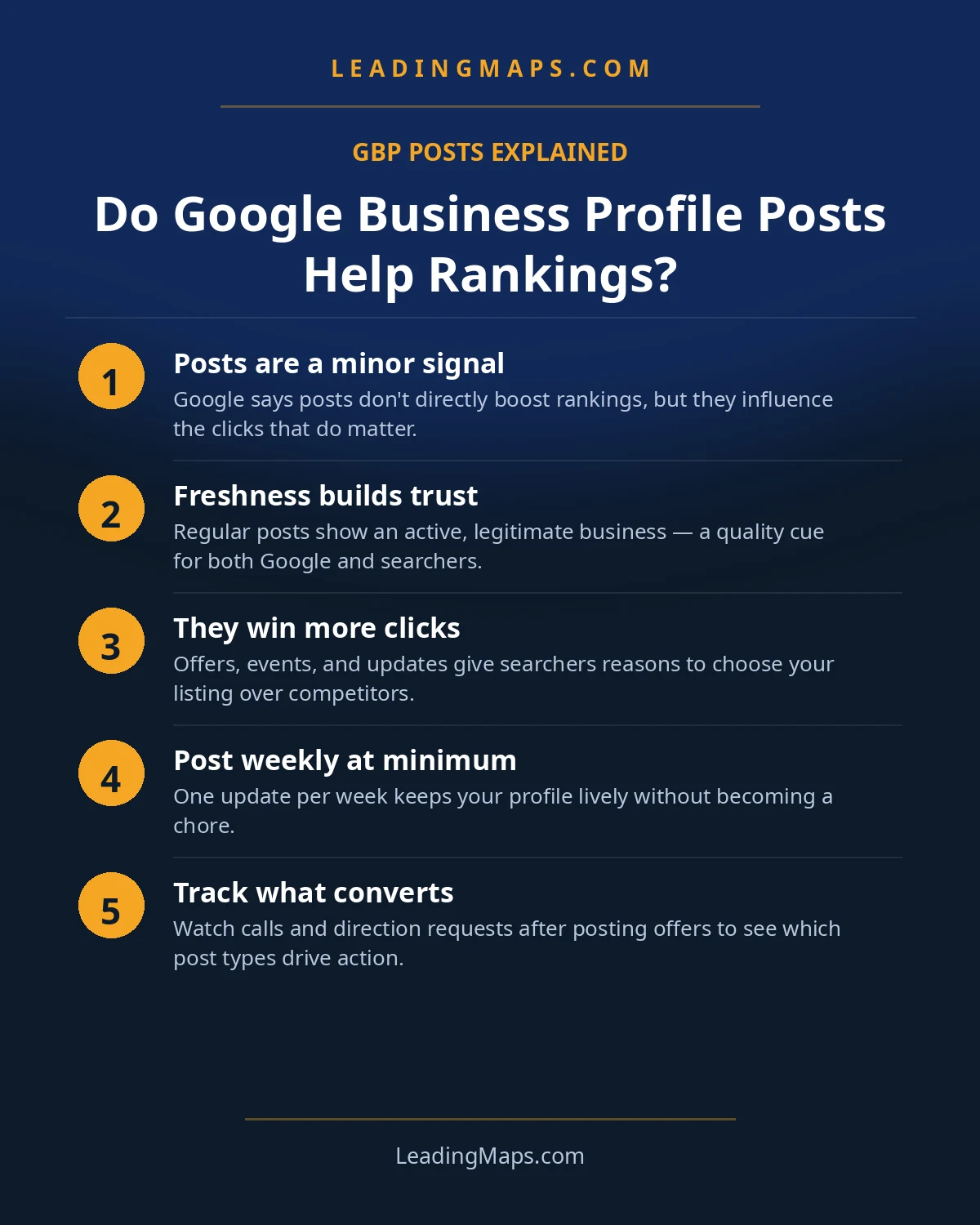
Your profile is the most-viewed page your business owns. When a homeowner compares two plumbers, they don't read both websites. They scan two profiles: stars, review count, photos, hours, and whatever sits in the Updates tab. Posts are what make one profile look alive and the other look abandoned.
Google's own help page frames posts exactly this way: they exist to share announcements, offers, and event details so customers can decide to choose your business. Note the framing. Not "rank your business." Help customers decide. Google's posts help page confirms that posts show on mobile in the Updates or Overview tabs and on desktop in the "From the owner" section, and that seasonal offers can even get featured placement on the profile.
What converts in practice:
- Offer posts with specifics. "$79 drain cleaning through August," "Free AC tune-up with any repair," coupon codes, start and end dates. Google requires a title and dates for offers, so use that structure to your advantage.
- Availability posts. "Same-day water heater installs," "24/7 emergency calls answered by a person," holiday hours. For emergency trades, availability is the offer.
- Trust posts. License numbers, "licensed, bonded, and insured," new technician certifications, before-and-after job photos.
The common thread is concreteness. A post that says "Call us for all your plumbing needs" converts no one. A post that says "Tankless water heater installs from $2,850, most done in one day, TX Master Plumber License #M-40213" gives a homeowner a reason to tap Call. The same specifics, by the way, are exactly what AI systems quote later. More on that below.
Why The "No" Is Trustworthy: What The Evidence Shows
This question keeps getting asked because the honest answer is bad for business, if your business is selling posting services. So let's be precise about what we know and what we don't.
What we know: controlled tests show no direct ranking lift from posting cadence. Industry surveys rank post-related signals at the bottom for the map pack. Google's documentation never mentions posts as a ranking factor while explicitly describing relevance, distance, and prominence. That's three independent lines of evidence pointing the same way.
What we don't know: nobody has published a rigorous test of whether posts influence AI Overviews citations or ChatGPT recommendations. There are anecdotes on both sides, including a 2026 test that planted a made-up word in a post and found it surfaced nowhere across AI Overviews, AI Mode, ChatGPT, Claude, and Perplexity. Anecdotes aren't data, but they set the bar: anyone claiming posts drive AI citations owes you a test, not a theory.
What would change our mind: a multi-listing test with unique, trackable phrases in posts, citation checks across platforms after several weeks, and a control group. Until that exists, treat posts as conversion and feedstock. Everything else is speculation sold as strategy.
Measurable ranking movement from nine weeks of weekly posts across three listings tracked on 441 keywords, in the only controlled GBP-posts ranking test published. Posts are a conversion tool, not a ranking lever.
The Contested Question: Do Posts Feed AI Answers?
Here's where the honest "no" gets complicated. The ranking question is about the map pack. The AI question is different: when ChatGPT, Perplexity, or Google's AI Overviews answer "who's a good plumber near me," what do they read?
AI systems build answers from retrievable, structured facts. Your profile is a dense bundle of them: categories, services, attributes, hours, review text, and yes, posts. Posts are one of the few profile fields you can update weekly with current facts: this month's special, holiday hours, a new service, same-day availability.
Does that mean a post will get cited? Probably not by itself. AI citations favor sources with corroboration: the same fact appearing in your profile, your reviews, and your website. A post that says you do tankless installs becomes powerful when three reviews mention tankless installs and your website has a tankless service page with schema. The post is feedstock, not the meal.
The honest settlement: posts alone won't win you AI citations, and anyone selling "AI posting" as a standalone service is selling the 2018 version of "blog for SEO." But a profile whose posts keep its facts current is easier for AI systems to describe accurately than a profile frozen since 2022. Currency is a signal, and posts are the cheapest way to show it. Our AEO and GEO work treats posts exactly this way, as one feed line into a larger answer engine.
Posts, Reviews, And Attributes As One AI Citation Engine
Stop thinking of posts as a tactic. Think of your profile as an answer machine. Every field is a fact an AI system might quote, and the fields work together:
- Attributes are machine-readable identity. 24/7 emergency service, licensed, veteran-owned, women-owned, appointment required. They're checkboxes, which makes them perfect for AI parsing.
- Reviews are social proof with specifics. "Replaced our water heater same-day in Plano" is quotable evidence that you do the work, in the place, with the outcome. See our guide to getting more reviews for how to shape that content legitimately.
- Posts are current facts. This week's offer, today's availability, this season's service push. They answer "are they active and legitimate right now?"
Together, the three answer the questions every AI assistant asks about a local business: who is this, what do they do, and can I trust them today. A profile with all three filled is quotable. A profile with empty posts, five attributes set, and twelve reviews is a question mark, and AI systems don't recommend question marks.
Make Your Profile The AI's Source Of Truth: The Checklist
If you do nothing else from this guide, run this checklist. It turns your profile from a directory listing into the single most consistent source of facts about your business anywhere online, which is exactly what AI systems look for before naming you.
- Services fully listed. Every service you sell is in the profile's services section with specific, keyword-rich descriptions. How to add services the right way.
- Attributes fully set. Hours, emergency service, licensing, ownership, accessibility. Every applicable checkbox, checked.
- Reviews flowing weekly. Techs nudge customers to mention the actual work and the city, not just "great service."
- One post per week. Every post contains at least one concrete fact: a price, a date, a license number, or an availability window.
- Website mirrors the facts. Your site says the same things, with LocalBusiness schema marking up services, area served, and reviews.
- NAP identical everywhere. Name, address, and phone are byte-identical across profile, website, citations, and social.
What Contractors Should Actually Post: A Trade Playbook
Generic posting advice ("share updates!") is why most contractor posts read like abandoned social accounts. Here is what to post, by trade and by season. Every idea follows the same formula: one concrete fact, one real photo, one clear call button.
HVAC: Sell The Season
- March to May: the AC tune-up special. Post the price, the deadline, and a photo of a tech at a condenser. "Spring AC tune-up, $89 through May 31. Most systems back to peak efficiency in one visit."
- September to November: the furnace safety check. Same formula, different season.
- Heat wave: same-day emergency availability. "Same-day AC repair during the heat wave, phones answered until 9 PM." Urgency converts, and it becomes a timestamped fact about your availability.
Plumbing: Lead With The Price
- Water heater installs: "Tankless water heater installs from $2,850, most done in a day." Big-ticket, high-intent, price-transparent.
- Drain cleaning: "$79 drain cleaning special through August." Small ticket, high volume.
- Winter: frozen-pipe prevention with a photo of an insulated line, ending with the emergency number.
Electrical, Roofing, And The Rest
- Electricians: panel upgrade posts with financing language, EV charger installs with the rebate mention.
- Roofers: storm-season free inspection posts, "we help with insurance claims" language.
- Everyone: license numbers. "Licensed, bonded, insured, TX Master Plumber #M-40213" belongs in your post text, not just your website footer. It's a trust signal for humans and a machine-readable fact for AI.
Point every post's button at the matching page on your website, the water heater page, not the homepage. The button is a "Learn more" that should actually teach more. And use real job photos. Stock photos of smiling families get scrolled past; a photo of your tech's van in a driveway stops the scroll.
The Weekly Cadence: Fifteen Minutes, One Post
Here's the whole system. One post per week, published the same day, taking fifteen minutes:
- Pick this week's concrete fact: the current offer, the season, the availability window.
- Write 100 to 150 words. One fact, one benefit, one call to action.
- Attach one real photo from a job this week.
- Add the CTA button and point it at the matching service page.
- Set an end date so the offer expires cleanly. Google archives posts after six months unless a date range is set.
Google now lets you schedule and repeat posts, so you can batch a month of seasonal posts in one sitting. That's the entire operation. Anything more is theater; anything less and the profile goes quiet.
Posts won't rank you. They will convert the rankings you earn, and they'll keep your profile current for the AI systems now reading it. Fifteen minutes a week, one concrete fact, real photos, real offers. That's the whole playbook.