When a homeowner asks ChatGPT for an emergency plumber, it does not rank web pages. It reaches for entities, the businesses it believes exist, and recommends the ones it trusts. That trust has a name in SEO: entity authority. It is the confidence score Google and AI systems attach to the statement "this business is real, this is what it does, this is where it operates." The businesses with the highest confidence get named. Everyone else gets skipped.
This post is the building phase. If your facts still disagree across the web, that is the accuracy layer, a different job, and it comes first. And once authority is built, measuring it (mentions, citations, share of voice) is a different discipline again. Here we build the weight itself, layer by layer, in priority order, written for a home-service trade.
On This Page
What An Entity Actually Is, In Plain English
An entity is your business as Google understands it: a single node in its knowledge graph with attributes attached. Name, phone, address, hours, services, service areas, reviews, and relationships to other entities (your city, your trade, your suppliers). Every place your business appears on the internet either reinforces that node or muddies it. There is no neutral.
Picture the two versions. Plumber A has one exact name, one phone number, one service area, and dozens of sources agreeing. That is a high-confidence entity. Plumber B has three name variations, an old landline on Yelp, a different phone on Angi, and a Facebook page last touched in 2019. That is a fog. AI assistants recommend from confidence, and fog does not get recommended. Google is not being unfair; it will not risk giving a homeowner a wrong phone number at 2 AM.
The Trade Entity Blueprint, In Priority Order
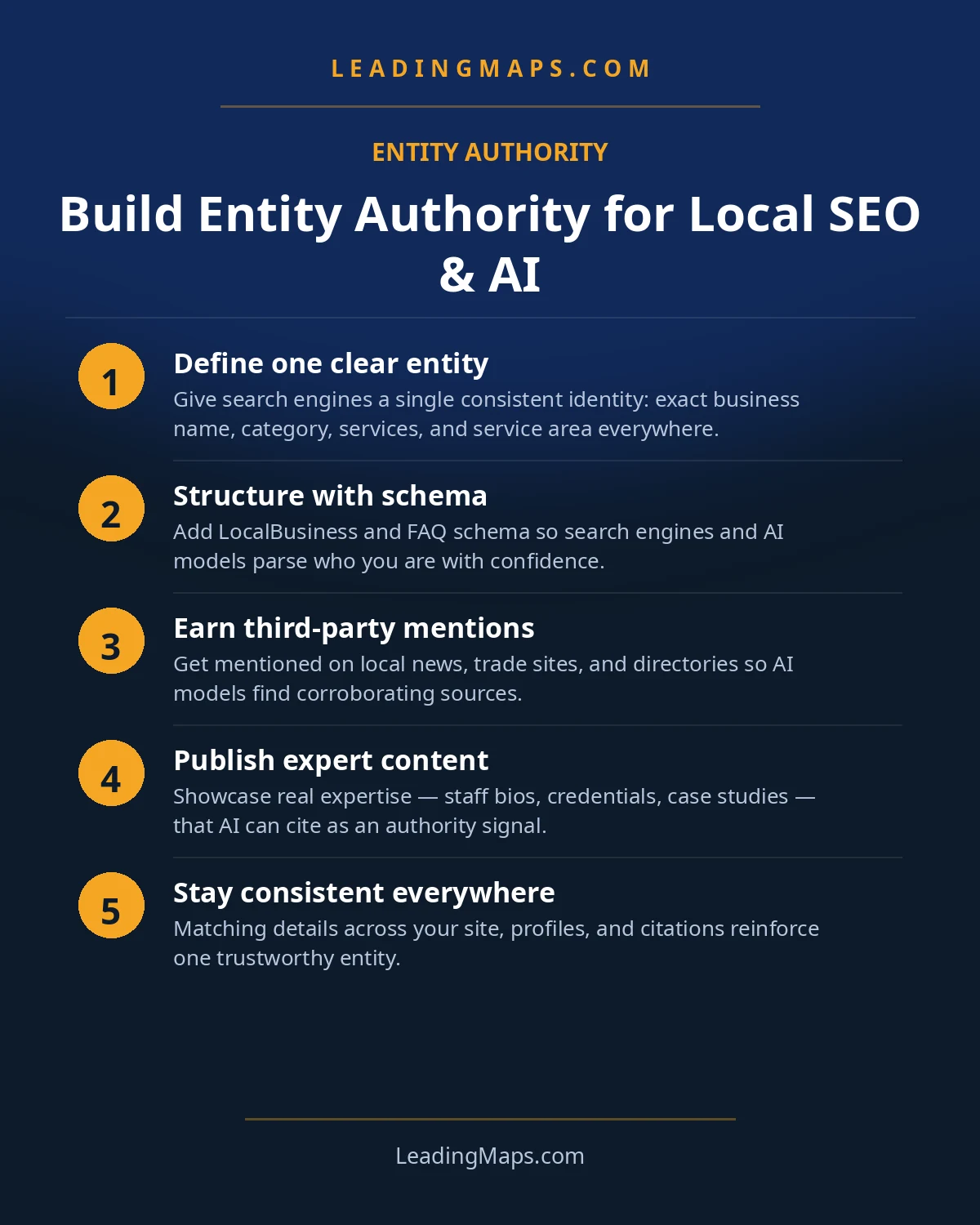
Build in this order. Each layer only carries weight once the one above it is solid, so do not skip ahead to press mentions while your phone number still disagrees with itself.
- 1. The canonical entity. Lock one exact business name, one phone number, one address or service-area definition, and your license number where your state issues one. Write it down. This document is now the constitution of your business identity, and everything below must cite it. Our NAP consistency guide is the field manual for this layer.
- 2. Your Google Business Profile as the primary entity source. For local businesses, the profile is the master record Google trusts most. Complete every field, pick the right primary category, list real services with descriptions. Our profile optimization checklist walks it field by field.
- 3. The sameAs web. Link your website to your profile, socials, and directories, and link them back where the platform allows it. sameAs is the explicit machine-readable claim that these scattered profiles are one business. This is the cheapest entity work on the list, and most trades skip it entirely.
- 4. Trade and local corroboration. Angi, HomeAdvisor, Thumbtack, Yelp, the BBB, your chamber of commerce. These are the sources AI systems cross-reference when a contractor query comes in. Our citation sites list has the trade-specific roster, and our citation building service exists because this layer is tedious and high-leverage at the same time.
- 5. Review platforms as entity evidence. Reviews are third-party statements about what you do and where you do it. Volume, recency, and specificity all feed entity confidence, and AI assistants read review text directly when recommending. Our review guide covers the system that keeps them coming.
- 6. Local press, sponsorships, and community mentions. The little-league sponsorship with a link from the local news site is entity gold for a contractor: a real-world signal that you exist in a community. This is the layer most trades never build, which is exactly why it separates number one from number four.
Notice what is not on this list: buying links, spinning up fifty thin directory profiles, or paying for a Wikipedia page. Entity authority comes from agreement, not volume, and the six layers above are the agreement.
One more thing the stack covers that most guides skip: people. Your technicians are entities too, and in trades they carry real weight. A tech with a named bio on your site, reviews that mention them by name, and a consistent presence across your profiles adds a human layer to the business entity. AI assistants notice when "Mike from Apex" appears in a dozen reviews and on the company site. It is the same corroboration mechanism, applied to the people behind the trucks.
The Corroboration Loop: How Confidence Actually Compounds
Here is the mechanism that makes the stack work. Google and AI systems do not trust any single source, not even your own website. They trust agreement across sources. Your profile says you are an HVAC company serving Plano. Your website's schema says the same. Angi says the same. A local news article mentions your company installing units in Plano. Each source confirms the others, and confidence compounds with every corroboration.
This is also why contradiction is so damaging. One source disagreeing does not cancel you out; it caps your confidence. Two sources disagreeing about your phone number, and an AI assistant will not risk giving the homeowner a wrong number at midnight. It will recommend the competitor whose data all agrees, even if that competitor has fewer reviews than you.
Entity authority is a consensus problem, not a link-count problem. A dozen sources telling the same story beats a hundred sources telling different stories.
How Entity Authority Differs From Backlink Authority
Traditional SEO taught you that authority equals backlinks. For AI recommendation, that model is incomplete. A backlink is a vote from a page to a page. Entity authority is a judgment about a business: is it real, is it established, is it what it claims to be? The two are related, but they answer different questions, and AI assistants ask the second one.
Search Engine Land's framework on semantics and topical authority shows how entity-attribute relationships and topical coverage shape what Google understands about a business, which is the advanced version of the same idea. But for a contractor, the practical difference is simpler: ten directory listings with consistent data build more entity authority than one press link carrying your old phone number. Consistency is the vote that counts.
HubSpot's AI-search visibility research makes the same point from the AI side: off-site signals about your brand shape what AI systems "remember" about you more than your own pages do. Your website gets to state the facts. The rest of the web gets to confirm them, and confirmation is what authority is made of.
The Monthly Routine That Builds It
Entity authority is not a project; it is a cadence. One focused hour a week, aimed at corroboration, compounds into the kind of confidence that wins recommendations:
- Claim one new corroborating profile a month until the roster is complete: chamber, trade directories, local press mentions.
- Generate one community signal a month: a sponsorship, a charity job, a local event. Real-world presence becomes web evidence.
- Keep review velocity steady. Ten new specific reviews a month beats fifty bought once, and specific review text ("replaced our water heater same day") is entity evidence.
- Audit one source a month for drift: old hours, old phone numbers, and old addresses creep back faster than you think.
- Publish one quotable, original piece a month: a pricing guide, a cost breakdown, a seasonal checklist. This is what earns the third-party mentions that build authority.
Realistic Timelines
Entity authority compounds slowly, then suddenly. The canonical entity and profile work (layers one and two) can firm up within 60 to 90 days, because they change what the primary sources say. Corroboration across directories and reviews builds over three to six months of steady work. The authority layer, press and community mentions, is a six to twelve month game. Anyone promising entity authority in 30 days is selling links, not identity.
On our managed builds, the full stack averages top-3 map-pack positions within 90 days, and that is the near-term payoff of entity work: rankings move first, AI recommendations follow as the corroboration compounds. If you would rather not spend a year doing this by hand, our AEO and LLM optimization service runs the whole blueprint. And the full do-it-yourself version lives in our contractor checklist.
Entity Authority Questions, Answered.
Entity authority is how confident Google and AI systems are that your business is real and correctly described. It comes from agreement across sources: your profile, website, directories, reviews, and mentions all telling the same story. High-confidence entities get recommended; low-confidence ones get skipped.
No. Domain authority estimates a website's link strength; entity authority estimates a business's identity confidence. A new site with perfect data consistency can have strong entity authority and weak domain authority. For AI recommendations, the entity judgment matters more. Chase identity first; links second.
The foundation (canonical entity, complete profile, sameAs web) can firm up in 60 to 90 days. Corroboration across directories and reviews builds over 3 to 6 months. Community and press mentions, the strongest authority signals, are a 6 to 12 month compounding game. Anyone promising it in 30 days is selling links, not identity.
No. A contractor does not need either. What matters is that the sources relevant to your trade agree about you: your profile, website, trade directories, BBB, chamber of commerce, and review platforms. Forced or paid encyclopedia entries are fragile and unnecessary.
Contradiction. Two different phone numbers, an old address on a directory, name variations across platforms: each disagreement caps how confident Google and AI systems can be. One conflicting source does more damage than ten consistent ones do good. Fix conflicts before building anything new.
Building Authority And Want To Know Where You Stand?
Profile, Maps rankings, citations, reviews, competitors, plus whether AI assistants recommend you. A prioritized action plan, free, no pitch.
- AI visibility check, real homeowner prompts across ChatGPT, Perplexity, and AI Overviews, who gets named.
- Proposal scorecard, what your current or prospective agency should be doing, item by item.
- Competitor gap analysis, what the top 3 in your market are doing that you're not.
Get My Free SEO Audit
Delivered within 48 hours. Yours to keep.