The plumber sitting in the number-one map pack spot didn't get there by accident. Somewhere along the way, other websites started vouching for him: the local news covered a community project, the chamber of commerce listed him, a supply house added him to a dealer page, a builder linked his preferred-vendor list. Every one of those links is public, and every one of them is a clue about what earns links in your market.
A competitor backlink audit is just the systematic version of that observation. You identify the businesses outranking you, list who links to them, figure out which of those links you can also earn, and throw the rest away. Do it right and you stop guessing about link building entirely. Your competitors have already done the research for you.
On This Page
Why Backlinks Still Move Local Rankings
Google says it plainly in its guidance on improving local ranking: among the factors feeding the "prominence" signal is how many websites link to your business. For local trades, prominence is the difference between the pack and page two. Reviews matter, proximity matters, but when two plumbers have similar reviews and similar locations, the one with the stronger local link profile usually takes the top spot.
The good news for home-service businesses: local link building is a small game. You do not need hundreds of links. A handful of the right local ones, earned from real local sources, will beat a scattershot pile of generic directory links every time. That is exactly what makes a competitor audit so valuable. It shows you the small set that actually counts.
What You Need (Free)
You can run a useful audit without spending anything. Two free tools cover it:
- Google Search Console's Links report shows every domain linking to your own site. Run this first so you know what you already have, and avoid chasing links you already own.
- Ahrefs' free backlink checker shows a sample of any competitor's referring domains, with domain rating, anchor text, and their best-linked pages. The free tier hides full exports, but it exposes the top domains, which is where the best opportunities usually live.
Paid tiers (Ahrefs, Semrush, Moz) unlock full exports and the one-click link-intersect report that compares domains across competitors automatically. They are worth it if you run audits quarterly, but they are not required. For a first audit, free is plenty.
Identify Your True Competitors First
The most common audit mistake is auditing the wrong businesses. National directories, Angi, HomeAdvisor, Yelp, are not your link competitors. Neither is the franchise's corporate site ranking nationally. Your link competitors are the local businesses showing up in the top three of the map pack and the top organic results for your money keywords, the ones a homeowner in your city actually chooses between.
Search your primary money keyword in an incognito window, "[trade] [city]" and "emergency [trade] [city]", and write down the two or three independent local companies that keep appearing. Check their NAP consistency while you are at it, because the audit sometimes reveals that a competitor is winning with weaker links but cleaner business data, which is a different fix.
The Link-Intersect Method
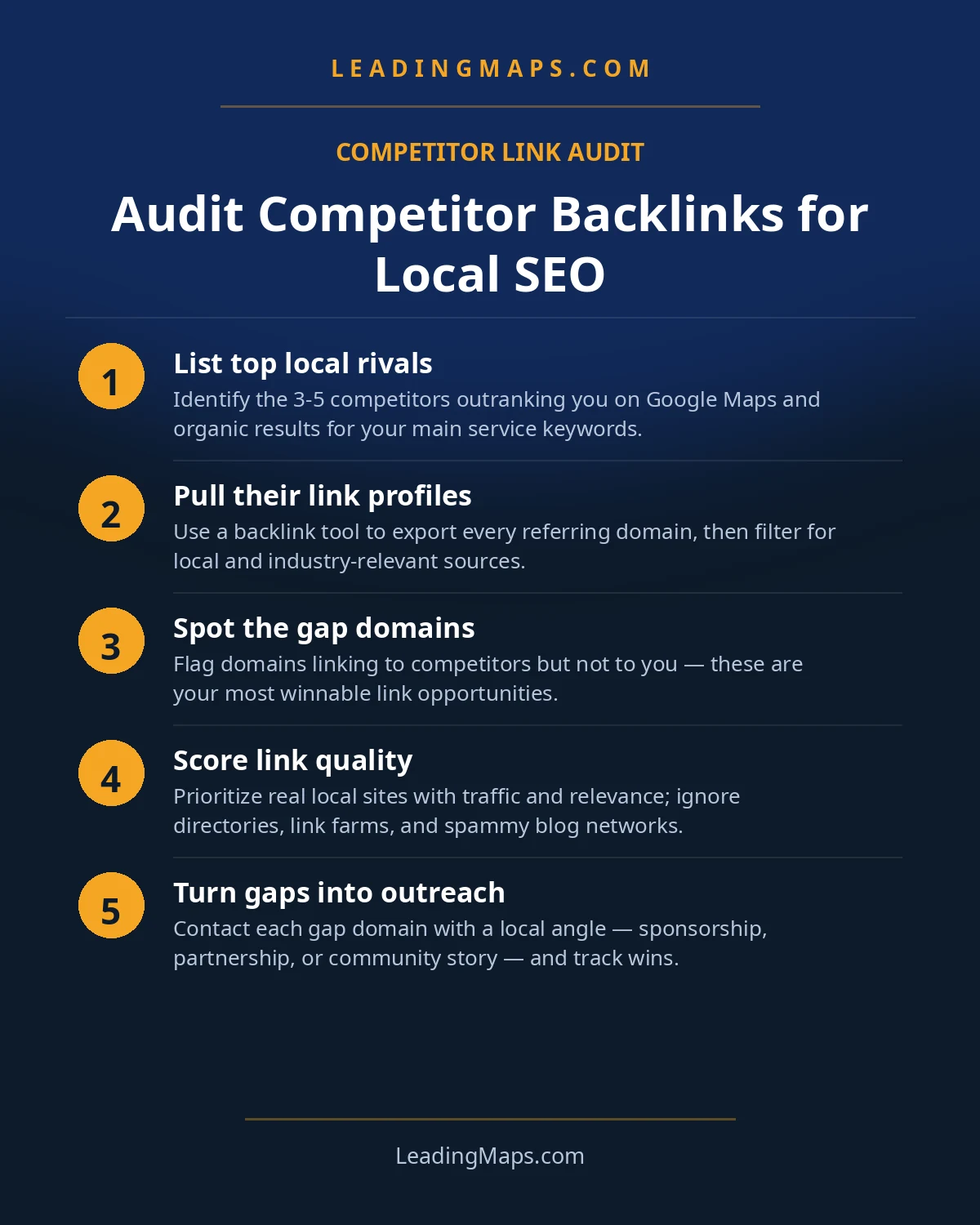
Here is the core of the audit. Run each of your two or three competitors through the backlink checker and collect their referring domains into one spreadsheet. Then mark which domains link to more than one of your competitors. Those overlapping domains are the link intersect, and they are almost always your highest-probability targets.
The logic is simple: if a domain links to two or three competing plumbers in your market, it is the kind of source that links to plumbers. The chamber of commerce, the local news site's business directory, a regional supplier's dealer locator, the BBB. It already has a linking relationship with your trade and your city, which means the outreach conversation starts warm.
- Column 1: referring domain. The domain name, nothing fancier.
- Column 2: domain rating. A rough authority gauge from the checker.
- Column 3: source type. Dealer page, news site, association, directory, blog, sponsor page.
- Column 4: links to how many competitors. Sort descending. The 2s and 3s are your first outreach list.
- Column 5: my link status. Yes, no, or in progress. This column alone prevents most wasted effort.
- Column 6: effort tier. Easy (fill out a form), medium (join, sponsor, pitch), hard (earn coverage). Work easy to hard.
Also note which pages on the competitor's site earn the most links. If a competitor's "find a dealer" style resource or a community guide page is their top-linked asset, that tells you what kind of content attracts links in your market, and it is a content idea for your own site.
Our top-3 map pack average: local businesses following the full system, links included, typically reach the top 3 within 90 days. Quality links start moving rankings in six to twelve weeks.
What To Replicate: The Trade Link Sources
Generic backlink advice tells you to guest post and do "outreach." Competitor audits in home-service markets reveal a much more specific set of sources that actually recur. When you see these in the intersect list, prioritize them:
- Manufacturer "find a dealer/installer" pages. HVAC manufacturers, water heater brands, roofing shingle makers, and electrical panel brands all run dealer locators. Registering your business is usually a form, and the link carries the authority of a national brand plus exact trade relevance.
- Supply-house and distributor vendor pages. The plumbing supply house, the electrical distributor, the roofing materials supplier. Many maintain contractor or vendor pages. If you buy from them, ask to be listed.
- Trade associations. PHCC, NATE, NECA, NRCA, and their state and local chapters. Membership usually includes a directory listing with a link, and the trade relevance is unmatched.
- Chamber of commerce and BBB. Nearly every local competitor worth auditing has these. Join, get listed, keep the profile complete.
- Local news and community coverage. Sponsorships, charity projects, storm-response work, apprenticeship programs. This is the hardest tier to earn but the most powerful: editorial links from the local paper or news site carry both authority and local trust.
- Builder, realtor, and property-manager vendor lists. Remodelers keep preferred-vendor pages, real estate teams maintain vendor resource lists, and property managers link the trades they trust. One relationship can mean a link plus actual referral work.
- Government and .org pages. City permit pages that reference licensed contractors, council meeting minutes mentioning local businesses, nonprofit partner pages. Boring, authoritative, and completely white-hat.
Our citation building service covers the directory tier of this list at scale, but the dealer pages, associations, and editorial links above are earned one at a time. That is what makes them valuable: your competitors cannot buy them in bulk either.
What To Ignore (And What To Report)
Every competitor audit turns up links you should not copy. Paid link schemes, foreign directories with thousands of unrelated listings, obvious private blog networks, spammy exact-match anchor text at scale. These show up because a competitor bought them, not because they earned them, and replicating them puts you in Google's link spam policies territory: link exchanges, excessive paid links without proper qualification, and scaled manipulative linking.
The rule is simple: if you cannot describe the link to a homeowner with a straight face ("we sponsor the youth league, so they list us"), do not build it. Paid sponsorship links are fine when disclosed, they should carry rel="sponsored" or rel="nofollow", but undisclosed paid links are a violation. Audit honestly, and treat the spam tier as evidence of which competitors are building on sand.
One more boundary: never try to disavow or attack a competitor's profile. The disavow tool only works on links to your own site, and sabotaging competitors is both ineffective and a line you do not cross. Spend the energy on the intersect list.
Turning The Gap List Into Links
A spreadsheet does not rank you. Outreach does, and most trades businesses lose here because the ask is awkward. Keep it short and specific: who you are, why you fit their page, exactly what you are asking for, and what you will provide. A dealer-page request is one paragraph with your license number and service area. A supplier vendor-page ask is a phone call to your rep. A local news pitch is a real story, a community project with photos, not a request for a link.
Work the list easy to hard. The forms and directory joins take an afternoon. The associations take a membership fee and a week. The editorial coverage takes months of being worth covering, sponsoring, showing up, doing visible work in the community. That last tier is the one that separates market leaders from everyone else, and it is also the tier that feeds the next section, because editorial coverage is exactly what AI search reads.
The AI-Visibility Competitor Audit (The Step Everyone Skips)
Traditional backlink audits answer who links to your competitors. In 2026, there is a second, equally important question: who does AI recommend instead of you? When a homeowner asks ChatGPT or Perplexity for the best plumber in your city, some business gets named. If it is not yours, that is a gap just as real as a missing link, and no backlink tool will show it.
Run the AI audit alongside the link audit. Ask ChatGPT, Gemini, Perplexity, and Google AI Overviews your money queries, "emergency plumber in [city]", "best HVAC company in [city]", "roof replacement cost [city]", and log who gets named, who gets cited, and where you appear, if at all. The pattern you are hunting is the mention gap: competitors named in AI answers whose link profiles you have already audited.
- Log the named businesses for each query on each platform, plus your own position: named, cited, or absent.
- Note what the AI cites. Third-party pages (review sites, directories, news) get cited far more than business websites, so map which third-party pages keep appearing.
- Reverse-engineer the winner's mention profile. More review depth, more consistent business data, more corroborating mentions, these are what AI systems weight, and they overlap heavily with the link sources in your intersect list.
Notice how the two audits converge. The chamber listing, the supplier dealer page, the local news coverage: these are links in the backlink audit and corroborating evidence in the AI audit. Earning one asset serves both. The tactics for closing the AI mention gap live in our ChatGPT recommendation playbook; the audit above tells you exactly where you stand before you start.
Competitor Audit Questions, Answered.
A competitor backlink audit is the review of the websites linking to businesses that outrank you. You identify who links to them, which of those links you can also earn, and which to ignore as spam. The result is a prioritized outreach list instead of guesswork, and it surfaces local sources you would never have found on your own.
Two free tools cover most of the job: Google Search Console's Links report shows who links to your own site, and Ahrefs' free backlink checker shows a sample of any competitor's referring domains with domain rating and anchors. Paid tiers unlock full exports and the link-intersect report, but the free versions are enough to find the best local opportunities.
Two or three is the sweet spot: the businesses holding the top map-pack or top organic spots for your money keywords, like emergency plumber in your city. More than three dilutes your focus; one misses the domains that link to several competitors, which are almost always your highest-probability targets.
No. The disavow tool only affects links pointing to your own site, and Google generally ignores it anyway for sites without a manual penalty. Never touch a competitor's profile; you cannot, and trying to report them is a distraction. Spend the same hours earning one real local link instead, because that moves your rankings forward.
Quality local links usually need six to twelve weeks to move the needle, since search engines must recrawl the linking page and reassess your prominence. A handful of strong local links, a chamber profile, a supplier dealer page, one local news mention, can lift rankings within that window. Volume matters far less than relevance and local context.
Know Who Links To Them. Now Close The Gap.
Profile, Maps rankings, citations, backlinks, reviews, plus whether AI assistants recommend you. A prioritized action plan, free, no pitch.
- AI visibility check, real homeowner prompts across ChatGPT, Perplexity, and AI Overviews, who gets named.
- Proposal scorecard, what your current or prospective agency should be doing, item by item.
- Competitor gap analysis, what the top 3 in your market are doing that you're not.
Get My Free SEO Audit
Delivered within 48 hours. Yours to keep.