Structured data is one of the most overhyped topics in AI search, and one of the most misunderstood. Depending on who you read, schema markup is either the secret key that makes ChatGPT recommend your business, or irrelevant decoration that large language models ignore entirely. For a contractor, the truth sits in the unglamorous middle: structured data is infrastructure. It will not win you the recommendation, but missing or wrong structured data can cost you one.
A quick map before we start, because AI search has three layers that get tangled together. This post is about the code layer on your website: the JSON-LD markup that machines read. It is not about whether your business facts are correct across the whole web (that is the accuracy layer, every field AI reads about you), and it is not about whether your pages are crawlable and readable in the first place (the whole-page readability layer). All three matter for AI search. This post does the code.
On This Page
The Short Answer: Yes, As Infrastructure, Not Magic
Structured data helps AI systems understand your business in a specific, limited way: it hands them a clean, unambiguous statement of your identity. Your name, what you do, where you do it, when you are open, how to reach you. When Google's crawler or an AI assistant's retrieval system encounters your pages, schema removes the guesswork. No parsing your footer copy, no inferring your service area from a paragraph, no guessing which "Apex Plumbing" in Texas is yours.
Think of it like the wiring behind a wall, not the paint. Nobody picks a contractor because the wiring is beautiful. But the house does not work without it, and bad wiring starts fires. Schema works the same way: invisible when right, costly when wrong. A plumber with correct, complete markup is trivially easy for an AI system to resolve as a real business. A plumber with no markup, or markup that contradicts the visible page, is a coin flip the machine has no reason to take.
Schema is a floor, not a ceiling. It gates rich results and entity clarity; it does not buy recommendations or AI citations. Set expectations there and the work is cheap and worth it.
What Google Actually Says About Structured Data And AI
Start with the sentence that deflates most AI-schema hype. Google's own documentation on AI features and your website states that AI features like AI Overviews and AI Mode have no additional technical requirements beyond standard SEO fundamentals. There is no secret "AI schema" you are missing. The same fundamentals apply, and structured data must match your visible text.
- No special AI markup exists. Google says so plainly. Anyone selling you a proprietary "AI schema pack" is selling confusion.
- Structured data must match visible content. If your markup claims 24-hour emergency service and your page does not, you are building a trust problem, not solving one.
- Crawl access outranks markup. Google's guidance also emphasizes keeping important content in textual form and allowing crawlers in robots.txt. Those fundamentals gate AI-feature eligibility far more than any markup type.
This is genuinely good news for contractors. The winning move is not buying exotic markup or rebuilding your site. It is getting the standard markup right and keeping it honest, which is a one-evening project, not a six-month engagement.
The Exact Schema Stack For A Home-Service Business
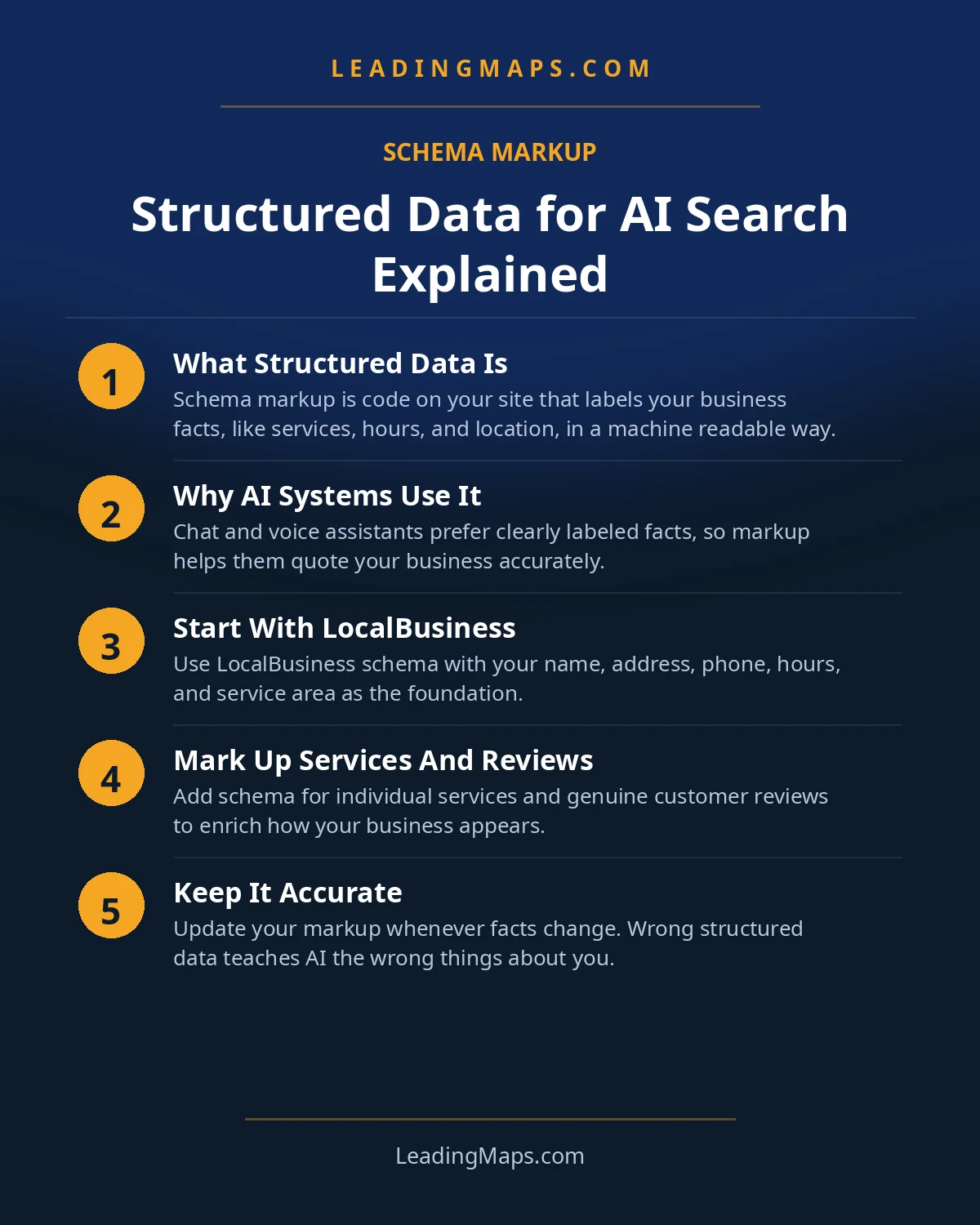
You do not need all 800 schema.org types. A contractor needs a tight stack, five pieces, that covers everything AI systems and Google read when they resolve your business as an entity. Here is the whole thing:
- Use your trade's LocalBusiness subtype. Schema.org offers specific subtypes: Plumber, HVACBusiness, Electrician, RoofingContractor. Use the one that matches the trade you actually do. A generic LocalBusiness type is accurate but weak; the subtype is the first disambiguation signal a machine gets. See the LocalBusiness type definition.
- Fill identity and contact fields exactly: name, telephone, address, plus geo coordinates. These must match your Google Business Profile character for character. Parity between GBP and schema is one of the strongest entity signals you own, and our profile optimization checklist covers it from the profile side.
- Set openingHoursSpecification with real hours, including honest emergency or after-hours coverage. If you answer emergencies at 2 AM, say so in both places, not just in an ad.
- Define areaServed with your actual service areas, the cities and ZIP codes your trucks genuinely reach, paired with Service entries naming what you sell. A Service entry with areaServed is the machine-readable version of "we do X in Y," and it is exactly what AI systems read when matching a query to a business.
- Add sameAs links to every authoritative profile: your website, Google Business Profile, Facebook, Yelp, BBB, and trade directories. sameAs is the explicit claim that these scattered profiles are one business, and it is the cheapest entity work on this list.
- Use aggregateRating only if reviews exist and are visible on the page. Never invent ratings. Mark up only what the page shows, and only real reviews.
That is the full stack. Implemented once as JSON-LD in your site's head or footer, it covers every page on the site. Most decent contractors could add it in an evening, and most SEO plugins generate it automatically, though you should verify what they output rather than trust the defaults.
The Parity Rule: Markup Must Match What Humans See
Here is the mistake that undoes good schema: markup that describes a different business than the visible page. Google is explicit on this point, and practitioners call it the markup-DOM mismatch. Phantom services, hours, or prices that exist only in the code do not make you look bigger to AI systems. They make you look untrustworthy.
- JS-only markup is fragile. If your schema only exists after JavaScript renders, some AI crawlers will never see it. Server-rendered, plain-HTML markup is the safe choice for a trade website.
- Schema bloat backfires. Marking up FAQ sections that are not visible on the page, or tagging review stars for reviews that appear nowhere, reads as manipulation, not thoroughness.
- One source of truth. The service list in your schema, the services on your Google Business Profile, and the services on your website should be the same list. Divergence is how AI assistants start stating wrong facts about you, and every wrong fact costs you a recommendation.
HubSpot's AI-search visibility playbook counts structured context among the core levers of answer-engine visibility, which is the right framing: schema is one input into a system that also reads your reviews, your directory listings, and what other sites say about you. It strengthens a strong foundation; it cannot replace one.
How To Validate It Without A Developer
You do not need a developer to check this. Three free tools, ten minutes, and you will know more about your markup than most agencies bother to learn:
- Google's Rich Results Test: paste your URL, confirm your LocalBusiness markup is detected, and treat any error as an instruction, not a suggestion.
- The Schema.org validator: catches structural problems the Google test glosses over, like properties attached to the wrong type.
- Search Console's enhancements report: after a few days, it shows whether Google actually trusts the markup it found. Errors here are your priority queue, because this is Google telling you what it thinks of your code.
Re-run this check any time you change hours, services, or service areas. Schema that was correct in 2024 and stale in 2026 is worse than no schema, because it asserts wrong facts with machine confidence, and AI systems repeat machine-confident facts.
What Schema Will Not Do For You
Expectations are the whole game here. Schema will make your business easier to understand. It will not make you easier to recommend. When an AI assistant answers "who is the best plumber near me," the recommendation comes from the same raw materials as a Google ranking: reviews, reputation, third-party corroboration, and content the system can quote. Independent tests reported in the SEO press have found that adding schema on its own barely moves AI citation rates, which matches what Google's own documentation implies. Infrastructure, not magic.
So do the markup because it is cheap, correct, and permanent. Do not do it expecting a citation surge next week. If you want the recommendation itself, that work lives elsewhere: in your review engine, your local mentions, and content worth quoting. Start with our AI Overviews playbook, and if you want the full picture of how AI recommendation works, our GEO guide explains the discipline from the ground up.
Structured Data Questions, Answered.
No. Google's own documentation states AI features have no additional technical requirements beyond standard SEO fundamentals. You do not need a new markup type for AI Overviews or AI Mode. Use the schema that fits your business: LocalBusiness subtypes, Service, FAQPage, and keep it accurate.
Start with a LocalBusiness subtype that matches the trade (Plumber, HVACBusiness, Electrician, RoofingContractor), plus Service entries with areaServed, openingHoursSpecification, geo coordinates, aggregateRating, and sameAs links to your profiles. That covers what both Google and AI assistants read when they resolve your business.
Yes. Google retired the FAQ rich result panel, but the markup remains valid structured data and still gives extraction systems clean question-answer pairs. Mark up only questions actually answered on the page, word for word, and keep the answers concise.
No. Schema makes your business machine-readable, which helps AI systems resolve your identity and services. Citations in AI answers come from quotable, original content and third-party corroboration. Treat schema as hygiene that removes a reason to be misunderstood, not as a lever that buys recommendations.
Run the page through Google's Rich Results Test and the Schema.org validator, then check Search Console's enhancements report for errors. The fastest failure to fix is mismatch: markup that says something your visible page text does not. Google requires the two to agree.
Finished The Schema And Still Invisible To AI?
Markup, profile, Maps rankings, citations, reviews, competitors, plus whether AI assistants recommend you. A prioritized action plan, free, no pitch.
- AI visibility check, real homeowner prompts across ChatGPT, Perplexity, and AI Overviews, who gets named.
- Proposal scorecard, what your current or prospective agency should be doing, item by item.
- Competitor gap analysis, what the top 3 in your market are doing that you're not.
Get My Free SEO Audit
Delivered within 48 hours. Yours to keep.