Think about what a homeowner is really deciding when they land on your site. They are not comparing marketing. They are deciding whether to give a stranger a key to their house, a signed estimate, and a few thousand dollars. Every trust signal on your website either answers that question or leaves it hanging, and the same signals that reassure the homeowner are the ones Google reads for its prominence signal and AI assistants read before recommending you.
This is not a list of badges to slap on a homepage. It is a checklist built around the buyer's actual anxieties: letting a stranger in, license and insurance verification, pricing fear, after-hours emergencies, and the oldest question in the trades, "will they actually show up?" Each signal below is mapped to how Google reads it and how AI search reads it, with one rule running through everything: verifiable only.
On This Page
- The home-service trust journey
- Identity: prove you are real and qualified
- Proof: show the work, not the claims
- Reputation: borrow trust from your customers
- Reliability: remove every friction
- The verifiable-only rule
- How AI assistants read your trust signals
- The pre-publish verification checklist
- FAQ
The Home-Service Trust Journey
Most trust-signal advice is written for restaurants and boutiques, where the stakes are a bad meal. Your stakes are different. Map the signals to the five moments where a homeowner's trust can break:
- "Is this a real company?" Answered by identity signals: license numbers, a real address and service area, actual team photos.
- "Can they do my job?" Answered by proof signals: job-site photos, service pages with specifics, guarantees.
- "What will it cost me?" Answered by pricing transparency: starting prices, financing mentions, plain-language estimates.
- "What if something goes wrong?" Answered by insurance, warranties, and a visible process for complaints.
- "Can I reach them right now?" Answered by reliability signals: tappable phone number, honest hours, after-hours clarity.
Build your site so a panicked homeowner with a burst pipe can answer all five without scrolling past the fold twice. Google's own local ranking guidance rewards complete, accurate business information for the same reason: complete information is itself a trust signal to the algorithm.
Identity: Prove You Are Real And Qualified
Identity signals answer the first and hardest question. A home-service business that cannot prove it is real and licensed will not rank well, will not convert, and will not get recommended by an AI assistant.
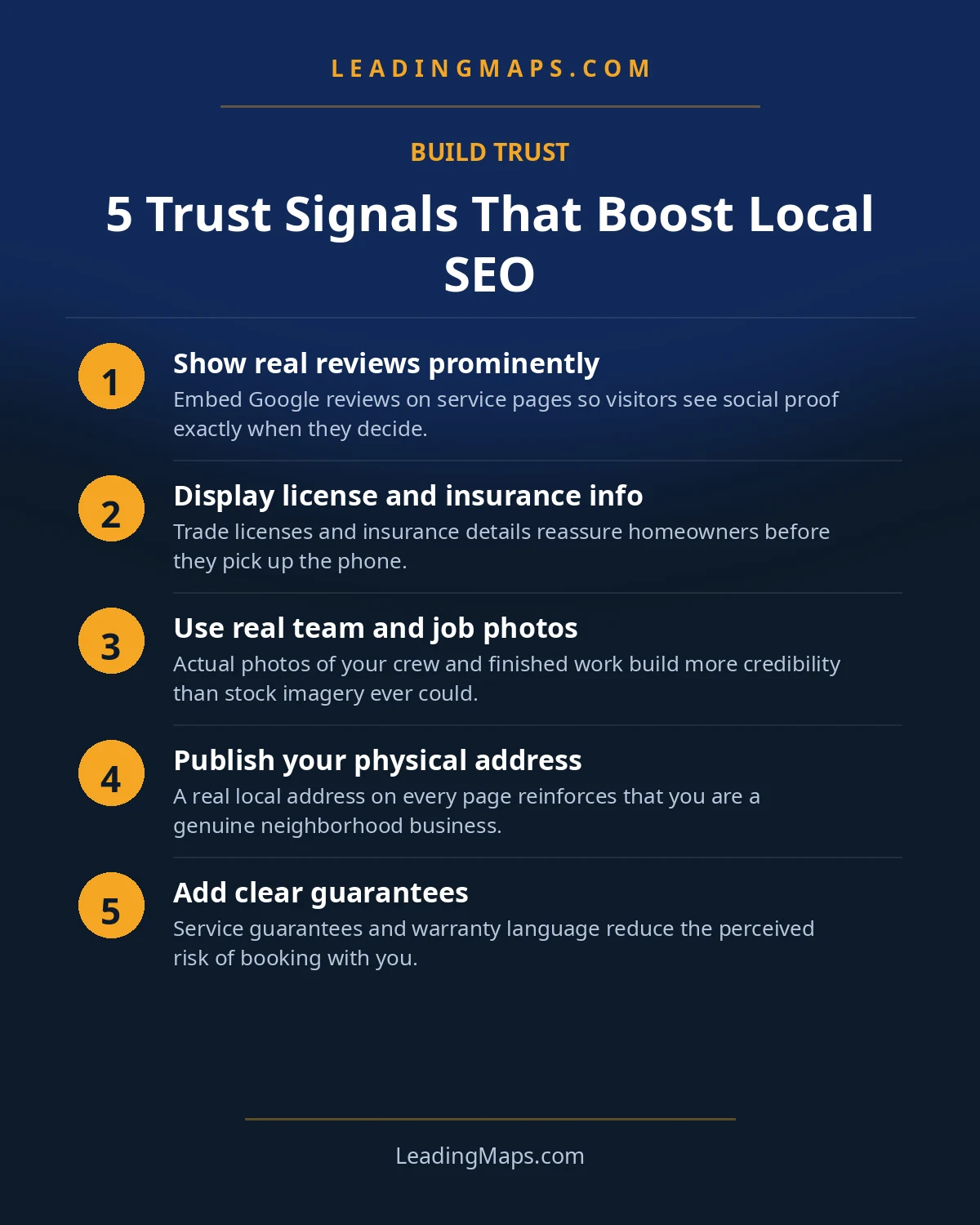
- Display your license number prominently, in the header, footer, or both, naming the issuing state board. This is the single strongest trade trust marker there is.
- State that you are bonded and insured, and name the coverage types (general liability, workers' comp). Link to the state license lookup page so homeowners can verify.
- Show your real people. Photos of your techs in uniform, your branded trucks, your actual office or shop. Stock photography of smiling models does the opposite of trust.
- Publish your exact service area, the cities and neighborhoods your trucks actually reach, matching your business profile exactly.
- Put your exact NAP in the footer of every page. Name, address, phone, identical everywhere, on your site and off it. Our NAP consistency guide covers why.
- Show real certifications: manufacturer certifications (NATE, EPA 608 for HVAC), trade association memberships, BBB accreditation. Each one earns its place by being verifiable.
Search Engine Land's scalable local SEO practices guide lists visual trust signals and certification components as standard parts of a location page. For trades, treat them as standard parts of every page.
Proof: Show The Work, Not The Claims
"Trusted experts" is not proof. Before-and-after photos of a water heater replacement in a specific neighborhood is proof. The gap between claims and evidence is where most contractor websites fail, and it is the easiest gap to close, because you generate proof on every job.
- Publish real job-site before-and-afters with neighborhood or city context. One genuine photo beats a paragraph of superlatives.
- Write guarantees in plain language: what is covered, for how long, and how to claim it. Vague "satisfaction guaranteed" lines read as filler.
- Describe your process on service pages: what happens from the first call to the finished job. Process pages answer the "what will this be like" anxiety.
- Give pricing honesty, not pricing precision: starting prices, typical ranges, financing availability. The number-one conversion fear in the trades is the open-ended invoice.
Calls by month 3 is the average our clients see once profile, trust, and rankings come together. Trust signals convert the traffic; rankings bring it.
Reputation: Borrow Trust From Your Customers
Your claims are advertising. Your customers' words are evidence. Reputation signals carry the weight your own copy cannot, and they do double duty for AI search, where review text is one of the primary sources assistants read.
- Embed real Google reviews on service and location pages, not just a reviews page. Reviews that mention specific work ("replaced our water heater same day") outperform generic five-star praise.
- Link out to your third-party profiles: Yelp, Angi, BBB, Facebook. A business confident enough to show independent review platforms looks honest, because it is.
- Add Review schema so search engines can parse your ratings. It also feeds star displays that lift click-through from search results.
- Keep the review engine running off-site too. On-site reviews close the deal; Google reviews win the map pack. Our review guide covers the system.
Reliability: Remove Every Friction
Reliability signals answer the emergency question: can I reach you, right now, and will you show up? Most contractor sites lose calls here, on their own phone number.
- Make the phone number tappable and above the fold on mobile. Most emergency searches happen on a phone, at the worst moment. One tap to call.
- Show honest hours, including after-hours reality. Only claim 24/7 if someone genuinely answers. False availability is the fastest way to earn a one-star review.
- Run HTTPS and load fast on mobile. A slow, insecure site reads as an abandoned business, and it loses the call before it happens.
- Offer one clear quote path: call, text, or short form, not all three competing for attention. One primary action per page.
The Verifiable-Only Rule
Every signal in this guide shares one property: it can be checked. The license number resolves at the state board. The address is real. The review is from a real customer. The truck photo is your truck. This is the rule that separates trust signals from marketing fluff, and it is non-negotiable, because an unverifiable claim does not just fail to build trust, it actively destroys it.
Before you publish any trust marker, run the verification question: what must be true for this to be accurate, and can a skeptical homeowner confirm it in under a minute? If the answer is no, fix the underlying fact first or leave the badge off. "Family owned since 1987" needs the incorporation record. "500+ happy customers" needs the review count to back it. "Award-winning" needs the award named and dated.
How AI Assistants Read Your Trust Signals
Here is the layer most trust guides miss. When someone asks ChatGPT or Perplexity for a plumber, the assistant does not read your hero headline and get a warm feeling. It hunts for verifiable specifics it can quote: license numbers, years in business, review counts, named neighborhoods, consistent contact details. AI answers cite specifics, so vague claims ("trusted local experts") are invisible to AI while concrete facts get quoted.
- Specifics get cited; superlatives don't. "Licensed TX Master Plumber #M-41208, 200+ reviews, serving Plano since 2009" is quotable. "Quality you can trust" is not.
- Consistency is corroboration. AI systems cross-check your site against your profile, directories, and reviews. Matching details everywhere reads as one confident entity; contradictions read as unreliable.
- Reviews are your AI bio. Assistants weight specific review text about real work done. Every detailed review is a paragraph about your business that AI can quote.
The machine-readable layer for all of this is LocalBusiness schema: areaServed, aggregateRating, hasCredential, openingHours, the structured facts that let machines confirm what your pages claim. It does not replace the visible signals, it makes them machine-checkable. Our AEO and LLM optimization service builds this full layer, but the principle is free: publish facts a machine can verify.
The Pre-Publish Verification Checklist
Run this before any trust marker goes live on your site:
- License number current and linked to the state lookup? Expired numbers are worse than none.
- Insurance statement accurate as of today? Coverage lapses happen; the claim must match the policy.
- Every number verifiable? Review counts, years in business, jobs completed, each traceable to a real source.
- Every photo actually yours? No stock trucks, no stock techs, no borrowed before-and-afters.
- NAP identical to your profile and citations? One inconsistent phone number undoes the whole identity layer.
- Schema matches the visible page? Structured data must say exactly what the page says, never more.
Trust is slow to build and instant to lose, online and off. A site that passes this checklist does not just rank better and convert better, it becomes the kind of business AI assistants can confidently recommend, because every claim checks out.
Trust Signal Questions, Answered.
Local SEO trust signals are verifiable facts and proof on your website that convince both search engines and homeowners your business is real, qualified, and reliable: license numbers, proof of insurance, real team and job photos, genuine reviews, clear guarantees, and structured business data. They influence rankings, conversions, and AI recommendations at the same time.
Some do directly: complete business information, reviews, and strong local links feed Google's prominence signal, and schema helps search engines understand your entity. Others work indirectly, boosting click-through rates and conversions, which improves behavioral signals. But the honest answer is that trust signals mostly convert the traffic your rankings already earn.
Display your license number prominently in the header or footer and on an about page, name the issuing state board, and state that you are bonded and insured with coverage types. Better still, link to the state license lookup so homeowners can verify it themselves. Never claim licensing you cannot document; unverifiable claims destroy trust instead of building it.
Embedded reviews help conversions a lot and SEO a little: they add fresh, keyword-rich content to your pages, and Review schema can generate star ratings in search results. But reviews on your own site never replace Google reviews for map-pack rankings. Treat on-site reviews as the closing argument, not the ranking factor.
AI assistants look for verifiable specifics they can quote: license numbers, years in business, review counts, named neighborhoods, and consistent contact details across sources. They corroborate claims across your site, directories, and reviews. Vague superlatives like trusted experts give them nothing to cite, while concrete facts get quoted in their answers.
Does Your Site Earn The Call?
Profile, Maps rankings, citations, reviews, site trust, plus whether AI assistants recommend you. A prioritized action plan, free, no pitch.
- AI visibility check, real homeowner prompts across ChatGPT, Perplexity, and AI Overviews, who gets named.
- Proposal scorecard, what your current or prospective agency should be doing, item by item.
- Competitor gap analysis, what the top 3 in your market are doing that you're not.
Get My Free SEO Audit
Delivered within 48 hours. Yours to keep.