You do drain cleaning, water heaters, repiping, and sewer line work from one shop. Your competitor does just drain cleaning, and he outranks you for every drain-related search in town. That is the multi-service problem: specialists keep beating generalists line by line, because their entire digital footprint screams one thing while yours whispers five.
This guide fixes that. It covers one Google Business Profile running many service lines, the page architecture that keeps them from competing with each other, the linking structure that feeds them all, and the structured-data layer that makes AI assistants recommend the right service for the right question. First, one distinction that confuses everyone.
On This Page
Multi-Service Is Not Multi-Location
Almost every "local SEO strategy" article out there assumes you have many locations and one service. You have the opposite: one location and many services. The playbooks do not transfer. Multi-location strategy is about distinct addresses, distinct profiles, and avoiding duplicate content across city pages. Multi-service strategy is about one profile, one address, and making every service line legible to Google as its own thing without splitting your authority into pieces.
The core tension: Google rewards specificity, but your business is broad. The specialist plumber wins "drain cleaning" because everything about his profile points one way. Your job is to give each of your service lines the same single-minded footprint, while keeping it all under one roof. Every section below is a technique for doing exactly that.
Primary Vs Secondary Categories
You get one primary category and up to nine secondaries. This is the single most consequential settings decision for a multi-service business, and most shops get it wrong in one of two ways: they pick the broadest category ("Plumber") and bury their specialties, or they pick their favorite niche and starve their main revenue line.
- Set primary to your money line. The category should match the service that drives the most revenue, not the one you enjoy most.
- Add genuine secondaries for every other service you truly offer. Drainage Service, Water Heater Repair Service, Sewer Service: each one is a relevance channel.
- Never add categories you do not qualify for. Google's guidance on categories is explicit, and aspirational categories invite edits, reports, and suspensions.
- Revisit when revenue shifts. If repiping overtakes drain cleaning, your primary category should move with it.
One hard limit to respect: categories describe the business, not individual web pages. You cannot have five primary categories, so the rest of your service lines earn their relevance through services lists, pages, reviews, and schema, which is what the next sections build. Our full category list for contractors shows which labels actually exist.
Service Pages That Actually Rank
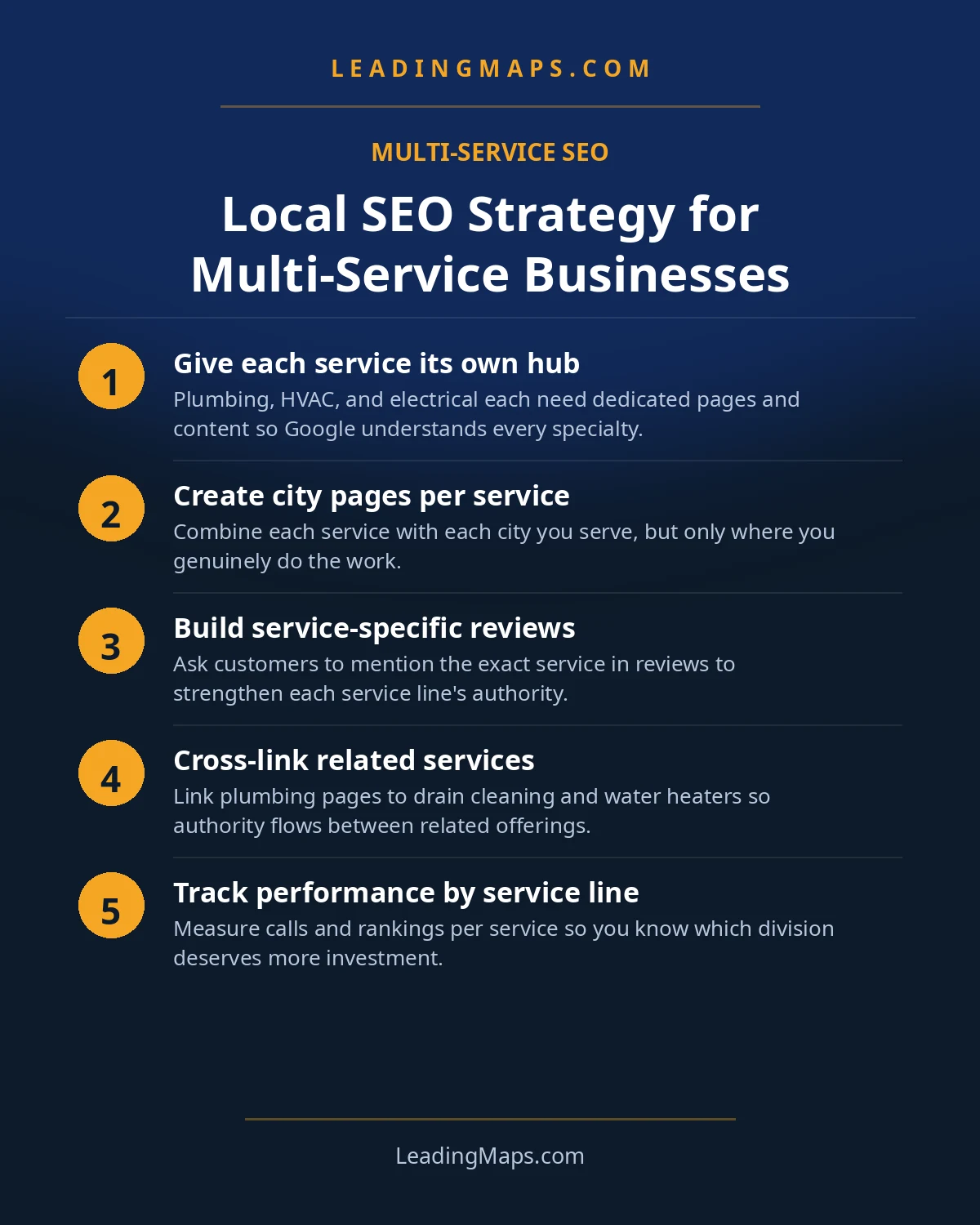
Your profile categories open the door; your website pages walk through it. Each service line you want to win needs its own dedicated page with genuinely unique content. Not a paragraph and a stock photo, a real page: what the service costs, how long it takes, your process, photos of your own work, and an FAQ that answers the questions customers actually ask on the phone.
- One page per service line, each targeting one clear query ("drain cleaning in [city]", "water heater installation [city]").
- Mirror the page in your profile services list. Every service line on the site should also exist as a named service in your profile, with a description.
- Add service-specific schema using schema.org's LocalBusiness types, so each service is machine-readable, not just human-readable.
- Prioritize by margin and volume. Build the page for your highest-value service first; the fourth service line can wait.
The specialist beating you has exactly this: one great page, all pointed at one query. You do not need to out-write him ten times over. You need one page per line that is as good as his one page, which is very achievable. The step-by-step for the profile side is in our services-list guide.
The whole strategy in one line: one profile as the hub, one strong page per service as the spokes, and clean links between them. Specialists win one query; you win five.
Internal Linking Between Services
Five orphaned service pages are five lonely islands. Internal linking is what turns them into one strong business in Google's eyes, and it is where multi-service shops either win big or bleed out.
- Build a services hub page that links to every service page with a real description of each, not just a nav list.
- Link sideways between related services where a customer would naturally cross over: drain cleaning to sewer line work, water heaters to repiping.
- Use descriptive anchor text. "Our sewer line replacement process" beats "click here" and tells Google exactly what the target page is about.
- Link every service page back up to the hub and to the homepage. Authority should flow both ways.
Think of it as a map of your business for a reader who only landed on one page. A homeowner who finds your drain-cleaning page should be one click from discovering you also replace water heaters. That is not just SEO, it is average ticket value going up.
Avoiding Cannibalization
Cannibalization is the multi-service trap: two of your pages chase the same query, Google cannot pick a winner, and both pages underperform. The classic case is a "plumbing services" page and a "drain cleaning" page both aimed at "plumber [city]". Neither ranks as well as either would alone.
- Give every page one job. The drain-cleaning page targets drain queries; the plumbing-services hub targets the broad query. Write it down per page and enforce it.
- Keep titles distinct. If two pages could swap titles without anyone noticing, they are cannibalizing. Make each title unmistakable.
- Point internal links deliberately. When in doubt, link up to the parent page for the broad query and keep the child page aimed at its specific one.
- Check Search Console quarterly. If two of your pages both earn impressions for the same query and neither ranks, that is cannibalization in the wild. Merge, redirect, or re-aim.
Resist the temptation to create a page for every keyword variant. One strong page per service line, aimed at one clear query, beats three thin pages aimed at three overlapping ones. Every time.
Reviews, Per Service Line
Here is the part most multi-service shops never think about: reviews are a per-service relevance signal, not just a star count. A review that says "they replaced our water heater the same day" tells Google and AI assistants that you do water heaters. Fifty generic five-star reviews tell them much less.
- Ask per service, not in general. After a water heater job, the follow-up text should nudge toward mentioning the water heater, not just "leave us a review".
- Balance your weaker lines. If drain cleaning has thirty detailed reviews and repiping has two, your repiping follow-up needs extra attention.
- Reply with the service named. "Glad our sewer crew got that line cleared for you" reinforces the service line in public, indexable text.
- Track review themes monthly. A quick scan of new reviews shows which service lines customers talk about, and which ones are going quiet.
This is compounding work: every specific review is a tiny ad for that service line, written by a customer, in the exact words the next customer will search. The system for getting them is our review guide.
Making Every Line Recommendable To AI
Now the layer nobody on the multi-service SERP covers. When a homeowner asks ChatGPT or Gemini for a contractor, the assistant matches the question to the business it can describe most completely. A specialist with rich structured data for one service will beat your five service lines if your five lines are vague.
- Complete services with real descriptions in your profile. This structured inventory is what AI answers pull from when matching a query to a business. Empty service entries are invisible entries.
- Service-specific FAQs on each page. AI systems match natural-language questions to content written in natural language. A drain-cleaning FAQ phrased the way homeowners talk is AI ammunition.
- Schema per service line. LocalBusiness schema with distinct services and offers tells machines exactly what each line includes and costs. This is the machine-readable menu of your business.
- Specific reviews per line. As covered above, review text mentioning actual services is one of the heaviest signals assistants weigh when choosing whom to recommend.
- Consistent NAP everywhere. AI resolves businesses as entities; inconsistent name, address, or phone data makes your five service lines look like five unreliable fragments.
Test it yourself: ask ChatGPT who it would recommend for each of your service lines in your city. The lines that get named have strong data; the ones that do not are your AI gaps. Close them with the checklist above. The professional version, monthly prompt testing across ChatGPT, Gemini, and Perplexity, is what our AEO and LLM optimization service runs. And the ranking-factor guide gives you the Google-side mechanics behind all of it.
Multi-Service Questions, Answered.
Yes. One profile serves one business, and that business can offer many services. You pick one primary category for your strongest line and add genuine secondary categories for the rest. Each service gets its own section of services, its own website page, and its own review themes. The profile is the hub; the services are the spokes.
No, not unless each service is truly a separate business with its own name, phone, and brand. Separate profiles for one business violate Google's policies and create duplicate-NAP chaos. One strong website with deep, distinct service pages outperforms two thin websites every time, and AI assistants recommend coherent businesses, not scattered ones.
One per service you actually want to sell, plus one per town you actually serve. A plumber offering five services across three towns needs five strong service pages, not fifteen thin ones. Each page must earn its place with unique content: real photos, real FAQs, real reviews for that service. Depth beats count in every market we watch.
It happens when two of your pages target the same query and Google cannot decide which one to rank, so neither ranks well. The classic multi-service case: a drain-cleaning page and a plumbing-services page both chasing 'plumber in Dallas.' Fix it by giving each page one clear job, distinct titles, and internal links that point up to the right parent.
They match the question to the service they can describe best. The line with the richest structured data, the most specific reviews, and its own FAQ page gets recommended. If your drain-cleaning service has ten detailed reviews and a dedicated page while repiping has nothing, AI will recommend your drain cleaning every time, even when the homeowner asked about repiping.
Every Service Line Should Pull Its Weight.
Profile, Maps rankings, citations, reviews, competitors, plus whether AI assistants recommend you. A prioritized action plan, free, no pitch.
- AI visibility check, real homeowner prompts across ChatGPT, Perplexity, and AI Overviews, who gets named.
- Proposal scorecard, what your current or prospective agency should be doing, item by item.
- Competitor gap analysis, what the top 3 in your market are doing that you're not.
Get My Free SEO Audit
Delivered within 48 hours. Yours to keep.