Most local SEO reports are written to make the agency look good, not to tell you whether you are getting jobs. Impressions, average position, domain authority, total traffic: all of these can climb while your phone stays silent. The metrics below are the opposite. Each one connects to a booked job with no more than one step between them, and each one can be pulled from tools you already have.
They are also trade-specific, because a plumber's SEO and a roofer's SEO convert differently. An emergency plumber lives on phone calls. A roofing company lives on booked estimates. The metric that matters most follows the money, and the money is different in each trade. Watch the right number for your business and ignore the rest.
On This Page
- The vanity-metric graveyard
- 1. Calls and actions from your profile
- 2. Map-pack rank on your money keywords
- 3. The branded vs. non-branded split
- 4. Review velocity and rating trend
- 5. Booked jobs from organic search
- 6. The metric the SERP ignores: AI-answer visibility
- The one-page monthly routine
- FAQ
The Vanity-Metric Graveyard (What To Stop Celebrating)
Before the metrics that matter, bury the ones that do not. Impressions without clicks mean people saw you and chose someone else. Average position across all queries is skewed by brand searches you would rank for anyway. Total website traffic includes the DIY readers who will never hire you. Domain authority is a third-party estimate, not a Google signal. None of these pay a tech's wages, and a report full of them is a report hiding something.
1. Calls And Actions From Your Google Business Profile
For emergency trades, this is the metric. Your Business Profile performance report shows calls, direction requests, website clicks, and bookings: the actions a homeowner takes right at your listing, often without ever visiting your site. When most of your jobs start with "the pipe burst," the call button on your profile is your cash register.
Weight it by trade. Plumbers and HVAC companies: calls first, bookings second. Electricians: calls, with after-hours calls as the canary in the coal mine. Roofers and remodelers: direction requests matter less; form fills and booked estimates matter more, because nobody books a $15,000 roof from a map pin. One metric per trade, watched monthly, tells you more than forty blended numbers.
Read the report in the right order. Searches (how often your profile surfaced) is vanity-adjacent; views of the profile are interest; actions (calls, direction requests, bookings, website clicks) are intent. Only the last column connects to revenue, and it is the only column that belongs on your one-pager. One honest caveat from Google's own docs: the searches metric can lag behind the actions data, so compare month to month, not day to day.
2. Map-Pack Rank On Your Money Keywords, Not All Keywords
Track three to five money keywords, the searches that produce jobs: "emergency plumber [city]," "ac repair [city]," "roof replacement [city]." Rank on those is what fills the schedule. Rank on "how to fix a leaking water heater" fills your analytics with readers who will never call, and celebrating it is how vanity metrics survive.
Check from the customer's side, not your office. Rankings shift by neighborhood, so a number one at your shop can be a number six two miles away, where the customer actually is. The trend on your money keywords, measured consistently, is the only ranking number worth a slot on the one-pager.
How to check without fooling yourself: use an incognito window, set the location to a customer neighborhood (not your shop's ZIP), and search the exact money keyword. Do it from the same two or three spots each month so the trend is comparable. Dedicated rank trackers and map-grid scans do this at scale, but the manual check is free and it is the version your customers actually experience.
3. The Branded Vs. Non-Branded Split (The Agency-Accountability Test)
Open your Search Console performance report and split queries into two buckets: searches containing your business name, and searches that do not. Non-branded growth is SEO working: strangers finding you. Branded growth is your trucks, your yard signs, and your reputation working.
This split is the honesty test for any agency, including us. If all the growth is branded, the agency is taking credit for your billboard. And do not borrow someone else's benchmark for the ratio. Compute your own baseline this month, then watch the trend. The direction is the data.
4. Review Velocity And Rating Trend
Reviews do double duty: they influence map-pack rankings, and they decide whether the homeowner calls you or the next listing down. Track new reviews per month and the rating trend, not just the total count. A 4.9 sliding to 4.6 is a warning light even at 300 reviews, and a competitor adding eight reviews a month while you add one is a gap that compounds. If you want the full system, our review guide covers it; the metric here is simply: steady, specific, and never bought.
One more review number worth logging: your response rate. Replying to every review, good and bad, within 48 hours is a signal in itself, and AI assistants read your responses when they summarize what customers say about you. A 100 percent response rate with specific, non-templated replies is the cheapest reputation asset on this list.
5. Booked Jobs Attributed To Organic Search (The Only Metric That Pays)
Calls are not jobs. A call that rings out, a price shopper, a wrong number: none of these pay. The metric that matters is booked jobs you can trace to organic search, and that requires a call log or CRM with a lead-source field. Our call and lead tracking guide sets that stack up step by step.
Then compute your own close rate: booked jobs divided by organic calls. That number is yours. It will not match anyone else's, and anyone quoting you a universal benchmark for your trade is guessing. Track it monthly and you will know, to the job, whether your SEO is paying for itself.
One refinement that matters for trades: segment emergency jobs from planned jobs before you average anything. A $189 drain cleaning and a $14,000 sewer line replacement should not share a "customer value," and their close rates will not match either. Two small segments with honest numbers beat one blended average that describes nothing.
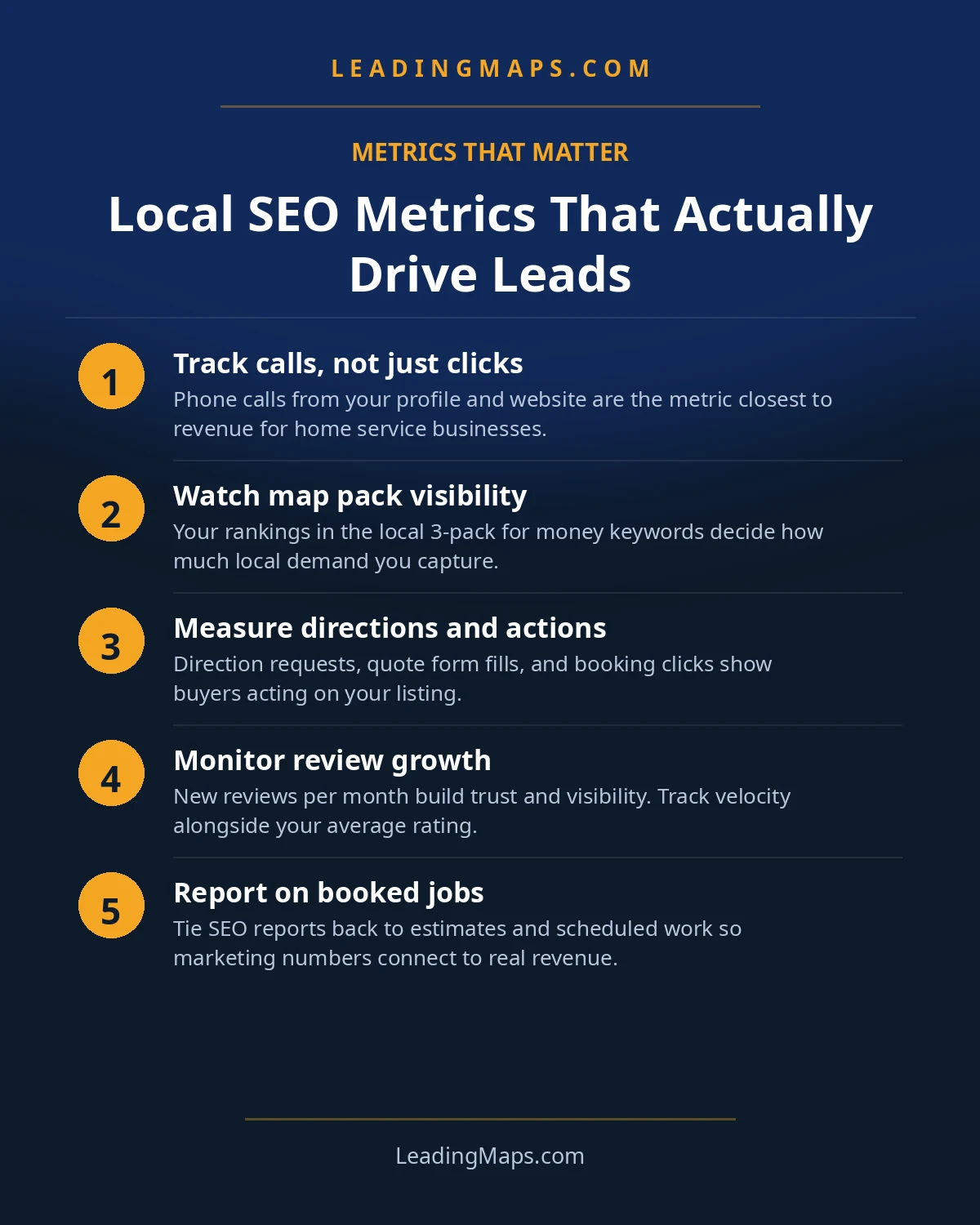
Calls, map-pack rank on money keywords, the branded split, review velocity, booked jobs. One page a month. Everything else is decoration.
6. The Metric The SERP Ignores: AI-Answer Visibility
None of the standard metric guides include this one, and in 2026 it belongs on the list. Once a month, run a fixed set of homeowner prompts across ChatGPT, Gemini, Perplexity, and AI Overviews: an emergency query, a cost query, a "best of" query, and a brand query naming you. Log whether you were named, cited, or skipped, and who got named instead.
Be honest about what this measures. There is no stable "rank" in AI answers, and nobody should sell you one. What you get is a trend: are you appearing more or less often than last month, and against which competitors? That trend is the early-warning system for a channel that is only growing. If you want the reasoning behind it, Search Engine Journal's local SEO guide is the solid foundation underneath everything on this page.
The One-Page Monthly Routine
Twenty minutes, once a month. This is the whole reporting discipline:
- Pull profile performance: calls, direction requests, website clicks, bookings. Note answered vs. missed if your call log shows it.
- Check your money keywords in the map pack from a customer-side location.
- Open Search Console: branded vs. non-branded split, and which money pages gained impressions.
- Log review velocity and the rating trend.
- Count booked jobs from organic sources in your CRM or call log, and compute your close rate.
- Run the monthly AI prompt battery and log named, cited, or skipped.
If your agency's report has forty metrics and none of these five, ask why. And if you are doing this yourself, our DIY checklist gives you the four-week build that produces numbers worth tracking, while our timeline guide sets expectations for how fast they move.
Finally, share the one-pager with anyone who touches the phones. When the dispatcher knows which numbers matter, the source field gets filled in, the missed calls get called back, and the whole measurement chain stays honest. Metrics only work when the people generating them understand them.
Metrics Questions, Answered.
There is no universal number. It depends on your trade, market size, competition, and how long the work has been running. The right question is trend: are organic calls rising month over month against your own baseline? Anyone quoting you a guaranteed call volume is selling, not measuring.
The top 3. Most local clicks go to the three map-pack listings, and positions below it behave like page two. Track your money keywords from a customer-side location, since rankings shift by neighborhood, and watch the trend rather than any single check.
Track both, but trust calls. Rankings are a leading indicator: they tell you the machine is noticing. Calls and booked jobs are the outcome. If rankings climb and calls do not, the leak is in your profile, your reviews, or your phone answering, not in your SEO.
In Search Console, open the Performance report and filter queries containing your business name versus all others. Non-branded queries are strangers finding you; branded queries are people who already knew you. Growth in the non-branded column is the proof SEO is working.
Monthly. Weekly checks catch noise, not signal: a slow week means nothing, a flat quarter means everything. The one exception is review velocity, which you watch continuously because every review is also a customer interaction that deserves a reply. Set a calendar reminder and stick to it.
Know Your Numbers, Or Want Them Built For You?
Profile, Maps rankings, citations, reviews, competitors, plus whether AI assistants recommend you. A prioritized action plan, free, no pitch.
- AI visibility check, real homeowner prompts across ChatGPT, Perplexity, and AI Overviews, who gets named.
- Proposal scorecard, what your current or prospective agency should be doing, item by item.
- Competitor gap analysis, what the top 3 in your market are doing that you're not.
Get My Free SEO Audit
Delivered within 48 hours. Yours to keep.