Nobody in home services gets excited about backlinks, and that is exactly why they still work. Most of your competitors have never built a single intentional link. Google's own local ranking guidance names linking sites as a prominence factor, and in most home-service markets the difference between map-pack position one and position five comes down to a handful of relevant local links, not hundreds.
This is not a guide to guest blogging or buying links. It is a contractor-grade playbook: the link sources that actually exist for plumbers, HVAC, roofers, and electricians, ranked by effort, with the exact ask for each one. And because 2026 is the AI-search era, it includes the twist most link guides miss: for AI assistants, the unlinked mention can matter as much as the link itself.
On This Page
- Why local links matter more than you think
- Start by auditing what you already have
- Tier 1: the quick wins (same-day effort)
- Tier 2: trade-specific links (a few hours each)
- Tier 3: earned links (weeks, but compound)
- The outreach playbook: what to actually ask for
- The compliance rule competitors skip
- What to never do
- The AI-search twist: links vs. mentions
- FAQ
Why Local Links Matter More Than You Think
For a national e-commerce site, a backlink is a vote in a global popularity contest. For your plumbing company, a backlink is something more specific: a signal that a real local or industry entity vouches for you. When the chamber of commerce, your equipment manufacturer, and three local builders all link to your site, Google has corroboration from independent sources that you are a legitimate, established business. That corroboration is prominence, and prominence is one of only three pillars Google says determine local ranking.
The practical math favors you. Our map-pack ranking factors breakdown shows how little link building most trade competitors do. In most markets, 15 to 30 quality local links puts you ahead, because the bar is not high. It is just unmet. Relevance beats volume every time: one link from your equipment manufacturer's dealer page outweighs fifty generic directory profiles nobody ever visits.
Start By Auditing What You Already Have
Before building anything, look at what is already pointing at your site. Run your domain through Ahrefs' free backlink checker and note three things: your total referring domains, the strongest domains among them, and any junk you would rather not be associated with. Then run your top three map-pack competitors through the same tool. The link-intersect view tells you exactly which sources they have that you don't. That gap list is your first outreach queue.
Quality local links is what typically puts a trade business ahead of its market. Not hundreds. Your competitors are not building links, which means the bar is low and the payoff is high.
Tier 1: The Quick Wins (Same-Day Effort)
These take hours, not weeks, and they are the foundation every trade business should already have. Get them all.
- Chamber of commerce membership. Most chambers publish a member directory with a link, and the membership doubles as community credibility. One application, one link, one receipt for your taxes.
- Manufacturer find-a-dealer programs. If you install Carrier, Trane, Rheem, Lennox, Bradford White, or similar equipment, the manufacturer's dealer locator almost always includes a profile with a link. Applications take under an hour.
- Supply-house vendor pages. Your Ferguson, Johnstone Supply, WinSupply, or regional distributor may list preferred contractors or have a "find a pro" page. Call your rep and ask.
- Trade association listings. PHCC, ACCA, NECA, NATE, and local builder associations maintain member directories with links. Join the one that fits your trade.
- Better Business Bureau accreditation. The BBB profile links out and carries trust weight with older homeowners, the demographic that still checks.
Tier 2: Trade-Specific Links (A Few Hours Each)
These are the links your competitors do not have, because they require knowing the trade, not just SEO. Start with whichever partner relationships you already have.
- Builder preferred-vendor pages. Custom home builders and remodelers often maintain lists of trusted trades on their sites. If you have done work for a builder, ask for a listing with your company name, trade, and city. One ask, one link, and a referral relationship that keeps paying.
- Realtor and property-manager vendor lists. Agents who recommend you to buyers and sellers sometimes publish "my trusted vendors" pages. Property managers who use you for maintenance calls are even better, because their pages tend to be city-specific.
- Insurance adjuster and restoration referrals (roofers especially). Roofers who work with adjusters after storms should check whether those partners list approved contractors anywhere public. Storm season is also when local news runs contractor-roundup stories, which leads to tier three.
- Local permit and inspection data pages. Some municipalities and trade publications publish contractor data, permit roundups, or inspection resources that name local companies. These are authoritative .gov and .org links that competitors cannot easily replicate.
- Community sponsorships. Youth leagues, charity 5Ks, school fundraisers. The sponsorship itself is marketing; the organization's sponsor page is the link. See the compliance section before you treat this as a paid link.
Notice what these have in common: they come from doing normal business and asking for the credit. That is the whole strategy.
Tier 3: Earned Links (Weeks, But Compound)
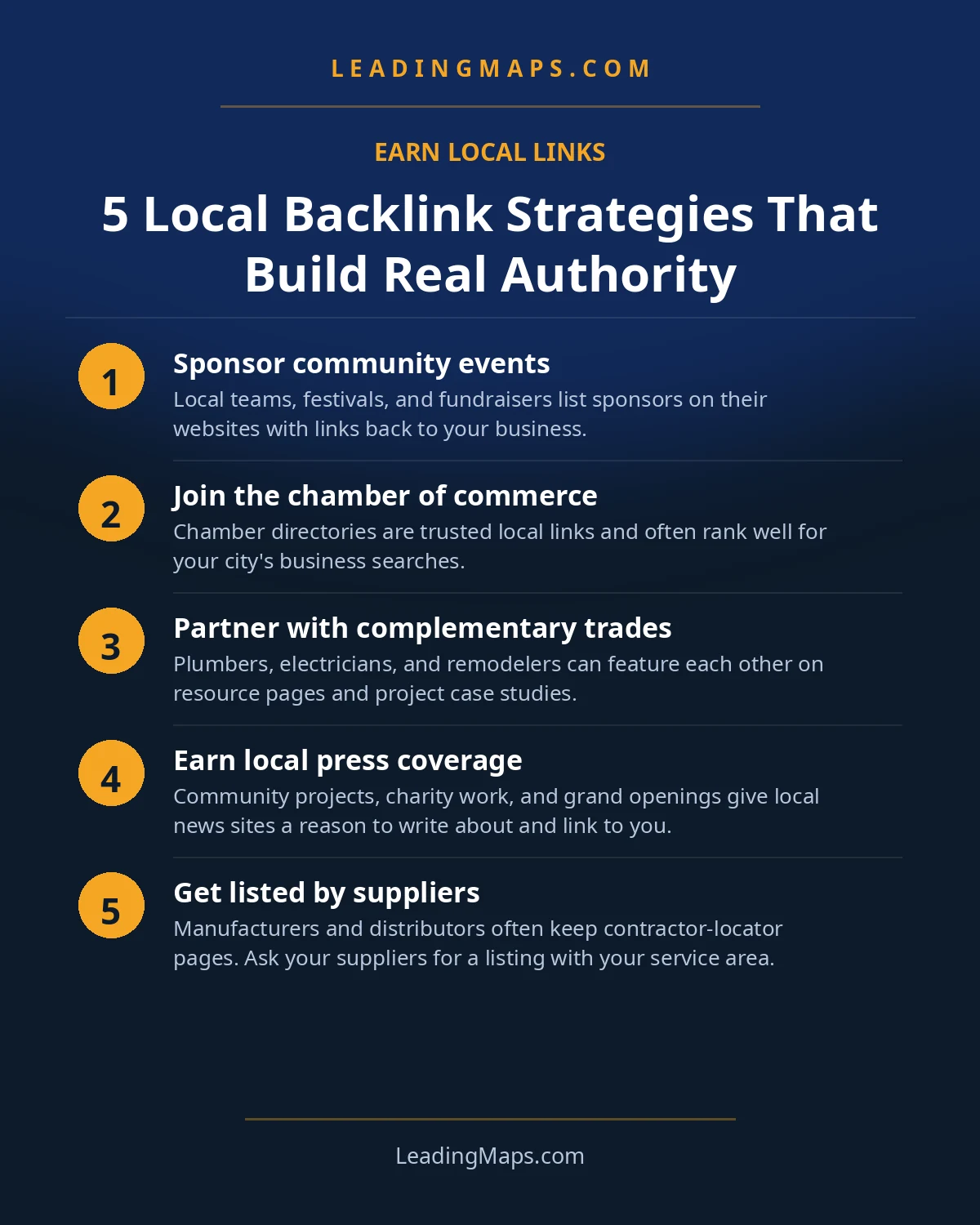
These take longer but they are the ones that separate a good profile from an unbeatable one.
- Local news coverage. Reporters covering storms, freeze warnings, recall announcements, or community stories need a local expert to quote. Get known as the tradesperson who picks up the phone, and the byline links follow. Keep a one-page media kit on your site with your credentials, service area, and a real photo, and send it to local assignment desks before storm season.
- Genuinely useful local content. A roofer's annual "storm season roof prep" guide for homeowners, a plumber's winterization checklist, an HVAC contractor's thermostat rebate roundup with local utility links. Content that local organizations and neighbors link to because it helps people, not because you asked.
- Scholarship programs. A $500 annual trade-school scholarship gets you .edu-adjacent links from schools and scholarship roundup pages. Run it every year, not once.
The Outreach Playbook: What To Actually Ask For
Generic "link to my site please" emails get deleted. The ask that works has three parts: who you are in one line, what they get (a finished sentence they can paste), and the exact link you want. Here is the structure, copy and adapt:
"Hi [name], we have worked together on [three addresses / the Maple St remodel / their rentals]. I noticed your trusted-vendors page, would you be open to adding us? Happy to provide the wording: 'Apex Plumbing, licensed plumbers serving [city] since [year].' The link would go to [URL]. Either way, thanks for the partnership."
Why this works: it reminds them of a real relationship, it does the writing work for them, and it asks for a natural, branded anchor. Never ask for keyword-stuffed anchor text like "best plumber [city]." Natural anchors (your company name, your trade, your city) are what real partnerships produce, and they are what Google trusts.
The Compliance Rule Competitors Skip
Here is the part almost every local link guide ignores. Google's spam policies require that links you paid for, including sponsorship links, be qualified with rel="sponsored" or rel="nofollow". An undeclared paid link is link spam, and it can get the link ignored or draw a penalty that costs far more than the link was worth.
Practically, this means: when you sponsor the youth league or the charity run, tell the organization you need the sponsored attribute on the link. It is a five-second fix for their web person. And do not engage in excessive link exchanges ("you link to me, I link to you, plus these eight friends"), which Google calls out by name as spam. Trade the sponsorship for the relationship and the brand visibility; let the link be a compliant bonus.
What To Never Do
- Buy links from link vendors. The "50 high-DA links for $99" packages are detectable, often from hacked or irrelevant sites, and they put your profile in danger.
- Keyword-stuffed anchor text. A link profile where every link says "emergency plumber dallas" is a neon sign that the links are manufactured.
- Private blog networks. If a link only exists because someone built a site to sell it, it is not a vote of confidence. It is a liability.
- Ignore your profile after building. Re-run the audit every six months. If a toxic-looking link appears, the disavow tool exists for exactly that.
The AI-Search Twist: Links Vs. Mentions
Here is what changes in 2026. When someone asks ChatGPT or Perplexity for a contractor, the assistant reads pages, it does not crawl the link graph. That means an unlinked brand mention, your name and trade appearing in a partner's "trusted vendors" page or a local news article, feeds AI answers just as well as a linked one. The research term for this is entity corroboration: multiple independent sources describing your business the same way makes AI systems confident enough to recommend you.
So build for both. Every partnership ask above earns you either a link, a mention, or both, and both count now. The pages to prioritize are the ones AI Overviews actually cite for "[trade] [city]" queries: review platforms, directories, and local news. Our AEO and LLM optimization service tests exactly this monthly, running real homeowner prompts to see who gets named and which pages the assistants cite. Our AI Overviews guide shows how to earn those citations.
Backlink Questions, Answered.
Yes. Google lists linking sites as a prominence factor in local ranking, and in home services a handful of relevant local links often separates rank one from rank five. Relevance beats volume: one link from a manufacturer dealer page or trade association outweighs fifty generic directory profiles nobody reads.
There is no magic number. In most home-service markets, 15 to 30 quality local links put you ahead of the pack, because competitors rarely build any at all. Audit the top three businesses in your market with a free checker and aim to close the gap on relevant domains, not raw link counts.
Yes, with one rule: the link must be qualified with rel=sponsored or rel=nofollow. Google treats undeclared paid links as link spam, which can get the link ignored or draw a penalty. Tell the sponsor you need the sponsored attribute on the link, and treat the relationship as marketing that happens to earn a link.
Trade-association and manufacturer dealer pages are usually fastest: many associations list members with links within days of joining, and manufacturer find-a-dealer programs accept applications in under an hour. Chamber of commerce memberships are similarly quick and typically include a member directory link.
Partially. AI assistants read pages, not links, so unlinked brand mentions on partner and press pages also feed their answers. What matters most is being named and described on third-party pages AI systems actually cite: directories, review platforms, and local news. Build for mentions and links, not links alone.
Your Competitors' Links, Mapped. Your Gap List, Ready.
Backlinks, Maps rankings, citations, reviews, competitors, plus whether AI assistants recommend you. A prioritized action plan, free, no pitch.
- AI visibility check, real homeowner prompts across ChatGPT, Perplexity, and AI Overviews, who gets named.
- Proposal scorecard, what your current or prospective agency should be doing, item by item.
- Competitor gap analysis, what the top 3 in your market are doing that you're not.
Get My Free SEO Audit
Delivered within 48 hours. Yours to keep.