Let us answer the headline question directly, because the internet is full of vague takes. Google's own documentation says review count and review score factor into local search ranking. Independent studies, including Whitespark's 2026 Local Search Ranking Factors, consistently weight review signals among the heaviest factors for the map pack. So yes: Google reviews affect local SEO rankings.
But the honest answer has a boundary. Reviews move the map pack and the local finder. They do not directly move your website's organic rankings for non-local queries. Your blog post about heat pumps does not rank higher because your profile has 200 reviews. Your map listing, though, climbs, gets clicked, and wins the call. For a trade business, that is the ranking that pays. Everything else in this guide is about making reviews do maximum work inside that boundary, and in the AI-search layer that sits on top of it.
On This Page
How Reviews Affect Rankings: The Mechanics
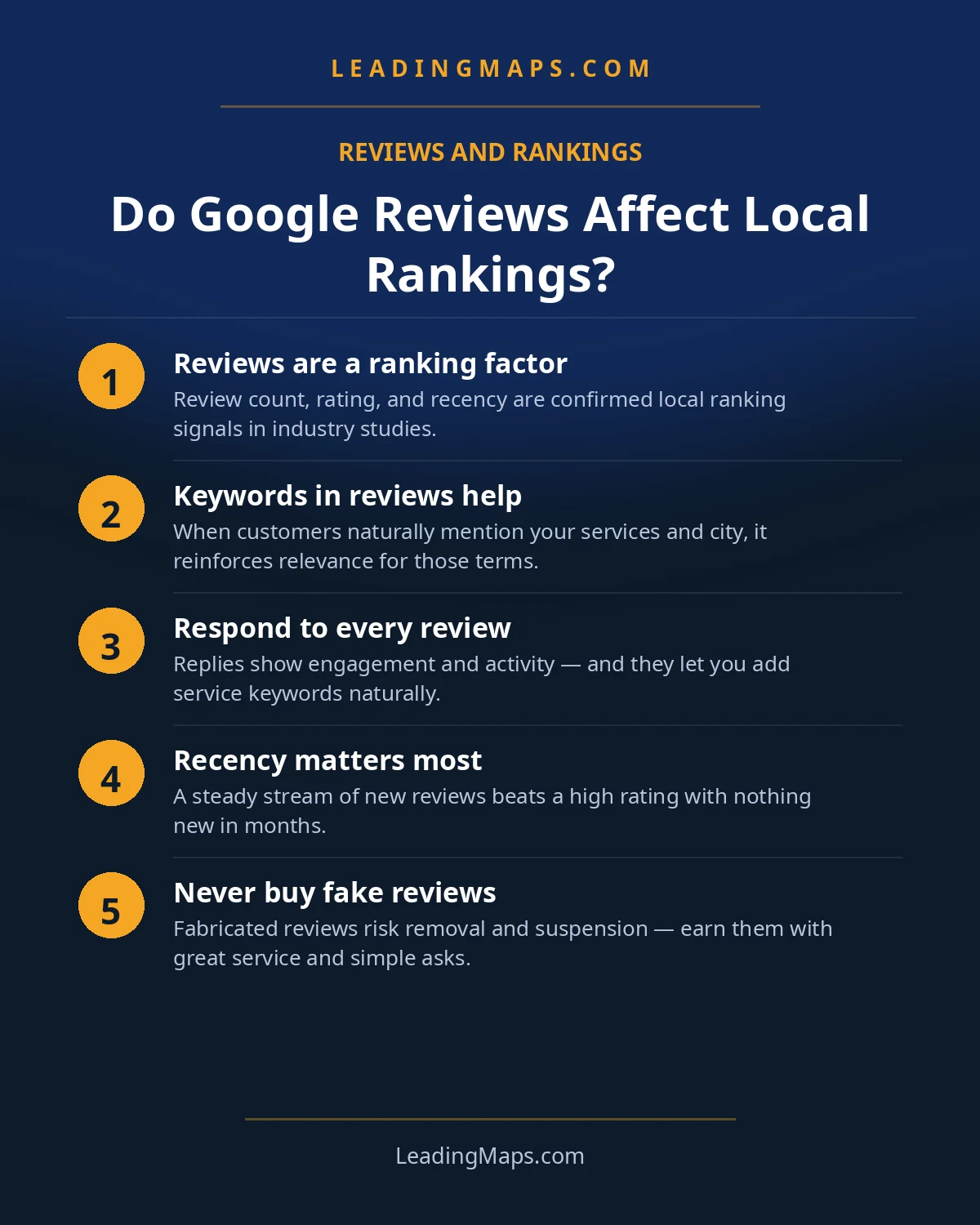
Google's local ranking guidance names three pillars: relevance, distance, and prominence. Reviews feed prominence directly (count and score) and relevance indirectly (review text describing your services in your city). When Google's systems see a plumbing company with 180 recent reviews mentioning drain cleaning, water heaters, and named neighborhoods, the business is both prominent and relevant for those queries. That is the mechanism, and it is why review signals show up so heavily in every ranking-factors study.
There is a second, less discussed mechanism: behavioral. A listing with 4.9 stars and 200 reviews gets clicked more than one with 4.2 and 30. More clicks and calls signal to Google that searchers prefer this business. Reviews drive the behavior that reinforces the ranking, which is why the gap between review-rich and review-poor businesses compounds over time.
What Matters: Quantity, Velocity, Keywords, Recency
Not every review profile is equal. Four dimensions decide how much ranking power your reviews carry:
- Quantity. Raw count, relative to your market. BrightLocal's 2026 consumer survey found 47% of consumers will not use a business with fewer than 20 reviews. Your first milestone is clearing that floor; your real target is beating the top three in your market.
- Velocity. The rate of new reviews. A business adding six reviews a month outranks one whose 100 reviews are all two years old. Velocity signals an active, operating business. Staleness signals the opposite.
- Keyword content. Review text mentioning actual services and neighborhoods feeds relevance. "Replaced our water heater same day" beats "great service" every time, for both Google and AI assistants.
- Recency. Fresh reviews carry more weight with everyone. BrightLocal found 74% of consumers only consider reviews from the last three months, and AI systems similarly weight freshness when summarizing businesses.
Rating matters too, but the threshold is not perfection: the difference between 4.7 and 5.0 barely registers, while the difference between 4.3 and 4.7 moves clicks. Do not chase perfect. Chase plenty, recent, and specific.
Of consumers only consider reviews from the last three months, per BrightLocal's 2026 survey. A deep review history means nothing if it has gone quiet. Velocity is the metric that never sleeps.
The Trades Playbook: Ask At The Moment Of Value
The trades have a review reality that generic guides ignore. You do not get dozens of small transactions a day like a coffee shop. You get a handful of jobs, some worth $200 and some worth $20,000, performed by techs in the field while the office handles the phones. The review system has to be built for that reality.
The golden rule: ask at the moment of value. For emergency trades, that is when the crisis is fixed and relief is fresh. For installs, it is at final walkthrough when the homeowner sees the finished work. The invoice is in hand, the tech is still there, and the goodwill is at its peak. Every hour after the tech leaves, the response rate drops.
- Text a direct review link within 24 hours of job completion. Email gets ignored; text gets opened. One tap, no account hurdles.
- Ask after every completed job, not just the happy ones. Filtering which customers get review links violates policy and skews your profile.
- Make seasonal velocity part of the plan. HVAC has two rush seasons, roofers have storm season. Plan campaigns around your busy months so velocity never flatlines.
- Never buy, incentivize, or gate reviews. All three violate policy, and all three can get your profile suspended, which costs more than any review is worth.
The full system, with timing templates and tech training, is in our review guide.
Equip Your Techs With The Ask Script
Your techs do the asking, not your office staff. They are the ones standing in the kitchen with the relieved homeowner. Give them one sentence and make it part of the job-close routine:
"I'm glad we got this fixed for you. You'll get a text with a link in a few minutes. If you have thirty seconds to leave us a review, it really helps our small team."
That is it. One sentence, mentioned naturally while wrapping up. It doubles response rates because it is personal, specific, and timed to the moment of value. Add a small internal incentive: track which techs generate the most reviews and recognize them monthly. You are building a review culture, not a review task.
Respond To Every Review With Keywords
Owner responses do not carry the ranking weight of new reviews, but they are free, indexable content on your profile, and they convert readers. The formula: thank them by name, name the work and the neighborhood, and close warmly.
"Thanks, Maria. Glad the team could get your water heater replaced same-day out in Riverside. If the new unit ever acts up, you know where to find us."
Compare that to "Thanks for the review!" The first one contains your service keyword, a neighborhood, and a human voice. It is content. The second is noise. Our map-pack ranking factors breakdown shows how these small content advantages stack up.
Negative-Review Triage For Trade Businesses
Bad reviews happen in the trades: a misdiagnosis, a scheduling miss, a price dispute. The triage is simple and it matters more than most owners think, because a handled complaint converts readers while an ignored one costs calls.
- Respond within 24 hours, publicly, calmly, with specifics. Name what you will do, not what they did wrong.
- Take the fix offline. Post your direct number or email in the response and invite them to call. Readers see accountability; the details stay private.
- Recover velocity after a bad stretch. A one-star review hurts less when ten fresh five-stars surround it. Double down on the ask system for the next month.
- Never argue publicly. Even when the reviewer is wrong, the audience is every future customer who reads the exchange.
The full response playbook is in our negative-review guide.
One more trades reality: commercial and property-management clients read reviews differently than homeowners. They look for reliability patterns, on-time arrival, clean work areas, clear invoicing, mentioned across many reviews rather than one glowing story. A profile full of "showed up on time and left the place spotless" wins maintenance contracts. Train your techs for the behaviors that produce those specific sentences.
Your Reviews Are Now Your AI Bio
Here is the layer the trade press is not covering yet. BrightLocal's 2026 survey found ChatGPT is now the third most used source of local business recommendations, jumping from 6% to 45% of consumers. When a homeowner asks an AI assistant for a contractor, the assistant reads your reviews. Not your star rating in the abstract, the actual text: what services customers mention, which neighborhoods appear, how recent the praise is. Your reviews are the biography the AI reads before deciding whether to name you.
This makes two things urgent. First, review text with service and neighborhood keywords is now entity corroboration for AI answers, not just relevance signals for Google. The techs prompting specificity at the door are writing your AI bio. Second, platform diversity matters. AI assistants pull from Google, Angi, Yelp, BBB, Facebook, and Apple Maps. Google reviews drive the map pack, but a business with depth across three platforms is corroborated in a way a Google-only business is not. Keep Google primary, add Angi or BBB next, and do not ignore Apple Maps as it rises.
Our AEO and LLM optimization service tests this monthly with real homeowner prompts across ChatGPT, Gemini, and Perplexity, and our guide on getting recommended by ChatGPT goes deeper on the review mechanics.
Review Questions, Answered.
Yes. Google states that review count and score factor into local search ranking, and review signals are among the heaviest-weighted factors in Whitespark's 2026 local ranking study. They move map-pack positions and local finder rankings. They do not directly move your website's organic rankings for non-local queries.
Aim to beat the top three businesses in your market on count, rating, and recency. BrightLocal's 2026 survey found 47% of consumers won't use a business with fewer than 20 reviews. In most trade markets, 50 to 150 genuine reviews with steady velocity puts you competitive; in big metros, the bar runs higher.
Responses don't carry the weight that new reviews do, but they help twice over. They add indexable, keyword-rich content to your profile, and they influence the homeowner reading them, which improves conversion. Respond to every review with specifics about the job and neighborhood, never with copy-paste templates.
Yes. Google reviews drive the map pack, but AI assistants and some homeowners also pull from Angi, Yelp, BBB, Facebook, and Apple Maps. Diversifying means your reputation survives if one platform changes and feeds the corroboration AI search uses. Keep Google primary and add one or two secondary platforms.
Strongly. Review text describing actual services and neighborhoods is entity corroboration that AI assistants read when deciding whom to recommend. Recent reviews matter most: 74% of consumers only consider reviews from the last three months, and AI systems similarly weight freshness. Velocity plus specificity is the formula.
Your Review Profile, Scored Against The Top 3.
Reviews, Maps rankings, citations, backlinks, competitors, plus whether AI assistants recommend you. A prioritized action plan, free, no pitch.
- AI visibility check, real homeowner prompts across ChatGPT, Perplexity, and AI Overviews, who gets named.
- Proposal scorecard, what your current or prospective agency should be doing, item by item.
- Competitor gap analysis, what the top 3 in your market are doing that you're not.
Get My Free SEO Audit
Delivered within 48 hours. Yours to keep.