Ask three agencies what you should buy and you will get three answers. One sells SEO, one sells AEO, one sells GEO, and each insists the other two are obsolete or included. Meanwhile you are a contractor with a truck fleet and a finite budget, trying to figure out whether any of this jargon maps to more booked jobs. This post is the decoder. It defines all three in plain trade terms, shows what each one actually wins you, and ends with a decision framework: which to fund first, given your situation.
One boundary before we start. This is a definitions-and-decisions post. If you want the machinery underneath, how LLM retrieval actually works and what changes versus classic ranking, our LLM SEO vs traditional SEO guide covers the mechanics. This post answers a different question: what each discipline is for, and when each one matters to you.
On This Page
The Three Definitions, Side By Side
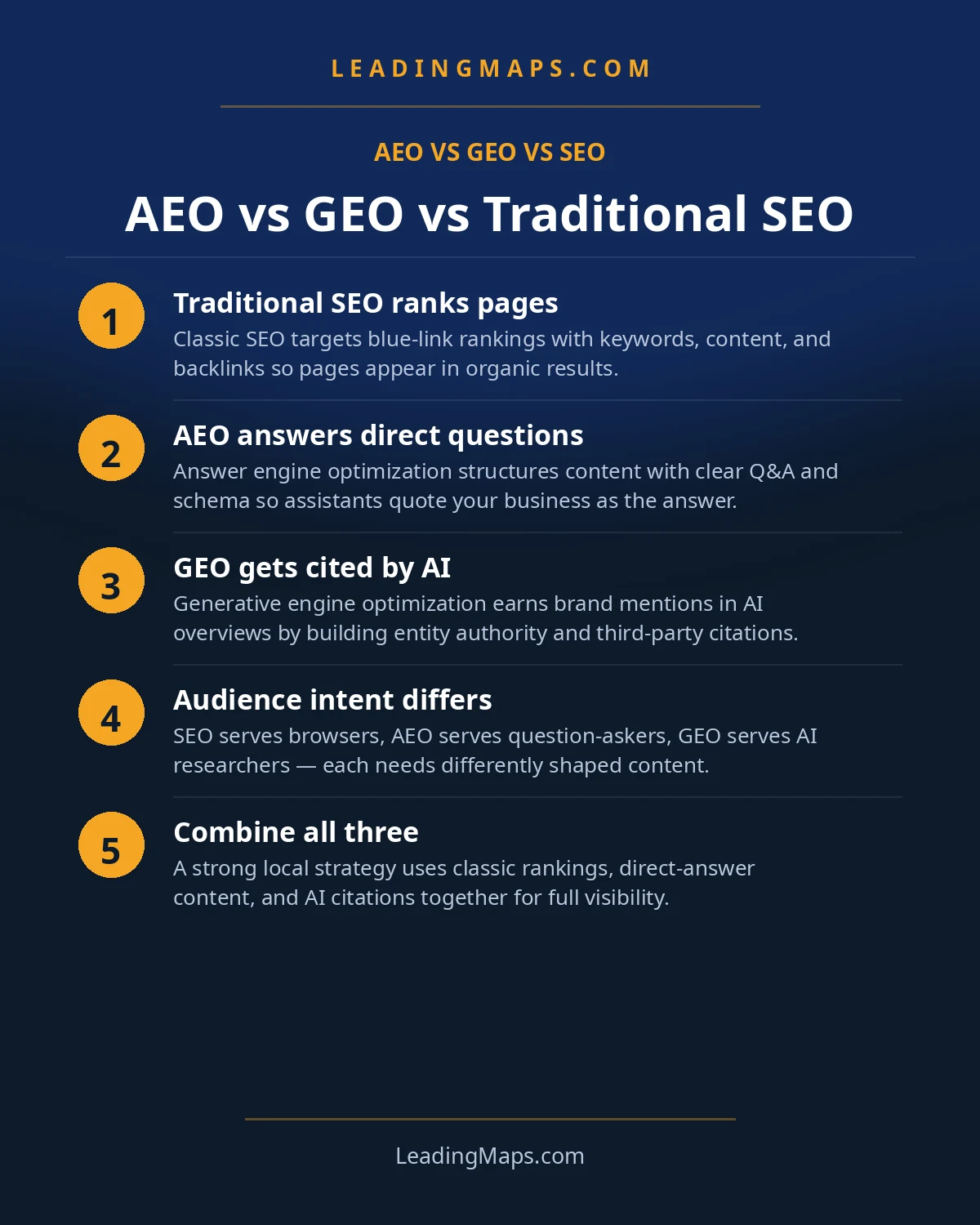
No jargon, no mystique. Each discipline is a bet on a different moment in the customer's journey:
- Traditional SEO wins you the ranking. The goal is to appear high in Google's results, including the map pack, for searches like "plumber near me." You win the click: the homeowner sees your listing and chooses you over the business below you. This is the discipline every contractor has been buying for fifteen years.
- AEO (Answer Engine Optimization) wins you the extracted answer. The goal is for your content to be pulled as the direct answer to a question: the snippet, the AI Overview paragraph, the voice-assistant reply. You win the quoted sentence: your words, or your facts, spoken as the answer. The surface is any place a machine answers instead of listing links.
- GEO (Generative Engine Optimization) wins you the recommendation. The goal is for ChatGPT, Gemini, or Perplexity to name your business, and frame it well, inside a generated answer to "who should I hire." You win the shortlist: being one of the two or three names the assistant puts forward, described in terms that make you the obvious pick.
Our standalone explainers go deeper on each: what AEO actually is and what GEO actually is, both written for contractors rather than enterprise marketers.
The Frame: Discovery, Extraction, Synthesis
Here is the memorable version, and the distinction this whole post turns on. SEO is about discovery: being found when someone looks. AEO is about extraction: your content being lifted as the answer. GEO is about synthesis: the assistant combining many sources into a recommendation and naming you inside it.
The AEO/GEO split deserves the emphasis, because most explainers blur it. Extraction and synthesis are genuinely different outcomes with different win conditions. Extraction rewards quotable, well-structured content: the direct answer block, the comparison table, the FAQ. Synthesis rewards entity strength: the assistant needs to resolve your business as a real, trustworthy entity, corroborated across sources, with review evidence and third-party mentions that justify recommending you. Search Engine Land's analysis of how brands appear in AI search grounds this in the technical reality: a brand can be used (its facts feed the answer) without being cited (named as the source), and GEO is the work of moving from used to named.
Think of it as the difference between being the library and being the recommendation. The library gets quoted; the recommendation gets the job. A contractor can absolutely be both, and the best AI-search outcomes are, but the work is different. Extraction is a content job: write the answer the machine wants to lift. Synthesis is an entity job: become the business the machine's sources agree is the right answer. Confusing the two is why so many "AEO audits" deliver a list of content tweaks to a business whose actual problem is that nothing corroborates it exists.
Discovery wins the click. Extraction wins the quoted sentence. Synthesis wins the recommendation. Every AI-search tactic you are ever pitched is aimed at one of these three, and knowing which tells you whether you need it.
One Query Through All Three Layers
Take one real homeowner moment: "emergency plumber dallas." Watch the same query flow through all three layers, and what winning looks like at each:
- The SEO layer. The homeowner types it into Google. You rank in the top three of the map pack with 200 reviews and a complete profile. Winning here means the click and, for an emergency query, very likely the call. This is the layer that has paid contractors' bills for a decade, and it still does.
- The AEO layer. The homeowner asks a question instead: "how much does an emergency plumber cost in dallas." Google answers with an AI-generated summary before the map pack loads. Winning here means your pricing page's answer block is the sentence the summary quotes, with your business named as the source. The homeowner arrives at the map pack already primed with your numbers.
- The GEO layer. The homeowner asks ChatGPT "who is a good emergency plumber in dallas." There is no results page, just an answer naming two or three companies with a sentence about each. Winning here means you are one of the names, framed well: "Apex Plumbing offers 24/7 emergency service with same-night response in the Dallas metro." No click to compete for. You are either in the answer or you do not exist.
Notice what the walkthrough reveals: the three layers are not three religions, they are three moments. The same homeowner can pass through all three in one evening. That is why the "pick one" framing agencies use is nonsense. The real question is order and emphasis, which is where we are headed.
When Each One Matters
The right emphasis depends on your situation, not on which acronym is trending:
- New site, no rankings, small market. Traditional SEO first, by a mile. You need the profile, the citations, the reviews, the service pages. AEO and GEO tactics layered onto a business with no foundation are decoration.
- Ranking well, but invisible in AI answers. This is the most common contractor situation in 2026. Your Google game is solid; the assistants do not name you. The gap is usually entity strength and quotable content, which is the GEO and AEO layer working together.
- Strong brand, weak website. If homeowners already know your name but your site is thin, AEO-style content (answer blocks, FAQs, cost guides) gives the assistants quotable material while the SEO rebuild runs underneath.
- Competitive metro, entrenched top three. All three, in order. You cannot out-recommend competitors in AI answers if you are not corroborated everywhere, and you cannot hold AI recommendations without the review and citation base that SEO builds.
- Multi-trade or multi-location. The foundation work multiplies with every trade and location, so SEO comes first by necessity: one inconsistent listing can poison the entity for all of them. But the payoff of the AI layers is larger too, because each location is a separate recommendation surface.
- Emergency trades specifically. Weight the GEO layer higher than most guides suggest. Burst-pipe moments increasingly go straight to an assistant, not a search box, and the assistant names whoever its sources support. Our guide to how AI search is changing local SEO covers the per-trade shift in detail.
The Investment Order
Sequenced the way a budget actually gets spent:
- SEO fundamentals, always first. Complete profile, correct categories, consistent citations, review engine, fast site with real service pages. This is the foundation the other two layers stand on, and Google's own position backs the ordering: no special technical requirements exist for AI features; the same SEO fundamentals apply.
- AEO extraction content, second. Question-style headings, 40 to 60 word answer blocks, FAQ sections, comparison tables, cost guides. Cheap to produce, and it feeds both featured placements and the quotable material GEO needs.
- GEO entity work, third and ongoing. Accuracy of business facts everywhere, review text that evidences real work, third-party mentions and directory presence, prompt testing to see what the assistants say. This is the long game: becoming the business the sources support.
The order is a sequence, not a menu. Skipping to step three without step one is the most common way contractors waste money on AI-search services: the assistant has nothing solid to synthesize, so it synthesizes a competitor.
A practical way to budget it: if you are starting from zero, plan on the foundation consuming most of the first quarter, with extraction content starting in month two as pages go live. The entity layer is never "done"; it becomes a monthly habit of reviews, mentions, accuracy checks, and prompt testing. Contractors who treat it as maintenance, like truck servicing, beat the ones who treat it as a project with an end date.
What Does Not Change
A few things the acronyms do not alter, worth stating because pitches imply otherwise. Reviews still decide who gets the call in every layer: no assistant recommends a 3.2-star business over a 4.9-star one. Proximity still matters in local answers. Spam policies apply to AI surfaces exactly as they do to classic results: keyword-stuffed business names and fake reviews are liabilities everywhere, not tactics. And the metric that matters is unchanged across all three disciplines. Not rankings, not mentions, not citations. Booked jobs. Our AEO, GEO, and LLM optimization service is built on that sequence: foundation first, extraction content second, entity and recommendation work ongoing, measured in calls.
AEO, GEO, And SEO Questions, Answered.
No. AEO is downstream of SEO: answer engines extract their answers from the same ranked, trustworthy documents SEO produces. Google's own position is that the same SEO fundamentals apply to AI surfaces. A business that abandons SEO to chase AEO alone is building answers on a foundation it stopped maintaining.
AEO optimizes for extraction: your content gets pulled as the direct answer to a question. GEO optimizes for synthesis: your business gets named and positively framed inside a generated recommendation. One wins you the quoted sentence, the other wins you the recommendation. They share tactics but chase different outcomes.
Yes, and arguably more than big brands. Homeowners already ask AI assistants who to hire, and those assistants name a short list, not a results page. If you are invisible there, a competitor with weaker reviews but stronger AI presence takes the call. GEO for a contractor is mostly entity accuracy plus quotable content, not an enterprise program.
Yes, and the best contractor pages do. A well-structured service page with question-style headings and direct answers ranks in Google, gets extracted into answers, and gives AI assistants quotable facts that support a recommendation. The disciplines layer on the same page; they are not three separate websites.
AEO shows up in visibility metrics: answer-box appearances, AI Overview citations, and featured placements. GEO shows up in recommendation metrics: how often assistants name your business, how they describe you, and your share of voice against competitors. Track them separately, because a page can win extractions while the brand loses recommendations.
Winning Google But Losing The AI Answers?
Profile, Maps rankings, citations, reviews, competitors, plus what ChatGPT, Gemini, and Perplexity say when homeowners ask who to hire. A prioritized action plan, free, no pitch.
- AI visibility check, real homeowner prompts across ChatGPT, Perplexity, and AI Overviews, who gets named.
- Proposal scorecard, what your current or prospective agency should be doing, item by item.
- Competitor gap analysis, what the top 3 in your market are doing that you're not.
Get My Free SEO Audit
Delivered within 48 hours. Yours to keep.