The most common contractor website has a "Services" page that lists twelve things in a bullet list and a homepage that says "welcome." That structure tells Google nothing and converts nobody. This post answers the two questions that actually matter: first, how your service pages should connect to each other and to your service area (the architecture), and second, what goes on each page so it ranks and books jobs (the anatomy).
Everything here is written for service-area trades, plumbers, HVAC shops, roofers, electricians, where customers do not come to you and every page has to prove where you work and what you do.
On This Page
Architecture First: The WHAT Versus WHERE Rule
A service page answers WHAT you do. A location page answers WHERE you do it. Most contractor sites fail because they confuse the two, building "drain cleaning in Springfield," "drain cleaning in Riverside," and "drain cleaning in Oakdale" as twelve near-identical pages with swapped city names. Google reads that as one page copied eleven times, and it ranks none of them well.
The structure that works:
- A services hub (/services/) that introduces every core service and links to each service page.
- One page per real service under the hub: drain cleaning, water heater installation, sewer line replacement. Each with genuinely unique content.
- Service-area spokes only where there is real local proof: a service-area hub listing your towns, plus individual city pages only for towns where you have completed jobs, local reviews, and something genuinely local to say.
The split test for whether a service earns its own page: does it have distinct intent, distinct pricing, and a distinct crew or timeline? "Toilet repair," "faucet repair," and "disposal repair" can share a general plumbing-repairs page. "Sewer line replacement" has its own pricing, its own permits, its own week-long timeline, and it gets its own page. When in doubt, one strong page beats three thin ones.
Keep the URL structure clean and shallow. Search Engine Land's guide to location-specific sites recommends folder patterns like /service-area/city-name/service-name for multi-service companies operating across many towns, and warns that pages buried five levels deep struggle to get crawled. For most single-location trades, a simple /services/ hub with one level of service pages is all the depth you need.
The right number of service pages for most trades: one per core service you actually sell. Every page needs unique content, real photos, and genuine proof, so depth wins over count.
The Trades Service-Page Blueprint
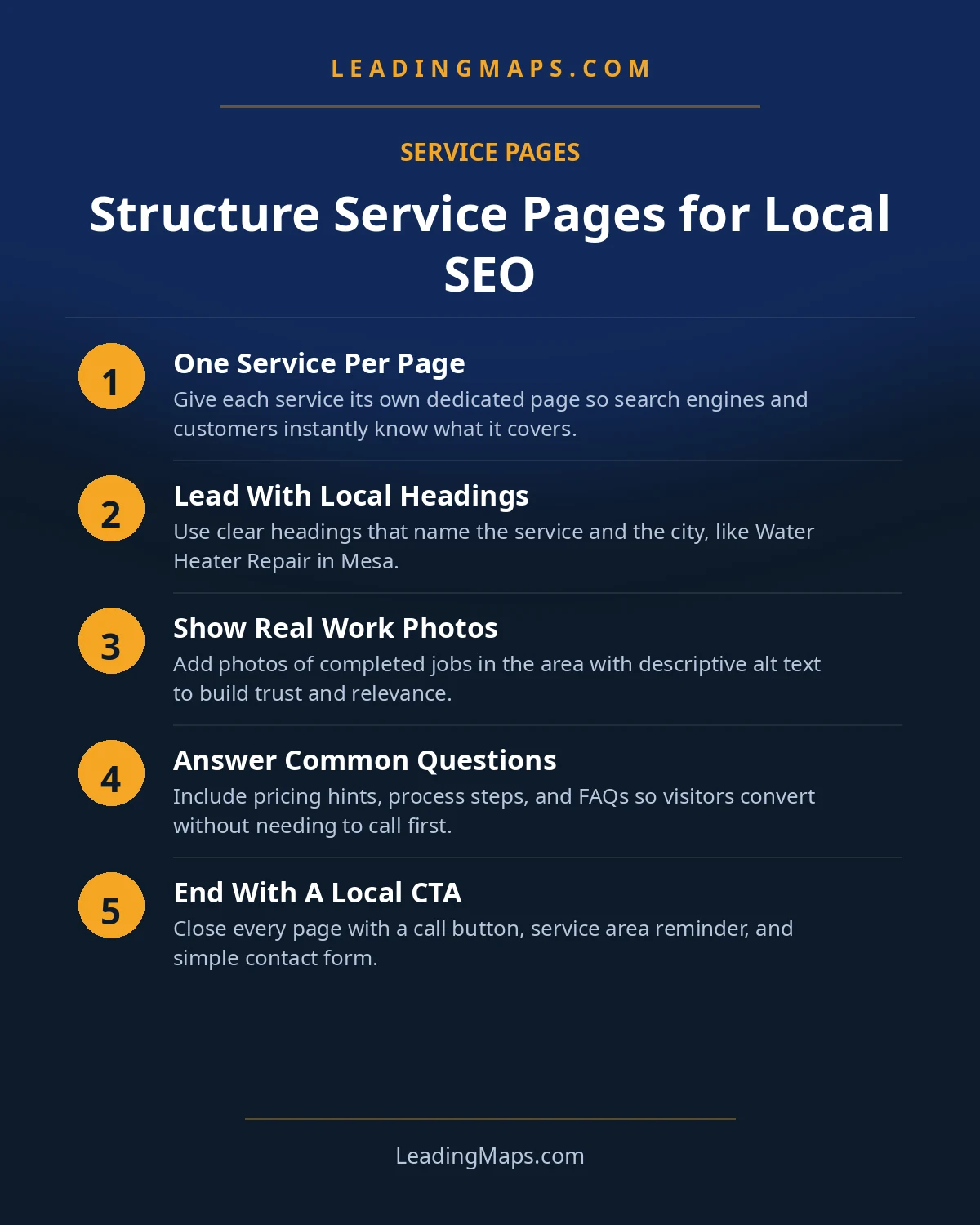
Architecture decides which pages exist. Anatomy decides whether each page ranks and converts. Every service page should carry these twelve elements:
- Keyword-first H1. "Drain Cleaning in Springfield," not "Welcome to Our Services Page."
- An entity sentence near the top: "Apex Plumbing is a licensed plumbing contractor serving Springfield and Riverside." One clear sentence that tells both Google and AI systems exactly what you are and where you work.
- What is included, and what is not. Scope beats adjectives. List what the visit covers and where the boundaries are.
- A pricing range. See the next section; this is the highest-converting element on most trades pages.
- What happens on the day: the process and timeline, from the call to the finished job. Homeowners hire the company that demystifies the visit.
- Real job photos. Before-and-afters from actual jobs, branded trucks, uniformed techs. No stock photography, ever.
- Service-specific reviews. Pull the reviews that mention this exact service. "Replaced our water heater same day" on the water heater page beats a generic five-star quote.
- Emergency availability, stated plainly. If you offer 24-hour service, say so with what "24-hour" actually means (a person answers, not a voicemail).
- Three to five service FAQs with direct answers: cost, duration, warranty, "do I need to be home."
- The CTA, repeated. Phone number tappable and above the fold on mobile, quote form further down. Emergency searches happen on phones; design for them first.
- Internal links to the services hub, related services, and the city pages you serve. Pages that are not linked are pages Google does not find.
- Schema: LocalBusiness with name, phone, hours, area served, and services, plus FAQ schema on the questions. Validate with Google's Rich Results Test before publishing.
Put The Price On The Page
Most contractor pages hide pricing behind "call for a quote." That is a conversion leak. The first question every homeowner has is what it costs, and the page that answers it wins the call over the page that does not. You do not need exact prices, you need an honest range: "$150 to $400 for most drain cleanings, depending on access and severity." Then add what moves the number up or down, so the range stays credible: after-hours visits, permit fees, the difference between a repair and a replacement. A page with a range out-converts a page with no price at all, every time.
Which Page Your Profile Should Point To
Your Google Business Profile has a website link and, for many trades, an appointment or booking link. Point them deliberately:
- The website link should go to the page that best represents the business for a cold visitor. For most single-trade companies that is the homepage. For a multi-trade company whose homepage is thin, it can be the strongest service page, as long as that page carries your full NAP and makes the breadth of services obvious.
- The appointment link should go to the page or form where the job gets booked, not a generic contact page three clicks from a phone number.
Whatever the link points at, that page must be your best page: fast, complete, and conversion-ready. And the NAP on it must match the profile exactly. The profile-to-website connection is one of the first things our profile optimization checklist verifies, and it is one of the most commonly broken.
Internal Linking: The Glue
Pages do not rank in isolation; they rank as a structure. The linking pattern for a trades site:
- Hub to spokes: the services hub links to every service page with descriptive anchor text ("drain cleaning in Springfield"), not "click here."
- Spokes to hub: every service page links back to the hub, so authority circulates instead of pooling.
- Sideways between related services: the water heater page links to leak detection and emergency plumbing, because that is how a customer's problem actually flows.
- Service pages to city pages: the drain cleaning page links to the Springfield and Riverside pages it serves, with a line of real local context, not a keyword-stuffed footer list.
When you consolidate or retire a page, update the links that pointed at it. A link to a redirected page is a vote for a page that no longer exists.
The AI Layer: Structure For Machines That Recommend
Zero coverage of this exists elsewhere, and it is wide open. When an AI assistant recommends a contractor, it extracts from pages structured the way assistants read:
- Answer-first blocks. Each section opens with one clear sentence that answers its heading directly, then expands. That first sentence is the unit AI Overviews lift and cite.
- The entity sentence, repeated once. "[Company] is a licensed [trade] contractor serving [cities]" belongs near the top of the page and in the footer schema. It is the sentence an LLM uses to resolve who you are.
- FAQ schema on real questions. The service FAQs are not filler; marked up with FAQ schema, they become citable answer units. Search Engine Journal's breakdown of Google's structured-data guidance for services is worth reading before you choose between Product and Service markup.
- HowTo schema for the process section. "What happens on the day" is naturally a HowTo: steps, in order, with a clear outcome. Mark it up as one.
- Concise factual sentences everywhere. "Most drain cleanings take 60 to 90 minutes." "We answer emergency calls around the clock." AI systems extract clean facts, not marketing copy.
The monthly version, testing which of your pages AI assistants actually cite for real homeowner questions, is our AEO and LLM optimization service. The structure above is the DIY foundation it builds on.
Service Page Questions, Answered.
One per core service you actually sell, which for most trades is five to ten. A plumber might have drain cleaning, water heater installation, sewer line replacement, leak detection, and emergency plumbing. More pages is not better: every page needs unique content, real photos, and genuine proof, and thin extra pages dilute the strong ones.
No. Create city pages only where you have real local proof: completed jobs, customer reviews from that town, photos, and something genuinely local to say. Every other town stays on the service page and the service-area hub. A dozen city pages with swapped names read as thin content to Google, and they cannibalize each other.
Long enough to answer the customer's real questions, which usually lands between 800 and 1,500 words for trades service pages. Length is not the goal; completeness is. A page that covers what is included, pricing, timeline, proof, and FAQs at 900 words beats a 2,000-word page that says nothing twice. Answer first, expand where it helps.
Yes, as ranges, and this is one of the highest-converting additions a trades page can make. A page with a realistic range, like '$150 to $400 for most drain cleanings,' out-converts a page with no price at all, because it answers the first question every homeowner has. Add what moves the price up or down so the range stays honest.
Yes, and it is cheap to add. LocalBusiness schema with your name, phone, hours, area served, and services gives both Google and AI assistants machine-readable facts about your business. Service schema can describe individual offerings, and FAQ schema makes your questions eligible for rich results. Validate everything with Google's Rich Results Test before publishing.
Service Pages Built But Nobody Finding Them?
Our free audit scores every page against your money keywords, finds the thin and cannibalized ones, and tells you exactly what to consolidate, rewrite, or rebuild, plus whether AI assistants name you or your competitor.
- Page-by-page diagnosis, every service and city page scored against the blueprint, with the fix list in priority order.
- AI visibility check, real homeowner prompts across ChatGPT, Perplexity, and AI Overviews, who gets named.
- Competitor gap analysis, what the top 3 in your market are doing that you're not.
Get My Free SEO Audit
Delivered within 48 hours. Yours to keep.